Feeds:
Posts
Comments

Archive for the ‘Sunday Hymns’ Category

Be Still My Soul is a hymn that has comforted me and calmed my fears on many occasions. This hymn has the benefit of amazing music that permits coupling only with correspondingly beautiful language.  Be Still My Soul  is the perfect marriage.

Jean Sibelius, a famous Finnish composer, wrote a nationalistic symphony called Finlandia in 1899-1900. Within a fairly turbulent and rousing string of movements, he embedded a quiet hymn-like moment, which became so popular itself that Sibelius later pulled that part of the symphony out and re-worked it into a choral piece.

Katarina Amalia Dorothea von Schlegel (1697-1768) wrote the German words in 1752, which were translated by Jane Laurie Borthwick into English in 1855.  I have not been able to determine when the melody and these words were first brought together.

Beyond the music, what really first captured me about these lyrics is that they do not promise an easy path or quick relief. What these hymn measures out to you in each verse is comfort and hope, so that you can bear your “cross of grief or pain.”

Be still, my soul: the Lord is on thy side.
Bear patiently the cross of grief or pain.
Leave to thy God to order and provide;
In every change, He faithful will remain.
Be still, my soul: thy best, thy heavenly Friend
Through thorny ways leads to a joyful end.

Your God is not helpless in the face of what unbelievers would call Fate or Destiny or Chance. In fact, He is entirely sovereign over the future and the past.

Be still, my soul: thy God doth undertake
To guide the future, as He has the past.
Thy hope, thy confidence let nothing shake;
All now mysterious shall be bright at last.
Be still, my soul: the waves and winds still know
His voice Who ruled them while He dwelt below.

The death of loved ones is perhaps our most painful moment in this life. That kind of separation even made Jesus cry—but not with a sorry that will not be healed by the Resurrection.

Be still, my soul: when dearest friends depart,
And all is darkened in the vale of tears,
Then shalt thou better know His love, His heart,
Who comes to soothe thy sorrow and thy fears.
Be still, my soul: thy Jesus can repay
From His own fullness all He takes away.

The fear of our own death and all the money we spend and hours we take trying to prolong our days and avoid the unavoidable.  We will need to find in God that moment of stillness when we “grief and fear are gone.”  Grief and fear are exchanged for “love’s purest joy restored.”

Be still, my soul: the hour is hastening on
When we shall be forever with the Lord.
When disappointment, grief and fear are gone,
Sorrow forgot, love’s purest joys restored.
Be still, my soul: when change and tears are past
All safe and blessèd we shall meet at last.

The story is told that this Eric Liddell, the runner about whom Chariots of Fire was made, taught this hymn to fellow prisoners in China while imprisoned during World War II, an imprisonment he escaped only by death.

A similarly moving story is told that a version of this hymn called “We Rest On Him” was the last hymn sung by Jim Elliot and four fellow missionaries before they were killed by a violent tribe of natives in Ecuador in 1956.

I certainly hope you are not facing imprisonment or native spears, but I suspect you have your own fearful moments.  In those moments, this hymn will be a blessing to you.

Be still and know that I am God.  Psalm 46:10

Read Full Post »

Some hymns we love because they help us through especially dark times.  O God Our Help In Ages Past is one of those songs for me. Sherrylee and I had a particularly tough stretch years ago, including death of a parent, loss of friends, bitter struggles at church, and more. Every area of our wonderfully blessed life seemed to be in crisis.

When we lived in Oklahoma, I walked to the campus of Oklahoma Christian University to my office almost every morning. It was a quiet ten minutes before the storms of the day. I walked past the houses of other faculty members, across the practice soccer fields, and through the backdoor of the library to the secondary stairs to my office.

Especially in those very painful years, I often prayed as I walked, or just as likely, I sang quietly to myself. One hymn in particular reminds me of those years because I sang all the stanzas over and over again to calm and instruct my soul: O God Our Help In Ages Past .

Most know this hymn by Isaac Watts (1719) to a tune called St. Anne by William Croft. I prefer the simpler melody called St. Leonard. I needed the chant-like melody, fewer notes,  and the quiet ending. That melody carried these words into the brokenness of my spirit in those days.

O God, our help in ages past,
Our hope for years to come,
Our shelter from the stormy blast,
And our eternal home.

God has worked mightily in my life in the past. The mountaintops of my life are His doing, the security of the past is because of Him, so there is no reason to doubt that He is the “hope for years to come.”  In difficult times, we need to be reminded that they have a context, that the darkest days are surrounded on every side by the grace of God.

Beneath the shadow of Thy throne
Thy saints have dwelt secure;
Sufficient is Thine arm alone,
And our defense is sure.

I am not the first to face hard times. God’s people have often suffered—sometimes for the very reason they are God’s people, so why should I expect to avoid pain? If I had always avoided pain, then I would have never learned that His arm is not too short to help, not just to help, but to secure our defense!

Before the hills in order stood,
Or earth received her frame,
From everlasting Thou art God,
To endless years the same.

We are not talking about a new God of our own invention.  We are not depending on an untested or unproven God. We are depending on the God who created the universe from everlasting to everlasting—who never changes. We are depending in the hour of our deepest need, not just on a God who is awesome, but on the Almighty, Everlasting God !

A thousand ages in Thy sight
Are like an evening gone;
Short as the watch that ends the night
Before the rising sun.

If I forget, I start trying to get God to work on my schedule. I need relief now, I want it all to stop now. I needed then to be reminded that God has a different clock. My clock is like the plastic toys we give to small children, little toys that seem real to them but don’t give the real time.  It’s an important moment to give up our toys to depend on Him who creates time.

Time, like an ever rolling stream,
Bears all its sons away;
They fly, forgotten, as a dream
Dies at the opening day.

And I too will be borne away someday. My momentous crisis of today will be nothing at all. Today’s pain that is so real will be a curious diary entry to some great-grandchild that can’t figure out which of the old pictures is of you cause you forgot to write on the back.

O God, our help in ages past,
Our hope for years to come,
Be Thou our guard while troubles last,
And our eternal home.

Certainly, the eternal context and the temporal perspective spoke to me as I walked in pain to work each morning during those years, but, as I think back on those days, I think it was the “O God” that calmed me the most.  Just singing  “O God”  brought me into the shadow of His throne where I could find help and hope—and an eternal home.

Psalm 90: 1,2,12

Lord, thou hast been our dwelling place in all generations.

Before the mountains were brought forth, or ever thou hadst formed the earth and the world, even from everlasting to everlasting, thou art God.

Teach us to number our days, that we may get us a heart of wisdom.


Read Full Post »

The critics of contemporary Christian music often make the claim that it is too individualistic, that is, individual relationships to God seem to have greater mention than communal, or that more of the songs focus on Me than on Him or They or Us.

You who feel that way will be shocked to learn which hymn—probably one of your favorites—was the first to be caught up in this kind of controversy.

At the turn of the 18th century, most Protestants were still singing the Psalms or the slightly more modern paraphrases of Scripture.  In 1701, Isaac Watts wrote a communion hymn, which he first titled Crucifixion To The World By The Cross of Christ.  We know this hymn today as When I Survey The Wondrous Cross, still used among us as a communion hymn and considered one of the best hymns ever written.  Charles Wesley is reported to have said that he would have sacrificed all of his own hymns freely if he could have written this one.

Nevertheless, this hymn stirred up controversy because it is the first known hymn to be written in first person.  To sing from one’s own heart about one’s own feelings and one’s own relationship to the cross and one’s own Savior was much too personal, too individualistic for Christians of that time.

Times and people have not changed much, have they!  But, neither has our amazement when we look on “the wondrous cross.”

When I survey the wondrous cross
On which the Prince of glory died,
My richest gain I count but loss,
And pour contempt on all my pride.

Forbid it, Lord, that I should boast,
Save in the death of Christ my God!
All the vain things that charm me most,
I sacrifice them to His blood.

In our fellowship, this was the moment when the voices quieted, and we paused between each phrase—“His head…His hands….his feet”– to realize the crucifixion moment.

See from His head, His hands, His feet,
Sorrow and love flow mingled down!
Did e’er such love and sorrow meet,
Or thorns compose so rich a crown?

The following stanza is original, but even Watts suggested it might be omitted, so most of us will find it unfamiliar.

His dying crimson, like a robe,
Spreads o’er His body on the tree;
Then I am dead to all the globe,
And all the globe is dead to me.

Were the whole realm of nature mine,
That were a present far too small;
Love so amazing, so divine,
Demands my soul, my life, my all.

With almost sudden volume, this last stanza would burst forth like the resurrection—from our own death and burial to new life, with renewed recognition of what the Cross demands in our—no, in MY life!

It’s very personal, isn’t it!

Read Full Post »

The word story is a key word to understanding the post modernist generation.  Earlier generations had other words. I think the word for my generation was journey; everybody was on a journey and everything was a journey.

But journeys have given way to stories now.  Now everyone has their own story and life is a narrative. Your witness is your story; your upbringing is your story; your history is your story. Preaching has moved from exegesis or exhortation to story telling.

The King James Bible (1611) uses the word story only in two obscure passages in 2 Chronicles. The American Standard Version (1901) never uses the word story  in this way, but The Message ( 2002) uses the word story  161 times! 

Hymns are a place where the generations meet around the word story, not necessarily in the great anthems, but in some of the more populist hymns of the 19th century.  Here are some that you will probably recognize

Tell Me the Old, Old Story (1866) with lyrics by Katherine Hankey.

Tell me the old, old story of unseen things above,
Of Jesus and His glory, of Jesus and His love.
Tell me the story simply, as to a little child,
For I am weak and weary, and helpless and defiled.

Tell me the story slowly, that I may take it in,
That wonderful redemption, God’s remedy for sin.
Tell me the story often, for I forget so soon;
The early dew of morning has passed away at noon.

Tell me the story softly, with earnest tones and grave;
Remember I’m the sinner whom Jesus came to save.
Tell me the story always, if you would really be,
In any time of trouble, a comforter to me.

Tell me the same old story when you have cause to fear
That this world’s empty glory is costing me too dear.
Yes, and when that world’s glory is dawning on my soul,
Tell me the old, old story: “Christ Jesus makes thee whole.”

Refrain

Tell me the old, old story, tell me the old, old story,
Tell me the old, old story, of Jesus and His love.

Interestingly enough, she also wrote the words to I Love To Tell the Story.  “I love to tell the story of unseen things above . . . .pretty post modern—except for the word above!

Then there is Tell Me The Story of Jesus, written by Fanny Crosby around 1880:

Tell me the story of Jesus,
Write on my heart every word.
Tell me the story most precious,
Sweetest that ever was heard

But one of my favorite hymns from my childhood which still occasionally surfaces is the rousing, almost dramatic  O Listen To Our Wondrous Story, sometimes titled What Did He Do?.  The words were written by James Gray around 1903, but, in this instance, the marriage of the words with the music by William Owen, a worker in the slate quarries of Wales in the mid-1800s, was what really made the hymn work.

I especially loved the antiphonal chorus, where the women sing, “Who saved us from eternal loss?” and before they even finish the question, the men are responding with the certain answer, “Who but the Son upon the Cross!”   As we most often sang it, the first questions were sung softly, with each succeeding question and answer a little louder, until the final triumphant response was full volume.

The final verse makes the question of story very personal: Will you surrender to the Savior, to his scepter humbly bow?   So journey and story meet in the certainty of Jesus and His Cross and the necessary response that it requires from me!

I love this song still:

O listen to our wondrous story,
Counted once among the lost;
Yet One came down from Heaven’s glory,
Saving us at awful cost!

No angel could His place have taken,
Highest of the high though he;
The loved One on the cross forsaken,
Was One of the Godhead three!

And yet this wondrous tale proceedeth,
Stirring heart and tongue aflame!
As our High Priest in Heav’n He pleadeth,
And Christ Jesus is His Name!

Will you surrender to this Savior?
To His scepter humbly bow?
You, too, shall come to know His favor,
He will save you, save you now.

Refrain

Who saved us from eternal loss?
Who but God’s Son upon the cross?
What did He do?
He died for you!
Where is He now?
In heaven interceding!

Read Full Post »

Brother Slater was a kind of celebrity at our church when I was a boy. He and his wife Sister Slater would sit toward the front on the left side of the auditorium. As a young boy, all I knew was that he had written Walking Alone At Eve, which was one of my favorite songs.

William Washington Slater was more than a celebrity; he was a great saint and servant of God. Born in 1885 in Arkansas, Will’s family moved to Indian Territory in 1890 to farm. Like many boys of his time, his formal schooling ended in the fourth or fifth grade, but not his desire for learning.

By the time he was 18, his special interest in music was apparent.  The story is told of his saddling and riding a mule fifteen miles every Saturday to attend singing schools, so he could become a better song leader.  He later decided he wanted to preach as well, so he soon became a preacher-song leader, preaching gospel meetings and leading singing for other great preachers.

He married Nettie Washington in 1910, and they had five children. Three of his daughters went to church at Eastridge Church of Christ, where I grew up, so I knew them and several of their children. Thelma Slater married Wade Banowsky and one of their sons William Slater Banowsky became president of University of Oklahoma and Pepperdine University.

I remember the quiet announcement at church that Brother Slater had died while preaching a meeting in Arkansas in 1959. According to accounts of his last day, he had preached his sermon and, as was his custom, offered to stay after church and sing with any who wanted to join him.  Someone asked him to lead a song entitled “This Is Someone’s Last Day.” Before leading it, he reminded the church to pay attention to the truth of the message, not knowing that it was his very own last day.

Walking Alone At Eve (1917) was one of Will Slater’s earliest songs.  As in many older hymns, it is God’s creation that inspires worship. I imagine country folks walking or riding in their wagons home from an evening of preaching and singing. As it grows dark and the stars start popping out, this might be one of the songs that they would sing.

Walking alone at eve and viewing the skies afar,
Bidding the darkness come to welcome each silver star;
I have a great delight in the wonderful scenes above,
God in His power and might is showing His truth and love.

Sitting alone at eve and dreaming the hours away,
Watching the shadows falling now at the close of day;
God in His mercy comes with His Word He is drawing near,
Spreading His love and truth around me and everywhere.

Closing my eyes at eve and thinking of Heaven’s grace,
Longing to see my Lord, yes meeting Him face to face;
Trusting Him as my all where-so-ever my footsteps roam,
Pleading with Him to guide me on to the spirits’ home!

The chorus is that simple, ubiquitous longing for rest with God.  Resting is the reward for working hard. I wonder why we don’t sing many songs about rest anymore?  The melody of the chorus is simple, not a passionate cry, but a quiet, simple longing.

O for a home with God, a place in His courts to rest,
Sure in a safe abode with Jesus and the blest;
Rest for a weary soul once redeemed by the Savior’s love,
Where I’ll be pure and whole and live with my God above!

I don’t really know why, but I have sung this song to all of our kids as I rocked them to sleep.  Perhaps it was singing at the end of the day, usually in a darkened room, and the simplicity of the melody—I’m not quite sure why it became one of those songs I sang to them, but it did.

I do know that it cleanses your soul to hold your little God-gifts on your shoulder and to sing about being pure and whole and living with God. The congruity of those precious moments with this melody has always been redemptive for me.

Great hymns do improve our walk with God. 

Read Full Post »

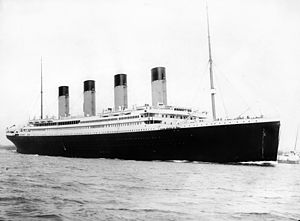
Just about three weeks ago, the world remembered the 100th anniversary of the sinking of the Titanic in April 1912.  I suspect that few events have impacted the psyche of the modern world like the sinking of this unsinkable ship, along with the tragic and needless deaths of over 1500 people, including some of the richest and most prominent people of their times.

One of the stories that persists in connection with the Titanic is that the string ensemble played Nearer My God To Thee until the very last moments before the ship sank, a story, whether true or not, certainly perpetuated by most of the movies about the Titanic, including the latest James Cameron Titanic (1997).

My memory of this great hymn places it among what we would have called communion songs, those songs sung just before serving the Lord’s Supper. As a boy, I remember this as being a very quiet time in our service, the lights dimmed, usually no music—just remembering the Lord’s death until He comes.

I’m sure it’s the mentioning of the cross in the first verse that made it seem appropriate for communion:

Nearer, my God, to Thee, nearer to Thee!

E’en though it be a cross that raiseth me;

Still all my song shall be nearer, my God, to Thee,

Chorus: Nearer, my God, to Thee, nearer to Thee!

It never really suggested imminent death to me, even though that appears to be the context in which it has been most often used.  Besides the Titanic story, this hymn is also associated with the death of two American presidents: William McKinley and James A. Garfield.
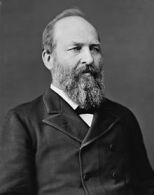
James A. Garfield

In 1881, just sixteen years after the assassination of Abraham Lincoln, Garfield, the 20th president was shot in Washington, D.C., ironically, in the presence of Robert Todd Lincoln, the former president’s son.  He died 80 days later.  Nearer My God To Thee was played during his funeral procession.

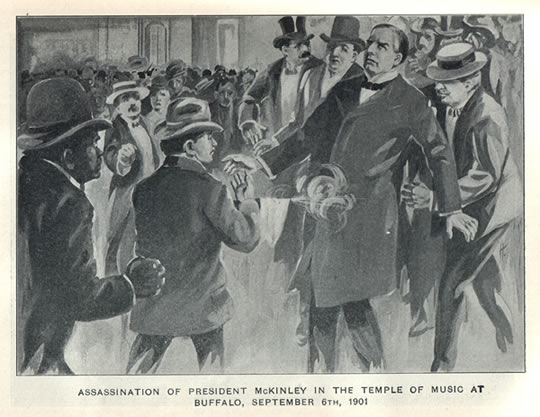
Twenty years later, President William McKinley was shot while visiting the Pan American Exhibition in Buffalo, N.Y. . Here is the report from The Life of William McKinley (1916)

SUNSHINE in the sky above and gladness in the heart of the President brightened the morning of the 6th day of September, 1901. It was to be a holiday: a visit to Niagara Falls in the forenoon, a reception to the people in the afternoon. In joyous mood McKinley passed the hours of the excursion, his nature never more serene.  . . . As he approached, the President extended his hand;—but the proffered friendliness was met by two pistol shots which rang out from the revolver concealed in the seemingly bandaged hand. Instantly several of the guards seized the assailant and bore him to the ground. As they did so, one of them, kneeling by the head of the prisoner, glanced upward and saw the President, still standing, supported by friends, and gazing with an indescribable look of wonder and reproach.

While he was being helped to a chair the Secret Service men dragged the prisoner to the center of the temple and there some one struck him squarely in the face. Seeing this, the spirit of the Master, whom he had served all his life, came upon the stricken President, and he cried in a tone of pity, “Don’t let them hurt him.”

The friends now gathered about the wounded man were fanning him with their hats and watching anxiously to discern if possible the full extent of his injury. But the President’s mind was not upon himself. He was thinking of the beloved wife, who had leaned upon him so many years and whom he had always shielded so tenderly against the slightest care. As the Secretary bent over him, he whispered, tremblingly, “My wife—be careful, Cortelyou, how you tell her—oh, be careful!”

The president was rushed into emergency surgery:

     At such a time as this, the very essence of the human spirit, which may have shrunk for a lifetime from exposure to the eyes of men, is likely to assert its presence. From the time he was ten years old, President McKinley had unreservedly, but without ostentation, put his trust in God. It was the richest, deepest thought of his inner soul, and now, as he closed his eyes, realizing that he was about to sleep, perhaps to wake no more, his lips began to move and his wan face lighted with a smile. It was the same trust that now supported him. “Thy kingdom come, thy will be done,” he murmured. The surgeons paused. Tears came into the eyes of those about the table. “For thine is the kingdom, and the power and the glory, forever, Amen.” With these words he passed into unconsciousness, while the earnest surgeons sought with all their skill to prolong his life.

McKinley seemed to do well immediately after the surgery and all were very hopeful, but suddenly, a week after the operation, he took a fatal turn for the worse:

In the afternoon of Friday the President knew that the time had come for him to bid farewell to the world. He called the surgeons to his bedside and said, “It is useless, gentlemen, I think we ought to have prayer.” His eyes were half closed and again the smile of sublime faith in the future illuminated his features. A solemn silence fell upon the assembled doctors and nurses and tears could not be restrained. The dying President moved his lips and again it was the Lord’s Prayer that welled from his overflowing heart. The twilight descended and the room grew dark.

 The room was silent. The President put his arm around his wife and smiled at her. The family group and intimate friends about the bedside watched and waited. Then the lips moved again and the worn face became radiant. The inner soul was speaking once more and was voiced in the lines of his favorite hymn:—

“Nearer, my God, to Thee,
Nearer to Thee,
E’en though it be a cross—”

Fainter and fainter came the words until the whisper could scarcely be heard. Then a moment of silence. “That has been my inextinguishable prayer,” he murmured, almost inaudibly.

Perhaps one mark of the greatest hymns are those hymns which speak for our souls in the most critical moments, those we choose when our own words fail usNearer My God To Thee has been one of those hymns and will continue to be if we don’t forget it.

Nearer, my God, to Thee, nearer to Thee!

E’en though it be a cross that raiseth me;

Still all my song shall be nearer, my God, to Thee,

Chorus: Nearer, my God, to Thee, nearer to Thee!

Though like the wanderer, the sun gone down,

Darkness be over me, my rest a stone;

Yet in my dreams I’d be nearer, my God, to Thee,

Chorus

There let the way appear steps unto heav’n;

All that Thou sendest me in mercy giv’n;

Angels to beckon me nearer, my God, to Thee,

Chorus

Then with my waking thoughts bright with Thy praise,

Out of my stony griefs Bethel I’ll raise;

So by my woes to be nearer, my God, to Thee,

Chorus

Or if on joyful wing, cleaving the sky,

Sun, moon, and stars forgot, upwards I fly,

Still all my song shall be, nearer, my God, to Thee 

Lyrics:  Sarah Flower Adams (1841)

Tune:   “Bethany” Lowell Mason (1856)

Read Full Post »

One of the sweet traditions that has all but disappeared in the last twenty years in many of our churches is the singing of morning and evening hymns.  If you don’t know what I’m talking about, then you probably worship in a little more contemporary church with no Sunday night service.

This is not a doctrinal issue or a matter of salvation, but it feels a little like it must have felt to give up eating food you grew in your own garden, or playing checkers with your friends at the courthouse, or watching Gunsmoke every Sunday night after church.  Some traditions were just sweet.

Here are some of my favorite morning hymns:

  1. Early My God Without Delay I Haste To See Thy Face
  2. In the Hush of Early Morning
  3. Again the Lord of Light and Life Awakes the Kindling Ray
  4. Awake and Sing the Song of Moses and the Lamb
  5. Holy, Holy, Holy, Lord God Almighty, Early in the Morning Our Songs Shall Rise to Thee

Of course, these specifically morning hymns blend with the great songs of praise that were opening calls to worship, mostly for morning worship:

  1. O Worship the King
  2. Come Thou Almighty King
  3. Joyful, Joyful, We Adore Thee
  4. All Creatures of Our God and King
  5. Come Ye That Love the Lord
  6. All Things Praise Thee  (also, For The Beauty of the Earth)
  7. Praise God From Whom All Blessings Flow

But nothing compares to evening hymns, the ones we not only sang at church but at retreats—and summer camp.  Every night at camp we would go to a different spot after dark, look up at the stars that none of us city kids could ever see, and sing one of these songs

  1. Abide With Me Fast Falls the Eventide
  2. Now the Day is Over (great tenor and bass parts)
  3. Softly Now the Light of Day
  4. Be With Me, Lord
  5. Savior, Breathe An Evening Blessing –  my very favorite!

James Edmeston wrote this last hymn sometime around 1820. There is a story told that during the Boxer Rebellion in China between 1898 and 1901, which was an uprising to root out imperialism and Christianity and when many thousands of Chinese Christians and foreign missionaries had been massacred, this hymn was sung as missionaries huddled together at night, worshipping God, but wondering if they would be alive in the morning.

Threatened with imminent death, the last verse must have taken great courage and faith to sing:

Should swift death this night o’er take us and our couch become our tomb . . . .

Here are all the lyrics:

Savior, breathe an evening blessing
Ere repose our spirits seal;
Sin and want we come confessing:
Thou canst save, and Thou canst heal.

Though destruction walk around us,
Though the arrow past us fly,
Angel guards from Thee surround us;
We are safe if Thou art nigh.

Though the night be dark and dreary,
Darkness cannot hide from Thee;
Thou art He who, never weary,
Watchest where Thy people be.

Should swift death this night o’ertake us,
And our couch become our tomb,
May the morn in heaven awake us,
Clad in light and deathless bloom

Of course, morning and evening hymns can still be sung suggesting symbolically the beginning and ending of life, so even without Sunday night services, I hope modern writers will draw on two of God’s most beautiful metaphors.

Read Full Post »

The words are a little archaic, but the hymn O Love That Wilt Not Let Me Go has always been one of my favorites.  The melody begins rather simply but moves quickly to a quietly triumphal—not a Sandi-Patty-rock- the-world–conclusion!

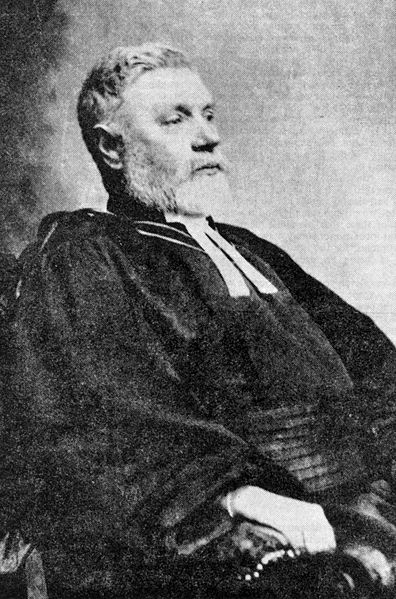
George Matheson (1842-1906) was a Scottish minister. While studying theology and with a promising theological career in front of him, in his twentieth year, he went completely blind.  Not only did his blindness block his academic ambitions, but the story is that his fiancé also left him, not being willing to be burdened with a blind husband for the rest of her life.

He was quite a successful pastoral minister who was served himself by his devoted sister.  When George was forty years old, his sister married and left him on his on. It was on the occasion of his sister’s wedding that George penned the words O Love That Wilt Not Let Me Go.!

O Love that wilt not let me go,

I rest my weary soul in Thee;

I give Thee back the life I owe,

That in Thine ocean depths its flow

May richer, fuller be.

First the loss of his sister’s care, rekindling no doubt the painful reminder of his own lost love, and all of this framed with his lost sight would have left many people bitter and angry. Matheson acknowledges the weariness of loss, but finds the ocean waves of God’s steadfast love life-giving as opposed to diminishing.

O Light that foll’west all my way,

I yield my flick’ring torch to Thee;

My heart restores its borrowed ray,

That in Thy sunshine’s blaze its day

May brighter, fairer be.

I love the “flick’ring torch” line. Our energies are too often spent trying to walk through life by the light of our flickering torch, when we could walk in the sunshine’s blaze with great confidence if we would yield.

O Joy that seekest me through pain,

I cannot close my heart to Thee;

I trace the rainbow thru the rain,

And feel the promise is not vain,

That morn shall tearless be.

The great hymns acknowledge pain rather than pretending that this world is tearless!  But Believers know that Joy is seeking us, not trying to allude us! Matheson may even suggest his own struggles with Joy because pain in this time can be a defining reality that we are tempted to close our hearts to Joy in doubt that it really exists.  Matheson traces the rainbow—not here a symbol of accomplished salvation, but rather a reminder of a sure promise!

O Cross that liftest up my head,

I dare not ask to fly from Thee;

I lay in dust life’s glory dead,

And from the ground there blossoms red

Life that shall endless be.

  A hymn that begins with a Love that will never let go ends with the Cross, a dying place.  Matheson’s hymn reminds us that we cannot circumvent the Cross—we dare not ask to fly from it—because only on that Cross do we find the Love that will never let us go—ever!

Amy Grant has a popular, somewhat bluesy version of the song with saxophones. I like a little more traditional version, but I don’t like at all the artists who turn it into a slow, sad dirge.

Matheson once described his life as “an obstructed life, a circumscribed life… but a life of quenchless hopefulness, a life which has beaten persistently against the cage of circumstance, and which even at the time of abandoned work has said not “Good night” but “Good morning.”

The pain is present, but there is nothing sad about this hymn!


Read Full Post »

« Newer Posts