Feeds:
Posts
Comments

Archive for the ‘Traveling Thoughts’ Category

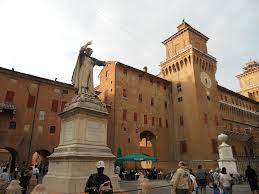
ferraraSitting at breakfast this morning in Ferrara, Italy, I had time to reflect a little on the whirlwind trip that Sherrylee and I have just completed in Italy.  It started down south in the boot heel and finishes when we fly from Pisa to France.  During our six days so far, we have been in contact with six churches, meeting with their leaders and often having an opportunity to speak to the entire church, to talk about their work and if LST might be of any help to them.

In virtually every case, we found Christians who wanted to grow, who wanted to be a brighter light, but were faced with significant challenges.  I don’t suppose that is much different from most smaller churches anywhere in the world.

We also met some wonderful Italian saints:  Pino and Evalina, Angelo, Alessandro, Paolo, Umberto, Marco, Luca—these are just a few of the names that I can spell, but there were many more sweet people.

And I don’t want to neglect mentioning the wonderful American couple that we met in Florence, David and Debbie Woodruff.  About five years ago, they gave up their comfortable life and home in the States to take on the work of directing the Avanti Italia program.

Avanti Italia was begun in the late 80s by former Italian missionaries to encourage young Americans to give two years of their life in missionary service, specifically in Italy for the encouragement of the Italian Churches of Christ.

The program was housed in the former Florence Bible School building in Scandicci, just outside of Florence.  I don’t know how many young people have gone through this program, but surely, each one has had a life-changing experience.

Different directors have had different programs, but they have all included outreach among the Italian young people, service to the Italian churches in the vicinity, and service to the community in general.

David, the current director, told us that the seven current Avanti Italia workers offer English conversation classes to about 80 people currently. In addition, one day a week they are encouraged to just pick someone they have met and spend extra time with them, developing a deeper relationship.

And another day each week is “work” day, when they let their hands do the talking.  In the last five years, with the help of their workers, the Woodruffs have completed much of a needed remodeling and updating of the Scandicci facility.

Maybe therein lies part of the answer for why anyone would want to go to Italy to do Christian mission work.  What sense does it make to go to one of the most “Christian” nations in the world?

Houses fall into ruin over time. Even those houses that are lived in and maintained need a fresh look, a renewal.  Our experience in countries like Italy is that

  • reading the story of Jesus again is a special blessing to many who would claim a church, but who have never really read the story for themselves.
  • A relationship of a deeply committed Christian can encourage a weaker or nominal believer to a closer walk.
  • Some people have never personally chosen faith in Jesus for themselves. Our conversation may be the first time they have ever been asked whether they really believe that Jesus is the Son of God.
  • Some people know the story and are true believers but they have never experienced the family of God as it can be experienced in a small congregation, where every member is known and cared for.
  • Every country has those who come as guests or visitors and who are not part of the Christian tradition at all.  Two of the young people in the church in Ferrara were born in Ukraine of Russian-speaking parents, but have been in Italy since they were small children.  They are thankful for those who told their family about Jesus and did not assume that everyone knows who He is.

I know of no church that is not plagued by human frailty and error. I would not presume to know when God blows out candlesticks.  I tend to lean more toward Jesus’ teaching in the parable of the weeds in Matthew 13:

24 He put another parable before them, saying, “The kingdom of heaven may be compared to a man who sowed good seed in his field, 25 but while his men were sleeping, his enemy came and sowed weeds among the wheat and went away. 26 So when the plants came up and bore grain, then the weeds appeared also. 27 And the servants of the master of the house came and said to him, ‘Master, did you not sow good seed in your field? How then does it have weeds?’ 28 He said to them, ‘An enemy has done this.’ So the servants said to him, ‘Then do you want us to go and gather them?’29 But he said, ‘No, lest in gathering the weeds you root up the wheat along with them. 30 Let both grow together until the harvest, and at harvest time I will tell the reapers, Gather the weeds first and bind them in bundles to be burned, but gather the wheat into my barn.’”

I’m thankful for this week in Italy and for every Christian here. 
Read Full Post »

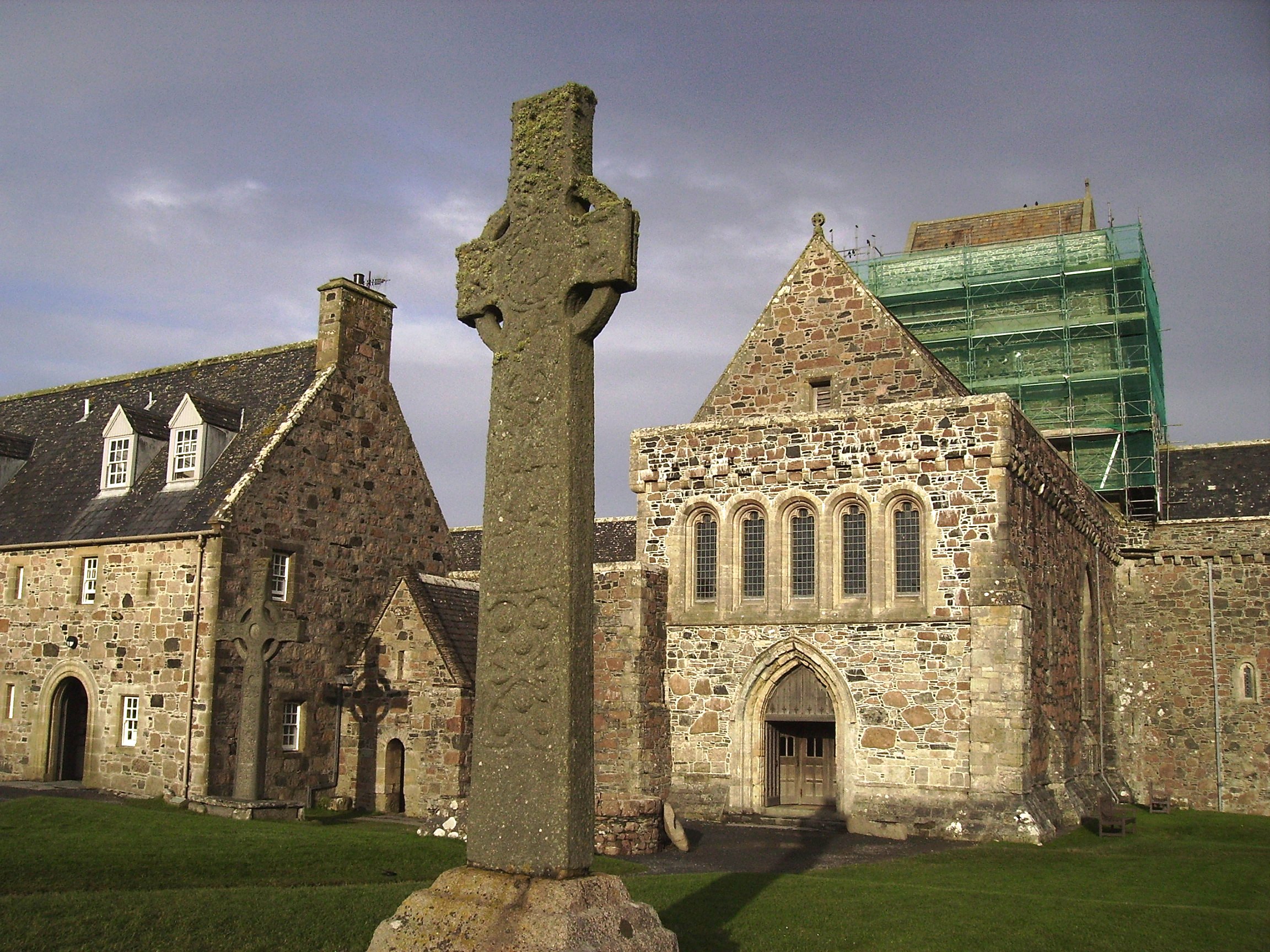
St_Martin's_CrossMuch of the American conversation among church leaders focuses on the challenges in big churches! As I thought about the questions that I see regularly addressed in minister’s blogs, many of them came with assumptions about their churches that were uniquely American and perhaps unintentionally, but nevertheless, big church questions.  For instance

  • Which is a better kingdom-building strategy, a mother church planting daughter churches, or the multi-campus single church strategy?
  • Which is a better leadership model, a staff-led church or a member-led church?
  • Is Sunday school still the best model or should the teaching of our children be returned to parents and small groups of parents?
  • Worship styles / Seekers worship / and all of those questions.
  • Staffing questions: large hired staff versus volunteers—with all the ensuing involvement questions
  • Ethnically mixed churches versus homogeneous ones—with accompanying language and cultural issues.
  • Leadership issues brought on by generational differences, especially as millennials (and pre-millennials) move toward the first arenas of ministry leadership.

One of the things I love about mission work is that when you are on the real front line of evangelism, it clears the air.  I was just with a small church in Scotland.  You know, I didn’t hear any of these questions on their lips.

Scotland is a country of about 5 million people with a Christian heritage dating back to the second century, though without much history until the sixth or seventh centuries. John Knox led the Scottish Christians out of Roman Catholicism and into the Church of Scotland during the Reformation, so while there is no established church in Scotland, these are still the two largest groupings.

No, that’s not quite right!  While 42% of Scots claim the Church of Scotland and 16% are Roman Catholic, 28% claim no religion. And although 42% claimed membership in the Church of Scotland, the church itself could only account for about 12% of the population as members.  The number quoted to me was 2% of the population attend any Christian worship service on any given week.

It’s not that the Scots have run off into non-western religions, which are represented mostly by the Muslims, Asians, and Indians living in Scotland. And, yes, there is a smattering of occult and even blatant pagan religion, but that’s not where most Scots seem to be.  No, they just are . . .not religious—secular!–not unusually immoral or uncharitable—in fact, there are charity stores and posters everywhere.  And their public schools not only permit, but encourage religious activities and instruction from Christian groups.

I had breakfast with the minister of this small Christian church in Scotland, and I was the guest of a family in this church. Both husband and wife are leaders there as well.  And in none of the hours of conversation that we had, did we talk about any of the questions listed above.

Here are some of the topics with which we wrestled:

  • What do we do when two of the three leadership families in the church have to move away in the same year?
  • How do we give our children what they need when there are only 5-6 children and they are of all different ages?
  • How can we reach out to young families when we are so few young families ourselves?
  • How can one paid minister (only partially from this church and with part coming from the US) take care of the spiritual needs of the members and reach out to seekers?
  • Do we need to recruit workers from America to help out? If so, how would we use them?
  • Where will our children find Christian friends? Who will they marry?  (All of these questions suggest the difficulty of engendering faith in children who grow up where none of their peers believe, of course.)
  • If everybody in the church is involved already, how do we create new growing edges that might encourage growth?
  • The church members, though few, come from every direction across the city, so how do we have strong fellowship and ample opportunity for Bible study and prayer together?
  • How do we integrate the foreign Christians whom we are glad to welcome, but who bring different perspectives, both from their culture and from their home churches that can be very disruptive?

Now, these are not unanswerable questions—nor are they unique to Scotland, but they do seem to be questions of a more basic nature than sometimes make the headlines among Christian thinkers.

And aren’t most of the Christian churches in the world more like the Scottish than like the mega-churches of America?

It won’t hurt all of us to drop back and make sure we are addressing foundational questions, even as our churches grow!

Read Full Post »

The Church of Christ in Ternopil, Ukraine, meets in property next to a huge city park that celebrates Ukrainian war heroes, most of whom died in 1944. The church that worships in that nearby building celebrates every Sunday One who is alive.

Of all the eastern European countries that opened up after the breakup of the Soviet Union, Ukraine seems to be the single one where Churches of Christ are not just thriving, but growing with a post-Pentecost fervor.  Much, if not most, of what Eastern European Missions does is in Ukraine; other “eastern European” efforts now locate most of their work in Ukraine, whereas 15 years ago they would have been active in several other countries.

I’m not saying that there is not good work in Russia, Romania, Albania, Bulgaria, Hungary, Czech Republic, Slovenia, and Serbia, not to mention Kazakhstan and Croatia. While most of these countries have excellent works, they have become slow and difficult in comparison to how it was in the early years after the Wall fell, and so the fervor for those countries has waned among American churches in general.

Not so in Ukraine, especially eastern Ukraine!  Schools of preaching, television evangelism, school programs, along with strong national leaders, all are resulting in new churches being planted throughout eastern Ukraine, as I understand the reports. You still hear about American churches sending preachers, teachers, and others to Ukraine—and when you do, you can be 99% sure they are going to Kiev and eastern Ukraine.

The one exception might be Ternopil, however, which lies in western Ukraine!

Part of the reason why we visit new LST sites is to determine how healthy the churches are who have invited our teams, so we also ask about their history to determine the path they have taken to be where they are today.  This church has followed an especially unusual path—and I’m not even sure they know it.

Their history as a congregation starts after the borders opened, when Stephen Bilak returned to his own country to continue preaching the Good News. He had been doing it by radio for many years before he was permitted to re- enter the country in person.  Thereafter, Christians in Michigan made Ternopil their personal mission site and came on their own many times.  The church grew, and about twelve years ago, bought property. With their own hands they constructed a wonderful facility with an unusually large auditorium, offices, and classrooms, but also with a large apartment—two sleeping areas, two full bath/showers, great kitchen. The apartment itself is not so unusual , but that they built it for the people who would be coming to help them was extraordinarily unusual and unselfish faith on their part!

Since then Brady Smith, missionary in Lausanne, Switzerland and Stephan Bilak’s son-in-law, has continued to come regularly to teach and serve this church.  The Minter Lane church in Abilene has sent many to Ternopil and see themselves as a mentoring church to the Ukrainian congregation. Professors from Abilene Christian have come to teach and train.

Are you getting the picture?  A lot of Christians with many and varied resources have come and worked with and served this single congregation over its twenty-year history!

The amount of attention paid to Ternopil is highly unusual. There is no church in Lviv, for instance, which is the much larger city into which one flies going to Ternopil, which is about a two-hour drive on a very bad road away! Why Ternopil and not Lviv?

When I try to come up with an explanation for eastern Ukraine’s mission efforts thriving as opposed to western Ukraine’s single thriving effort, one correlation appears to me especially obvious, that is, where many workers have gone for many years and where American churches have provided strong financial support, the churches are thriving.

Where individuals have worked with little support, either in personnel and/or financial resources, the work seems weak.

Or even worse, that area has been deemed unreceptive

Many people know missions in Ukraine better than I, so there may be other factors and explanations.  I know the work in Kiev has been a rollercoaster ride, with lots of good things and lots of disappointment. I’m pretty sure that is because from the first days of the work in Kiev by Churches of Christ, there was division among the churches over a whole slate of issues.   It was sometimes a little hard to know that we were Christians by our love for one another!

I’m so thankful for the church in Ternopil, for the strong and faithful leadership, for their fearless desire to grow the kingdom in their hometown.  And I’m thankful for all those partners in the Gospel over many years who have supported and mentored and served this church without making it dependent nor stealing its great passion for Christ.

And, who is willing to start a work in Lviv?  LST will help!

Read Full Post »

Last week, Sherrylee and I spent two of our vacation days in Gettysburg, Pennsylvania. I think Sherrylee agreed to visit Gettysburg mostly to humor me because while she is a history buff as I am, she does not get excited about visiting battlefields and old forts.

I made sure to plan a visit to the Eisenhower farm which I thought might be especially interesting enough to her. Though interesting enough, the time we spent on the battlefield at Gettysburg and going through the Gettysburg National Military Park was an extraordinary experience for both of us!

I had been to Gettysburg while in college, but had only spent an hour there, so my entire recollection was of a field full of monuments and a not very sophisticated museum show that tried but failed to connect you to this moment and battle.

I don’t know who recommended Michael Shaara’s historical fiction novel The Killer Angels (1973) to me, a novel which he wrote after too visiting the battlefield and becoming enthralled with the events and the people, but let me recommend it to you too, even if it is not the kind of fiction you usually read.  In fact, when I was teaching literature at Oklahoma Christian, it was the book that I recommended first to those students who either hated reading or simply had never read a novel. The Killer Angels never failed to capture their attention—and some even turned into avid readers afterwards.

Anyway, Sherrylee and I decided to buy the auto CD tour, the one that guides your drive through the park, giving you background and telling stories all along the way, while stopping you at certain sites to identify what you are seeing both up close as well as in panorama. The drive lasts 3 ½ hours if you listen and look at everything—very thorough and fascinating.

We drove and listened and looked until it was too dark to see anything else that day. Then I got up early the next morning and drove back to Little Round Top and to the Highwater Mark, just to see those special places in the daylight and to take some pictures. (If you don’t know those sites. . . . keep reading!)

If you know us at all you can guess what we did as soon as we got back home! We bought the movie Gettysburg (1993) and watched it—not for the first time, of course. No, we saw it when it first came out—but what a difference it makes to really know the history and to have walked the battlefield.

Put this movie into your queue. You’ll find it long (over four hours) and sometimes the pace is slow. You may think that Martin Sheen’s southern accent could be improved and that Tom Berenger needs acting lessons, but try to watch it for the history. Perhaps not absolutely, but the film is certainly highly accurate in its depiction of the people and the events.  And much was filmed on location, so you truly get a good picture of these important three days that changed the course of history in this country.

I have felt as moved before; for instance, at Pearl Harbor, at Omaha Beach, and (don’t laugh) at the Alamo, but what makes Gettysburg unique among such memorable war sites is that this deadliest battle ever fought on U.S. soil (over 53,000 killed on both sides) was brother against brother—sometimes literally.

We heard the story of the Schwarz brothers, two young men who immigrated at different times from Germany to the U.S. On the very first day of battle at Gettysburg, the younger Confederate brother is captured in a skirmish. As he is being taken back to the Union position, he asks if a Rudolph Schwarz is in this company from New York. The older brother Rudolph, whom the younger had not seen since leaving Germany, is located and the two are re-united briefly.  Literally minutes later, as the younger brother is being taken away as a prisoner, his brother Rudolph is killed in the fighting.

Many of the generals and commanders had gone to school together and served together, sometimes for years, before Ft. Sumter. The film focuses especially on Generals Hancock (US) and Armstead (Conf), very dear friends, who must fight each other at Gettysburg. Both are severely wounded, Armstead mortally and at the hands of Hancock’s own men.

President Lincoln made the words famous perhaps, but Jesus said it first: “Any kingdom divided against itself will be ruined, and a house divided against itself will fall” Luke 11:17.

Before we pick up our muskets and march against our brethren, we should count the cost of civil war. One hundred fifty years ago, our great grandfathers were slaughtering one another, were lined up–cannon fodder—because both sides believed themselves right—and God was on their side!

Blue vs. Red has replaced blue vs. gray. I pray that even as divided as we are, that we can find a way to avoid even the rhetoric of civil war.

We dare not forget Gettysburg!


Read Full Post »

Our family car was a 53 Chevrolet like this one.

Sherrylee and I both grew up in families that liked to make road trips!. While we were still dating, her family decided one evening to drive through the night to Atlanta to shop at Rich’s Department Store—eight hours away! Her family used to drive from Fort Lauderdale up to Jacksonville, Florida to visit grandparents—only a six-hour drive today, but 8-10 hours before the interstate highway saved us from getting behind big trucks on a two-lane stretch or the red lights in small towns that stopped you even in the middle of the night after the sidewalks had been rolled up!

My family traveled from Fort Worth to Glasco, Kansas, every year to visit my grandparents. With Mom and Dad and the smallest child in the front seat and the three other children in the backseat–in the days before seatbelts, a/c in cars, and minivans–we always traveled through the night, mostly, however, to preserve my parents’ nerves, I suspect.

Last Friday Sherrylee mentioned that she thought we needed to, and Saturday morning, we decided to drive to Nashville to visit a dear friend who is very sick. We left on the 700-mile trip three hours later! Our plan was to return on Monday, but because of too many relatives in Nashville, a little car trouble, and the need for a predictably good internet connection for an LST board web conference, we did not get away until almost 7pm, so we spent the night in Memphis and drove in on Tuesday. I don’t do all-night drives anymore!

I’ve noticed among the younger people in our office—and that’s almost everyone else—that long car trips are not even a considered option. Those with children seem sometimes forced into them by the economics of travel, but they seem to dread the trip itself.

If you decide you might even try a longer road trip—for any reason, here are a few ideas to make it fun and easier for you.

  • Don’t try to cover so much ground that you are rushed—either leaving or arriving.My personal preference is no more than 8 hours per day when you have to get somewhere, although this trip to Nashville was eleven.
  • Don’t let meals and restaurants be what defines your trip!  It’s so easy to overeat and feel bloated while traveling. You are not getting that much exercise while riding in the car, so take it easy on the eating. Keep it simple and lighter!
  • Use good music, downloaded podcasts, and especially audiobooks to make the trip fly by! On this trip, Sherrylee and I listened first to Condolezza Rice’s book A Memoir of My Extraordinary Family, Ordinary Family and Me, which was quite interesting.  After that we started The Last Hero: A Life of Henry Aaron by Howard Bryant. The book itself is very interesting, but the man who reads it mispronounces names of Hall-of-Fame baseball players, which I find particularly irritating.   We rent and return our audiobooks from Crackerbarrel restaurants, which makes them very reasonable. You just have to watch that you don’t buy a bunch of other stuff every time you stop.
  • Use a GPS, even a cheap one!  No single technological innovation has relieved my stress in driving more than a GPS system.  I’m never lost! If I miss a turn, the nice lady immediately recalculates and gets me on the right track. I know how far it is and how long it should take me, and if I need a detour around traffic (as we did yesterday in Arkansas!), it quite handily re-routes us through new territory. Also, I love that it looks for nearby restaurants and gas stations!
  • Make sure your car and tires are in good shape.  Nothing ruins a trip more than a blown tire or a leaky hose out in the middle of nowhere! I “risked” a bit on the trip to Nashville because I knew the car needed an oil change badly, but I got it done in Nashville and even replaced a tire that they discovered was worn while changing the oil.
  • Smartphones not only provide some security in case of a breakdown, but let you call ahead for hotel reservations or avoid inconveniencing someone you might be meeting. We were trying to meet someone for lunch in Little Rock who was driving to Nashville yesterday; we got stuck in a construction site jam after leaving Memphis, but because we both had cell phones, we were able to coordinate our travel and meet in DeValls, AR instead.
  • Allow for saying YES to some unplanned pleasure.  While driving through Little Rock, Sherrylee noticed a big antique mall, which to her is like a good bookstore is to me. Rather than being goal oriented and thinking, “No, we need to get home before 10pm, it was so nice to say, “Yes, sure—why not!”
  • Road trips are great times for longer conversations.  Turn the book off, turn the ballgame off, turn the music off, and see what interesting things can pop up in conversations between mile markers!

I’d love to hear your stories of road trips and what you do to make them fun!

Read Full Post »

I spoke yesterday in chapel to about fifteen students at South Pacific Bible College in Tauranga, New Zealand.  These are students from all over the world who have committed at least two years of their lives to studying Bible and ministry from great teachers. Some even stay for a third year of practicum—not an academic year, but a year of guided practice in using the knowledge and skills they have received in the previous two years of classes.  I love that!

Sherrylee and I arrived in New Zealand after a not atypical day with international travel. At 8am, we left our hotel in Kuching, Malaysia, in order to arrive at the airport two hours before departure—only to find out that our flight had been cancelled—which is why you always arrive two hours early for international flights!

A very nice woman took our passports and information, disappeared into an office and came back in about twenty minutes with new tickets that required us to fly first to Kuala Limpur, then to Singapore, arriving about two hours before our long, overnight flight to Sydney. So no real damage to our plans, just an additional stop and more time in the air.

We boarded our flight from KL to Singapore right on time—then sat on the tarmac in a very hot airplane for over an hour because two passengers who had checked bags did not show—so their luggage had to be found and removed from the plane. I’m ok with good safety precautions, but it was going to really push us to make our connection in Singapore.

With less than an hour now after landing in Singapore, we had to clear immigration and customs, pick up our suitcases, change terminals, check-in at the British Airways counter to get board passes, check our luggage, clear passport control again to leave Singapore, and go through security.

But we made it, boarding our 747 for Sydney at 8pm, twelve hours after leaving our hotel in Kuching and with time even to get ready for our 7-hour overnight flight—you know, pick out movies to watch, get our books out, and hope for a little sleep.

The plane backed out of the gate—stopped—waited 10 minutes—then pulled back into the gate!   A cargo hold was overheating, so they were going to try to cool it down, but if they couldn’t, then . . . . Oh boy, here we go again! But after 45 minutes they got it cooled down, so we took off just about 90 minutes late. . . .

Which meant we missed our connection in Sydney, Australia! Now airlines are pretty good about booking you onto the next flight when you miss your connection, but because of the way we had booked our tickets, our names were not on the roster of those making connections, so we had again a short wait while they worked out our connection—all of this happening at 6am in the morning in Sydney—before coffee!

Finally around 11:30am, we boarded our Qantas Airways flight to Auckland, New Zealand, and arrived only about four hours later than originally scheduled—not a bad result for international travel any more.

Steve Raine, principal (president) of South Pacific Bible College and a very good friend, met us in Auckland and drove us two hours through the beautiful green countryside of New Zealand’s north island to Tauranga, which is our last stop on this Asian mission trip. Steve and his wife Gill have been guests in our home often, so we are thrilled to be able to spend some time in their home and get to know their work for God better.

After chapel at SPBC, Sherrylee and I joined the students on a special outing they were having, and what a pleasure it was. We spoke German with Lukas, who is here from Switzerland; we found common friends with Marcellus and his wife who are here from Santiago, Chile. Of course, the three or four students from Thailand all knew about RCC and Patinya, with whom LST has worked for many years. One girl from New Zealand told us her story of her parents being Christians, then leaving faith and divorcing, then at least her dad finding his way back to God. All of these students are here because they love God and want to be trained to serve Him better.  This college is a bright light in the South Pacific, but serves the kingdom of God all over the world!

The icing on the cake was to discover our friends Curt and Deborah Niccum here, who are just finishing a month of teaching at SPBC. Curt is a professor of Religion at Abilene Christian University and perhaps the best biblical language scholar in our fellowship. The students at SPBC are truly getting the best of our best!

Early Monday morning Sherrylee and I will leave New Zealand for home!! This is one of those crazy flights where we will fly 15 hours and arrive at DFW 20 minutes after departing—because of crossing the international dateline.

But getting home is always the best part of any journey! Hey, that sounds like there is a sermon in there somewhere, doesn’t it!

Read Full Post »

God’s Drama In Asia!

What an amazing world we live in! Because our flight from Kuching, Malaysia to Singapore is cancelled this morning, we are being re-routed through Kuala Limpur on a flight leaving in three hours. So while Sherrylee does some airport shopping for the grandkids, I’m sitting in a Coffee Bean shop, having a latte with a banana muffin while Carrie Underwood sings from the Grand Ole Opry on the TV monitor above me—in Kuching, Malaysia.

Next door to this little oasis of western culture is a shop selling prayer rugs and shawls for Muslim tourists, and in the restaurant at the other end of the departure area, advertisements announce a special menu for Ramadan. It’s about 90 degrees outside with 150% humidity, but beautiful purple wild orchids grow everywhere on the side of the road. The humidity we have in Houston, but not the orchids!

Last night’s dinner was a drama of mixed cultures: a seafood dinner served family style with peppered crab, whole shrimp, grilled whole fish, fern, and something my friend Dave Hogan (Singapore) called “worms” when he asked me to pass them.  And then we had a McDonald’s strawberry sundae for dessert. What an amazing world we live in!

Sherrylee and I attended the 51st Asia Mission Forum (AMF) in Kuching this year in order to visit with many of the Asian church leaders and missionaries to whom LST sends teams.  If you think the world is amazing, God’s church in this world is amazingly dramatic!

About two hundred people attended this AMF, one of the larger crowds, from about a dozen different countries.  On any row of seats, you would probably find a Christian couple from Singapore sitting next to their friends from Kuala Limpur and a family from the Philippines.  Japan had an especially large group this year; China was represented as was Cambodia, Laos, and Thailand. Then there were the guests like us from the United States and a whole mob from Texas!

Joel Osborne, a former LST worker who now lives and works in Japan, was the director of the AMF and did an especially wonderful job balancing worship, teaching, fellowship, and inspiration.  Jim McGuiggin, the Irish saint of Churches of Christ who now lives near Nashville, brought deeply moving lessons each day. Joel led us in stirring worship—almost liturgical in its thoughtful structure and responsive readingsbut the highlight for me were the personal testimonies of some of the Asian Christians.

Talk about drama, would you be surprised to know that one of the highest officials in the government in the Philippines is a devout Christian who hosts a congregation of saints in his home near Manilla?  And while he could have awed us with his own story, he spent most of his allotted time talking about his wife, who was rising in the judicial ranks as a judge in the Philippines, perhaps on a track to the Supreme Court, when she resigned! She resigned her position because of the corruption and abuse of power in the ranks of her fellow judges—but she didn’t resign out of fear! No, she resigned to fight! She wrote two books documenting the corruption and abuse of power and has become a national figure in the fight against corruption.  The two of them are powerful Christian voices for the revival of integrity in a country that has a long Christian tradition.

Then last night three young Japanese Christians, struggling to control their emotions, told about how the disastrous earthquake and tsunami of March 11, 2011 had affected them. These three young Christians, alone with Joel Osborne, directed much of the Japanese disaster relief done by Churches of Christ, including collection and distribution of food and clothing and relief items, in addition to the clean-up and recovery work that continues.

Pausing with every sentence, the young woman told how she went to the disaster area in faith but how the questions of God’s absence in the midst of all the destruction and suffering actually caused her to decide there could not be a God who would allow such! She abandoned her faith–but stayed with her work for the disaster victims. What she discovered was that giving up on God brought no more answers and no relief to her pain. Then her Christian friends reminded her of Christ’s suffering, even his feeling abandoned on the cross, and God found her soft heart and moved back in to recover and heal her—as she continues to help others heal.

The exotic plants, the food, the culture—these are all interesting—but the people and their stories, this is where we see God’s drama being unpacked in our lives. God’s story has life, death, joy and sorrow, beauty and beasts—but God’s drama is the real world—the most amazing one of all!

Read Full Post »

Nothing challenges your sense of the existence of real time like international travel. Look at how relative time is in our world:

  • Twice a year 49 out of the 50 states change the clock one hour for daylight savings.
  • When it is 12 noon in Texas and the Sunday football game is about to start, it is 1:00pm in New York and the Californians are still in church because it is 10am. So what time is it really?
  • The tip of Chile is 6000 miles from Dallas and is only one hour ahead of Central time, whereas Tokyo—about the same distance—is 14 hours ahead of Dallas.

Sherrylee and I left DFW at 10pm on Saturday, flew direct to Brisbane for 15 hours, but on the ground it was Monday at 5am.  When we return from Sydney, we depart on Monday at 3:20pm and we arrive in Dallas on Monday at 3:45pm—20 minutes later!!!

So what time is it really?  Or is there a real time—anywhere??

Then you have the “sense of time” or whether time has a feel to it.  Does time move at a different speed depending on whether you are in a boring movie or at a thrilling ball game?  Do children have any sense of time?  Is it something you learn?

Time is somehow connected to intervals between events. We have a great need to know how long since the baby ate—in fact, the baby’s body has a rhythm that demands certain time intervals be acknowledged!  Most time is measured by the time it takes for the earth to travel around the sun—which has for millennia been recognized to be about 365 days plus or minus. Days have been measured in all sorts of ways: watches, quarters, hours, tidal rhythms, lunar patterns, etc.

So there may be time, but the only way we can talk about it is to agree on some standard of conversation. If Texas says it is noon and California says it is 10am, someone has to explain why both of these answers could be correct.

And so it is with good and bad, with moral and immoral, with definitions of colors, of words—of life and death.  The only way we can talk about any of these is to agree on some standard of what is true.

The world becomes a much more difficult place when we quit talking about what we have in common and start focusing on what is different.

I think that “live at peace with all men, as much as it depends on you” (Romans 12 :18)means being willing to search together for “whatever is true, whatever is noble, whatever is right, whatever is pure, whatever is lovely, whatever is admirable—if anything is excellent or praiseworthy—think about such things” (Philippians 4:8)—and primarily to believe that people can agree on these things for the common good.

So,  if you ask me what time it is, I will tell you it is 8:25am on Tuesday, July 24, but you might say, no, it is 5:25pm on Monday, July 23rd. If we will keep talking, we will come to an agreeable understanding, won’t we!

If that works for time, maybe it will work for other things that we seem to have trouble agreeing on.

Read Full Post »

Four hours until we land in Chicago.  We were not scheduled originally to fly through Chicago, but when we got up this morning, we found the notice that our flight to New York from Rome was delayed two hours, meaning that we would certainly miss our connection to Seattle, which is our next stop.

With the cost of making international calls via internet now affordable, I turned on my own mobile phone, called the American Airlines  US office and rescheduled us through Chicago.  No problem—as they say all over the world!

Because Sherrylee and I spent our first Thanksgiving together in Germany in 1971, to call home, we went to the Post Office, informed the clerk that we wanted to make an international call, gave him the number, and then stepped into a special telephone booth in the office to wait for the call to be placed.

In a minute, our phone rang—no ringtones then—and her parents were on the other end. We talked for eight minutes, part of which was taken by Sherrylee asking her mother which end of the turkey to stuff. I remember vividly paying over $50 for that phone call, which, as a point of reference, was exactly what we had been paying monthly for rent at our first apartment.

I’m glad we came to Italy.  Our Rome to Florence flight took a bit longer because our plane was diverted to Pisa because of high winds.  I thought I might catch a glimpse of the leaning tower as we landed, but no such luck.  By the way, if you ever go there, the baptistery in front of the church in front of the leaning tower may be the most interesting structure to visit.

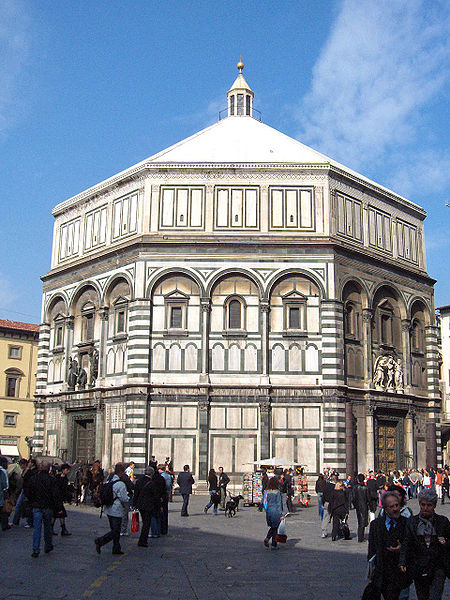
The same is true in Florence where the Baptistry of St. John  is a must visit.  As it was explained to us, these early medieval churches built their buildings to reflect their theology. A large building would be built, large enough for a very large pool of water into which you went down and walked out of to be baptized. This building not only would be highly adorned and appropriately decorated, but often the artwork—or so it appears to us—was really the medieval version of Powerpoint slides thrown onto all the walls and ceilings for instructional purposes. The art of baptistries tends towards the stories of God’s redeeming work , which seems highly appropriate to me!

But the theological lesson continues. The baptistry would always be built outside of the church, but not too far from the front door!  So in Florence,  one would be baptized, exit the building through the famous doors called the “Gates of Paradise” and then walk into the church as a new-born member of the Body of Christ, straight to the altar to participate in communion.  The theological instruction for the new Christian is unavoidable!

Makes me wonder about our baptistries?  I’ve seen baptistries under trap doors under the pulpit! Then there are those high above the pulpit—or low and over on the side behind a curtain.  In fact, almost all of ours are behind a curtain. What does that say??

We had about an hour of wandering in Florence before we met two missionaries from Ancona, Italy, who rode a train several hours both ways to meet with us. Brian and Kyle have been part of a team, which has worked in Ancona for the last ten years. Wonderful guys who didn’t know that much about LST, so we spent some time together talking about possibilities.

Our second day in Florence, we had a delicious lunch with Mike and Anto Mahan and their two children. They have ministered to the Church of Christ in Prato, just outside of Florence for many years and have hosted many mission interns over the years, but will host their first LST team from York College this summer.  We like to meet personally with new hosts to make sure everyone has the same expectations.

After rushing to the airport this morning, then, to catch the flight to Chicago, which left an hour earlier than the New York flight, just enough time remained before we needed to go through passport control and security to meet with Andrea and Heather Gentile, a great couple who are part of a team planting a church outside of Rome. He is Italian and she American; in fact, their teammates are of the same configuration.

Sherrylee and I have the best job in the world. We get to travel to Scotland, Ukraine, Greece, and Italy, meeting with local Christians, U.S. missionaries, national evangelists; we get to listen to them tell excitedly about their work; sometimes we get to encourage them ; we always pray with them.  We talk about the Kingdom of God and what we might be able to do together to bring glory to God!

The churches we have visited this time battle for God in fields, where the spiritual warfare is vicious. But we must never forget that even in Europe, we are more than conquerors!


Read Full Post »

 On Sunday, those gathered were from Bulgaria, Albania, Greece, Switzerland, Ukraine, Russia, Australia, South Africa, Iran, Iraq, and Texas.  We used three different songbooks and the Greek, Cyrillic, and Roman alphabet.

The Lord’s Prayer was prayed simultaneously multi-tongued. The Spirit interceded in an unutterable language according to St. Paul in Romans 8, to make the thoughts of our hearts known to God.  Regardless of country of origin, the bread was broken in Ƙoinonia (Fellowship) and the cup was taken with Agape for the One who bought His Church with His own blood.

I preached twice yesterday in Athens at two wonderful congregations. I told them that their services at first reminded me of the Tower of Babel, but as I thought about it, I realized that God had used different languages to drive men apart in that story because of their haughtiness and pride.  Jesus, of course, came to break down the walls and unify people,which is why we could all sit together in one room. Our different languages are the remnants of punishment for our pride, but what seems today like a barrier is, in fact, the hope and promise of feasting with all the nations at the banquet of the Lamb.

These multi-national churches are like a taste of heaven!

And why is this?  Not so long ago, I reminded you of what St. Paul said in this same city two thousand years ago, when he had the opportunity to talk about the Unknown God with the Athenians:

From one man He made every nation of men, that they should inhabit the whole earth; and he determined the times set for them and the exact places where they should live. 

God did this so that men would seek him and perhaps reach out for him and find him, though he is not far from each one of us. Acts 17:24

We visited with four Muslims who will be baptized next week. We talked with a Christian Iraqi preacher who fled with his wife and three children because of death threats.  We heard about twenty-five Africans in Athens training to be preachers.

Greece is considered unreceptive! Churches in America will not spend money in Europe because post-Christian Europeans don’t want to listen to American missionaries!

But what about the rest of the world that is in Europe? What about the nations?  What about all the world? What about God’s Spirit being poured out on all flesh?  What about God putting people in the exact place where they should live so that they will seek Him and find Him?  What about the peoples that God has put in Europe?

Maybe that’s too many rhetorical questions, but just come to Athens and see.  Visit the islands, enjoy the ruins and biblical sites, but don’t forget to see the nations!

Read Full Post »

« Newer Posts - Older Posts »