Feeds:
Posts
Comments

Archive for the ‘Uncategorized’ Category

ImageSherrylee and I are again in New England, so allow me to repost these observations from 2010.  

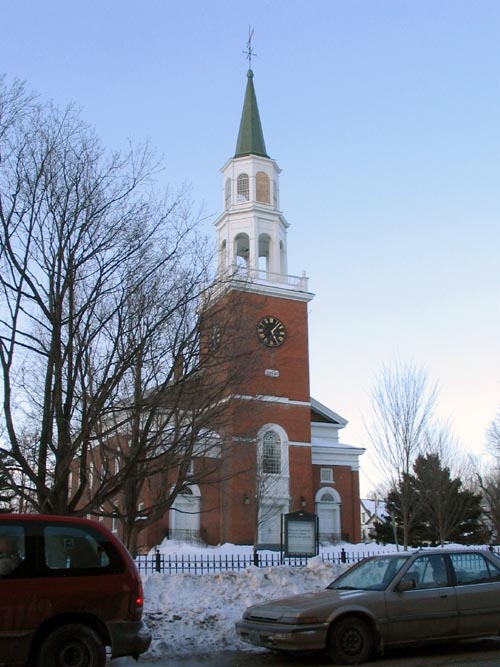
While we were in Vermont and Massachusetts last week, I saw a large number of Unitarian Universalist congregations, mostly meeting in buildings that were at one time Congregationalist churches.  I did some work on the Puritans a few years back, so I began thinking about the history of these churches—and I started to get a bad feeling.  Here’s the super-zipped history, so you can see why.

Although historically tied to the Presbyterian church, this new movement eventually separated themselves from that denomination. As they pursued their independent study of the Bible, they became convinced that the only true path to reform was to return to the practices of the first century church, including adult conversion and the pattern of congregational autonomy.

This new movement flourished, but with time, because there was no higher authority than the local congregation, the movement splintered into Arminianism (legalism), Deism (social gospel), transcendentalism (spirit-filled), and Unitarianism (liberal)—parentheses are my translation into 21st century labels.

I thought this could have been a description of Restoration Movement history to this point in time. If you feel that way too, then read on to see where the future might lie!

Within two hundred years of its beginnings in America, many of the most influential Congregationalist ministers were Unitarians (a belief in the singleness of God and a rejection of a trinitarian understanding, including a rejection of the exclusive claims of Jesus because He is the Son of God).

During this same historical period, the doctrine of universal salvation was at its zenith in America. Universalism teaches that a loving God would not create humans, then send them to hell or eternal punishment.  It is no surprise that after rejecting the divinity of Jesus and opening the doctrinal door to acceptance of everything under God, Unitarians quite easily moved into universal salvation as well. It would be the natural step following their move to a more syncretic understanding of God.

Today, these beautiful old church buildings in New England are no longer Christian churches; rather, they are filled with the great grandchildren of those early Restorationists.  Unitarian Universalists profess the following in their own words (http://www.uua.org/visitors/6798.shtml ):

There are seven principles which Unitarian Universalist congregations affirm and promote:

  • The inherent worth and dignity of every person;
  • Justice, equity and compassion in human relations;
  • Acceptance of one another and encouragement to spiritual growth in our congregations;
  • A free and responsible search for truth and meaning;
  • The right of conscience and the use of the democratic process within our congregations and in society at large;
  • The goal of world community with peace, liberty, and justice for all;
  • Respect for the interdependent web of all existence of which we are a part.

Unitarian Universalism (UU) draws from many sources:

  • Direct experience of that transcending mystery and wonder, affirmed in all cultures, which moves us to a renewal of the spirit and an openness to the forces which create and uphold life;
  • Words and deeds of prophetic women and men which challenge us to confront powers and structures of evil with justice, compassion, and the transforming power of love;
  • Wisdom from the world’s religions which inspires us in our ethical and spiritual life;
  • Jewish and Christian teachings which call us to respond to God’s love by loving our neighbors as ourselves;
  • Humanist teachings which counsel us to heed the guidance of reason and the results of science, and warn us against idolatries of the mind and spirit.
  • Spiritual teachings of earth-centered traditions which celebrate the sacred circle of life and instruct us to live in harmony with the rhythms of nature.

I want to think that my church could never slide down this path, but I do recognize some of these footprints in the road we are traveling.  I do believe that those who cannot remember the past are condemned to repeat it” (G. Santayana).

And if this is not what I want for my grandchildren, what must I do today?

Read Full Post »

July 12, 1974

July 12, 1974.

woodward 1980Seven months before, I had carried a little sack with a urine sample down to the pharmacy about two blocks away from our apartment on the Lister Meile in Hannover, Germany.  A couple of years earlier, we had been pregnant and miscarried, so we were eager, but cautious about getting our hopes up.

I don’t think they did the test immediately. I think I had to come back the next day to get the results—the results that made me smile all the way home.

We already knew where our little nursery would be—the room in our apartment that shared a wall with Frau Hakemeyer. She was an 80-year-old concert pianist, who had a grand piano in the room with the common wall, so every afternoon our new little baby would be treated to Chopin!  What more could you want.

A modern wall mural of Noah and the ark went in over the new crib, which was outfitted in bright red, white, and blue!  Yes, this was going to be an American baby!

The evening of July 11, I came home from our office and found Sherrylee scrubbing down the balcony!  As I questioned where she got the energy in her condition, she interrupted me: she had already finished thoroughly mopping the kitchen—just getting things ready, she said—but I think it was that burst of energy that God gives women right before the Time!

About 11pm, she said it’s time to go.  It was about a twenty-minute drive in our little bronze-colored Chrysler Simca—a BMW could have made it in 10– to the hospital—even so, there wasn’t a lot of conversation, but I’m sure both of us were praying and wondering about what was getting ready to happen.

We arrived at the Universitätsklinik just before midnight, so the night nurses were helping Sherrylee get prepared and telling me to go home because nothing was going to happen very quickly.

I was prepared for that trick, however! You see, we had searched all over Hannover for a doctor that would allow us to do Lamaze natural childbirth, which includes the husband coaching the wife through the delivery. There were no Lamaze classes at that time—at least in Hannover, so we read seven how-to books.  We were experts! We were prepared!

But then we discovered that no one had ever done this in Hannover, so the doctors would not cooperate. We went to clinic after clinic and were getting nowhere! Crazy Americans!

Our last stop was late one evening at the university hospital. We walked in, found the doctor’s office closed, but a light on in one office, so Sherrylee opened the door carefully—and there was Dr. Künzel, the Chief of Obstetrics for the medical school in Hannover—wondering who was barging into his office at that time of night.

When he realized that we were Americans and when he heard our plea, much to our surprise and pleasure, he agreed! He, as a university professor, was perhaps more interested in new methods and ideas than some of his colleagues—or maybe Sherrylee just charmed him. I’ve never been quite sure!

So, anyway, I was not about to let the nurses trick me into going home—and I told them that Herr Prof. Dr. Künzel—long titles are impressive in Germany–had approved my being there, and I was staying.

Finally, they let me in–and there was Sherrylee in her gown already hooked up to the fetal monitor that registered every heartbeat of our new baby as well as the pressure when each contraction came.

Through the night we breathed, we talked, I rubbed talcum powder, we breathed, we talked, sometimes she slept between contractions, but then we breathed, and talked, and rubbed talcum powder.

By mid-morning of the 12th, I was exhausted! I sat down—but by this time, the nurses that had been through the night with me were all friends, so they brought me some small refreshments. Before I had time to even snack, it was Time.

Almost without warning, God did His miracle! First the crown of his head, then his head, then his whole slightly blue body!  It was a boy!  And even though there had been a little cord issue that caused the doctor to slow the delivery down a little, he appeared to be fine! OK, I did cry a few tears of wonder and joy!

The nurses stuck him under a faucet and washed him off, pulled on his legs to straighten him out for measuring, and did some other stuff to him as well.  Then they let us sit and hold him, our son Philip Gary.

There are so many more little stories to tell: Granny Joy coming to help Philip recover from “his little operation,” weighing him on scales after every meal to figure out how much he was eating, but especially the story of getting his pram and him stuck in the revolving doors of the Cologne cathedral on his first excursion just three weeks after his birth.

. You’ve grown into an impressive man, a great husband and father. You’ve always been wonderful son—even when you broke my thumb!!  You truly love God.  You have blessed our lives.

Your mother and I love you dearly—and always will.

Read Full Post »

josephWe just finished a series on Joseph, son of Jacob, at church. Such a familiar story full of dreams, threats, seduction, rise from ashes to power, surprise revelations—all the elements of great drama! I’m surprised it has not been the subject of more movies.

I learned something completely new to me this time through the old story.  Let’s start with a little back story review for those of you who have not read Genesis in a long time!

In Genesis 12, God calls Abram out of Ur of the Chaldees to go to Canaan. He promises to make of Abram a great nation. In verse 7, God also promises Abram, “To your offspring I will give this land.”

For many years, Abram is pretty nomadic, even going down to Egypt to escape a famine in Canaan, but he eventually returns to the place where he first pitched his tent and where God made him the promise of land, between Bethel and Ai for those of you with Bible maps.

But Abraham owned no land until he purchased a site near Hebron (Mamre) to bury Sarah, the cave and field of Machpelah (Genesis 23).  Two chapters later, his sons Isaac and Ishmael bury him in the same cave.

The family of promise owned so little, but God didn’t want them to forget his promise of the whole land, so when another famine came in the time of Isaac, the Lord told Isaac NOT to go to Egypt:  “Do not go down to Egypt; live in the land where I tell you to live. Stay in this land for a while, and I will be with you and will bless you. For to you and your descendants I will give all these lands and will confirm the oath I swore to your father Abraham (Gen. 26).

Isaac’s son Jacob flees the revenge of his brother Esau and must leave the promised land, but before he gets beyond its borders, God appears to him in a dream and says, “I am the Lord, the God of your father Abraham and the God of Isaac. I will give you and your descendants the land on which you are lying (Gen.28).  Only then does God allow Jacob to continue to the “lands of the eastern peoples.”

After accumulating wives, sons, and wealth, God sends him back: “I am the God of Bethel, where you anointed a pillar and where you made a vow to me. Now leave this land at once and go back to your native land (Gen. 31).’”

Upon arrival in Canaan, Jacob does purchase a plot of land near Shechem, but God keeps moving him southerly towards Bethel, where the promise of land was given to him, and where he buries his father Isaac in Mamre (Hebron) in the cave with Abraham.

So, interestingly enough, the story of Joseph starts in Genesis 37 with the words: “Jacob lived in the land where his father had stayed, the land of Canaan.”

You remember that as a very young man Joseph is sold into slavery in Egypt!  The son of promise is taken forcibly from the land of promise, but it is all the design of God. Almost 25 years later, the whole family comes to Egypt to be rescued by Joseph from the terrible seven-year famine.  They are given the land of Goshen in which to settle and they thrive and multiply there. “God intended it for good to accomplish what is now being done, the saving of many lives,” Joseph tells his brothers (Gen. 50).

But Egypt was not the Promised Land, so Jacob gathers his children to his deathbed and says, “I am about to be gathered to my people. Bury me with my fathers in the cave in the field of Ephron the Hittite, the cave in the field of Machpelah, near Mamre in Canaan, which Abraham bought along with the field as a burial place from Ephron the Hittite. 31 There Abraham and his wife Sarah were buried, there Isaac and his wife Rebekah were buried, and there I buried Leah. 32 The field and the cave in it were bought from the Hittites (Gen 49).”

Joseph learned something from Jacob. When it was his turn to die, this man who had lived almost a century in Egypt, who had lived the best life an Egyptian could have—once he got out of prison—and who had children and grandchildren born and raised in Egypt, this man’s final words were, “I am about to die. But God will surely come to your aid and take you up out of this land to the land he promised on oath to Abraham, Isaac and Jacob.” And Joseph made the Israelites swear an oath and said, “God will surely come to your aid, and then you must carry my bones up from this place.”

So Joseph died at the age of a hundred and ten. And after they embalmed him, he was placed in a coffin in Egypt.

Maybe 400 years later, Moses and the people of Israel carry Joseph’s bones with them as they exit Egypt (Exodus 13)! 

So, does it make a difference where you are buried?  It certainly did to the children of Abraham.  It made a difference because they did not want to forget the promise!  And it made a difference because they wanted their children to remember the promise!

And—this is the cool part—what do you think they did with Joseph’s coffin for 400 years???  It was probably honored royally for awhile—until a Pharaoh came along who did not know Joseph—and then it was just another coffin.

But not to the emerging Hebrew nation. To them, his bones were the reminder that Egypt was not their home and that they had been promised another land.  For 400 years, kids asked their parents who was in the coffin, and they got to tell the story of Joseph and that someday his bones would go back to Canaan to rest beside his fathers in the land of promise.

Here are the takeaways:

  • Generations may pass with no resolution of the Promise, but each generation is responsible for holding on to the promise of God and bringing the next generation a little closer to its fulfillment .
  • Don’t go places that take you away from the Promise, and if you must—get home as soon as you can.
  • This world is not our Home, so don’t get too comfortable in Egypt.
  • Use the opportunity of your death and dying for your children!  Tell your children and grandchildren where you are going when you die!  Make them promise never to forget where their Home is.  Make a plan for all of you to be there!

Thank you, Lord, for the story of Joseph’s bones!

Read Full Post »

Recently a distraught member of a small mission church wrote me, asking for advice as to ways for saving their ever-diminishing church. Their attendance and involvement has declined over the last 6-7 years to the point where they are wondering if they should continue as a church together.strain

I wrote to the church with this reply. Perhaps it will help you or a church you know in similar circumstances–because there are many!

To the church in ___________________:

Grace and peace from one who loves you and who has worked beside you.

I know you are struggling with challenges that seem insurmountable to you. You see yourselves as weak in number, with diminished opportunities, and some perhaps even consider themselves weak in faith.

Here’s what I would ask you to remember as you are praying for direction from God.

Though congregations live and die as do individual Christians, the Church will prevail and will come to the Wedding as a beautiful Bride.  


Ask yourselves these questions and pray for wisdom and discernment of what are the true answers:

1)    What strengths, what gifts are among you?  What gifts has God blessed this remnant with that should be used faithfully?  What does each person contribute to the proper functioning of the body?

2)    What sin is there in the church?  Of what do you need to repent?  And how will you do that?  When will you confess this and ask for forgiveness?

3)    What opportunities has God put before you?  What call?  What burdens?  Look at your gifts and ask how God intended for them to be used, then look around for places to use them as God intended.

4)    What is threatening you?  Be specific.  There are places in the world where 10 Christians together would be a huge, strong church—a bright light in a dark world, so there is no number that means you are a failed church.  Are the threats against you spiritual threats?  Do they come from Satan?  If so, is your response to flee? To fight? To ask for protection from the Guardian of your souls?

I believe that if you prayerfully ask these questions of God and each other, asking God at the same time for wisdom and discernment, that He will make His will known to you.

I have just three pieces of personal advice for you:

  • Your building is a tremendous blessing, but do not let it or its value be the determining factor in your basic decision about the church’s value. Since the church is the people, your decisions about church should be based on the people, not the building.
  • Do not make final decisions until you feel certain that this is what God wants you to do.  Best would be that the whole body agrees. A body is not a democracy that moves best by majority rule; a body is healthiest that is in complete harmony.
  • And when your decision as a body is made and all feel like God has spoken clearly, then proceed with all your might in confidence and trust!

May the Lord bless you and keep you and make His face to shine upon you!

Mark

Read Full Post »

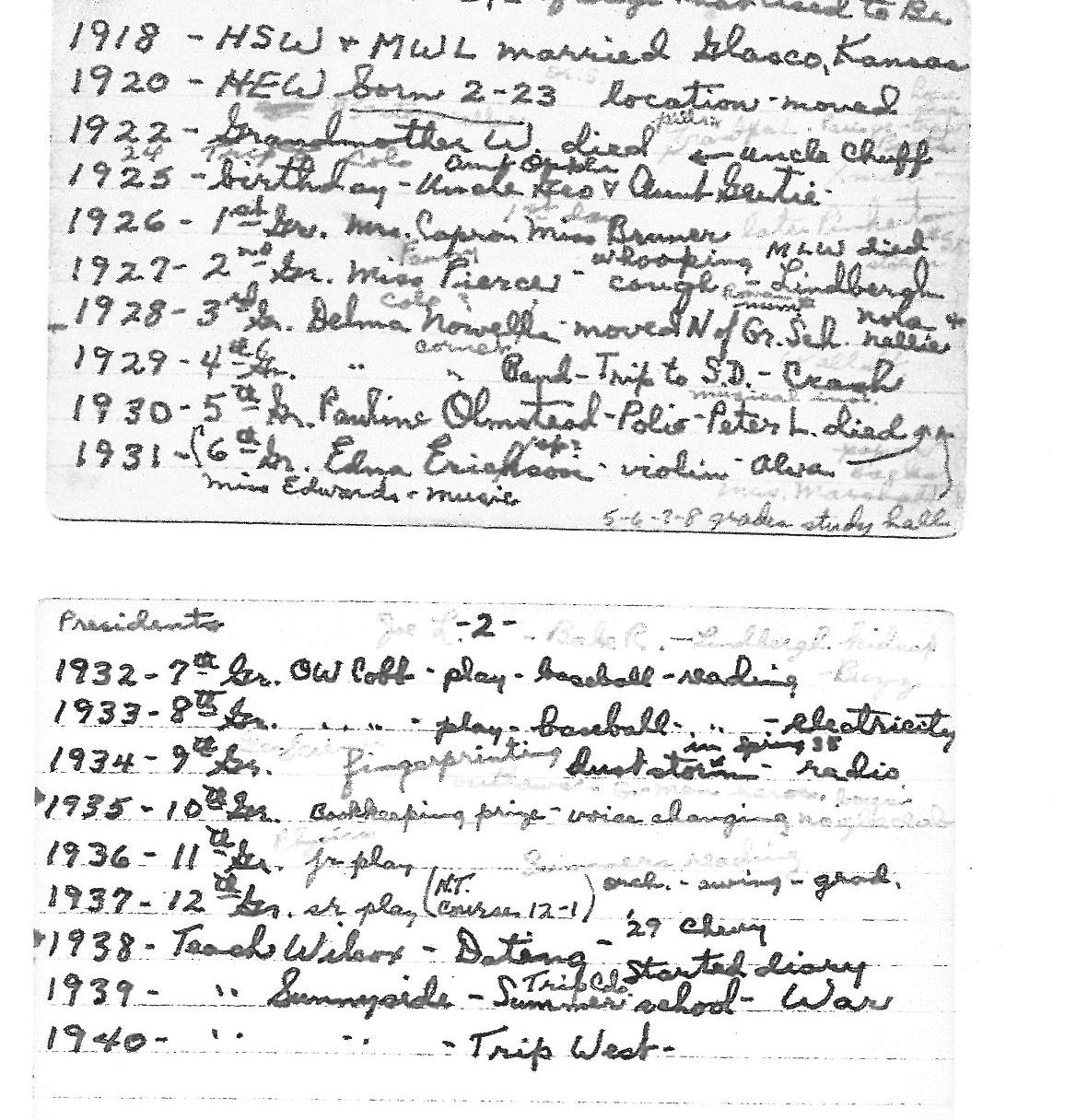
SLet's Star13061709260_0001My dad died 24 years ago this month at the age of 69.  A couple of days ago, my sister gave me a photocopy of an outline of his life in his own handwriting—which was fascinating.

I don’t know if it was after he knew he was sick or whether it was something he was thinking about—as all of us do at this point in life—but he was obviously thinking about writing the story of his life, and these were the notes he was making to himself of what happened along the way.

Dad used the working title “Of Days That Used to Be”—a little dramatic for my tastes, but, then it was just a working title!

He started with “1918 – HSW & MWL married in Glasco, Kansas”. The initials, of course, identify his parents Hanson Sumner Woodward and Mary Wilhelmina Lampert. 

Dad was an only child, so he always had a very close relationship to his parents. My dad only got one week of vacation each year, but for most of my childhood, there was no question but that our annual family excursion was to drive through the night to Kansas to visit his parents. And when Granddad Woodward died in 1963, Grandma Woodward came to Texas to live with us for last eight years of her life.  Dad was a devoted son.

Dad duly notes his own birth on February 23, 1920, the death of his grandmother in 1922, and a family trip to Colorado in 1924, certainly important family events, but ones that he probably only remembered as heard from his parents.

Dad loved learning!  It must have started early because the next most important years for his memoirs are his years in elementary school. He listed all of his teachers by name—except his fourth grade teacher who must have been very unimpressive not to make the list:  Mrs. Capron and Miss Bruner (1st grade), Miss Pierce (2nd grade), Delma Nowella (3rd grade—and who remembers their third grade teachers first name???) Pauline Olmstead (5th grade), Edna Erickson (6th grade), and O.W. Cobb (7th grade).

Dad does drop a few subscripts into his notes about getting whooping cough and “Lindbergh” in 1927. I don’t know if we have American heroes like Charles Lindbergh anymore!

From 1932, when he was 12, to the end of high school, he tended to list activities that he loved doing. In his own shorthand, he writes: “ play – baseball —  reading” .  If I had to describe my years 12-15, I might have made the same list!! Pretty interesting.

He notes a few personalities “Joe L (Joe Louis), Babe R (no explanation needed!) Lindbergh kidnapping”  but those were all afterthoughts in his notes, after “play – baseball – reading”.

In 1933, he adds electricity and in 1934, he added radio to his lists of interests and activities.  Hold on to that—because he did for the rest of his life.

After graduating from high school, he lists the following for 1938:  Teaching (his first job), Dating (first outings, I’m sure), and ’29 Chevy (first car).  The relationship of those three items is pretty obvious, isn’t it!!

Most Americans would say that WWII broke out in 1941 after the bombing of Pearl Harbor, but the word War makes his list in 1939—the year Hitler actually began WWII with the invasion of Poland.

Dad left teaching at his one-room Kansas schoolhouse in 1941 to go to Radio School in Kansas City, which is where he roomed with J.P. Lyles from Justin, Texas, who had a picture of his little sister on his desk, a Texas girl named Daisy with beautiful red hair.  The single entry that recurs every year from 1941-1945 is Daisy, ending with “married Daisy” and “war ends” –kind of a humorous juxtaposition that Dad would have definitely inserted purposefully. He had a great, but subtle sense of humor.

1946 – Converted . He took his faith very seriously and while he had always been a believer, even a church goer as a boy and young man, his word converted probably describes his new lifelong commitment.SLet's Star13061709260_0002

From this point on in his outline, it is pretty sketchy. I don’t know where the detail went, but it is mostly the birth of children and family moves.  He does include, however, the planting of the Eastridge Church of Christ in 1953, of which we were part, and Fort Worth Christian’s (FWC) beginning in 1958.  I know that these two events were BIG events in our family, moments when Dad’s faith was stretched and he grew. I believe that’s why they are in this list.

Mom and Dad were pretty young in 1953, and Dad was pretty new at commitment, yet he took on teaching responsibilities at the new Eastridge church, teaching jr. high boys for years—which was no easy task.  He became an elder sometime in the late 50s or early 60’s, just before Eastridge merged with other congregations to become the Midtown Church of Christ, where he continued to serve through that transition.

His outline ends in 1961, something I would explain with the fact that in 1965, my dad’s life changed drastically. He lost his job, lost his health, and became severely depressed. No doctors, no treatments, nothing really fully restored Dad to the physical or mental health that he had earlier enjoyed.

When he was diagnosed with terminal cancer (mesothelioma) in 1989, it was another bitter disappointment—the last one—that he had to deal with. I know that he had had bigger ambitions, bigger expectations for himself, but starting with his polio in 1930, his life had not been that easy.  This last and final disappointment could have hardened his heart.

I’m so happy to write the momentary conclusion of his story though for him because I know that he was faithful to the end.  As death came closer and after he had no more voice for words, he wrote on his notepad. “My Jesus, as Thou Wilt”

A few years back I had one of those dreams that is so vivid that I sometimes call it my vision.  I die in that dream and as I approach heaven, I see my dad running to meet me. I never saw my dad run because of his polio-inflicted lameness, so I know that this image is of a new time—and that his story did not conclude at the Prairie Mound Cemetery.

I look forward to running to see him too!HEW 

Read Full Post »

pennybank_300Dan Palotta, delivered this Ted Talk in March 2013.  The video, already seen by over 1.7 million viewers, has stirred up a lot of passionate conversation.  Although he is talking from the perspective of humanitarian non-profit charities, I find that the environment he describes is also present for churches and religious non-profits as well. I wonder what you think?

I have taken the liberty to abridge and edit his talk to a blog-sized version, mostly by removing examples, but if you would like to hear the whole talk, go to www.Ted.com and search for “Dan Palotta: The way we think about charity is dead wrong!”


. . . The real social innovation I want to talk about involves charity. I want to talk about how the things we’ve been taught to think about giving and about charity and about the nonprofit sector are actually undermining the causes we love and our profound yearning to change the world.

  . . . We have two rulebooks. We have one for the nonprofit sector and one for the rest of the economic world. It’s an apartheid, and it discriminates against the [nonprofit] sector in five different areas, the first being compensation.

So in the for-profit sector, the more value you produce, the more money you can make. But we don’t like nonprofits to use money to incentivize people to produce more in social service. We have a visceral reaction to the idea that anyone would make very much money helping other people.(Interesting that we don’t have a visceral reaction to the notion that people would make a lot of money not helping other people.) You know, you want to make 50 million dollars selling violent video games to kids, go for it. We’ll put you on the cover of Wired magazine. But you want to make half a million dollars trying to cure kids of malaria, and you’re considered a parasite yourself.

And we think of this as our system of ethics, but what we don’t realize is that this system has a powerful side effect, which is, it gives a really stark, mutually exclusive choice between doing very well for yourself and your family or doing good for the world to the brightest minds coming out of our best universities, and sends tens of thousands of people who could make a huge difference in the nonprofit sector marching every year directly into the for-profit sector because they’re not willing to make that kind of lifelong economic sacrifice.

Businessweek did a survey, looked at the compensation packages for MBAs 10 years of business school, and the median compensation for a Stanford MBA, with bonus, at the age of 38, was 400,000 dollars. Meanwhile, for the same year, the average salary for the CEO of a $5 million-plus medical charity in the U.S. was 232,000 dollars, and for a hunger charity, 84,000 dollars. Now, there’s no way you’re going to get a lot of people with $400,000 talent to make a $316,000 sacrifice every year to become the CEO of a hunger charity.

Some people say, “Well, that’s just because those MBA types are greedy.” Not necessarily. They might be smart. It’s cheaper for that person to donate 100,000 dollars every year to the hunger charity, save 50,000 dollars on their taxes, so still be roughly 270,000 dollars a year ahead of the game, now be called a philanthropist because they donated 100,000 dollars to charity, probably sit on the board of the hunger charity, indeed, probably supervise the poor [person] who decided to become the CEO of the hunger charity, and have a lifetime of this kind of power and influence and popular praise still ahead of them.

The second area of discrimination is advertising and marketing. So we tell the for-profit sector, “Spend, spend, spend on advertising until the last dollar no longer produces a penny of value.” But we don’t like to see our donations spent on advertising in charity. Our attitude is, “Well, look, if you can get the advertising donated, you know, at four o’clock in the morning, I’m okay with that. But I don’t want my donations spent on advertising. I want it go to the needy.” As if the money invested in advertising could not bring in dramatically greater sums of money to serve the needy.

In the 1990s, my company created the long distance AIDSRide bicycle journeys and the 60-mile-long breast cancer three-day walks, and over the course of nine years, we had 182,000 ordinary heroes participate, and they raised a total of 581 million dollars. They raised more money more quickly for these causes than any events in history, all based on the idea that people are weary of being asked to do the least they can possibly do. People are yearning to measure the full distance of their potential on behalf of the causes that they care about deeply. But they have to be asked. We got that many people to participate by buying full-page ads in The New York Times, in The Boston Globe, in primetime radio and TV advertising. Do you know how many people we would have gotten if we put up flyers in the laundromat?

. . . The third area of discrimination is the taking of risk in pursuit of new ideas for generating revenue. So Disney can make a new $200 million movie that flops, and nobody calls the attorney general. But you do a little $1 million community fundraiser for the poor, and it doesn’t produce a 75 percent profit to the cause in the first 12 months, and your character is called into question. So nonprofits are really reluctant to attempt any brave, daring, giant-scale new fundraising endeavors for fear that if the thing fails, their reputations will be dragged through the mud. Well, you and I know when you prohibit failure, you kill innovation. If you kill innovation in fundraising, you can’t raise more revenue. If you can’t raise more revenue, you can’t grow. And if you can’t grow, you can’t possibly solve large social problems.

The fourth area is time. So Amazon went for six years without returning any profit to investors, and people had patience. They knew that there was a long-term objective down the line of building market dominance. But if a nonprofit organization ever had a dream of building magnificent scale that required that for six years, no money was going to go to the needy, it was all going to be invested in building this scale, we would expect a crucifixion.

And the last area is profit itself. So the for-profit sector can pay people profits in order to attract their capital for their new ideas, but you can’t pay profits in a nonprofit sector, so the for-profit sector has a lock on the multi-trillion-dollar capital markets, and the nonprofit sector is starved for growth and risk and idea capital.

Well, you put those five things together — you can’t use money to lure talent away from the for-profit sector, you can’t advertise on anywhere near the scale the for-profit sector does for new customers, you can’t take the kinds of risks in pursuit of those customers that the for-profit sector takes, you don’t have the same amount of time to find them as the for-profit sector, and you don’t have a stock market with which to fund any of this, even if you could do it in the first place, and you’ve just put the nonprofit sector at an extreme disadvantage to the for-profit sector on every level. If we have any doubts about the effects of this separate rule book, this statistic is sobering: From 1970 to 2009, the number of nonprofits that really grew, that crossed the $50 million annual revenue barrier, is 144. In the same time, the number of for-profits that crossed it is 46,136. So we’re dealing with social problems that are massive in scale, and our organizations can’t generate any scale. All of the scale goes to Coca-Cola and Burger King.

. . . Now this ideology gets policed by this one very dangerous question, which is, “What percentage of my donation goes to the cause versus overhead?” There are a lot of problems with this question. I’m going to just focus on two.

First, it makes us think that overhead is a negative, that it is somehow not part of the cause. But it absolutely is, especially if it’s being used for growth. Now, this idea that overhead is somehow an enemy of the cause creates this second, much larger problem, which is, it forces organizations to go without the overhead things they really need to grow in the interest of keeping overhead low.

So we’ve all been taught that charities should spend as little as possible on overhead things like fundraising under the theory that, well, the less money you spend on fundraising, the more money there is available for the cause. . . .  We should be investing more money, not less, in fundraising, because fundraising is the one thing that has the potential to multiply the amount of money available for the cause that we care about so deeply.

 . . . This is what happens when we confuse morality with frugality. We’ve all been taught that the bake sale with five percent overhead is morally superior to the professional fundraising enterprise with 40 percent overhead, but we’re missing the most important piece of information, which is, what is the actual size of these pies? Who cares if the bake sale only has five percent overhead if it’s tiny? What if the bake sale only netted 71 dollars for charity because it made no investment in its scale and the professional fundraising enterprise netted 71 million dollars because it did? Now which pie would we prefer, and which pie do we think people who are hungry would prefer?

Here’s how all of this impacts the big picture. I said that charitable giving is two percent of GDP in the United States. That’s about 300 billion dollars a year. . . .  But if we could move charitable giving from two percent of GDP up just one step to three percent of GDP, by investing in that growth, . . . . Now we’re talking scale. Now we’re talking the potential for real change. But it’s never going to happen by forcing these organizations to lower their horizons to the demoralizing objective of keeping their overhead low.

Our generation does not want its epitaph to read, “We kept charity overhead low.” We want it to read that we changed the world, and that part of the way we did that was by changing the way we think about these things. So the next time you’re looking at a charity, don’t ask about the rate of their overhead. Ask about the scale of their dreams, their Apple-, Google-, Amazon-scale dreams, how they measure their progress toward those dreams, and what resources they need to make them come true regardless of what the overhead is. Who cares what the overhead is if these problems are actually getting solved? If we can have that kind of generosity, a generosity of thought, then the non-profit sector can play a massive role in changing the world for all those citizens most desperately in need of it to change. . . .

Read Full Post »

MondayDid you know that many ministers/priests take the week after Easter off because they have had such an intensive preparation and celebration time, that they need some well-deserved rest and renewal?  Easter Sunday is Day One of the rest of our lives.

Sunday morning changed the history of the world. Without Sunday morning, the story that Christians would tell would be like the story in many great movements: an extraordinary teacher/leader, misunderstanding/persecution by those conserving the status quo, and eventual martyrdom.

Christians have a different story because Jesus died, was buried, but then rose by the power of the very Creator of Life itself. Jesus is not dead. Sunday morning changed the world—and the life of everyone who believes in the risen Lord.

Sunday morning was God’s part of the story. Monday begins our part!

Look at how the earliest disciples spent the time after the resurrection:

  • Two of them decided to go home to Emmaus, so disappointed—stunned—by the events of the weekend.  “We had hoped that he was the one . . . .” (Luke 24)
  • Some were sequestered in their room, trying to decide if they believed the story of the women.
  • Thomas was out, just trying to figure things out for himself—not with the others.
  • Even after Jesus appeared to them and breathed on them the Holy Spirit, some of them decided to do some fishing while they waited in Galilee (John 21)
  • The disciples went to Galilee (home for many of them), but then returned to Jerusalem to wait for further instructions. That’s a lot of walking in the 50 days between Passover and Pentecost.

What are you doing the day after Easter?

Of course you are putting away the Easter eggs and sending the Sunday clothes to the cleaners—just like the disciples going fishing.

But what are you really doing after Easter?

  • Are you waiting for Power?
  • Are you waiting for an assignment?
  • Are you waiting for instruction?
  • Are you waiting for an epiphany?
  • Are you waiting for the persecution to settle down?

Waiting is appropriate for a while!  We see that with the first disciples, but waiting was not the pattern for the rest of their lives?

The Easter story was the beginning for them, not the end of their ministry!  And so it should be for all of God’s people.  Sunday resurrection gives us a new life!  This new life is the same new life that Jesus received, or, as Paul said in Romans 6:13:

but rather offer yourselves to God as those who have been brought from death to life; and offer every part of yourself to him as an instrument of righteousness.

To “offer” is not to passively wait. To offer may be to actively wait, but in anticipation of a certain assignment.

The four Gospels all end with Monday assignments for these Jesus’ disciples and beneficiaries of the Sunday resurrection:

Matthew: 16 Then the eleven disciples went to Galilee, to the mountain where Jesus had told them to go.17 When they saw him, they worshiped him; but some doubted. 18 Then Jesus came to them and said,“All authority in heaven and on earth has been given to me. 19 Therefore go and make disciples of all nations, baptizing them in the name of the Father and of the Son and of the Holy Spirit, 20 and teaching them to obey everything I have commanded you. And surely I am with you always, to the very end of the age.”

Mark: 14 Later Jesus appeared to the Eleven as they were eating; he rebuked them for their lack of faith and their stubborn refusal to believe those who had seen him after he had risen.15 He said to them, “Go into all the world and preach the gospel to all creation. 16 Whoever believes and is baptized will be saved, but whoever does not believe will be condemned.

Luke: 46 He told them, “This is what is written: The Messiah will suffer and rise from the dead on the third day, 47 and repentance for the forgiveness of sins will be preached in his name to all nations, beginning at Jerusalem. 48 You are witnesses of these things. 49 I am going to send you what my Father has promised; but stay in the city until you have been clothed with power from on high.”

John:  21 Again Jesus said, “Peace be with you! As the Father has sent me, I am sending you.” 22 And with that he breathed on them and said, “Receive the Holy Spirit. 

What are you going to do on Monday?  Today?

Read Full Post »

irish cathedralIn Dublin, just as in all of Europe, the spires and steeples of beautiful church buildings turn your eyes upward as you walk around each corner of the city. I noticed in the advertising about tourism in Dublin that one particularly beautiful building adorned the ads for The Church. John Wesley delivered his first sermon in Ireland here in 1747 when it was known as St. Mary’s Church of Ireland. George Handel used its organ to practice as he prepared for the first public performance in Ireland of his Messiah. Other notables attended and a few are buried within its walls—as is the case with many churches in Europe.

Welcome to The Church. The Church is the ‘local’ of choice for native Dubliners and welcomes approx 700,000 visitors annually from all over the world who come to experience the culture, atmosphere and friendly service at The Church.

So begins the description on its website—well, not exactly. I deleted a few words in the opening sentence, so let me put them back in now.

Welcome to The Church, we are Dublin’s most unique bar and restaurant.

Now that’s disappointing, isn’t it!  Just as disappointing to me is to note their website http://www.thechurch.ie .  Was there no Christian church in all of Ireland that claimed this site??

Today . . . today the Irish are nominally Christian (84%), but the churches are empty while the bars are full!

Christianity in Ireland dates back to the very earliest mission efforts of the earliest Christians, perhaps as early as the second century, but surely by the third. The national treasure of Ireland is the Book of Kells, an illuminated copy of the four gospels, created sometime around 800 AD.  And then there is St. Patrick and St. Columba, from the 5th and 6th centuries respectively—great heroes of faith in Ireland. Many stories of early Irish missionaries, then later Irish Christian scholars, fill the pages of western church history.

We worshiped with a very faithful remnant in Dublin on Sunday, and I’m sure there were other very faithful Christians meeting around the city. The variety of nationalities represented jumped out at us.  Out of 40 people in this service, at least half were from non-western countries: Liberia, South Africa, Ghana, Malaysia—probably others whom I did not meet.

Fortunately, the pages of western church history do not contain the whole story of the Way—just as the story of the Jerusalem church was/ not the whole story of the Way even in the first century.

I’ve been thinking of how much trouble the Jerusalem-mostly-Jewish Christians had accepting the fact that the gospel was not just going to a few Gentiles, but was spreading throughout the Gentile world.  We call them the “judaizers,” but mostly they were Christians who were trying to imprison the Message into the Jewish context from which it started.

As late as the end of the book of Acts, roughly thirty years after the day of Pentecost, James, the brother of the Lord and an apostle/elder in the Jerusalem church, pleads with Paul to accommodate the Jewish Christians who needed to see that he had not forsaken the Law and that he was not introducing Gentile elements into temple worship!  As the Jews saw their place in the world slipping away from them—it’s only another decade until Jerusalem and the temple are completely destroyed and the Jews scattered among the nations for 20 centuries—they held on even more tightly to their own traditions—even the Christian Jews apparently.

Is it possible that the Christianity of the western world with all its centuries of architecture and tradition has grown so stale that God is moving on with His plan? Many have reported the shift in Christianity’s center to Africa and the southern hemisphere.  The rapid growth of the kingdom in China has great potential for changing the outward appearance of Christianity in a world where one out of every four persons alive is Chinese.

I don’t have all the answers, but I can tell you that I believe what the Apostle Paul said to the Greeks at the Aeropagus (ERV, Acts 17:26-27),

God began by making one man, and from him he made all the different people who live everywhere in the world. He decided exactly when and where they would live. God wanted people to look for him, and perhaps in searching all around for him, they would find him. But he is not far from any of us.”

We feel like we are in a battle for the very life of the church in America. We see churches closing around us now and we are afraid they will all become bars and restaurants like in Europe.  Of course, we, as do the European Christians, must continue to be faithful, to bear witness, to be salt and light, but we should not be afraid for God’s church.

And we should be wide open to receiving the nations into the heart of our fellowship—because they are in God’s heart!


Read Full Post »

A New Journey!

airplaneIn twenty minutes, I’m getting on the plane to Frankfurt, Germany, which is the beginning of 41 days on the road in Europe.  We will be working with English-speaking churches in Germany, Ireland, and Scotland to help them either establish or advance their FriendSpeak programs.  Then I will be conducting a workshop in Turkey.   After that it is Italy (5 churches), France, Spain, Austria, Hungary, Czech Republic, and back to Germany to touch base with works interested or possibly interested in hosting Let’s Start Talking teams.

There are going to be lots of trains, planes, and automobiles, hopefully without the adventures of the movie by the same name! Lots of meetings, lots of working meals, lots of new beds, but mostly lots of new people.

I guess you can see that this is not a vacation–never more than two nights in the same location, but that’s OK. The part we enjoy are the conversations about the kingdom, with people we may not know but with whom we have so much in common because we are all about sharing the Good News.

Although my blog may be a little sporadic while we travel, I will certainly try to stop long enough to share with you some of the special pleasures of our trip.

Time to board.  Pray for us as we pray for you!

Read Full Post »

20130202_130022My grandson and I had a little run in the other day on the basketball court and it reminded me of David and Goliath. Let me tell you my version of what happened.

He is 10 years old, about 4’8’ tall, loves basketball, plays on two above-average teams and has a very sweet shot, especially from a distance. I, on the other hand, am more than 6x his age, only used to be 6’ tall, played my last organized basketball game in 1969, and need I go on about the differences.

He and I decided to play a little one-on-one for fun, and I’m pretty sure he was thinking he would win handily.  What he did not allow for was the difference between 4’8” and 6’.

I scored the first two baskets because I could shoot and miss, but get my own rebound and have 3-4 more shots under the basket until I would finally make it. Because of my height, he had a hard time driving and he doesn’t have a jump shot yet, so he had a hard time scoring. He then tried to dribble all over the driveway to wear me out—which he was doing faster than he knew.

That’s the moment when the wheels started coming off our game—that moment when he realized no matter what he did, I was going to win—simply because I was taller.

First he changed the boundaries to create more court—for him to run around in, of course.  Then he started changing the rules of scoring, so that if he thought he was fouled, he would always get to shoot two shots that counted two points each.

I know you think I should have just backed down and been grandfatherly and let him win—and maybe you are right—but I really haven’t ever let anyone win. I was taught that to do so was the height of condescension. You don’t beat people badly, but you never just give away a game.

After some fourth-grade level trash talking from both of us, I did let him change rules to his advantage, but it did raise the tension in our game a bit.

That’s when I made a big mistake.  In the heat of battle as he was using his speed to zip around me, I grabbed his arm and held him—a very obvious and intentional foul—but without harm—or so I thought!

Never intentionally foul an already frustrated grandson in the moment when he is about to score!  Very bad idea!

Next thing I knew he was walking off mad. He had had enough with Grandad!

I did give him a few minutes, then followed him up to his room, but found the door locked. Of course, I’m not showing it, but I’m kinda sick inside that I had let the whole competition thing get out of hand.

About 15 minutes later, I’m sitting on the couch downstairs, when I get shot by a nerf gun from upstairs.  I was smart enough to know that what might seem like an angry act of revenge was really just a ten-year-old way of seeking rapprochement.

I worked my way upstairs and asked him if we could talk. He agreed, so we had a great five-minute conversation about what had happened. From his perspective, it was all about fairness.  Nothing about the game was fair to him—and, of course, he was right, so we agreed that next time we would play and not keep score OR we would play and he would get his brother and maybe another cousin to be on his side because 3 against Grandad might be fair!

I love that boy, and I’m thankful that we got that all worked out—but it did make me think about fairness.

Not every David and Goliath story ends with David slaying the giant!  The tall guys sometimes win.

Big countries have more influence than little countries; rich people control more of the world than poor people.  Strong people rule weak people.  Does any of this have to do with fairness?

Big states have more sway than little states Attractive kids make better grades in school than less attractive kids. Smart kids make better grades than average kids.

Not everyone gets a trophy. And if they did, then that would not be fair!

God causes it to rain on the just and the unjust (Matt. 5:45)! He chose Jacob over Esau (Romans 9). He chose Israel, not because they were the biggest or the best nation, but because he . . . chose them. (Deuteronomy 7:7).

If you are Ishmael, you cry out, “Unfair! Unfair!”  but here’s what Paul says about that in Romans 9:

20 No, don’t say that. Who are you, a mere human being, to argue with God? Should the thing that was created say to the one who created it, “Why have you made me like this?”

I think what this means is that if Goliath had won the battle, David could not have complained of unfairness. Nor could Goliath complain that David’s divine partner gave the little guy an unfair advantage.

As I write this, I’m hearing the cringes and frowns from most of us who want—demand—fairness. Immense trust is required of us to believe that God’s will is absolutely righteous and that He is sovereign over his creation—and that He loves us.

Life isn’t fair, but Christians believe an absolutely good and righteous God is!

But don’t ever intentionally foul your grandson!!

Read Full Post »

« Newer Posts - Older Posts »