Feeds:
Posts
Comments

churchofchristsignI think many Churches of Christ are caught in a dilemma that they don’t even know will have a long-term effect on them.  See if you agree with me.

Prior to the last quarter century, Churches of Christ viewed as part of their core identity their non-denominationalism.  In fact, the earliest roots of the Restoration Movement in the U.S. were a reaction to the fact that denominationalism had become the means of excluding those from one’s fellowship who had different creedal beliefs.  By laying aside all human creeds and denominational organizations, restorationists believed they were more perfectly practicing the unity of the Spirit in the one Body of Christ.

During the 1970s, many in Churches of Christ began to believe that regardless of our theology, our practice had become denominational.  Churches of Christ had in practice adopted a brand that was defined by its own traditions and that brand was used to exclude rather than include.

Whereas in the sixties, we argued over whether to write “church of Christ” with a capital C or not, by the 70s, those debates were over, and we had become totally tolerant of talking about “Church of Christ” preachers, “Church of Christ” colleges, “Church of Christ” elderships, buildings, JOY buses, and when asked about personal membership “Church of Christ” was the only acceptable answer.  The term “Church of Christ” no longer was just a descriptive name borrowed from Romans 16:16, but rather a brand name and trademark of a very particular group of Christians—the very definition of denominationalism.

Interestingly enough, about the same time period, two new developments began to surface in the broader Christian community:  a number of new non-denominational  groups like Calvary Chapel, The Vineyard,  and The Way were started.  Also the whole Bible church and community church movements flourished. These were typically individual congregations very loosely associated with other churches, if at all.

As these independent non-denominational churches became more numerous, they were seen to be taking advantage of growing tolerance among evangelical Christians in particular.  Congregations of mainline denominations, seeing the tide moving away from denominationalism, began changing their congregational names to more generic names.  New names like Harvest Church, Covenant Church, New Life Church, etc., replaced old names and left old denominational identifications to very small fonts in parentheses, if visible at all.  Some of these churches quit their denominational organizations, but most just changed names.

 So as I see it, about the time the Churches of Christ became comfortable about being one among many churches—at least among evangelical churches (although I myself think we are very inconsistent to only identify with evangelical churches),  those same denominations started moving away from that very position and towards the non-denominational position that Churches of Christ were abandoning.

Here are my conclusions for Churches of Christ:

  • Churches of Christ need to return to their roots and recover their non-denominational theology.  What a great opportunity to be what we have historically claimed to be, a unity movement.  What a great time to preach and actively embrace the unity in the Body of Christ.
  • Churches of Christ need to quit trying to imitate “successful” churches and decide who God wants them to be and what He wants them to teach. Turning to market research for our identity has two big drawbacks: It leaves us being a lesser imitation—a knock-off—of an original, and it means we are always catching up to the “latest trends” often after those who established those trends have moved on.
  • The highly autonomous congregational approach to church is robbing Churches of Christ of the power in community, in fellowship, in “many members but one body!”  We must learn to be more collaborative, to look for true fellowship in the work of the Gospel, and to welcome partnerships with other members of the Body.  Isn’t that the only way to be a whole and healthy Body!

Watch for more on this last point later.

marseilleOne month ago today, I started this particular trip through Europe on behalf of Let’s Start Talking. I’ve tried to avoid making the posts during this time simple travel logs, but rather I’ve tried to record reflections as I’ve traveled.

Today is different though!  I have to tell you about the wonderful day Sherrylee and I had yesterday in Marseille, France.

I began the morning scavenging the neighborhood outside our hotel for croissants and coffee for breakfast, trying to beat the $20/person cost of breakfast in the hotel. I found a beautiful little Pattisserie/Chocolateria just about a block away where I got the croissants, but I had to get the coffee in the hotel because none of the little “bars” in the area had takeaway cups for their coffee. Still it was much less expensive this way—and much more interesting.

Craig and Katie Young, missionaries in Marseille for 23 years, picked us up and took us to a little eating place in downtown Marseille. I hardly remember what we ate though because we had the greatest conversation with them!  Of course, we talked about their LST project that they are having this summer, but the talk quickly slipped over to life—as it often does, we find, with missionaries.

It is not really the creature comforts, the lifestyle, or anything material about “home” that missionaries really sacrifice when they move to a foreign country (and most would be embarrassed even using the word sacrifice), it’s the deep relationships with other Christians and opportunities to share with people who have had similar experiences that they miss.

To whom do they turn when they want to talk about what it will be like to have a baby in their new home, to start school with their six-year-old, to face high school years in a country that you have never experienced high school in??

What do you do when your children start leaving home and going off to college in America?  What do you do with elderly parents when you live a continent away?  What do you do when your children are seriously dating people they’ve met, but you’ve never been closer than 5000 miles to the person they are falling in love with?

To whom do they turn when suddenly their body starts slowing down: is this normal, is this allowed for missionaries?  How do they explain that to their sponsoring church?  “I need to do less,” might not go over so well? “I need to come to the States more often to see my children—or my grandchildren!”  Will their supporters go for that? Our mission partners are leaving—now what are we supposed to do? Stay by ourselves? Start over somewhere else?  And who can they talk to about these things?

These are the kinds of conversations Sherrylee and I have with missionaries all over the world, and because we are pretty gray now (although Sherrylee doesn’t show it J), we’ve been through some of it and have talked with others who have been through most of it, God can use us as listening ears and sounding boards for these saints who have served most of their lives abroad.  We had that kind of conversation with Craig and Katie, from which we were blessed and hope they were too.

During that conversation, however, we realized that we had the opportunity to use the afternoon to train the young people in their Christians On Mission program to be used in the LST follow-up, so hastily Craig called them together and Sherrylee and I spent an hour with about six of their students, teaching them that the Word is the Teacher and that they are the Illustration and what the ramifications of those two principles are for working with unbelievers.

Craig and Katie started Christians On Mission for French young people, not as preacher training, but as training to be a strong Christian. Max and Phillippe Dauner also teach in the program. Currently they have students from the US, from Tanzania, and from France.

Immediately following our hour of training, we went to their Children’s hour, where about 20 kids met to sing and hear Miss Katie tell them about Easter eggs—and the real story of Easter.  During the last part of the hour, Miss Sherrylee got to tell them all about LST and getting their parents interested in practicing their English when the American students are here in the summer.

Between the Children’s hour and the Ladies Bible study that Sherrylee was going to speak to, we had 30 minutes.  Sherrylee had accidentally wandered into a neighbor’s house, thinking it was part of the church building. . . . ., but it turned out that this neighbor had been baptized a couple of years ago, so as Craig was explaining to the neighbor why Sherrylee had walked into his house, he invited us in for tea and cookies. Khered (?) is his name and he is Algerian.  He and his wife want to return someday to Algeria, which could be a great opportunity to carry the Good News with him.  He says he is the first Christian in his family in over one thousand years!  Think about that!

Sherrylee talked to the women’s Bible study about LST, then Craig took us to a little hole-in-the-wall kind of “snack bar” named Ishtar!  The owner is Iraqi, an Iraqi Christian—Chaldean Christian.  Where do those words take you?  To Ur, or the Babylonians, or where?

In broken French, a smattering of German, and almost no English we talked with him and his brother-in-law and a couple of other people about the millions of Christians that had been in Iraq and protected under Saddam Hussein, but who were immediately persecuted and killed after the Iraqi War by the Islamic fundamentalist until today there are only a few hundred thousand left, mostly in the north among the Kurds—at least that is the way it was reported last night by these Iraqis to us.

As we ate, one of them led us in prayer and then said the Lord’s Prayer in Aramean—the same language Jesus used.  It was a special moment. With the flat bread and the wine on the table, it felt like communion.

We fell into bed last night, having said goodby to Craig and Katie, but thanking God for them, for the saints here in Marseille, and for the blessings we had received from Algeria and Iraq.

26 And he made from one man every nation of mankind to live on all the face of the earth, having determined allotted periods and the boundaries of their dwelling place, 27 that they should seek God, and perhaps feel their way toward him and find him.Yet he is actually not far from each one of us. Acts 17:26,27

Do you need to spend ten hours on learning Chinese if you are going to go to China for a two-week missions project?  Do you need to spend five sessions learning about Communism for your mission trip to Albania?  If you are the missions ministry leader at your church or the youth minister in charge of the teen mission trip,  and you believe that everyone who goes on a short-term mission should go equipped—which I hope and pray you do–, how do you determine the best way to equip those workers going out from your church.

Let’s look in the next few posts at some suggestions about the content of training for short-term mission teams.

God first!

Everyone who goes on a short-term mission needs to be prepared spiritually! Just like you get vaccinations and take vitamins before the trip, you need to help your workers bolster their spiritual health before they go.  They need prophylactic preparation to prevent spiritual sickness, they need instruction on managing their spiritual health while they are there, and then they need to know what to do if they get sick.

  • Talk about motivations for going—and be honest because most people have multiple motivations, including adventure, travel, self-improvement, improvement of personal skills, and—of yes, helping someone else to know Jesus!  Preparation should include acknowledgement of these motivations along with a healthy way to prioritize them.  Acknowledging the lesser motivations helps remove any guilt or shame workers might otherwise carry with them. Good preparation will help them know ways to focus their motivations so that their activities will be both appropriate and effective for reaching their higher goals!
  • Talk about the spiritual goals for this trip. It is not enough to just hope that somehow conducting a VBS will make an impact for Christ. How will you know if you have made a difference or not? Do you have short-term and/or long-term goals? Are you planting seeds or harvesting because of what others have done before you?
  • What spiritual challenges might workers meet?  Most short-term mission projects are mountain-top experiences for the workers, but in every mission situation, there are also inherent possibilities for spiritual challenges.  If your workers are prepared for those challenges, they are more likely to overcome them effectively.

                For instance, sometimes workers are confronted by “differentness” at the mission site: different doctrines, different rites, different styles of worship–and it shakes up their spiritual world for a while. Other workers are challenged when they try to verbalize their own faith and fail to do so adequately. Some workers find moral temptations more alluring away from home and are challenged!

I’ve often said that being on a mission field is like being in a pressure cooker and any little crack in your spiritual armor may be put under enough pressure to split wide open and leave you very vulnerable.  Preparation for such challenges before a worker goes should give him/her an opportunity to check for cracks!

  • What role will praise and prayer play? If you will have daily times together for praise and prayer—and I hope you will—then you will need to prepare for those times before you go!  Nothing is more discouraging than haphazardly prepared devotionals with half-baked thoughts and dashed-off prayer to cap it off.  Nothing is more encouraging than good time with God and your fellow workers, when you are giving thanks, praising Him, listening for His instructions for the day, interceding with Him for those people with whom you are working, and asking Him to work powerfully through you.

Putting a spiritually healthy team on the plane, a team prepared for spiritual challenges while on the field, must be one of the highest priorities for your mission preparations.

The fault in our starsIf the new releaseThe Fault In Our Stars, starring Shailene Woodley and Ansel Elgort, could talk, it would tell you that it unashamedly intends to play on your most maudlin emotions and will use all of the film clichés about death and dying to do so, BUT if a good cry does you good, then you’ll love this film.

I agree with the film—if it could talk!

Two teenagers with cancer meet at a support group, one with an attitude and one with—well, another attitude!  They both are coping with their terminal illnesses within their own understandings about life and death.  One of my favorite scenes and a scene that really demonstrates the quality of the actors is their first meeting at the support group meeting when Gus is just looking and smiling at Hazel and she is trying first to ignore him, then warn him off—both of them speaking volumes without words.

Such a script demands a wide range of emotions from both Woodley and Elgort. Woodley does a remarkable job as the terminal teen, mildly depressed and mildly bitter about her fate.  Ansel Elgort’s performance is equally believable—but only when he is in his relatively idealistic mode; he is less convincing with his dark side.

With no more information than I have given you, you can probably finish the rest of the plot with at least 90% accuracy, that is, the story is quite predictable.  So what makes the film worth seeing?

Here is why I can be positive about the film—as long as you know you are going to need your tissues!

Hazel and Augustus each have very real questions about death and dying for which they hope to discover an answer before they die. 

Hazel Grace wants to know if the lives of her loved ones will be ruined by her death? She is afraid her mother will lose her motherhood, that when she dies they will lose their purpose in life because all she knows of them is that they have spent all of her life focused on her and her illness.

Augustus wants to leave this life having made an impact, being remembered forever, leaving his mark on the world! But what if he doesn’t? What if he sees the end before he has time to live remarkably.

The drama of the film is not about whether they live or die, but whether they find the answers to their questions, whether they are able to find not only love but peace and a measure of understanding.

I hate the title and I hate the way religion is portrayed in the film.  If you are a Christian, then you will also hate the portrayal of the “heart of Jesus” support group which is a caricature of the worst of pastoral care in the name of Jesus.  The film would have been a better film with more realistic and sympathetic people of faith.

With regard to the title The Fault Is Our Stars, there is a disconnect for me between the title and the film script.  Perhaps the title came from the book’s author or the publisher and is appropriate for the book, but the prevailing philosophy in the film is optimistic, not fatalistic, one of hope for something other than oblivion.

Finally, don’t take young teenagers or pre-teens to this film; they will leave thinking it is all about love. And they will remember the obligatory sex scene as much more important than it is.


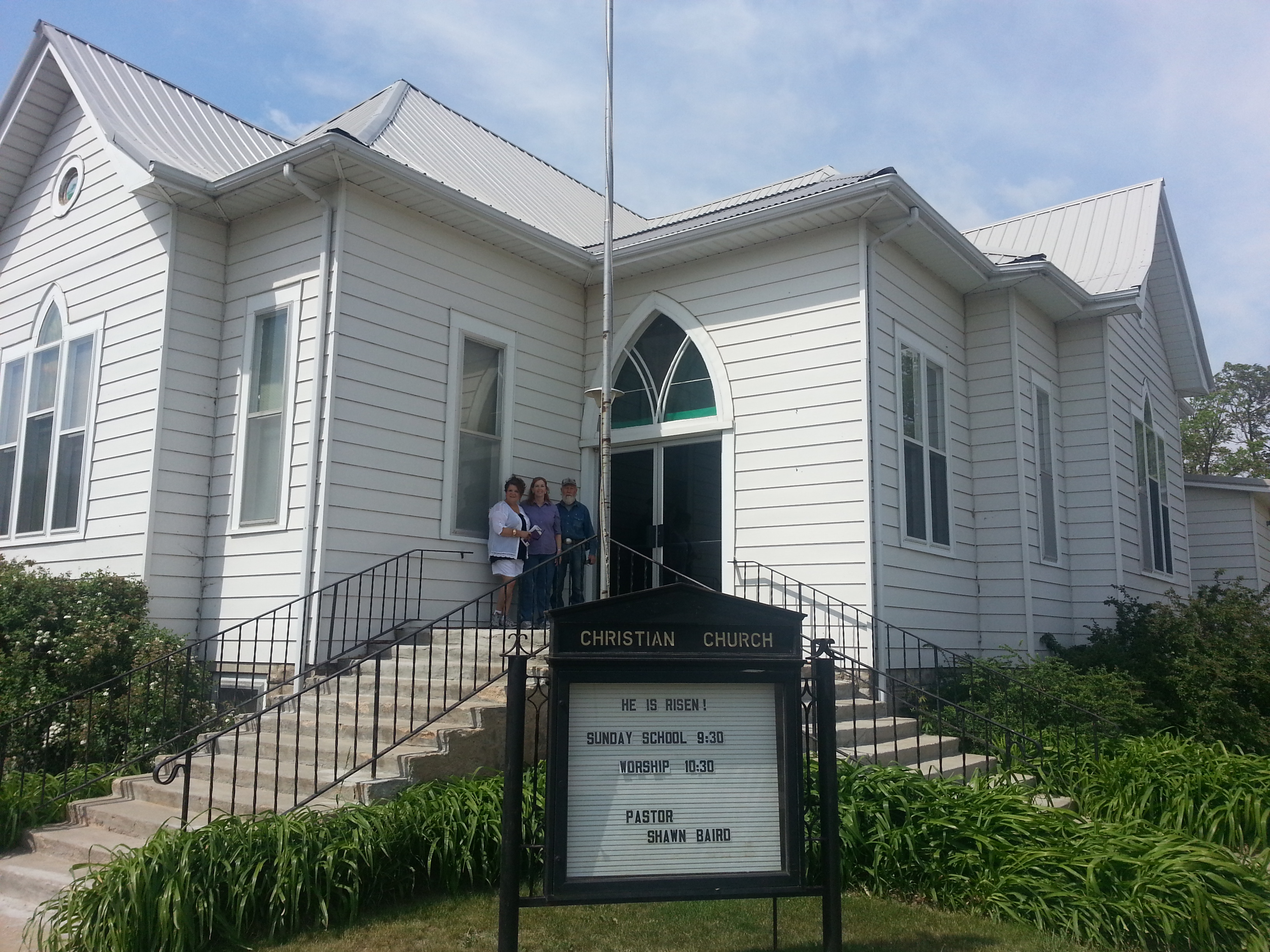
Glasco ChristianIn the late 1870s,  my great-grandfather and my and other family members were part of starting a new church in a small Kansas town.  They just called themselves Christians, and so the church was also called a Christian church.  As one reads the history of this small insignificant church in this scarcely populated wheat town in the Solomon River valley, the description inadvertently betrays the post-civil war rift in the Restoration movement.  On some pages, the words introduce former preachers while just a few pages later, a new minister is called a pastor. Pages are periodically silent about the music, then suddenly there is an organist, only to go silent again for a few more years!

Our  family’s conclusion is that this little wheat field town’s church members hardly noticed the differences that other Restoration Christians in larger cities were debating and dividing over.  They were first a community of Christians, living and worshiping  together–with no further adjectives necessary.

By 1906, someone who was somebody decided it was time to differentiate the two groups–that is, the instrumental, mission society Christians from the acapella, non-missionary  society Christians.  I wonder how long it took the Christians in that tiny town in Kansas to know to which group they belonged?  They may have been confused and just thought that they were Christians.

For one hundred years, the two groups operated with few exceptions in completely different circles.  We each developed our own jargon, our own heroes, our own missionaries, our own colleges.  With the exception of a few touch points, we were not talking, certainly not fighting–because we hardly knew the other existed.

The instrumental churches of Christ–not everyone bothered to change their name–later split into two distinct fellowships:  the Independent Christian Church/Church of Christ (because not everyone changed their name!) and Disciples of Christ.  The movement which began as a unity movement . . . oh, well!

Some individuals of all three groups continued to keep the hope of unity alive with annual gatherings, some pretty scholarly publications, and an occasional token invitation to a lectureship, but with the exception of this high-level contact, the average members of these churches continued to exist in different worlds, practically oblivious to the others.

On the occasion of the 100th anniversary of the separation of Churches of Christ and Independent Christian Churches in 2006, several leading preachers and pastors in both groups declared that the 1906 breach was wrong and that the unity of the Restoration Movement should be restored.  At several high-profile gatherings, representatives of both groups repented for participating in division, asked for forgiveness, extended  fellowship to their counterpart, and ceremoniously traded Bibles as peace offerings.

Let me tell you why I am thinking about this.

My personal history is in the acapella Church of Christ. During the last few days, however, I have had the privilege of being on the campuses of two of the Independent Christian Churches larger colleges/universities.  I have been extraordinarily well hosted and extended complete and unreserved cooperation.  I would not have expected it to be any other way between Christians!

What  continues to sadden me, however, is how little either of us really knows about the history and the daily life of the other.  Just today, in casual conversations with colleagues,  I have learned of marvelous missions efforts,  of amazing heroes of faith, both alive and dead, even of Christian colleges/universities–all completely unknown to me.  I know a lot about our side of the aisle, but embarrassingly little about these brothers and sisters.

Maybe we have reconciled, but not actually restored fellowship.  Let me suggest a few actions that could possibly get us started in the process of really loving the whole brotherhood.

  • Local congregations should begin getting to know other congregations. It might only be a common potluck at first, but perhaps with the goal of getting to know each other.
  • Preachers could swap pulpits and use some of their time to introduce the history and heroes of their congregations.
  • Youth ministers from both groups could plan joint outings/camps/mission trips together.
  • The Christian Chronicle and The Christian Standard could each begin a section that deals with the news and ongoings of the other group.
  • Christian colleges/universities of both groups could include tracks in their lectureships/conferences that introduce both groups to each other.
  • Perhaps somebody needs to start a ministry of fellowship restoration, specifically focused on bringing not just the leaders, but the grassroots of these two groups together until we learn how to love each other again.

I know somebody is going to think that all this talk of getting to know each other and fellowshipping with people that we hardly know and may not entirely agree with is going to be a slippery slope to  . . . you know where!

I’m sure they (the others!)  aren’t perfect–but I’m not either, so I’m not going to be afraid of loving someone who loves God.  Fear makes us do terrible things–like ignore people who belong to the Body of Christ.

Maybe those people in that little church in Kansas knew something about love and fellowship and unity after all!

_foreignmissions2 (1)In Part One of this blog, I reviewed briefly our history of foreign missions in churches of Christ and then listed characteristics of our efforts, which were

  • We only have the stamina for harvesting, not for planting and nurturing.
  • We believe we should be able to work everywhere else in the world cheaper than in the U.S. 
  • Our mission work is dependent on how many self-motivated missionaries surface in our fellowship as opposed to a strategic global vision.
  • We are not by nature collaborative.
  • Our missionaries tend to be “lone rangers! 
  • We have been and are still too often negligent in caring for missionaries on the field, but especially when they return.

Click here, if you would like to review the comments that went with these points.


I suggested at the end of the last post that these particular characteristics would not serve us well going into the near future of foreign missions, so in order to become more effective in carrying the Gospel to the whole world, we are going to have to work differently.  In this and the next post, we will explore these two ideas.

Churches of Christ are represented in a little over 90 of the 196 independent countries of the world with probably around 1000 American workers outside of the United States. We have a lot of work to do—and the challenge of world evangelism is growing. Let me outline why I say that:

  • Americans are less well-liked in the world. After WWII, Americans were welcomed as defenders of liberty. Even into the 60s (our second big wave of mission efforts), Americans were relatively popular because we had defended the world against Communism. That glow was slightly tarnished by Vietnam, but re-polished in most parts of the world through the Reagan era and the collapse of the Soviet Union (another big Mission Wave).  Most of that global popularity has been lost.  Look at this map, charting those who have a favorable view toward the U.S.

worldmap

What you see in dark blue are those countries who like us. Even the other bluish countries have fewer than 50% positive responses.

My point is not about U.S. politics and its participation in the global community, rather that being an American abroad is, at best, no great advantage and, at worst, can be outright dangerous—none of which is really good for the future of foreign missions from the U.S..

  • The world is now urban and becoming increasingly more so!  In 1900 there were only 12 cities of 1 million population or more, but these 12 became 400 by the year 2000. You probably aren’t surprised that Singapore is 89% urban, but Congo is 41%–that’s surprising!  Forty cities in the world boast populations of 5 million plus—and 80% of those are in poor countries, so it is not just the industrialized world where the flight to cities is dramatically changing the landscape.

We Americans have had good rural churches, and now we have good suburban churches, but urban churches are a challenge we have not yet figured out at home, much        less abroad.  Global urbanization is making missions more challenging for us.

  • Poorer countries are getting wealthier. (“The Whole World Is Getting Richer, and That’s Good News,” Charles Kenny, Bloomberg Businessweek, July 29, 2013).  Just ask Google if poor countries are getting richer and look at all the evidence.   If we accept this as true, then here are my conclusions for foreign missions:

o   There are no cheap places in the world to go!! The most expensive city for expatriates in the world is Luanda, Angola—did you expect that? Number four is N’Djamena in Chad. New York City is #32 and the only U.S. city in the top 50!

o   If poorer countries (like African countries) are getting more urban and wealthier, then they are going to be less and less impressed by our humanitarian approach to foreign missions.

To summarize, globally speaking, the people that US–sent missionaries would want to approach view Americans less favorably, they are typically living in very large cities with costs that Americans can hardly afford to live in, and even the poorer places are climbing out of poverty and need our benevolence and services less and less.

These are the challenges in foreign missions for churches of Christ in the near future.


I attended a funeral today of a man of faith, so it was good–no, better than that, it was inspiring.   He was not a perfect person, but he was a man who is known for the good that he did.  He finished well.

I hope and pray that 2014 finishes well for you! The year has been dramatic: Ebola, Syria, ISIS, typhoons, landing on asteroids, on Mars, Ukraine, Cuba, Malaysia Airlines, World Cup, Ferguson–and while all of these big things affect us, it is more usually the birth, the death, the new job, the new location, the new school, the new boss–these changes seem just as dramatic to most of us!

Recently, I heard a famous psychologist say that the only truly stable people in this world are the ones who have accepted that change is a constant.

I hope and pray that the changes in your life in 2014 have brought you closer to God and to those you love, and that you go into the new year with hope–not hope that nothing will change, but that the inevitable changes bring peace on earth and good will for all people.

As is my practice, I’m publishing the top five posts of 2014 from my blogging.  I did not post as much in 2014, but my hope is to return to more thoughtful writing in 2015–Lord willing.

Merry Christmas to you, and a blessed New Year!

Mark


If you want your children to be thankful—grateful—adults, you have a great opportunity to work on them during Thanksgiving.  This holiday can be so much more than Indians and pilgrims or eating and football!  We Christians have a great opportunity to re-capture the holiday from the secularists and materialists and instill in our children a grateful spirit rather than an entitled one!

Here is a list of some of the things you can do for Thanksgiving that will move your children (and perhaps yourselves) closer to the spirit of Psalm 100:4-5 (NLT):

Enter his gates with thanksgiving;
go into his courts with praise.
Give thanks to him and praise his name.
For the Lord is good.
His unfailing love continues forever,
and his faithfulness continues to each generation.

  1. The Bible contains many good stories of people giving thanks for God’s goodness and blessings. One of the best is the story of the ten lepers in Luke 17:11-17. Tell or read your child this story and then ask why the one came back and why the others did not. What might have been their reasons for not returning to thank Jesus?
  2. Make calendars to record one thing each day for which you are thankful. See how many days you can keep this going. Be sure and not let it get silly. You can do this, for instance, by always asking “why are you thankful for . . . .worms?” You can also remind your child of how God is the source of that blessing.
  3. Teach your kids the principle of Philippians 4:6 (ERV): “Don’t worry about anything, but pray and ask God for everything you need, always giving thanks for what you have.” When you pray at meals or at bedtime with them, suggest that they first give thanks before they start asking.
  4. If you think your children might take their blessings for granted, you might suggest having an Africa day, or a “poverty” day where they must live without their tech toys and TV, and have a very small meal or two of very plain food (rice and water, or just one-half of a bread & butter sandwich and only water to drink.) You will need to talk about this with them to help them understand what is going on. A good time to do this is at a meal prayer when we casually slide over “Thank you for our food.”
  5. Have a day of “no complaints before giving thanks!”  No complaints are allowed about anything before a “thanks” for something is registered.
  6. The internet is full of Thanksgiving games, stories, poems, and songs. You might spend some time with your child finding appropriate crafts or expressions of thanksgiving.
  7. Another activity is to find images either in magazines or online and find all the things for which we could be thankful.  You might even insert some of your own family photos. Be sure and notice actions, emotions, and/or people in the pictures, not just “stuff!”
  8. You might enjoy letting your child help you with Thanksgiving Day dinner, first by helping pick out the menu, then shopping with you for the food you need, and then, when possible, with preparing the food.  This is great together time when you can talk about God’s goodness to your family, to the children, to your church, to the country—you have many different paths for conversations, but always let your children know how thankful YOU are to God.

As you know, the best way to help your children become thankful is to model it in front of them.  I’m reminded of the scene in the old movie Shenandoah(1965) when Jimmy Stewart leads his family in giving thanks at the table, but takes all the credit for putting the food on the table http://www.youtube.com/watch?v=IzzyZ1M-kVU . Watch this and laugh—but be careful that you don’t live your life as if this were your prayer!

And if you do, don’t do it in front of your kids!

Happy Thanksgiving!

Colossians 3:17 (The Message): Let every detail in your lives—words, actions, whatever—be done in the name of the Master, Jesus, thanking God the Father every step of the way.


(Repost from November 2012)

God Loves A Symphony!

ICOM 2014My dad played the violin–not the fiddle, the violin. He had polio when he was ten, and, fortunately, it didn’t leave him crippled, but he could never really run again, so he couldn’t play sports like the other boys. He chose to play in the orchestra–in the high school orchestra, which was the pride of Glasco, Kansas.

When I was eight and in the third grade, my school offered free violin lessons, so, of course, I started getting out of class one or two days a week and taking violin lessons. I used my dad’s violin.

By the time I was in the fifth grade, I was the only one who was playing at my level at the Bonnie Brae Elementary School, so my weekly lessons were private lessons–and still free. Because I was pretty good for my age–maybe–my teacher would take me to other schools and we would play short programs together in their assembly, probably trying to get younger children to enroll in the free strings programs at their schools.

In the All-City Elementary school orchestra, I sat on the first row with four or five other kids, so I guess I was decent, but the perk I really liked was that because I was in the violin program, each year I was taken out of school one day with the other kids in strings to attend a special concert by the Fort Worth Symphony Orchestra at the Will Rogers Auditorium. I knew nothing about what they played or who the composers were, but I loved the music–the huge blend of all of those different instruments: violins, violas, cellos, bass violins, oboes, bassoons–even the triangle and tympani.

How could all of those different people–maybe 40-50 players–with so many different gifts and playing so many different instruments at the same time produce a result that was so beautiful?

The word symphony comes to English from two Greek words: sun, which means “together,” and phone, which means “sound.” The word is usually translated harmony, harmonious, or harmoniously, when talking about music, but is also commonly used to mean to agree, to be of one mind, or to connect the most literal meaning with the vernacular: to be in unison.

Matthew used a derivative of symphony in chapter 18, verse 19, quoting Jesus he writes, “Again, I tell you the truth, if two of you on earth are in agreement (symphōnēsōsin) about anything whatever you may ask, it will be done for you by my Father who is in heaven.”

About five years ago, we started attending the National Missionary Convention of the Independent Christian Church/Church of Christ. Having been involved with foreign missions our whole life together, Sherrylee and I have been to many, many missions conferences and mission workshops in our branch of the Restoration Movement–and because of our direct involvement we know lots and lots of the people involved.

But just across the aisle at the NMC the first time, our most common feeling was: we don’t know anybody here!

That was five or six years ago. Last week we attended the International Conference on Missions (ICOM), which is the new name of the NMC. Over 10,000 people attended the 2-3 day event, held in the Convention Center in Columbus, OH–one of the largest single venues I’ve ever been in. One huge section of the convention center was set aside for “exhibitors,” which at most conventions means businesses which are trying to sell you something, either immediately or after you get home.

At ICOM it was different. Picture an area the size of your nearest Super Wal-Mart or Super Target–not just your neighborhood sized–and then fill that whole area with small booths, each one representing a mission effort of some kind.

There were individual missionaries, like Pino Neglia, missionary to Lecce, Italy and to Albania. We met him three years ago at his booth and in 2014, LST sent him a team to be a part of his efforts. Eric Estrada (not the movie star), missionary to Murcia, Spain, was there. We sent him three teams in 2014.

There were also plenty of mission organizations like us: Pioneer Bible Translators, Open Door Libraries, Holy Land Christian Foundation–and other businesses and organizations that support missions: transportation, security, training ministries, even fund raising ministries.

It was a symphony! So much diversity of talent and interest. Long-term, short-term, house church, mega-church, men and women, social justice and evangelism, academic and common, all these different instruments but all playing their part in the same symphony: the Missio Dei — the Mission of God!

I came home wondering why we in Churches of Christ have so much trouble playing together? Many have already spoken to this question, but one part of the answer is that we are rapidly losing our sense of together. We know the music, we know the director, but too many of us do “what is right in our own eyes,” a phrase from Judges 21:25 that introduces some of the darkest days for God’s chosen people Israel.

Our papers first created a sense of together, but we are down to one, the Christian Chronicle, and it struggles to survive. Then our lectureships held us together–but they are a shadow of what they used to be–perhaps with the exception of Pepperdine Bible Lectures. Even our song books used to keep us together, but we don’t all sing the same songs anymore!

Our symphony is not in harmony. We try to have a Global Missions Conference every three years–and we hope to have 1000 people attend. The World Missions Workshop for college students is barely hanging on to life. There are lots of small, independent gatherings for missions, nice little quartets, but where is the symphonic chorus?

After the fifth grade, I changed schools. I started attending Fort Worth Christian School, which offered no free violin lessons–so I quit playing the violin. Two years later, when FWC started a band program, I took up the trombone and played through college. My brother Gary was three years behind me in school, but that was not a big gap at FWC in those years. He and I were the whole trombone section of the band for 4-5 years. We didn’t march–we were too few; we did well just to have enough of the required instruments to play at all.

We as a fellowship have been satisfied too long with being a small non-marching band.

Jesus said he wanted a symphony.

We dare not forget how to play in harmony together.


short term mission globeI moderated the four panels on short-term missions for the Global Missions Conference in October. This is a summary of the last three panels. The previous post summarizes the first panel. You can find it at the bottom of this post.  MW


Why and How Should Teens Do Short-Term Missions (Buster Clemens, Youth minister at Highland Church of Christ, Memphis, TN, and George Welty, Youth minister at White Station Church of Christ, Memphis, TN.)

The two panel members in this second session had not heard the great debate of the first session. These two ministers had at least forty years of youth ministry between them; in other words, they weren’t fresh-out-of-college youth ministers. These two guys have between them literally hundreds of kids in their programs. These guys both do at least one youth mission trip each year personally, and they help organize others for their students.

How do they feel about short-term missions?

Buster just told his story, how he was a young man with a quite predictable, successful future, then he participated in a short-term mission and it changed his life. He left the safe lane and became a youth minister, so he could help young people find what he found. One of the main ways he does this is to make sure they all have short-term mission experiences–like he did!

These guys had not read those academic studies that said short-term missions have no impact on those who participate. They have years of experience and lives of hundreds of their young people who contradict the conclusions of those studies.

They did acknowledge, however, that without proper planning and preparation, that a lot can go wrong. There is, however, no need for every church to re-invent the wheel. Many resources exist to help you evaluate your church’s teen mission program. (MW: Start with “Standards of Excellence for Short-Term Missions”   www.soe.org ).


Short-term Missions Opportunities in Hard Places. (Craig Altrock, LST; Tom Langley, World English Institute; Benny Baker, Mision Para Cristo)

This third panel began by confessing confusion over the topic that I had given them. What is a “hard” place? Were we talking about unreceptive places, about inaccessible places, or perhaps unsafe places. As they talked about unreceptive and inaccessible places, their message seemed clear: sometimes short-term missions are the only productive way to work in these places. I can tell you that LST was created for the unreceptive people of Germany and Western Europe, and over three decades later, what created opportunities in Germany has created the same kinds of opportunities all over the world. World English Institute is also penetrating places previously considered inaccessible.

What really captured the conversation in this session was the question of those places in the world that might be considered unsafe! Benny Baker has worked in Nicaragua for many years, and one of his main strategies has been to bring short-term teams in–lots of them–and to send them all over the country, including some places where they went with armed guards.

Our American obsession with safety (see the whole Ebola-in-America drama going on right now!) was referenced more than once. Benny argued strongly and well that safety is a solvable problem with good information. He argued that most churches, schools, and volunteers make their decisions about whether it is safe to go to Mexico or Africa or anywhere based on what they see in television.

Benny offered three good sources of information that are available to anyone wondering if it is safe to send their teens or their members–or to go themselves–to a particular spot. The first is just common sense, but the other two need to be out there where you can get to them too:

  • Pick up the phone and call the local missionary or your most trusted person at the site you are considering.
  • Overseas Security Advisory Council (OSAC) – a U.S. State Department sponsored source of daily information on a global scale.   http://www.osac.gov
  • Fang Protective Services –dedicated to enhancing the safety and security of faith-based humanitarian and medical mission teams as they care for the most vulnerable members of humanity. http://www.fangprotectiveservices.org


Session Four: New Opportunities For Adults in Short-Term Missions (Leslee Altrock, LST; Chris Altrock, Senior Minister at Highland Church of Christ, Memphis)

If you thought that short-term missions were only for teens or college students, then these two panel members were prepared to change your thinking. Leslee described the great shift that Let’s Start Talking has experienced in the last few years. Once almost exclusively a college student/ summer short-term mission ministry, now LST finds itself recruiting, equipping, and sending twice as many adult church members as college students. Retired, almost retired, long retired, families on vacation, homeschoolers, teachers off in the summer–the demographic is huge of those church members who have always wanted to do mission work, but they didn’t have a vehicle. Now there are many opportunities.

Chris mentioned many of the activities of their church members that perhaps earlier wouldn’t even have been called a short-term mission. He emphasized how important these were to the local church’s outreach, both at home and abroad.

My Concluding Remarks:

  • Short-term missions are not going away any time soon–nor should we want them to.
  • There is no excuse for doing a poor short-term mission project. There are enough resources to guide you and enough people who do them right. Use them. Join them.
  • There is a short-term mission experience that every Christian can do! And they will be better for it. And the Kingdom of God will be advanced because they did it.