
Feeds:
Posts
Comments

Strategic-PlanningI offer this confession to you in case you are leading an organization, a church, or a ministry and find yourself in a similar circumstance:

In September 2012, the Board of Directors for Let’s Start Talking  met by teleconference for one of our three regular meetings.  At the very end of this meeting, one of the directors brought up—again—the question of whether I (Executive Director) had made any progress towards implementing the board’s desire for LST to develop a strategic plan.

I had not been really keen on the idea, so I had used the fact that the board wanted to hire outside assistance and the costs that such assistance would involve as an excuse to drag my feet on the whole process.

With polite and kind words, the board made it very clear to me that they really wanted this to happen and that I should quit resisting.  I admit to being more than a little irritated about being pushed, but I do serve at their pleasure, so I reluctantly acquiesced.  (By the way, Sherrylee sided with the board, so if I was going to have peace at home, I was going to have to cooperate as well!)

Perhaps, the one good decision I made that day was to do what I was told to do!  Now I not only see their wisdom, but I’ve enjoyed the process and believe that the money, time, and effort were well spent and will benefit the ministry and the mission immensely.

Here was our timeline:

September 2012       Decision to proceed with strategic plan and to hire a coach to assist

Dec/Jan 2013           Search for strategic planning coach.  Mike Bonem hired Jan. 15

February 2013          Bonem meets with LST board/ Kick-off of strategic planning

March 2013               Debrief board and prepare surveys and database lists for data gathering. Begin collecting data from outside surveys

April 2013                  Staff workshop;  Senior staff assimilates all input into 6-8 major objectives

May 2013                   Board meets to assimilate all input and suggests major objects. Determination that Board and senior staff lists were virtually identical.  Executive Director assigned to create working list of objectives and begin developing appropriate strategies.

June, July, August  ED with regular input from coach develops the concrete strategies and actions plans for each ministry objective

End of August          The first draft of the strategic plan is submitted to LST senior staff, the coach, and the board of directors

September                 Revisioning and reviews

Sept. 29, 2013          The strategic plan was presented for final adoption to the board of directors. With some amendments, the plan was approved.

October 2013            The final plan was distributed to the board and to the staff.


The following steps should occur after the process has been completed:

  • Announce the objectives appropriately.  This does not mean you publish it as is to everyone you know, but my experience is that if you don’t tell people what you are planning to do, then you are not really committed to it yet!  Or you are too afraid of failure!  Announce the objectives, perhaps even individually at different times, but your community needs to know that you are thinking strategically and the direction you are going, so that they can be as fully committed to you as you desire.
  • Do not make the mistake of trying to do everything at once. Your plan should have included a timeline for action items. If you don’t have a timeline for your action items, now is the time to create it—with a big dose of realistic expectations!
  • Plan immediately when you and your board will review the strategic plan? The plan should be available at all future board meetings until everyone becomes very familiar with it.  Using it as a checklist against reality will become natural.  Sometimes you will want to change what you are doing to match the plan; other times, you may want to change the plan to match a new reality.
  • Be clear on the timeframe that the plan encompasses. What this suggests, of course, is that this plan has a pre-determined lifespan.  Don’t wait until it dies to start the process again for the next one.  If you will stop and review the process you have just gone through, you may capture some ideas that will help the next strategic planning process go more smoothly or produce better results.

Finally, this verse has long been one that has brought peace to my soul when I feel the burden of leadership, especially with looking into an uncertain future. I offer it to you at the end of this series as my best advice.  Believe it!

Unless the Lord builds the house,
    those who build it labor in vain.
Unless the Lord watches over the city,
    the watchman stays awake in vain.
It is in vain that you rise up early
    and go late to rest,
eating the bread of anxious toil;
    for he gives to his beloved sleep 

                        Psalm 127:1-2
 

Strategic-PlanningIf you have been collaborative in your development of the strategic plan, then this final step should be easy.  On the other hand, if you have either chosen or been required to develop the plan alone, it could be more challenging to get others on board with your strategies.

In either case, getting final agreement on the strategic plan is critical to the success of your plan—even more so, the success of your mission!

First, be clear on who must approve the strategic plan.  For our ministry, it is required that the board of directors approves the plan.  Our board asked for the strategic plan and voted to secure the outside coach in order to facilitate the process. They have invested heavily both of themselves and their resources in the ministry, therefore, in the results of the strategic plan.  Their approval is essential for all of the reasons given above.

On the other hand, while it is important for the LST staff to buy into the plan, it is not necessary for them to approve it. The same is true of volunteers or donors or other constituents.  They should have all had input as you collected information, and your plans should serve them well, but their delight should be with the results of the implementation of the plan, not the plan itself.

Second, when you go to get the final approval, be prepared to feel challenged. The tension in this final approval meeting is that you have poured yourself into this strategic plan for weeks or months, but you must present it to people who are highly invested, but not nearly as familiar with it.  Expect to be questioned; expect to explain the most basic rationale for any assumption or any conclusion stated in the strategic plan; expect to feel challenged.  If you expect to feel challenged, then you will better control your natural desire to defend every word on the page!

Third, be prepared for something to be changed.  If you and your approval board are truly not on the same page, then you’ve got a bigger problem that just getting the strategic plan approved. But assuming that you and your approval board are very much in agreement, and assuming that your approval board has had a significant role in the planning process, then you can expect less to be changed . . .however, less is still something, and you can’t allow yourself to think that you have created the perfect document and any change will destroy its perfection.

Upon presentation of our plan to the LST board of directors, they eliminated one major objective of the plan as being redundant.  By the time we had talked it through, I agreed with them, so while it was a significant change to what I had presented, the impact on our common strategic plan was very slight.  Keep your ego out of the way and assume that you and your approval board both are focused on the common mission and suggested changes to the plan are much less threatening.

Finally, call for a vote and bring closure to the process.  If there are changes to be made, then you can offer to revise the document to include the changes and then re-submit it for final approval, but don’t leave the final approval up in the air, or uncertain, or for some undetermined time.  If you cannot get agreement at what you thought was the final meeting, set another date when you will meet again to get the final approval.  What you want to avoid is assuming that the plan was adopted when, in fact, anyone on your board still has serious reservations that might torpedo the whole plan if not addressed and either dismissed or affirmed by the whole board.

As I said at the beginning, the easiest way to avoid tension and conflict at this final stage is to include the decision-makers in meaningful ways early and throughout the process.

The  last installment of this series on strategic planning is what to do next after the strategic plan is approved. 


O store gudThe chorus was probably the most popular extra-curricular activity during my high school years at Fort Worth Christian.  Almost every student was in chorus, although only 40 could perform at any one time.

One of the reasons so many were in chorus was because we did lots of short trips to churches to present programs. We would present our program in area churches every Wednesday night and often on Sunday nights!  During the intermission in our program, the president of the school would speak about the advantages of Christian education and then pass the collection plate. I suspect what the students really liked was that when the bus returned to the school in the evening, we would all hold hands and sing Bless Be the Tie—a great time to hold hands with your new girlfriend!

At the conclusion of almost all of our programs, we would take requests from the audience.. We had a menu of around fifty hymns and songs that we were prepared to sing upon request.  A few of the songs on the menu were ALWAYS selected, such as My God and I, There Is A Balm in Gilead, and Just A Closer Walk With Thee, but I suspect that the one most often selected was How Great Thou Art.

That was the early 60s.  On April 17, 2013, George Beverly Shea died at the age of 104. He was the one who popularized How Great Thou Art in the United States in the early 50s, when he sang it as a theme for the Billy Graham Crusades.

But while he may be the single person most associated with this hymn, the hymn itself has as many people and diverse stories connected with it as it has versions and verses.

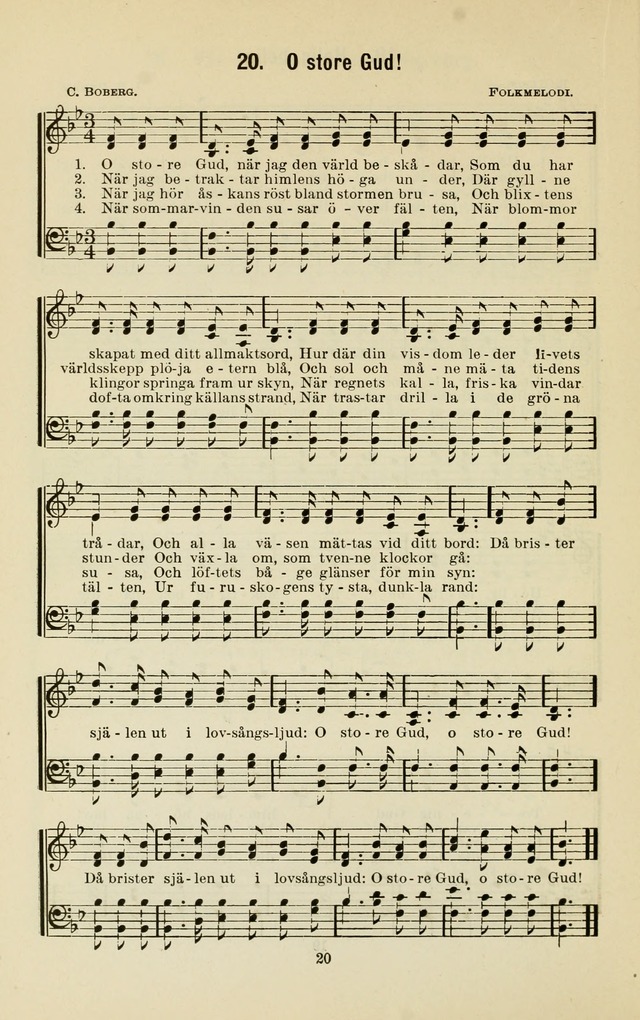
The original hymn was composed by Carl Gustav Boberg in Sweden in 1885 . O Store Gud originally had nine verses. One version of its origin talks about walking in nature, getting caught in a storm, and then watching the storm pass and thinking about the greatness of God.

Another version is that it was a paraphrase of Psalm 8 which was used in the underground church in Sweden during a time of persecution of Baptists and Mission Friends in the late 1800s.

I don’t see any reason why there can’t be a version where both of these hold true.

The hymn was first published in Sweden, but then traveled to Germany where it was translated into Wie Gross Bist Du or identified by the first words Du Grosser Gott, and as in Sweden became very popular.

From Germany it went to Russia. The Russian version is what a British Methodist missionary Stuart K Hines heard on a mission trip in Ukraine in 1931, who then translated, perhaps better said, paraphrased the meaning of the German/Russian translation into English, into what we today know as How Great Thou Art.

Hines also felt free to add new verses to the song. The story of the third verse goes like this according to one source:

It was typical of the Hines to inquire as to the existence of any Christians in the villages they visited. In one case, they found out that the only Christians that their host knew about were a man named Dmitri and his wife Lyudmila. Dmitri’s wife knew how to read — evidently a fairly rare thing at that time and in that place. She taught herself how to read because a Russian soldier had left a Bible behind several years earlier, and she started slowly learning by reading that Bible. When the Hines arrived in the village and approached Dmitri’s house, they heard a strange and wonderful sound: Dmitri’s wife was reading from the gospel of John about the crucifixion of Christ to a houseful of guests, and those visitors were in the very act of repenting. In Ukraine, this act of repenting is done very much out loud. So the Hines heard people calling out to God, saying how unbelievable it was that Christ would die for their own sins, and praising Him for His love and mercy. They just couldn’t barge in and disrupt this obvious work of the Holy Spirit, so they stayed outside and listened. Stuart wrote down the phrases he heard the Repenters use, and (even though this was all in Russian), it became the third verse that we know today: “And when I think that God, His Son not sparing, Sent Him to die, I scarce can take it in.


The story of the fourth verse is equally as moving, although occurring seventeen years later. Hines was working among Russian refugees in England after World War II. In one particular camp where they only found two professing Christians, one of them told him this story:

One man to whom they were ministering told them an amazing story: he had been separated from his wife at the very end of the war, and had not seen her since. At the time they were separated, his wife was a Christian, but he was not, but he had since been converted. His deep desire was to find his wife so they could at last share their faith together. But he told the Hines that he did not think he would ever see his wife on earth again. Instead he was longing for the day when they would meet in heaven, and could share in the Life Eternal there. These words again inspired Hine, and they became the basis for his fourth and final verse to ‘How Great Thou Art’:

I first remember singing the song in the woods surrounding  Camp Deer Run in East Texas, but later in many beautiful natural settings around the world; I’ve sung the third verse in communion settings—quietly, reverently—and I’ve stood up to sing the fourth verse loudly with joyful anticipation of the resurrection.

It took Swedish Christians, German Christians, Russian Christians, and British Christians to give us today the song we love—a great lesson in community—a great lesson about God.

For God so loved the world . . . .


Strategic-PlanningI’ve heard that most airplane crashes happen in the first two minutes of take-off or the last two minutes in landing!  I’ve also read that the majority of car wrecks happen within two miles of home!  Do you get my drift here?

Finish the written strategic plan strong. You have put so much work into it that you can hardly imagine that you might not finish strong, so let me just point out a few of the traps and make a couple of suggestions for landing the written strategic plan.

Trap #1          Being tired of the process is not the same as finishing!  You have put in so many hours, often weeks and months worth of work, not just in the writing process, but also in the surveying, the analyzing, the focus groups, the drafting, the revisioning processes, that it is just time to deliver this baby!  The temptation is to draw the line today and deliver it to the board . . . . but that’s not finishing. That’s just stopping—and there is a big difference!

Trap #2          The deadline can become more important than finishing well. Should a pilot that is coming in for landing too fast just risk it, or should he pull up and go around again.  Of the many factors that must be considered, getting the passengers to the gate on time is not one of the most important ones when it comes to safety. If you need another day, another week to finish well, ask for it. Most of you are dealing with self-imposed deadlines anyway.

Trap #3          During the revisioning process, someone suggests that you are totally off track and calls for a re-start.  Everyone who writes a dissertation has a story. I had one professor on my committee who was known to leave doctoral students crashed and burning in his wake.  After spending two years researching and writing my dissertation and receiving the tentative approval of my advisor, we submitted it to the committee. It came back from them with high praise—except for The Wrecker, who thought the whole premise was unworthy.  Five days before my defense before the committee who would determine whether the dissertation passed or failed, my advisor suggested that I write one more chapter which he felt would give him enough leverage to withstand the assault of the Wrecker.  I wrote that chapter; we added it to the previous ones and submitted the final version of the dissertation to the committee.  At the defense, the Wrecker arrived 45 minutes late, then acted rudely indifferent to anything happening in the room. When it came his turn to comment, he simply said that he never had believed in the project and he thought it was a poor excuse for a dissertation.  He was the only dissenter when it came time to vote, so I passed.  Don’t let a minority naysayer throw you off course.  If you have gone through the process, sought good input and feedback along the way, and are confident that the plan is good, don’t let the almost inevitable critic derail you.  Finish anyway!

And here are a couple of tips you should follow to finish strong!

Tip #1       Pay attention to formatting and packaging your strategic plan well.  Now I’m really getting picky, but you must now think of the wrapping paper. Don’t stick your gift in a brown paper bag and just pitch it to the recipients.  Wrap it beautifully and appropriately and make the delivery something special.  Specifically, I’m suggesting that you look again carefully at the formatting on the page. Is it organized, divided and subdivided clearly?  Is the organization transparent?  Is the font readable while appropriate for the level of formality?  Do the pagination and page breaks contribute to the ease of reading? Would it be better received in a binder than put together with paper clips?

Tip #2       Deliver it. Believe in it! Nothing is perfect. As soon as you send it out, you are going to find a typo or a phrase that you wish you could rewrite. But as much as you wanted perfection, don’t let its imperfection devastate you or you won’t be able to make others believe in it.

I’ve got two more pieces in this series on strategic planning. Next we will look at getting final agreement for your board or overseers, and then we’ll talk about what to do when the whole process is finally finished.


Peter Paul And Mary  1965I was driving home from Oklahoma last night and listening to my Peter, Paul and Mary playlist, and in one of their medleys they sang We Shall Overcome. Of course, they have a history with that song as do many of us who lived during the turbulent 60s. Even today, listening to it stirs deep, sometimes unnamed emotions in me like very few songs.

The origin of the song is disputed.  For many years the root of the song was attributed to Charles Albert Tindley’s gospel song I’ll Overcome Someday , first published in 1901. Tindley was a well-known pastor in the African Methodist Episcopal Church and wrote over forty other published gospel songs. He is best remembered for his very quotable lyrics such as these from I’ll Overcome Someday:

The world is one great battlefield
With forces all arrayed.
If in my heart I do not yield,
I’ll overcome some day

If you accept this starting point, then there is evidence that the song—or a version of it became popular quite early among labor union workers, but disappeared from the gospel world.

Other strong evidence points to Louise Shropshire’s gospel hymn If My Jesus Wills as the original version. She was an African American Baptist choir director who apparently knew personally some key African American artists in the civil rights movement.

The simplicity of both the lyrics and the melody—as well as the emotional context that continues to make it a song of protest and of hope—certainly come down to us today from the protest singers of the late 50s and early 60s.

What you may not know is the President Lyndon B. Johnson is also credited with extending the impact of this gospel hymn when he used the phrase “we shall overcome” in his address to Congress on March 15, 1965, after the nation had seen the pictures of attacks of civil rights demonstrators during the Selma to Montgomery marches.

But if you associate the song with any one historical figure from that time, you probably have never forgotten how Martin Luther King used the hymn to encourage and rally those who would stand up with him.

On Sunday, March 31, 1968, just hours before his assassination, King quoted the lyrics of We Shall Overcome in his final sermon in Memphis.  His words from his famous sermon delivered at Temple Israel in Hollywood, California, will give you the sense of how he used these words:

We shall overcome. We shall overcome. Deep in my heart I do believe we shall overcome. And I believe it because somehow the arc of the moral universe is long, but it bends towards justice. We shall overcome because Carlyle is right; “no lie can live forever”. We shall overcome because William Cullen Bryant is right; “truth crushed to earth will rise again”. We shall overcome because James Russell Lowell is right:.

Truth forever on the scaffold,
Wrong forever on the throne.
Yet that scaffold sways the future,
And behind the then unknown
Standeth God within the shadow,
Keeping watch above his own.

With this faith, we will be able to hew out of the mountain of despair a stone of hope. With this faith, we will be able to transform the jangling discords of our nation into a beautiful symphony of brotherhood. With this faith, we will be able to speed up the day. And in the words of prophecy, every valley shall be exalted. And every mountain and hill shall be made low. The rough places will be made plain and the crooked places straight. And the glory of the Lord shall be revealed and all flesh shall see it together. This will be a great day. This will be a marvelous hour. And at that moment—figuratively speaking in biblical words—the morning stars will sing together and the sons of God will shout for joy

As our nation finishes a month set aside to remember Black History and a day to remember Dr. King, it seemed fitting to me on this Sunday morning to remember a hymn that belongs to all who believe that this world is a broken place where people whom God loves still oppress and abuse other children of God.  The Apostle Paul put it this way in Romans 8:

For the creation was subjected to frustration, not by its own choice, but by the will of the one who subjected it, in hope 21 that the creation itself will be liberated from its bondage to decay and brought into the freedom and glory of the children of God. 22 We know that the whole creation has been groaning as in the pains of childbirth right up to the present time. 23 Not only so, but we ourselves, who have the firstfruits of the Spirit, groan inwardly as we wait eagerly for our adoption to sonship  . . . .

And notice that the apostle used the communal we in his writing, just as apparently the original words to this hymn were changed from I will overcome  to We shall overcome.  It’s not so much about the individual as about the congregation!

So, finally, again the words of Paul from which this hymn sprang:

Galatians 6:9 – And let us not be weary in well doing: for in due season we shall reap, if we faint not.

A_Charge_to_Keep

A Charge To Keep (W.H.D. Koerner) hung in President Bush’s office during his presidency.

Recently Sherrylee and I visited the new George W. Bush Presidential Library and Museum on the campus of Southern Methodist University in Dallas. Of the thirteen official libraries, we have visited all of them except the Hoover and the Eisenhower libraries, which we hope to see soon to complete our quest.

Without exception these libraries and museums are amazing! They tell the story of men who have served their country in the highest office of the land in war and peace, in glory and in shame, but all with a strong commitment to what they believed to be for the common good of the nation.  Regardless of whether history has proven them correct or whether you personally were a supporter of that particular president, you leave each library with greater respect for the man and a new perspective on the history that they shaped.

About a year ago, we visited the George H. W. Bush library in College Station, Texas, and one of the very obvious directions of the museum was to show Bush #41 as a man raised in a family of faith and who with wife Barbara attempted to rear their children in faith.  I had not known that about Mr. Bush, but was deeply impressed with how overtly this message was presented in the story of his life.

In a different way, I found the same to be true of #43, not so much in the biographical section of the museum, but just as explicitly.

Almost all of the presidential museums have a replica of the Oval Office in the White House as it was during that particular president’s term of office, but the replica in the Bush 43 library is the only one where visitors are allowed to sit behind the desk and actually walk around; one is only allowed to peer into all of the others.

The Oval offices have replica pictures on the walls, replica furniture that the former president had used and even replica family pictures and mementoes.  Here is where I was both surprised and impressed in George W’s library.  Behind his desk on a credenza sat a replica of his personal Bible for every visitor to notice. In addition, sitting not far from his desk on a spot that he might pass every day of his presidency sat a small, simply framed copy of A Charge To Keep I Have by Charles Wesley.

A charge to keep I have,
A God to glorify,
Who gave His Son my soul to save,
And fit it for the sky.

To serve the present age,
My calling to fulfill:
O may it all my powers engage
To do my Master’s will!

Arm me with jealous care,
As in Thy sight to live;
And O Thy servant, Lord, prepare
A strict account to give!

Help me to watch and pray,
And on Thyself rely,
Assured, if I my trust betray,
I shall for ever die.

 The first two stanzas apparently spoke to President Bush. Not only is “A Charge To Keep” one of the themes of his library, but you might remember that it is also the title of his book released in 1999.

Both Wesley and Bush take the title words to this hymn from Leviticus 8:35, where Moses delivered to Aaron and his sons the final instructions from the Lord on the establishment of the wilderness Tent of Meeting (tabernacle) and the sacrifices: and keep the charge of the Lord, that ye die not; for so I am commanded.”

I appreciate very much the decision President Bush made to demonstrate his faith in these small ways in his library. Not everyone is charged with being president—or high priest—or any prominent position where we are watched by masses of people, but we are all charged  as Paul charged Timothy in his first letter to him:

This charge I commit to you, Timothy, my son, . . .that you fight the good fight . . . .(1:18)

Wesley’s admonitions in this great hymn will help us:Arm me with jealous care/As in Thy sight to live,” and “Help me to watch and pray,/And on Thyself rely.”

umpiresDid you hear that Major League Baseball has approved a broad expansion of instant replay reviews beginning with the 2014 season.  I think that is a great idea—so good, in fact, that I’m thinking about suggesting instant replay for churches!  Here is what it would look like . . . oops, that won’t work. There are no umpires at church!

One could, of course, argue that God is the Big Umpire in the Sky, and that He doesn’t need instant reply because He always makes the right call.

One could argue that it is hard to have rules for and expectations of churches because there is no enforcement mechanism—at least not since Ananias and Sapphira!

But let’s set aside for the moment Judgment Day questions that God will ask and focus on daily decisions that most likely fall into the category of opinion, not into the category of deadly sins.  Let’s look at decisions like whether to have Bible classes for children, how long the worship and praise service should be, whether to spend 8 million dollars on a new building, which preacher to hire, or whether to discipline adulterous church members or not.

Besides these opinion questions,  church leaders are called upon to decide doctrinal questions as well,  like whether this church will be Calvinistic or pre-millennial, or whether to baptize with the Spirit or with water—or both. They almost always decide who can be a member of this church and who can’t.

With no “umpires” who holds your church leaders accountable for their decisions?  Who decides if they are wise, if they are prudent, if they are good shepherds, or if they are incompetent or unwise or cowardly?  Who determines what is foul or fair when a church leader is at bat?

It’s not as if churches make no attempt at holding leaders accountable:

  • Some churches use a democratic vote. The vocal majority leads and the loyal opposition attempts to hold them accountable.  Sounds good to Americans, but it is not really biblical.
  • Some churches use a representative vote.  Members vote church leaders in or out, according to whether they have represented your viewpoint successfully in church meetings. Again, more a pragmatic solution than a biblical one.
  • Some churches choose to allow an oligarchy.  These are the churches who either allow a small group of life-time appointed leaders to have absolute rule, or it could be a small group of senior staff with so much seniority that they are like banks which are too big to fail.  The common thread is no accountability.
  • Many newer churches and some very old ones are centered around single persons as the Hegemon. Dictator or tyrant is too strong and negative. Monarch suggests divine right—and some make this claim—but it is still not my favorite term. The underlying problem is the very fact of a single leader with absolute power and no accountability, and this danger is a fact even if the church acquiesces to a benevolent, but absolute leader.
  • Some churches—usually smaller ones–believe they exist without leaders. In my opinion, those don’t really exist because the more likely truth is that the church has leaders, but they are simply not designated leaders, rather leaders by default.

I think we can all agree that regardless of how your church is organized that it is accountable to God as are all the leaders as well as all the members. But how do we have an accountable leadership on earth in time and space when God does not seem to strike people dead for lying or open the earth to swallow his people for rebellion.

Here are some suggestions:

  • Recognize that leadership in the Body of Christ is a gift of God (Romans 12:8). Those who have the gift are the true leaders, whether designated or not, and those without the gift of leadership may be doing leadership tasks, but are not the true leaders of your church.  A healthy church identifies those with the gift of leadership and uses them to lead.
  • While you may not believe that Paul’s instructions to Timothy and Titus are a divine checklist for church pastors/bishops/elders/deacons/leaders/servants, they are certainly inspired instructional information and should not be ignored or lightly amended.  If every church leader were of the caliber required by Paul, fewer replays would be needed.
  • Implement what we at Let’s Start Talking call 1A Leadership, that is “One Another” leadership.  Here are the instructions for this leadership model. You will find them very simple:

Be devoted to one another in love.

Honor one another above yourselves.

Live in harmony with one another.

Stop passing judgment on one another.

Accept one another.

Instruct one another.

Encourage one another, be of one mind, live in peace.

Serve one another.

Submit to one another

Bear with each other and forgive one another.

Teach and admonish one another.

Love one another.

So everyone is an umpire?  Somehow the baseball metaphor begins to break down because umpires are determiners and enforcers. What churches should have are encouragers, instructors, servants, admonishers, and lovers.

If churches were led by these kinds of leaders, our Sundays would be filled with replays—not to determine who is safe and who is out—no, rather to celebrate over and over again the exemplary displays of Christ-likeness.

Holy BibleWhat could be holier than the Bible?  After all, that’s its title Holy Bible!  I looked up “holy books” in Wikipedia and was shocked to find literally hundreds listed. Of course, the Bible was included—but even what I assume is The Bible is murky.  Apparently Protestants have 66 books, but Catholics have 73 and two more in the appendix. The Eastern Orthodox church adds three more to the Catholic canon, and the Georgian Orthodox still one more.  The Ethiopian Orthodox Tewahedo Church and the Eritrean Orthodox Church include still more books, including 4 Esdras, the Book of Jubilees1 Enoch4 Baruch, and 1, 2, and 3 Meqabyan (no relation to the Books of Maccabees), and some Syrian Orthodox churches accept the Book of Baruch as holy scripture.

I was watching an episode of Homeland a couple of weeks ago, and it portrayed one of the main characters ritually burying his copy of the Koran because it had been thrown on the floor and defiled.  Afghanistan, Somalia, and Pakistan have had laws making desecration of the Koran punishable by life imprisonment or death.

That’s really holy!  That is much holier than most of us consider our Bibles.

In fact, have you noticed a trend in trying to make The Bible not quite so holy—mostly for commercial reasons, I suspect.  In almost any Christian bookstore, you can find now myriad special versions of the Bible, such as NIV Boys Backpack Bible, NIV Faithgirlz Bible, Adventure Bible, NIV Revolution: The Bible for Teen Guys, Sequin Bible, NIV Green Camo Backpack Bible, God’s Little Princess Devotional Bible—shall I go on?

Yesterday at lunch after church, while munching on chips and salsa, three young dads and I got into a conversation about Bibles. One father raised the question of whether we should be instilling in our children the love and practice of using and carrying a printed Bible, or should we “lower our standards” and allow Bible apps and electronic book versions of the Bible on whatever device they carry, i.e., for most of their kids, their smartphones?

This is a very tech-savvy guy who raised the question, not a Ludite. I quickly realized this is not an anti-technology question, but rather a question about our personal relationship to our personal Bibles.

Intellectually, we all agreed that electronic devices and screens are here to stay and that printed books are going the way of 78 rpm records. But this answer did not seem entirely satisfying for several reasons:

  • Our printed Bibles have been part of our testimony.  You left it on your desk at work or on the coffee table at home as a declaration of faith.
  • Our printed Bibles have contained our history, not only family history, but often our spiritual history as we underline, highlight, and take notes.
  • Our printed Bibles have measured our spiritual growth. The more worn our Bible, the more obvious to us and others that it is well used.
  • Printed Bibles have been personalized gifts. I received a beautiful leather Bible as a gift from our local preacher for my first sermon preached when I was 15 years old. We give little Bibles to babies, white Bibles for wedding gifts, and inscribed Bibles for graduations and baptisms.

Our relationship to our Bibles has been very personal–and inevitably that will change in the digital age.

I do see, however, the potential for learning an important lesson with the impending change; that is, we will either learn or remember that not the book itself, nor our relationship with our book, nor how we use that book, nor what we invest in that book is holy; rather, the Word of God is holy.

The Koran is not so different from the Bible, but is very different from the Word of God. The holiness of the Chaitanya Bhagavata (Krishna-karnamrita) is created and imposed upon it by religious teachers; the holiness of God’s words is created by the holiness of God.

Our Bible is not holy. God is holy.

Neither the form nor the title nor the translation, nor the color of the book that we own brings holiness into our lives and our homes, but rather the breath (inspiration) of God, spoken into our lives, yes and absolutely through the written word, but only if that written word is the living Word.  The living Word in us!

The Holy Word fills us, dwells in us, then we too become holy.

I don’t really know how generally well-known Be With Me, Lord is—or was!  This beautiful prayer hymn was a standard hymn in the churches I grew up in, often used as a closing song/prayer, but I remember it best from smaller group devotionals.

We sometimes played with the words and turned the singular pronoun me into us in order to express greater fellowship in the community—something I sometimes miss in the most individualistic praise music of today.

LO SandersonL.O. Sanderson (1901-1992), one of the great hymnists to come out of the Restoration Movement, wrote this particular hymn in 1934. In his autobiographical sketch The Lord Has Been Mindful of Me, he describes in his own words how this hymn was the result of providential circumstances:

“Be With Me, Lord” is perhaps my most popular hymn. In Springfield, in 1934, I was working on my first hymnal for the Gospel Advocate Co. At about 2 a.m. one Tuesday a melody came to mind. I found it difficult to get rid of it. So I stopped and wrote it down, lest I forget. Even then, I kept seeing or sensing the harmony, which bothered my work; so I turned and wrote it out completely. It is a rare meter – 11 notes in a phrase, 10 in the next, 11 in the third, and again 10 in the fourth. I couldn’t come up with or find words to fit it. About eight days passed when I received a letter from Thomas O. Chisholm, who had long written words for me. He wrote that he had retired on the same night I was working, and a theme for a poem seemed to command his attention. Finally after midnight of that same Tuesday, he got up and wrote out the poem. He was sending it to me to see what I thought of it. It was an exact fit for my music. I bought the poem, and the twain have been together since.

Life had not been easy for Sanderson. He was born and raised in a log house in Arkansas. His parents were musical, but they could afford no instruments. Sanderson was gifted, so he began school at age 4 and was in the 4th grade by age 6.

He finished what schooling was available before he was old enough to quit school—probably at about 11 years old because that is when he says his father “put me on my own,” meaning at least he had to buy his own clothes and earn the money for any further schooling.

He began picking cotton so he could afford to attend music normal schools, and by the age of 15, he was certified to teach his own singing school clinics. No doubt Sanderson had often experienced the dependency expressed in the opening stanza of this hymn, and therefore quickly identified with the words given him by T. O. Chisholm .

Be with me, Lord — I cannot live without Thee,
I dare not try to take one step alone,
I cannot bear the loads of life, unaided,
I need Thy strength to lean myself upon.

The second stanza is a more physical description of the “loads of life” and how dangerous those loads can be.

Be with me, Lord, and then if dangers threaten,
If storms of trial burst above my head,
If lashing seas leap ev’rywhere about me,
They cannot harm, or make my heart afraid.

We do know about storms and crashing lightening bursting above our heads—or tornadoes dropping out of clouds—but we are much less familiar with “lashing seas.”

The events to which I now relate those words are the Asian tsunamis, those mortifying pictures of the sea crashing through the man-made barriers and sweeping away homes and cars and people!

Did you see The Impossible (2012) starring Naomi Watts and Ewan McGregor, the based-on reality story of a family swept apart in the 2004 Indian Ocean tsunami?  The calm peaceful scene on the beach followed by instant, unexpected, and total devastation—those can make your heart afraid!

Be with me, Lord! No other gift or blessing
Thou couldst bestow could with this one compare —
A constant sense of Thy abiding presence,
Where’er I am, to feel that Thou art near.

“A constant sense of Thy abiding presence”—that’s the difference between those swept away by fear and those who lose their fears in faith!  No wonder His Presence is the incomparable gift!

And then we always sang the last stanza very quietly:

Be with me, Lord, when loneliness o’ertakes me,
When I must weep amid the fires of pain,
And when shall come the hour of  my departure
For worlds unknown, O Lord, be with me then.

I always thought the last stanza was a little disjointed—but I understand it better now.

As a teenager and young adult, I didn’t understand how loneliness and pain had anything to do with “the hour of my departure.”  Forty or fifty years later, I have seen the loneliness that creeps up on you as you grow older. I’ve seen friends who have lost their spouses-their best friends. I’ve watched the  row of “ widow ladies”  at church slowly grow shorter and shorter until only one  remains. I’ve returned to familiar places where the history of your life has happened in detail, only to discover that it has all been replaced with new and shiny –and you feel like very little of you is left there.

Loneliness and the accompanying pain are perhaps some of the fiercest storms that “burst above my head.”

The last two phrases are the prayerful expression of confidence that we are not left alone—that our last hour will not be our loneliest; rather, our last hour will deliver us from the “constant sense of Thy abiding presence” to be supplanted by the  comforting Presence itself!

Be with us, Lord.

Mary PoppinsWhy is Saving Mr. Banks (2013) such a wonderful film? You can start with Emma Thompson and Tom Hanks, two of the finest actors of our time.  You could follow them with Mary Poppins (1964), the Disney family classic starring a very young Julie Andrews and a very likeable Dick Van Dyke.  Is that enough?

No, well then how about 45 minutes of music from the Mary Poppins soundtrack, including still recognizable songs like Chim Chim Cher-ee, Supercalifragilisticexpialidocious, and Let’s Go Fly a Kite, all composed by the Sherman brothers.

Still not enough?  OK, then I’ll mention great supporting performances by Colin Farrell, Paul Giamatti, and Bradley Whitford, all of whom had to play roles that moved from comedy to pathos, from frustration to almost frolic, without letting themselves slip into tripe on either end of the spectrum.

In addition–even though you didn’t ask–Saving Mr. Banks is a wonderfully told story—but not the same story as the book.  The book Mary Poppins by P.L. Travers (born Helen Lyndon Goff, 1899–1996) first appeared in 1934, and is about a magical nanny and her adventures in the household of Mr. Banks.

Prior to the Disney film, only five books appeared in the series. After the film, Travers published three more volumes to add to the series, the last Mary Poppins and the House Next Door appearing in 1988.

But the film dramatizes the internal struggle of Travers to let go of her characters, to let Disney give them to the world, risking an almost unbearable exposure of her own family’s story buried especially in the character of Mr Banks.

Tom Hanks’ portrayal of Walt Disney—the first time Disney is ever portrayed on-screen by an actor—is absolutely believable. Disney was an unusual businessman, artist, and a visionary. Hanks is able to capture all of these qualities without caricature.

What makes Saving Mr. Banks work is that the audience is able to believe in the transformation that takes place. It’s not miraculous, it’s not without struggle, it’s not even without loss, yet the redemptive story results in a typically British understated happiness that the audience can believe and share in.

The only parts of the film that would be difficult for younger children are the flashbacks to Travers’ childhood. Her father’s alcoholism and eventual death emotionally impact his daughter, so your sons and daughters will be confronted equally.

If you want some talking points after the film is over to use with your children, you might try these:

  • How did you feel about the father and daughter’s relationship in the flashbacks?
  • Why do you think the young girl felt betrayed when her father died?
  • Why do you think Mrs. Travers was so hard to get along with in the beginning?
  • Did you feel like Walt Disney liked Mrs. Travers or was he just trying to make his movie so he could make more money?
  • Did you like the car driver?  Was he important in this movie?
  • Did sharing her characters in the movie make Mrs. Travers happy?

Saving Mr. Banks is definitely one of the top films of 2013.  It should be nominated for Best Picture, but even if it is too schmaltzig for the Academy, I think you will love it!