Feeds:
Posts
Comments

campfire songsHave you noticed that kumbaya has turned into a verb!

When I was barely a teenager, I was invited one summer to one of those all-city teen devotions that travels from church to church each week. (Do they still do those? That’s how you got to know the teens from other churches.)  Anyway, on this particular night, we were actually in some big park, and there was a young man from Thailand giving the devotional talk.  In the middle of his talk, he asked if any of us knew the song Kumbaya?  No one knew it, so he taught it to us—as a song of mission.

His version of the song’s story was the one where the African missionary is on his way to some place when he hears natives by the river singing, “Kum ba yah, my Lord, Kum ba yah,” which he translated as, “Come by here, my Lord, come by here.”

Then each verse is a reason for the missionary to stop there:  someone’s singing, someone’s praying, someone’s dying . . . . I think it was one of those songs to which you could add an endless number of verses.

It might have been three or four years before I went to any devotional after that where Kumbaya was NOT sung. It was that popular.

Of course, the early 60s were also the moment in musical history when folk music was the rage, so I’m pretty sure that Joan Baez recorded Kumbaya  and a little later Peter, Paul, and Mary included it in their repertoire as well.

Most of the folk singers took spirituals or spiritual songs and presented them as political songs, most often about freedom.  That’s what happened to Kumbaya.  It went from being what we called a “devo song” to being a “camp song.”

Camp songs were the songs sung around the campfire, usually with an acoustic guitar—simple, not elaborate melodies, often pretty repetitive.  Think of songs like Michael, Row the Boat Ashore or Where Have All the Flowers Gone? Anybody could play them, and everyone could sing them.  We could sing them at Bible camp, but also at Boy Scout camp, Campfire Girls Camp, or YMCA camp.

The evolution to a camp song, however, pretty much assured that the song would no longer be appropriate as a “devo” song.

By the mid-90’s, cynicism in American politics overwhelmed the song, and suddenly Kumbaya  became a symbol of a naïve innocence that was no longer viable reality.  Listen to what Rick Santorum is quoted as saying in a 1994 statement addressing the idea of paying young people for national service:

Someone’s going to pick up trash in a park and sing ‘Kumbaya’ around a campfire, and you’re going to give them 90 percent of the benefits of the GI Bill! That’s a slap in the face to every person who put their butts on the line in a foreign country. … That’s not what America is all about.”

Within ten more years, the metaphor is firmly entrenched into the sarcastic rhetoric of politics, suggesting that the harmony and mindless unity of sitting around a campfire and singing Kumbaya is not unreal, but not the desired reality either!

NPR quoted the White House Press Secretary Jay Carney recently as saying,

“I don’t think that anybody expected or expects Washington to be a campfire where everybody holds hands together and sings ‘Kumbaya,’ ” Carney said. “That’s not what the nation’s business is about.”

We were watching the new Denzel Washington movie 2 Guns the other day when his character came out with something along the line of “We are not going to be able to kumbaya our way out of the mess we are in.”  At the time, I thought to myself, “That poor song.  Does anyone remember at all its original meaning and sentiment?”

But then I started feeling worse for a people who laugh and scoff at innocence, for a people who feel that contentiousness is a greater virtue than consensus, for people who can’t trust anyone, and have no one greater than they are to follow.

Is it empty nostalgia to long for simple faith, to hold “naïve” confidence in the goodness of other people, or to be willing to trust those who lead us?

If you are a Christian who finds yourself too disappointed, too disillusioned, or just too cynical to believe or trust or follow, you might want to hum a little Kumbaya, and think about where you are looking for goodness, for certainty, for truth, for trust.  If you aren’t finding anything good where you are looking, then you are looking in the wrong place!

Try adding the words then to the melody of Kumbaya:  “Come by here, Lord, come by here,”   and make it your prayer.

volcanoSherrylee and I were watching a Netflix movie last night about a rogue oil company that drilled too deep and hit a pocket of magnum. By bursting into this pocket of magnum, they created not only a catastrophic volcanic eruption in Oregon, but also a chain reaction with all the other volcanoes on the Pacific Rim.

The geologist who explained what was happening to everyone in the movie called it an ELE, an Extinction Level Event, meaning that if all of these volcanoes went up at the same time, the dust and ash would block out the sun for so long that life on Planet Earth as we know it would die out. Of course, he saved the world from the ELD and got the girl, so you can rest easy tonight!

Or can you?

I started thinking about churches/congregations and what an ELE for them would be.  For churches, this was my short list

  • The last young family with children leaves your church because you have no viable children’s program.
  • Your church only has two men willing to be elders and lead the church, and one of them quits and the other has an affair.
  • Your church overbuilds in a burst of faith-based optimism and then does not have the resources to repay the debt.
  • A church hires a divisive preacher and doesn’t get rid of him fast enough.
  • Your church makes the decision that it is too small or weak to be concerned externally, so God just wants you to take care of the flock already in the building.
  • The church’s vision is the same as the budget report!

Nothing can destroy the church of God! No power in this world or the invisible world!  But the lampstands of some individual expressions of God’s church will be removed (Revelation 2:5), if they don’t repent.

Interestingly, almost no one in the Oregon town of the movie believed that the ELE was possible.  And most of our churches don’t think it could happen to them either.  It might be worth one church meeting to just brainstorm the question: what could happen that would destroy this congregation.  Some natural events are both unpredictable and unavoidable.  Churches die naturally like people do.  But too many may die early deaths which could have been prevented.

In last night’s movie,  it took a single person being willing to risk his life in order to place a bomb in the right place to seal up the volcano, and only then was the world saved from extinction.

What might be the metaphorical bomb that needs to be put in the exact right place to save your congregation?

Who might be the person in your church who has to take the big risk?  You?


Strategic-PlanningThis series might be called a series of “reality posts” since we are following LST in real time through its strategic planning process.  To see earlier posts, go to the Categories drop down box and find the Strategic Planning Series.  

As I reported in the last blog in this strategic planning series—which was about 90 days ago—LST sent out over 9000 surveys to all its different constituencies in order to help us know how to plan for the future.  We received about 15% of the surveys back and if each survey averaged 50 questions, then we are talking about approximately 70,000 bits of information for us to analyze.

The ease with which you can get useful information out of your surveying depends primarily on two main factors:

A good online survey tool like www.surveymonkey.com will make the task much easier. 

  • A good tool itself provides some basic analysis of the captured data.
  • The data analysis must be presented in both table and graph forms.  You need it in both because different people in your organization process information differently.  Your accountants will love the tables with all their numbers, but your public relations people will often understand the graphs much faster.  Your board members will likely have different ways of processing information as well.
  • Filters should be available to further refine the data.  For instance, in LST’s Donor Survey, we asked “Have you personally done LST either out of the country or through FriendSpeak?”  This question would seem to require a simple Yes or No, and would result in a percentage of Yes’s and No’s, but because of other questions that we asked, we could find out how many men vs. women said yes, how many of those who said no contributed over $100, and much more.  Your online tool must allow for sorting and filtering your bits of information.

The demographic questions you build into your survey are the second big factor in making your information easy to understand. You only get out of a survey what you ask!

  • If your survey is 50 questions or less, probably the first 7-10 questions should be the demographic questions that are important to you, i.e., the categories that could be important for sorting the answers. Here were our questions for our donor survey:
  1. Gender?
  2. Age?
  3. Average household income?
  4. Size of home congregation?
  5. Have you ever done LST?
  6. How many non-profits do you support?
  7. What has been your single largest contribution to LST?
  8. Largest annual contribution?
  9. What prompted your most recent contribution?

What these questions have in common is that they are going to provide sorting and filtering categories for all of the remaining questions in the survey.

In this particular survey, there are a total of 25 questions.  After these first nine demographic questions, the remaining ones are mostly satisfaction or preference questions:  Example:

  • On a scale of 1- 5, how satisfied are you with the way your donation is used by LST,” and
  • When giving to LST, how do you prefer to contribute?”

Inevitably, you will discover that you failed to ask one demographic question that you really needed to ask.  We got all of this information back but realized that we could not separate our regular donors to our general fund who have given to us perhaps for years from those donors who had only given once to support a particular worker, often one of their family members.  The difference between these two types of donors is huge—and we simply failed to ask the one right question that would allow us to separate them in our analysis.

And, finally, you are going to need to let many eyes look at the results if you truly want to understand what your surveys are saying.  We gave all of our staff and all of our board members complete access to all of the raw data online, so that they could see everything, sort and filter the numbers as they wanted to, and then we asked for them to tell us what they saw as well.

One tip:  you can be more open with the data if the surveys themselves are anonymous.

Next, we’ll talk about actually beginning to draft the strategic plan.

passport-for-travel-frontDear C,K,C,C,C,L,A,O, and N,

I can’t believe that right now three of you are in Italy on an LST mission project! And all the rest—except the very youngest ones—have already been on mission trips too!  We are so proud of all of you!  And if you are one of the young ones, don’t worry! I’m sure you will get your chance soon!

You also really have remarkable parents—all of them—because they have gone on mission trips and taken you with them!  Can you believe that some parents leave their kids at home when they go on mission trips—maybe their kids are too young or too rowdy–, but your parents wanted you to go!.  Yours want you to know how fun, how great and awesome, and how important mission trips are!  They are really good parents!!

Think of all the places you have been:  Germany, Japan, Honduras, Rwanda, Italy, Brazil, the Netherlands. Amazing!  Did you know that Grandad was 21 years-old and almost out of college before I ever went anywhere out of the United States. (No, it wasn’t that they hadn’t invented the wheel yet! I’m not that old!)

And did you know that Mimi and Grandad went to Germany as missionaries and lived there for eight years. (That’s why we always say, “Guten Appetit!” after we pray at meals.) Then, starting when Philip was 7, Ben was 5, and Emily was 3, we took them and went on mission trips every summer when school was out.

You might be wondering why mission work is so important in our family!  Good question.

First, mission work is important to our family because we are Christians, and we believe that everyone needs to know about God.  Lots of people grow up in countries where no one knows who God is. They sometimes have been told that there is no God; other kids grow up believing in many different gods.  Do you remember the 10 Commandment song that Mimi taught you when you were little.  Remember, “Don’t bow down to any yukky idols!”  That’s what Christians tell people, so they can know about the one, true God!

Second, mission work is important to our family because we believe Jesus is God’s Son, and God said that everyone needs to know this to go to heaven someday .  If we are going to be called by Jesus’ name “Christ-ians” and if we really love him, then we just naturally want to do what he says. So if God said to go and tell people, then we go and tell people.  Why wouldn’t we?

Thirdly, who is going to tell people that God loves them, if we don’t go and tell them?  And there are so many people in the world!  I think that God has some people for all of us to talk to.  What happens if one of us Christians just sleeps in or is afraid or decides to watch TV instead and some people don’t get told?  Well, don’t worry because God is very close to everyone and has promised that if people are looking for him, they will find him!  God might send somebody else to tell that person, but then wouldn’t He be a little disappointed in us for not doing what we were supposed to do!

Here are a few things I need you to know if you are going to grow up in a family that does mission work:

  1. Your family is not better than families who don’t go on mission trips.  Other people’s families do other things for God.  Some families love to give food to poor people, some families love to mow yards and repair houses for people who are sick or old.  Remember that God’s family is like a body with many different body parts:  Some people are eyes and ears, some people are hands.  Your family might be the feet that like to go places—but it takes all of you to be the whole body of Jesus.
  2. You have special gifts from God for doing mission work!  You’ve been on lots of airplanes and you weren’t afraid!  You’ve slept in strange beds—or maybe even on the floor without a bed. You know how to make friends with people who don’t speak English very well.  You even try a few new foods—sometimes!  These are all special gifts that make it much easier for you to do mission work.
  3. Mission trips are really fun—but not all the time!  Getting to see a new country and meet new people to tell about Jesus is wonderful fun, BUT sometimes the food can make you sick, or big new bugs can bite you, or your bed is too hard, or there are no water fountains and you are thirsty, or there is no one your age to hang out with, or you just get homesick.  What I can tell you is that if you can just not gripe or complain and keep doing the good things that you went to do, a couple of weeks after you get home, you’ll hardly remember the things you didn’t like.
  4. You might want to be a missionary that lives in another country someday!  Not very many people really want to do this, but as you get older, you might just listen to see if God puts this into your heart.  Now, you can’t go on your own until you are old enough and prepared to go, but don’t let that stop you from being excited about being a missionary someday.

Did you know that Jesus went on a mission trip one time?  Yep, he and his father talked it over and when it was just the right time, Jesus left his father and went on a mission trip.  When he got there, it wasn’t all that fun. At first it was a little fun because people listened to what he told them about God, but then they started saying bad things about him, things that weren’t really true.

But Jesus didn’t gripe. He stayed on his mission trip for about three years. That’s how long it took for him to do everything God wanted him to do. Then it was time to go home, so God just brought him back to Heaven.

Of course, you know where he went on his mission trip.  He came here to this world so that we could know who God is and how much he loves us. Aren’t you glad Jesus was a missionary?

And that’s why our family loves mission trips. 


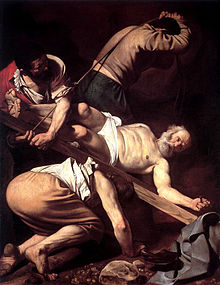
Crucifixion of St. Peter by Caravaggio

Crucifixion of St. Peter by Caravaggio

“Christian convert from Islam shot dead in Kashmir.”  “Christians live in fear of death squads.”  These are real headlines about real Christians in our own times. Such persecution makes our complaining about discrimination towards Christians in America seem a little whiny to me!

Could it come to death squads in America or Christians in Guantanamo?  That hardly seems likely, but then it was probably just as impossible an idea for the people of Germany in 1932 as well, the year before they brought the National Socialist German Workers Party into the government.

The privileged political status that Christianity has enjoyed throughout American history seems to be coming to an end.  Changing attitudes toward Christians by large numbers of other Americans has begun to make us afraid that someday it might not be that we can’t pray in public schools, but that anyone caught praying could be thrown into the lions’ den.

How are Christians to respond in the face of suffering or persecution?  This may become the most pressing conversation we can have in the next century.

Graciously, God used His Spirit to guide his servant Peter to write a little short letter to Christians who were facing some suffering, and in this first letter Peter elaborated perfectly God’s Way with suffering as a Christian.  Here are a few of the instructions that we American Christians may need to know someday!

  1. Why should Christians ever expect to suffer?  “  . . . you have had to suffer various trials so that the genuineness of your faith—being more precious than gold that, though perishable, is tested by fire—may be found to result in praise and glory and honor when Jesus Christ is revealed..” 1:7
  2.  How do Christians prepare for this time of suffering?  Therefore prepare your minds for action; discipline yourselves; set all your hope on the grace that Jesus Christ will bring you when he is revealed.. . . purify your souls “by your obedience to the truth so that you have genuine mutual love, love one another deeply from the heart.”1:22
  3. How do Christians live among those who would persecute them?  Conduct yourselves honorably among the pagans, so that, though they malign you as evildoers, they may see your honorable deeds and glorify God when he comes to judge. 2:12
  4. What should your attitude be toward a government that oppresses Christians?  For the Lord’s sake accept the authority of every human institution, whether of the emperor as supreme, 14 or of governors, as sent by him to punish those who do wrong and to praise those who do right. 15 For it is God’s will that by doing right you should silence the ignorance of the foolish. 16 As servants of God, live as free people, yet do not use your freedom as a pretext for evil. 17 Honor everyone. Love the family of believers. Fear God. Honor the emperor. 2:13-17
  5. What should Christians do about employers who discriminate against them because of their faith? Servants, be subject to your masters with all respect, not only to the good and gentle but also to the unjust.19 For this is a gracious thing, when, mindful of God, one endures sorrows while suffering unjustly. 2:18,19
  6. What should Christian wives do who suffer at the hands of their non-Christian husbands?  Wives, in the same way, accept the authority of your husbands, so that, even if some of them do not obey the word, they may be won over without a word by their wives’ conduct, when they see the purity and reverence of your lives.3:1-2
  7. What does it look like when a Christian woman accepts the authority of her non-Christian husband? . . .  they [husbands] see the purity and reverence of your lives.  . . .  let your adornment be the inner self with the lasting beauty of a gentle and quiet spirit, which is very precious in God’s sight.” 3:2-4
  8. What about husbands who might suffer with non-Christian wives?  In the same way, husbands, live with your wives in an understanding way, showing honor to the woman as the weaker vessel, since they are heirs with you of the grace of life, so that your prayers may not be hindered. 3:7
  9. What about unmarried Christians, in fact, all Christians?  . . .  have unity of spirit, sympathy, love for one another, a tender heart, and a humble mind. Do not repay evil for evil or abuse for abuse; but, on the contrary, repay with a blessing. It is for this that you were called—that you might inherit a blessing.3:8,9

Peter encourages these first century Christians then, not with the promise of release from suffering, but with a framework for it:

Now who will harm you if you are eager to do what is good? 14 But even if you do suffer for doing what is right, you are blessed. Do not fear what they fear, and do not be intimidated, 15 but in your hearts sanctify Christ as Lord. 3:13-15a

It’s not that Christians can’t defend themselves; Peter says to be ready to defend yourself . . . but pay attention to what that means to him:

Always be ready to make your defense to anyone who demands from you an accounting for the hope that is in you; 16 yet do it with gentleness and reverence. Keep your conscience clear, so that, when you are maligned, those who abuse you for your good conduct in Christ may be put to shame. 17 For it is better to suffer for doing good, if suffering should be God’s will, than to suffer for doing evil. 3:15b-17

I suspect these are hard words for American Christians—but were they any easier for those first century Christians in the middle of their persecution and suffering. Are we supposed to be more protected from suffering?

Peter’s conclusions drive this point home clearly!  The Word should speak into our hearts as well as it did theirs!

12 Beloved, do not be surprised at the fiery ordeal that is taking place among you to test you, as though something strange were happening to you. 13 But rejoice insofar as you are sharing Christ’s sufferings, so that you may also be glad and shout for joy when his glory is revealed. 14 If you are reviled for the name of Christ, you are blessed, because the spirit of glory, which is the Spirit of God, is resting on you. 15 But let none of you suffer as a murderer, a thief, a criminal, or even as a mischief maker.16 Yet if any of you suffers as a Christian, do not consider it a disgrace, but glorify God because you bear this name. . . . 19 Therefore, let those suffering in accordance with God’s will entrust themselves to a faithful Creator, while continuing to do good.

Did you know that traditionally Peter was crucified head-down for his faith?

When the world gets so upside down that God’s people suffer and die for doing good, no army, no vote, no march, no legislation, no petition, no guns, no talk shows are going to make things right again. 

No, Peter’s final word to us today tells us that only God can stop suffering—and He will!

Resist the Evil One, steadfast in your faith, for you know that your brothers and sisters in all the world are undergoing the same kinds of suffering. 10 And after you have suffered for a little while, the God of all grace, who has called you to his eternal glory in Christ, will himself restore, support, strengthen, and establish you. 11 To him be the power forever and ever. Amen.


baby with glassesWhich sites do you read regularly on the web?  I read the headlines from many sites, but I rarely slow down long enough to actually read a whole post or article unless there is something really special or interesting that turns me around!

I thought I would share with you today some of the sites that I often (not always) make it a point to read, ones that you may or may not already be reading as well.

Let’s start with the bigger, better known sites. I read Belief Blog on the CNN site quite often, especially for current issues, but also to read intelligent counterpoint to what I believe to be true.  Daniel Burke and Eric Marrapodi are co-editors of the sight. Stephen Prothero, professor of religion at Boston University and author of numerous books, is a frequent contributor.  Some recent titles are “Satanists Square Off on Abortion. (Yes, really!), “The Belief Blog guide to Ramadan,” and “Behold, the Six Types of Atheists.”  I do want to warn you that the comments to each post can be addictive, but they also are often egregiously sarcastic or cynical.

By the way, I did search Fox News for a religiously oriented blog and did not find anything. Just for those of you who think CNN is from the devil.

Staying in the commercial arena, I receive and read parts of Christianity Today Direct almost every day, Not only is one exposed to the best of the articles from the monthly magazine version, but since, it seems most denominations are moving toward the center, that is, neither extremely liberal theologically and certainly not extremely fundamental, Christianity Today and its writers find themselves writing to and for many readers other than their traditional evangelical audience. In these daily gleanings, one gets a little news, reviews of pop culture, as well as a daily article that addresses either a current event or a current religious issue.  You will not often be offended, though you will be challenged—not a bad combination.

Now to a couple of blogs from the private sphere which you probably are not reading, but that I find engaging, notwithstanding that the two are very different.

Accompanying the current trending toward The Book of Revelation, 7 Subversive Letters, a blog by Dr. Richard Oster, is scholarly, thoughtful, and insightful—and absolutely accessible. Dr. Oster is a New Testament professor at Harding School of Theology in Memphis. What I especially enjoy are the enlightening glimpses of historical artifacts that Dr. Oster uses to expand one’s understanding of the already challenging book.  He is also not afraid to challenge popularly held ideas. I suspect this particular blog grew out of his readings and writings for his latest book Seven Congregations In a Roman Crucible. (I like the title of the blog better!)  If you try this blog, try more than one before you decide to subscribe regularly.

And, finally, I want to risk all kinds of hoots and hollers by recommending to you New Vintage Leadership, an excellent blog by my son-in-law Dr. Tim Spivey, senior minister of New Vintage Church in Escondido, California.  Of course I’m biased, but I’m not the only one because his blog on church leadership is very popular. As you could find out yourself with a little research, his early blogging was more personal. A couple of years ago, in conjunction with the launch of a new church planting in Escondido, he decided to focus his writing on church leadership.  Tim is especially good with practical advice in areas of administration and organization. Since such topics rarely surface in seminary courses, ministers find his writing especially helpful. As a ministry leader myself, I think the same would be true for anyone in a leadership position.

On Fridays, Tim treats his readers to “Friday Stream of Consciousness,” a panoply of thoughts that give you an insight into his person. These little snatches of thought I find a bit unique and quite beneficial to this kind of focused blog which otherwise could have been just as impersonal as many other blogs.

Well, try some of these—and if you like them, tell them that Mark sent you!

July 12, 1974

July 12, 1974.

woodward 1980Seven months before, I had carried a little sack with a urine sample down to the pharmacy about two blocks away from our apartment on the Lister Meile in Hannover, Germany.  A couple of years earlier, we had been pregnant and miscarried, so we were eager, but cautious about getting our hopes up.

I don’t think they did the test immediately. I think I had to come back the next day to get the results—the results that made me smile all the way home.

We already knew where our little nursery would be—the room in our apartment that shared a wall with Frau Hakemeyer. She was an 80-year-old concert pianist, who had a grand piano in the room with the common wall, so every afternoon our new little baby would be treated to Chopin!  What more could you want.

A modern wall mural of Noah and the ark went in over the new crib, which was outfitted in bright red, white, and blue!  Yes, this was going to be an American baby!

The evening of July 11, I came home from our office and found Sherrylee scrubbing down the balcony!  As I questioned where she got the energy in her condition, she interrupted me: she had already finished thoroughly mopping the kitchen—just getting things ready, she said—but I think it was that burst of energy that God gives women right before the Time!

About 11pm, she said it’s time to go.  It was about a twenty-minute drive in our little bronze-colored Chrysler Simca—a BMW could have made it in 10– to the hospital—even so, there wasn’t a lot of conversation, but I’m sure both of us were praying and wondering about what was getting ready to happen.

We arrived at the Universitätsklinik just before midnight, so the night nurses were helping Sherrylee get prepared and telling me to go home because nothing was going to happen very quickly.

I was prepared for that trick, however! You see, we had searched all over Hannover for a doctor that would allow us to do Lamaze natural childbirth, which includes the husband coaching the wife through the delivery. There were no Lamaze classes at that time—at least in Hannover, so we read seven how-to books.  We were experts! We were prepared!

But then we discovered that no one had ever done this in Hannover, so the doctors would not cooperate. We went to clinic after clinic and were getting nowhere! Crazy Americans!

Our last stop was late one evening at the university hospital. We walked in, found the doctor’s office closed, but a light on in one office, so Sherrylee opened the door carefully—and there was Dr. Künzel, the Chief of Obstetrics for the medical school in Hannover—wondering who was barging into his office at that time of night.

When he realized that we were Americans and when he heard our plea, much to our surprise and pleasure, he agreed! He, as a university professor, was perhaps more interested in new methods and ideas than some of his colleagues—or maybe Sherrylee just charmed him. I’ve never been quite sure!

So, anyway, I was not about to let the nurses trick me into going home—and I told them that Herr Prof. Dr. Künzel—long titles are impressive in Germany–had approved my being there, and I was staying.

Finally, they let me in–and there was Sherrylee in her gown already hooked up to the fetal monitor that registered every heartbeat of our new baby as well as the pressure when each contraction came.

Through the night we breathed, we talked, I rubbed talcum powder, we breathed, we talked, sometimes she slept between contractions, but then we breathed, and talked, and rubbed talcum powder.

By mid-morning of the 12th, I was exhausted! I sat down—but by this time, the nurses that had been through the night with me were all friends, so they brought me some small refreshments. Before I had time to even snack, it was Time.

Almost without warning, God did His miracle! First the crown of his head, then his head, then his whole slightly blue body!  It was a boy!  And even though there had been a little cord issue that caused the doctor to slow the delivery down a little, he appeared to be fine! OK, I did cry a few tears of wonder and joy!

The nurses stuck him under a faucet and washed him off, pulled on his legs to straighten him out for measuring, and did some other stuff to him as well.  Then they let us sit and hold him, our son Philip Gary.

There are so many more little stories to tell: Granny Joy coming to help Philip recover from “his little operation,” weighing him on scales after every meal to figure out how much he was eating, but especially the story of getting his pram and him stuck in the revolving doors of the Cologne cathedral on his first excursion just three weeks after his birth.

. You’ve grown into an impressive man, a great husband and father. You’ve always been wonderful son—even when you broke my thumb!!  You truly love God.  You have blessed our lives.

Your mother and I love you dearly—and always will.

babe ruthBases loaded! One run down! Bottom of the ninth! Two outs! And you, the team captain come up to bat! Best player!  Most dependable! Cheerleader for the whole team!

And you strike out on three pitches!

I’ve read that one of the most difficult things for great baseball players to accept as they move from being a high school or college superstar to playing professionally is the inevitable and frequent disappointments—even failure—that is part of the game.

Hall of Fame players only get hits 30% of the time!  That means 7 out of 10 times that they bat, they make an out!

The big sluggers, the home-run kings, strike out more than anyone else, and only hit a home run about 1 out of 15 times at bat.

What do you do as a church/ministry leader when you “strike out?”  What do you do when you make a bad financial decision, the wrong hire, a damaging strategic decision?  What do you do when you and everyone in the whole stadium know that you just struck out on three pitches?

  • Some players blame the umpire, the fans, their wife, the team spirit—everybody but themselves.
  • Some players just throw the bat and slam their helmet down in rage. That helps everybody on the team feel better!
  • Some players give up on themselves; they quit.
  • Some players play cavalier—just pretend like it didn’t make any difference!

If these are not productive ways to respond when you strike out, what might we do:

  • Admit that you struck out!  Don’t try to pretend that you didn’t.
  • Don’t blame other people! Even if the pitcher is GREAT, he’s not striking everyone out, so somebody is hitting him!  The umpire is not calling everyone out on strikes.
  • Seek to understand the reason you struck out. Did you guess incorrectly? Were you too aggressive, too impatient, too unfocused? Did you irritate the umpire?
  • When you think you might know why, you might think about whether this is an area that you can improve upon with training, with practice, with coaching, with self-control—and then do what you need to do!
  • If you can’t figure out what you did wrong, then ask other people to tell you—and listen to them.
  • Get back up to bat as soon as you can.  Fear of failure is really bad! Once that gets into your head and takes over, it is increasingly difficult to succeed again.

In church leadership and ministry, even the best leaders are going to make dramatic errors. I’m not talking about moral choices or integrity issues, I’m just talking about bad decisions.  These decisions affect people’s jobs, people’s lives, and sometimes even people’s faith because so much of what people believe is wrapped up in the leaders they follow.

That is why it is so painful, just gut-wrenching when you make big, wrong decisions.

The Bible is full of great men who made terrible decisions:

  • Abram passes Sara off as his sister to Pharaoh
  • Jacob steals the birthright from Esau
  • Joseph can’t keep his dreams to himself
  • Moses kills the Egyptian in rage. Later he gets so frustrated with his people that he overstates his own role in satisfying their needs and offends God.
  • Samson, Jephthah, Eli—the judges God chose made big mistakes.
  • King Saul, even David, and especially Solomon

Haven’t you wondered as I have about the great heroes of faith in Hebrews 11, that is, how some of them made the list?  All of these were leaders—but all of them only got hits 3 out of 10 at-bats!!

After that list of great heroes in Hebrews 11, the writer says thatout of weakness [they]were made strong “ (v.34).

You will strike out!  Maybe a lot!  But if you can acknowledge your weakness and respond to it in a godly way, He can still make you a Hall of Fame player!

PowerCorrupts-300x207We were in the Pergamon Museum in East Berlin, just a few months after the fall of the wall.  The young woman with us was walking around, enjoying the artifacts, but bottle-feeding her baby at the same time.

Bolting from the corner of the largely empty room, a small but sturdy East German security lady hurried across the room to inform our friend that under no circumstances could she walk around the museum and feed her baby at the same time!  When we asked politely what the problem was, she just simply repeated a little firmer and louder that it was verboten!

Continue Reading »

josephWe just finished a series on Joseph, son of Jacob, at church. Such a familiar story full of dreams, threats, seduction, rise from ashes to power, surprise revelations—all the elements of great drama! I’m surprised it has not been the subject of more movies.

I learned something completely new to me this time through the old story.  Let’s start with a little back story review for those of you who have not read Genesis in a long time!

In Genesis 12, God calls Abram out of Ur of the Chaldees to go to Canaan. He promises to make of Abram a great nation. In verse 7, God also promises Abram, “To your offspring I will give this land.”

For many years, Abram is pretty nomadic, even going down to Egypt to escape a famine in Canaan, but he eventually returns to the place where he first pitched his tent and where God made him the promise of land, between Bethel and Ai for those of you with Bible maps.

But Abraham owned no land until he purchased a site near Hebron (Mamre) to bury Sarah, the cave and field of Machpelah (Genesis 23).  Two chapters later, his sons Isaac and Ishmael bury him in the same cave.

The family of promise owned so little, but God didn’t want them to forget his promise of the whole land, so when another famine came in the time of Isaac, the Lord told Isaac NOT to go to Egypt:  “Do not go down to Egypt; live in the land where I tell you to live. Stay in this land for a while, and I will be with you and will bless you. For to you and your descendants I will give all these lands and will confirm the oath I swore to your father Abraham (Gen. 26).

Isaac’s son Jacob flees the revenge of his brother Esau and must leave the promised land, but before he gets beyond its borders, God appears to him in a dream and says, “I am the Lord, the God of your father Abraham and the God of Isaac. I will give you and your descendants the land on which you are lying (Gen.28).  Only then does God allow Jacob to continue to the “lands of the eastern peoples.”

After accumulating wives, sons, and wealth, God sends him back: “I am the God of Bethel, where you anointed a pillar and where you made a vow to me. Now leave this land at once and go back to your native land (Gen. 31).’”

Upon arrival in Canaan, Jacob does purchase a plot of land near Shechem, but God keeps moving him southerly towards Bethel, where the promise of land was given to him, and where he buries his father Isaac in Mamre (Hebron) in the cave with Abraham.

So, interestingly enough, the story of Joseph starts in Genesis 37 with the words: “Jacob lived in the land where his father had stayed, the land of Canaan.”

You remember that as a very young man Joseph is sold into slavery in Egypt!  The son of promise is taken forcibly from the land of promise, but it is all the design of God. Almost 25 years later, the whole family comes to Egypt to be rescued by Joseph from the terrible seven-year famine.  They are given the land of Goshen in which to settle and they thrive and multiply there. “God intended it for good to accomplish what is now being done, the saving of many lives,” Joseph tells his brothers (Gen. 50).

But Egypt was not the Promised Land, so Jacob gathers his children to his deathbed and says, “I am about to be gathered to my people. Bury me with my fathers in the cave in the field of Ephron the Hittite, the cave in the field of Machpelah, near Mamre in Canaan, which Abraham bought along with the field as a burial place from Ephron the Hittite. 31 There Abraham and his wife Sarah were buried, there Isaac and his wife Rebekah were buried, and there I buried Leah. 32 The field and the cave in it were bought from the Hittites (Gen 49).”

Joseph learned something from Jacob. When it was his turn to die, this man who had lived almost a century in Egypt, who had lived the best life an Egyptian could have—once he got out of prison—and who had children and grandchildren born and raised in Egypt, this man’s final words were, “I am about to die. But God will surely come to your aid and take you up out of this land to the land he promised on oath to Abraham, Isaac and Jacob.” And Joseph made the Israelites swear an oath and said, “God will surely come to your aid, and then you must carry my bones up from this place.”

So Joseph died at the age of a hundred and ten. And after they embalmed him, he was placed in a coffin in Egypt.

Maybe 400 years later, Moses and the people of Israel carry Joseph’s bones with them as they exit Egypt (Exodus 13)! 

So, does it make a difference where you are buried?  It certainly did to the children of Abraham.  It made a difference because they did not want to forget the promise!  And it made a difference because they wanted their children to remember the promise!

And—this is the cool part—what do you think they did with Joseph’s coffin for 400 years???  It was probably honored royally for awhile—until a Pharaoh came along who did not know Joseph—and then it was just another coffin.

But not to the emerging Hebrew nation. To them, his bones were the reminder that Egypt was not their home and that they had been promised another land.  For 400 years, kids asked their parents who was in the coffin, and they got to tell the story of Joseph and that someday his bones would go back to Canaan to rest beside his fathers in the land of promise.

Here are the takeaways:

  • Generations may pass with no resolution of the Promise, but each generation is responsible for holding on to the promise of God and bringing the next generation a little closer to its fulfillment .
  • Don’t go places that take you away from the Promise, and if you must—get home as soon as you can.
  • This world is not our Home, so don’t get too comfortable in Egypt.
  • Use the opportunity of your death and dying for your children!  Tell your children and grandchildren where you are going when you die!  Make them promise never to forget where their Home is.  Make a plan for all of you to be there!

Thank you, Lord, for the story of Joseph’s bones!