Feeds:
Posts
Comments

Recently a distraught member of a small mission church wrote me, asking for advice as to ways for saving their ever-diminishing church. Their attendance and involvement has declined over the last 6-7 years to the point where they are wondering if they should continue as a church together.strain

I wrote to the church with this reply. Perhaps it will help you or a church you know in similar circumstances–because there are many!

To the church in ___________________:

Grace and peace from one who loves you and who has worked beside you.

I know you are struggling with challenges that seem insurmountable to you. You see yourselves as weak in number, with diminished opportunities, and some perhaps even consider themselves weak in faith.

Here’s what I would ask you to remember as you are praying for direction from God.

Though congregations live and die as do individual Christians, the Church will prevail and will come to the Wedding as a beautiful Bride.  


Ask yourselves these questions and pray for wisdom and discernment of what are the true answers:

1)    What strengths, what gifts are among you?  What gifts has God blessed this remnant with that should be used faithfully?  What does each person contribute to the proper functioning of the body?

2)    What sin is there in the church?  Of what do you need to repent?  And how will you do that?  When will you confess this and ask for forgiveness?

3)    What opportunities has God put before you?  What call?  What burdens?  Look at your gifts and ask how God intended for them to be used, then look around for places to use them as God intended.

4)    What is threatening you?  Be specific.  There are places in the world where 10 Christians together would be a huge, strong church—a bright light in a dark world, so there is no number that means you are a failed church.  Are the threats against you spiritual threats?  Do they come from Satan?  If so, is your response to flee? To fight? To ask for protection from the Guardian of your souls?

I believe that if you prayerfully ask these questions of God and each other, asking God at the same time for wisdom and discernment, that He will make His will known to you.

I have just three pieces of personal advice for you:

  • Your building is a tremendous blessing, but do not let it or its value be the determining factor in your basic decision about the church’s value. Since the church is the people, your decisions about church should be based on the people, not the building.
  • Do not make final decisions until you feel certain that this is what God wants you to do.  Best would be that the whole body agrees. A body is not a democracy that moves best by majority rule; a body is healthiest that is in complete harmony.
  • And when your decision as a body is made and all feel like God has spoken clearly, then proceed with all your might in confidence and trust!

May the Lord bless you and keep you and make His face to shine upon you!

Mark

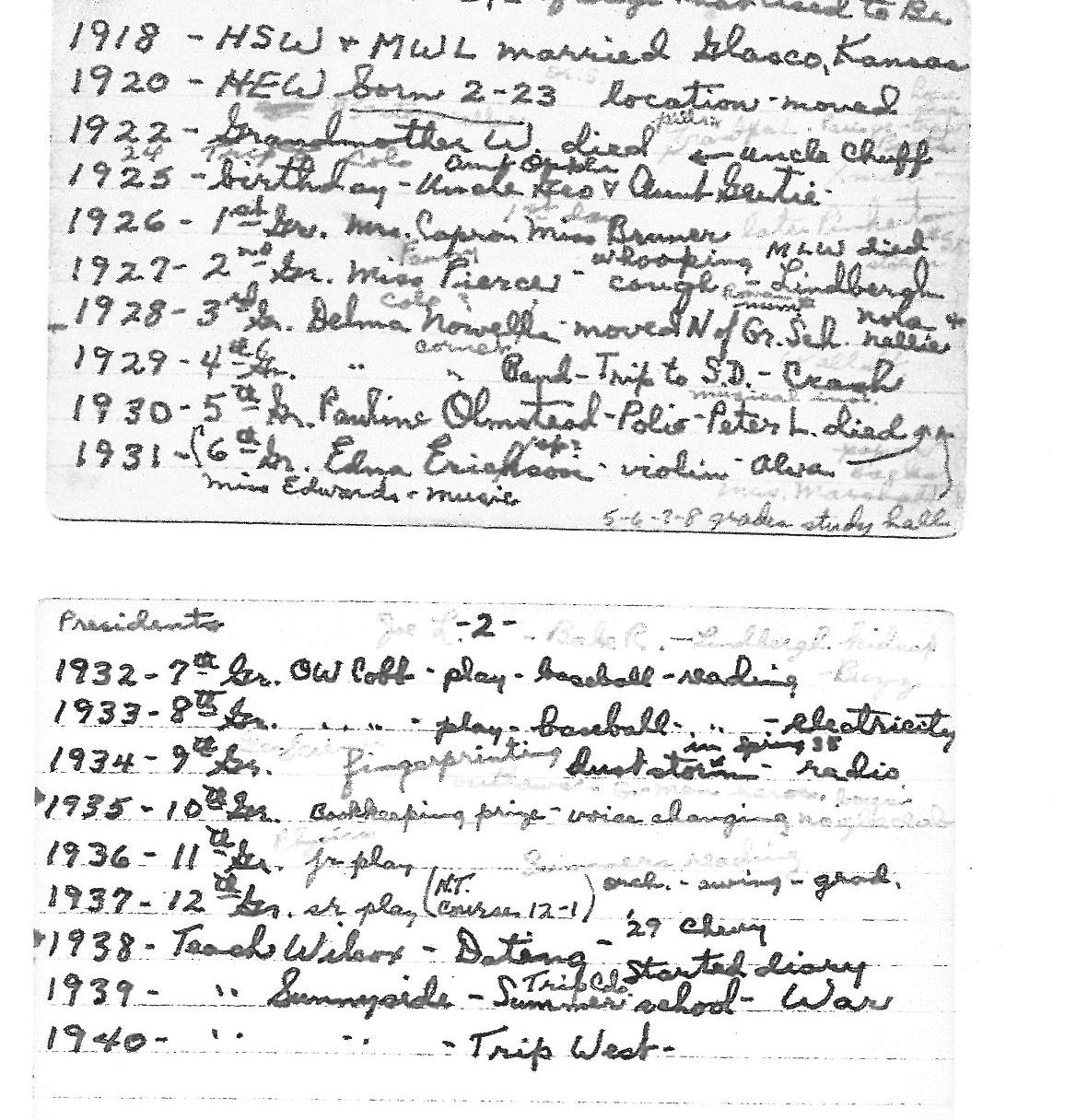
SLet's Star13061709260_0001My dad died 24 years ago this month at the age of 69.  A couple of days ago, my sister gave me a photocopy of an outline of his life in his own handwriting—which was fascinating.

I don’t know if it was after he knew he was sick or whether it was something he was thinking about—as all of us do at this point in life—but he was obviously thinking about writing the story of his life, and these were the notes he was making to himself of what happened along the way.

Dad used the working title “Of Days That Used to Be”—a little dramatic for my tastes, but, then it was just a working title!

He started with “1918 – HSW & MWL married in Glasco, Kansas”. The initials, of course, identify his parents Hanson Sumner Woodward and Mary Wilhelmina Lampert. 

Dad was an only child, so he always had a very close relationship to his parents. My dad only got one week of vacation each year, but for most of my childhood, there was no question but that our annual family excursion was to drive through the night to Kansas to visit his parents. And when Granddad Woodward died in 1963, Grandma Woodward came to Texas to live with us for last eight years of her life.  Dad was a devoted son.

Dad duly notes his own birth on February 23, 1920, the death of his grandmother in 1922, and a family trip to Colorado in 1924, certainly important family events, but ones that he probably only remembered as heard from his parents.

Dad loved learning!  It must have started early because the next most important years for his memoirs are his years in elementary school. He listed all of his teachers by name—except his fourth grade teacher who must have been very unimpressive not to make the list:  Mrs. Capron and Miss Bruner (1st grade), Miss Pierce (2nd grade), Delma Nowella (3rd grade—and who remembers their third grade teachers first name???) Pauline Olmstead (5th grade), Edna Erickson (6th grade), and O.W. Cobb (7th grade).

Dad does drop a few subscripts into his notes about getting whooping cough and “Lindbergh” in 1927. I don’t know if we have American heroes like Charles Lindbergh anymore!

From 1932, when he was 12, to the end of high school, he tended to list activities that he loved doing. In his own shorthand, he writes: “ play – baseball —  reading” .  If I had to describe my years 12-15, I might have made the same list!! Pretty interesting.

He notes a few personalities “Joe L (Joe Louis), Babe R (no explanation needed!) Lindbergh kidnapping”  but those were all afterthoughts in his notes, after “play – baseball – reading”.

In 1933, he adds electricity and in 1934, he added radio to his lists of interests and activities.  Hold on to that—because he did for the rest of his life.

After graduating from high school, he lists the following for 1938:  Teaching (his first job), Dating (first outings, I’m sure), and ’29 Chevy (first car).  The relationship of those three items is pretty obvious, isn’t it!!

Most Americans would say that WWII broke out in 1941 after the bombing of Pearl Harbor, but the word War makes his list in 1939—the year Hitler actually began WWII with the invasion of Poland.

Dad left teaching at his one-room Kansas schoolhouse in 1941 to go to Radio School in Kansas City, which is where he roomed with J.P. Lyles from Justin, Texas, who had a picture of his little sister on his desk, a Texas girl named Daisy with beautiful red hair.  The single entry that recurs every year from 1941-1945 is Daisy, ending with “married Daisy” and “war ends” –kind of a humorous juxtaposition that Dad would have definitely inserted purposefully. He had a great, but subtle sense of humor.

1946 – Converted . He took his faith very seriously and while he had always been a believer, even a church goer as a boy and young man, his word converted probably describes his new lifelong commitment.SLet's Star13061709260_0002

From this point on in his outline, it is pretty sketchy. I don’t know where the detail went, but it is mostly the birth of children and family moves.  He does include, however, the planting of the Eastridge Church of Christ in 1953, of which we were part, and Fort Worth Christian’s (FWC) beginning in 1958.  I know that these two events were BIG events in our family, moments when Dad’s faith was stretched and he grew. I believe that’s why they are in this list.

Mom and Dad were pretty young in 1953, and Dad was pretty new at commitment, yet he took on teaching responsibilities at the new Eastridge church, teaching jr. high boys for years—which was no easy task.  He became an elder sometime in the late 50s or early 60’s, just before Eastridge merged with other congregations to become the Midtown Church of Christ, where he continued to serve through that transition.

His outline ends in 1961, something I would explain with the fact that in 1965, my dad’s life changed drastically. He lost his job, lost his health, and became severely depressed. No doctors, no treatments, nothing really fully restored Dad to the physical or mental health that he had earlier enjoyed.

When he was diagnosed with terminal cancer (mesothelioma) in 1989, it was another bitter disappointment—the last one—that he had to deal with. I know that he had had bigger ambitions, bigger expectations for himself, but starting with his polio in 1930, his life had not been that easy.  This last and final disappointment could have hardened his heart.

I’m so happy to write the momentary conclusion of his story though for him because I know that he was faithful to the end.  As death came closer and after he had no more voice for words, he wrote on his notepad. “My Jesus, as Thou Wilt”

A few years back I had one of those dreams that is so vivid that I sometimes call it my vision.  I die in that dream and as I approach heaven, I see my dad running to meet me. I never saw my dad run because of his polio-inflicted lameness, so I know that this image is of a new time—and that his story did not conclude at the Prairie Mound Cemetery.

I look forward to running to see him too!HEW 

rocking chairIf your church is putting the Boomers out to pasture, you are making a big mistake!

Yes, I am one of the oldest Boomers, and I’d like at least to speak out for almost forty million Boomers born in the first half of the Boomer years (1946-1955), and what I say is probably true for the other 40 million born in the last half of the Boomer cycle (1956-1964).  Almost eighty million Boomers!

Here’s how you will know if your church is putting Boomers out to pasture:

  • You move your preaching minister out at age 59 for someone younger to attract a younger demographic.
  • You decide to disregard the preferred worship styles of everyone over 50.
  • No one over 50 teaches anyone younger than 50 in your educational program.
  • Your “senior” ministry is mostly eating and social activities, carrying for the sick and home-bound, and singing “foot-stomping” gospel songs.

 One out of every four persons in the United States is a Boomer!  And the percentage in your church is probably much higher because the Boomers, though some wandered off momentarily during the 60s,  returned to their churches shortly thereafter and have been faithful, though less traditional than their parents ever since.  Can you really afford to dismiss one out four people in the general population?

Another reason not to dismiss the Boomers is because they aren’t going to quit working! Sixty-seven percent say they are either delaying retirement or will never retire!  Every church longs for more involvement and investment of time by its members. Who has more time?  The younger dads and moms with three kids under 12, trying to grow their career and their family?  The parents of teenagers, trying to both work while running between school activities and ball games?  Or the empty-nester Boomers?

Here’s another reason not to ignore your Boomers:  “The typical U.S. household headed by a person age 65 or older has a net worth 47 times greater than a household headed by someone under 35, according to an analysis of census data released Monday” (Pew Research Center 2011).   Another source cited, “Baby boomers control over 80% of personal financial assets and more than half of all consumer spending.”

So let’s talk about who gives!  And let’s talk about who will continue to give over the next 10-20 years!  According to the Convio study (2010), the average Boomer contributes $901 per year, whereas a Gen Xer gives $796, and a Gen Yer  $341 per year.  Even though the individual difference between the Boomer and GenXer is not amazingly large, when you multiply that difference by the difference in group numbers, it makes a big difference! The annual total for Boomers is 47.1 billion compared to $28.68 billion for GenXers.

What I’m saying is that if you are already dismissing the Boomers, putting them out to pasture, then you are ignoring or retiring the most numerous and the most charitable people in your church, and those who have the most disposable time!

These are likely people who invented the word anti-establishment but who are probably still loyal to their tribe!  Also, while being very sympathetic and eager to support the social justice causes about which their children care so deeply, the Boomers are still evangelistic and understand the need to carry the Gospel in word as well as deed.

Every generation has to pass the torch of leadership.  Boomers will continue to be available for service, for leadership, and for active, meaningful participation in their church for twenty more years—and that’s a good thing!

Younger church leaders would do well to capitalize on this demographic in their churches, not caricature it!   

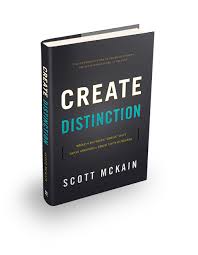
distinctionCreate Distinction by Scott McKain was recommended to me by our son Ben, who has a real knack for business.  In our family, lots of books circulate. I love it that our grown kids still search our bookshelves—because I do the same when I go to their houses!

I don’t read very many business books because that’s not the world I live in, but I do find that when one comes highly recommended, it often has salient information for . . . life as a Christian and especially life as a church leader.  Create Distinction really spoke to some of my own questions!

McKain’s basic premise is that being “great” (as in Good to Great by Jim Collins) is not really what makes your business grow; rather you must differentiate yourself, but then take differentiation to the level of distinction!

I’ve talked in earlier posts about some of my concerns in the church world that differentiation has become a bad word synonymous with sectarian. Our current cultural worship of tolerance has its good side, but it also has a gene that tends toward mediocrity, the worship of that which doesn’t rise above anybody or anything else, of that which does not claim to be true or holy, especially in the sense of set apart. The result in the American church world is lots of lots of churches and fewer and fewer Christians.

McKain offers three differentiation destroyers.  Let’s try these on in church clothes instead of business suits and see if any of them fit.

Differentiation Destroyer #1: Copycat Competition and Incremental Advancement

As happens in the business world, if we see a church growing when we are not, one of our first responses  is to look for ways to copy the successful church.  If they play rock praise songs on a smoke-filled stage, we think we need to do the same. If they don’t have Sunday school, then we do the same.  If their preacher wears jeans and flipflops, then we want our preacher to also.

McKain would say that when we copy other churches, we are focusing on those other churches rather than on the people that we are trying to speak Jesus to. We are exchanging the goal of speaking Jesus into the hearts of people for the goal of growing as big as that other church!  Pretty subtle temptation, isn’t it!

And even scarier, apparently in the business world, when “customers” can’t tell the difference between businesses, they buy less from all of them.  This translates into “all churches are pretty much alike—and none of them really offers me something that I’m really looking for” in the Christian world.

Differentiation Destroyer #2: Change That Creates Tougher Competition

McKain’s main example was that the development of the Interstate system created a new world of opportunity for something different—fast food, cheaper and predictable—and put lots of local retailers out of business because they tried, but could not compete with McDonalds.  They did not differentiate themselves enough to make their customers want to slow down and pay more for their “better” hamburgers. Having a better product was not good enough to keep them in business.

Don’t lots of our churches depend on the fact that they have a better “product” (the Truth) to attract people!  Either that or they try to become McDonalds—you’ve heard of the “honk and pray” churches. Both are losing strategies for growth.  McKain argues for differentiation and distinction instead.

Differentiation Destroyer #3: Familiarity Breeds Complacency

“When we have become familiar with something, and it is boundlessly available, we do not scorn it, hate it, or hold it in contempt. Instead, we take it for granted” (33)

How many of our members take church for granted? It’s comfortable, predictable, and there every Sunday morning.  Isn’t this a good thing?  You won’t lose anyone this way—except anyone who is not already there!  And those who are looking for a passionate commitment! And those who don’t want to be taken for granted themselves.

Familiar churches are probably not growing churches.  Where does that thought lead you?

Perhaps this very brief suggestion of what the book contains will lead you to read Create Distinction.  McKain does go on to talk about how to differentiate and become distinct. And it’s not by trying to be like everyone else!

We’ll look at some of those ideas later.


I love lucyIn May 1953, I was finishing first grade at Springdale Elementary School in Fort Worth.  Much is different today than it was then:

  • Our class memorized the 23rd Psalm to recite over the school’s intercom system during morning announcements.
  • We used big red No.1 pencils
  • We shared desks
  • We bought war stamps and put them in savings books. (The Korean War did not end until June 27, 1953)
  • We had bomb drills (in case of atom bombs) both marching outside of our building in nice, straight lines and getting under our desks (crowded with two people sharing a desk!)
  • We feared polio and ending up in an iron lung, which dictated much of what we were allowed to do in the summer months.

My dad worked with televisions, so we always had at least one.  We watched Dwight Eisenhower being sworn in as president in 1953, the birth of Little Ricky on I Love Lucy (71% of all TV owners watched this episode), and we watched Hit Parade’s version of How Much Is That Doggie In the Window, sung by Patti Page, which was the Number 1 pop song in 1953.

And to think that we could see all of that on just three channels—channels that went off the air sometime around midnight.

The average annual wage in 1953 was $3750, which is probably about what my dad made to support our five-member family. Our house was a little smaller than average, so it cost only about $9,000..  The average new car cost $1800. I do remember “gas wars” and prices of 13-15 cents per gallon.

We always ate at home—no such thing really as fast food. McDonalds was just starting in Florida. Dairy Queens were around, but they were mostly just for ice cream and milk shakes. When the milk shakes went to 35 cents, we had to stop buying them because they were too expensive.

So. . . . , that’s nice! Eisenhower

Here’s where we are today

  • No prayer in schools
  • Ipads in schools instead of Big Red pencils
  • Hundreds of 24/7 hr. TV channels (some still showing I Love Lucy!)
  • Teens spend more time now on the Internet than watching TV.
  • Average house sells for $330,000
  • Average car sells for $30,700 with gas at $3.89/gallon.
  • Polio is virtually eradicated
  • Sex is risk free with contraception. Even AIDS seems to have lost its scariness!

Life has changed a lot!

Here’s my point:  Who in 1953 was thinking that in 2013 our world would be as different as it is today? 

Who was thinking that in just 60 years,

  • both parents would have to work,
  • that a fast-growing percentage of homes would have only one parent,
  •  that same-sex marriage would be the issue of the day,
  • that Christians would be marginalized culturally,
  • that a drug culture would undermine our sense of security more than the threat of nuclear war


So what will life in the USA be like in 2073?  There is a lot of talk about how we want to leave the world for our grandchildren, but I’m not so sure we can even imagine what the world might be like then.

History does not believe in straight lines, so I’m not terribly concerned that the trends of today inevitably lead to their logical end!

Christians have a real advantage in this kind of world:  we know where we came from, we know whose we are, and we know where we are going!  That’s not entirely a metaphysical statement.

Having a framework to live within is a real help for dealing with a runaway culture.  We don’t know what diseases will threaten us in the future, we don’t know what political threats are waiting to be born, we don’t know whether technology will embellish the future or darken it, and we don’t know if our environment will continue to serve us or will retaliate and threaten our existence.

We don’t know what the future will be, but we can live in the days that each of us has with confidence and certainty that our lives are part of God’s plan.

We are not deists. We believe God was active in the world on Day One, has been involved and in control every day since, and will continue His work until the day of Redemption, when all of Creation will be made True!

“In Him we live and move and have our very being!”

Jackie Robinson We finally saw 42 last night! The theater was so full that we could not sit with our friends who came with us, so either lots of people are seeing it more than once, or we are not the only ones who waited too long to see it.

If you haven’t seen 42 yet, go see it tonight before it disappears from the theaters in your city.

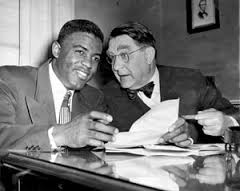
42 is the story of Branch Rickey (Harrison Ford) and Jackie Robinson (Chadwick Boseman)  breaking the color line in Major League Baseball.  Sure, it’s a baseball movie, but it’s so much more.  It’s a reminder of how ugly racism and prejudice are; the film is also a lesson in the kind of bravery and extraordinary effort required to challenge the status quo.

In 1943, Branch Rickey, then general manager of the Brooklyn Dodgers, quite intentionally began looking for the right black ballplayer to be the first African American in Major League Baseball since the1880s.  He may not have chosen the best baseball player in the Negro League, but he chose the one who could withstand the intense and acrimonious personal attacks that would come with being the first black major leaguer.  The one chosen had to not only be a great ballplayer, but one who “had the guts not to fight back” when the inevitable blows and threats came.

branch rickeyIn 1945, Rickey signed Jackie Robinson! The real drama of the film is Robinson’s struggle to answer the brutal harassment and racial slurring without stooping to similar tactics—a great lesson for the kids that will watch this movie!

The movie carries a rating of PG-13, not really because of the usual suspects: sex, violence, or even bad language, but because of the vicious racial comments. One particular scene has the opposing manager smugly slandering Robinson with every racial slur you’ve ever heard and it just goes on and on and on! I don’t know if a 10-year-old should be exposed to such vitriol, perhaps at least until they have studied some of the history and have a context for understanding it.

But your teenagers should see it!  They need to know what racism looks like and what it has taken to make any progress, so that they are not guilty in the future of the same social hatred.

Here are some ideas for the conversation on the way home—or if you are renting, even as you watch.

  • Why was Branch Rickey willing to go against all of his friends and advisors, why was he willing to “cause trouble” just to have a black baseball player on his team?  What would it take for you to do something like that?
  • How hard was it for Jackie Robinson to always “turn the other cheek?”  Do you think he should have fought back in a different way?
  • Did you notice one of the last scenes when the little boy learns to use the “n” word from listening to his dad at the ballpark?  What happened then that really confused the boy?  (The boy’s baseball hero Pee Wee Reese puts his arm around Robinson as a friend! Now the boy is getting two conflicting messages about Robinson.)
  • Are there any people around that our family looks down on? Or certain groups of kids at school that other kids look down on? (Be quiet and let your kids answer! You could really learn a lot!)

Don’t let your kids forget that this is a true story—and only part of the story.  A strength of the film is that it doesn’t take on Robinson’s whole career or his life story. It’s just the story of the breakthrough.  That does give you and your children plenty of space for further reading and research if you want.

Branch Rickey—and despite some critics who thought otherwise, I thought Harrison Ford did a terrific job, both of not just playing Harrison Ford, but also of bringing a historic  person to life—had some especially memorable lines.

But the speech that made the audience clap was when Rickey is talking to another GM who is refusing to allow his team to take the field against the Dodgers if Robinson is on the field, Rickey asks if him if he thinks God likes baseball. Rickey then tells him that if on Judgment Day God asks him why his team didn’t take the field and his answer is because of Robinson, that God is going to find that answer “insufficient!”

I think Rickey is right!  This movie portrays good people doing good things in the face of an immoral system propagated by hatred and ignorance, and the good prevails!  That’s a movie you should watch!

And, btw, God does like baseball!  His first book starts out, “In the big inning!”

pennybank_300Dan Palotta, delivered this Ted Talk in March 2013.  The video, already seen by over 1.7 million viewers, has stirred up a lot of passionate conversation.  Although he is talking from the perspective of humanitarian non-profit charities, I find that the environment he describes is also present for churches and religious non-profits as well. I wonder what you think?

I have taken the liberty to abridge and edit his talk to a blog-sized version, mostly by removing examples, but if you would like to hear the whole talk, go to www.Ted.com and search for “Dan Palotta: The way we think about charity is dead wrong!”


. . . The real social innovation I want to talk about involves charity. I want to talk about how the things we’ve been taught to think about giving and about charity and about the nonprofit sector are actually undermining the causes we love and our profound yearning to change the world.

  . . . We have two rulebooks. We have one for the nonprofit sector and one for the rest of the economic world. It’s an apartheid, and it discriminates against the [nonprofit] sector in five different areas, the first being compensation.

So in the for-profit sector, the more value you produce, the more money you can make. But we don’t like nonprofits to use money to incentivize people to produce more in social service. We have a visceral reaction to the idea that anyone would make very much money helping other people.(Interesting that we don’t have a visceral reaction to the notion that people would make a lot of money not helping other people.) You know, you want to make 50 million dollars selling violent video games to kids, go for it. We’ll put you on the cover of Wired magazine. But you want to make half a million dollars trying to cure kids of malaria, and you’re considered a parasite yourself.

And we think of this as our system of ethics, but what we don’t realize is that this system has a powerful side effect, which is, it gives a really stark, mutually exclusive choice between doing very well for yourself and your family or doing good for the world to the brightest minds coming out of our best universities, and sends tens of thousands of people who could make a huge difference in the nonprofit sector marching every year directly into the for-profit sector because they’re not willing to make that kind of lifelong economic sacrifice.

Businessweek did a survey, looked at the compensation packages for MBAs 10 years of business school, and the median compensation for a Stanford MBA, with bonus, at the age of 38, was 400,000 dollars. Meanwhile, for the same year, the average salary for the CEO of a $5 million-plus medical charity in the U.S. was 232,000 dollars, and for a hunger charity, 84,000 dollars. Now, there’s no way you’re going to get a lot of people with $400,000 talent to make a $316,000 sacrifice every year to become the CEO of a hunger charity.

Some people say, “Well, that’s just because those MBA types are greedy.” Not necessarily. They might be smart. It’s cheaper for that person to donate 100,000 dollars every year to the hunger charity, save 50,000 dollars on their taxes, so still be roughly 270,000 dollars a year ahead of the game, now be called a philanthropist because they donated 100,000 dollars to charity, probably sit on the board of the hunger charity, indeed, probably supervise the poor [person] who decided to become the CEO of the hunger charity, and have a lifetime of this kind of power and influence and popular praise still ahead of them.

The second area of discrimination is advertising and marketing. So we tell the for-profit sector, “Spend, spend, spend on advertising until the last dollar no longer produces a penny of value.” But we don’t like to see our donations spent on advertising in charity. Our attitude is, “Well, look, if you can get the advertising donated, you know, at four o’clock in the morning, I’m okay with that. But I don’t want my donations spent on advertising. I want it go to the needy.” As if the money invested in advertising could not bring in dramatically greater sums of money to serve the needy.

In the 1990s, my company created the long distance AIDSRide bicycle journeys and the 60-mile-long breast cancer three-day walks, and over the course of nine years, we had 182,000 ordinary heroes participate, and they raised a total of 581 million dollars. They raised more money more quickly for these causes than any events in history, all based on the idea that people are weary of being asked to do the least they can possibly do. People are yearning to measure the full distance of their potential on behalf of the causes that they care about deeply. But they have to be asked. We got that many people to participate by buying full-page ads in The New York Times, in The Boston Globe, in primetime radio and TV advertising. Do you know how many people we would have gotten if we put up flyers in the laundromat?

. . . The third area of discrimination is the taking of risk in pursuit of new ideas for generating revenue. So Disney can make a new $200 million movie that flops, and nobody calls the attorney general. But you do a little $1 million community fundraiser for the poor, and it doesn’t produce a 75 percent profit to the cause in the first 12 months, and your character is called into question. So nonprofits are really reluctant to attempt any brave, daring, giant-scale new fundraising endeavors for fear that if the thing fails, their reputations will be dragged through the mud. Well, you and I know when you prohibit failure, you kill innovation. If you kill innovation in fundraising, you can’t raise more revenue. If you can’t raise more revenue, you can’t grow. And if you can’t grow, you can’t possibly solve large social problems.

The fourth area is time. So Amazon went for six years without returning any profit to investors, and people had patience. They knew that there was a long-term objective down the line of building market dominance. But if a nonprofit organization ever had a dream of building magnificent scale that required that for six years, no money was going to go to the needy, it was all going to be invested in building this scale, we would expect a crucifixion.

And the last area is profit itself. So the for-profit sector can pay people profits in order to attract their capital for their new ideas, but you can’t pay profits in a nonprofit sector, so the for-profit sector has a lock on the multi-trillion-dollar capital markets, and the nonprofit sector is starved for growth and risk and idea capital.

Well, you put those five things together — you can’t use money to lure talent away from the for-profit sector, you can’t advertise on anywhere near the scale the for-profit sector does for new customers, you can’t take the kinds of risks in pursuit of those customers that the for-profit sector takes, you don’t have the same amount of time to find them as the for-profit sector, and you don’t have a stock market with which to fund any of this, even if you could do it in the first place, and you’ve just put the nonprofit sector at an extreme disadvantage to the for-profit sector on every level. If we have any doubts about the effects of this separate rule book, this statistic is sobering: From 1970 to 2009, the number of nonprofits that really grew, that crossed the $50 million annual revenue barrier, is 144. In the same time, the number of for-profits that crossed it is 46,136. So we’re dealing with social problems that are massive in scale, and our organizations can’t generate any scale. All of the scale goes to Coca-Cola and Burger King.

. . . Now this ideology gets policed by this one very dangerous question, which is, “What percentage of my donation goes to the cause versus overhead?” There are a lot of problems with this question. I’m going to just focus on two.

First, it makes us think that overhead is a negative, that it is somehow not part of the cause. But it absolutely is, especially if it’s being used for growth. Now, this idea that overhead is somehow an enemy of the cause creates this second, much larger problem, which is, it forces organizations to go without the overhead things they really need to grow in the interest of keeping overhead low.

So we’ve all been taught that charities should spend as little as possible on overhead things like fundraising under the theory that, well, the less money you spend on fundraising, the more money there is available for the cause. . . .  We should be investing more money, not less, in fundraising, because fundraising is the one thing that has the potential to multiply the amount of money available for the cause that we care about so deeply.

 . . . This is what happens when we confuse morality with frugality. We’ve all been taught that the bake sale with five percent overhead is morally superior to the professional fundraising enterprise with 40 percent overhead, but we’re missing the most important piece of information, which is, what is the actual size of these pies? Who cares if the bake sale only has five percent overhead if it’s tiny? What if the bake sale only netted 71 dollars for charity because it made no investment in its scale and the professional fundraising enterprise netted 71 million dollars because it did? Now which pie would we prefer, and which pie do we think people who are hungry would prefer?

Here’s how all of this impacts the big picture. I said that charitable giving is two percent of GDP in the United States. That’s about 300 billion dollars a year. . . .  But if we could move charitable giving from two percent of GDP up just one step to three percent of GDP, by investing in that growth, . . . . Now we’re talking scale. Now we’re talking the potential for real change. But it’s never going to happen by forcing these organizations to lower their horizons to the demoralizing objective of keeping their overhead low.

Our generation does not want its epitaph to read, “We kept charity overhead low.” We want it to read that we changed the world, and that part of the way we did that was by changing the way we think about these things. So the next time you’re looking at a charity, don’t ask about the rate of their overhead. Ask about the scale of their dreams, their Apple-, Google-, Amazon-scale dreams, how they measure their progress toward those dreams, and what resources they need to make them come true regardless of what the overhead is. Who cares what the overhead is if these problems are actually getting solved? If we can have that kind of generosity, a generosity of thought, then the non-profit sector can play a massive role in changing the world for all those citizens most desperately in need of it to change. . . .

IronmanIf you haven’t seen Iron Man 3, you are among the few! Much of the world has already seen it.  The film premiered in Paris in early April, then worldwide to record setting opening audiences in late April, and finally on May 3 in the U.S.

Not only are Robert Downey, Jr., Gwyneth Paltrow, and Tony Cheadle back to head the good-guy team, but well-known and greatly admired actors like Ben Kingsley and Guy Pearce appear on the dark side to create a dynamic contrast.  I like Rebecca Hall, but her character did not bring much to the film.

The plot itself has an occasional twist, but not enough to keep it from being as predictable as comic books usually are.  One new character, eight-year-old Harley (Ty Simpkins) becomes Tony Stark’s younger counterpart and even rescues Stark during one of the more interesting fight sequences, but, unfortunately for the film, this young sidekick is virtually abandoned for the rest of the film.

Iron Man 3 is rated PG-13, and rightly so! The audience comes expecting the comic-book action, but some of the violence borders on being up-close torture.  Trying to roast people alive is pretty disturbing; even the self-repairing bodies appear to be burning. Limbs are severed and people are blown up—all in tolerable ways for teens perhaps, but pretty rough for younger children.

In addition, though subtle, there are some sexual references you probably wish your kids didn’t have to hear.

But since lots of kids are going to see Iron Man 3, let’s talk about a few ideas that you can bring up in the car on the way home.

  • Many ideas start out as good ideas, but then are turned into bad things! Self-repairing bodies would be a good thing, wouldn’t it!   If this were real science, we’d be glad!  Can you think of other areas of science today that might be good, but could be turned toward evil if misused?  (Some answers:  cloning, genetic engineering, nuclear power, new drugs—really almost anything.  In fact, in God’s creation, everything was created good!  So what went wrong?)
  • “We create our own demons” – Tony Stark (Iron Man).  (You might want to point out that he is talking about evil, not literal demons.) What went wrong with God’s good creation is that people made bad choices and took His good things and used them for bad purposes.  Show them James 1:14,15 – “But people are tempted when their own evil desire leads them away and traps them. 15 This desire leads to sin, and then the sin grows and brings death.”
  • Tony Stark actually started this chain of events:  he lied to the young Alldrich Killian about meeting him on the roof, when he had no intentions of doing it.  Being kind and honest all the time can prevent lots of bad things from happening.
  • Being the good guy (even the Superhero) does not mean you are going to win every battle.  The good guys had to learn how to be defeated, then to come back and try again.  Learning to bounce back from defeat or failure is a very important lesson for our children to learn. You don’t always deserve a trophy.

Well, you probably don’t live that far away from the theater, so maybe that’s enough to get you home.

Remember two things if you talk with the kids about movies:  first, you are just planting seeds, so don’t dig too deep and don’t over water.  Secondly, you don’t have to get to agreement. They absorb a lot more than they want us to believe!

And it is just a comic-book movie after all!

maggie-smith-downtown-abbey-tIf you are not a Downton Abbey viewer, then you have some explaining to do! Sherrylee and I just finished Season 3, but now, days later, I find myself still thinking about some of the drama—sure, some of the melodrama also—and I do miss the Dowager Countess of Grantham, Lady Violet Crawley, played amazingly by the great Maggie Smith.

Downton Abbey has been broadcast in 200 countries worldwide and has had at least 120 million viewers!  I’ve been asking myself this morning what is it about this very British, very Edwardian period piece, that speaks to the whole world?

One of the ways to analyze narrative, whether TV, film, or literature, is to find the points of dramatic conflict or tension.  For instance, in Downton Abbey, the following points of tension are fairly obvious:

  • Tradition versus Change  –  The house and estate themselves represent ancient values and the fact that they are hardly financially viable—one of the main tensions running through the series—is because the world outside is changing in previously unimaginable ways.  WWI is (and was) the dramatic end of the old era—but not everyone at Downton knows that!
  • Upstairs versus Downstairs – The downstairs world of those in service, though intricately connected to the upstairs world of the lords and ladies, operates its own systems and personalities in both dramatic contrast but also a surprising degree of similarity to their superiors.
  • Dominance of men versus equality of women – The very first dramatic moment of the series occurs when the Crawley family with only daughters cannot continue at Downton because of a tragedy unless one of the daughters marries the heir-apparent, since only men can inherit titles.
  • Privileged social class versus democratic middle-class values – The new male heir-apparent to Downton is a distant relative who has grown up middle class. As another example in later episodes, the Crawley’s youngest daughter marries the chauffeur, creating still further class tensions in the family.
  • Inherited wealth versus mercantile values – The idea of the estate turning a profit is beneath the Earl of Grantham, but not the heir-apparent who later becomes co-owner of the estate.

I do not intend to allegorize Downton Abbey, but I can’t help but observe some obvious similarities to our yet-to-be serialized melodrama in churches today!

I wonder if a series called Old Campbell Street Church would go as viral as Downton Abbey?   Do you think we could develop the theme of Tradition vs. Change? What about the role of men and women?  And I have a pretty good idea we could do inherited values vs. current values!

The first episode might be something like this:  The Campbell family has been the wealthiest, most influential family in the Old Campbell Street Church for seven generations. The oldest male Campbell has always presided over the eldership, but the current Campbell family only has daughters, so the question of continuity of power is acute!

To make matters worse, the oldest and prettiest daughter has fallen in love with the youth minister, a talented but uncredentialed young man who did not even attend one of the big Christian universities!  The fear in the Campbell family is that if these two were to marry, the Campbell daughter would be doomed to a life of youth rallies and summer camps and that her husband, in an abuse of his family connection with them, might try to introduce new songs into the traditional worship.

The tensions increase further when the youngest Campbell daughter runs off with a Young Democrat!  Will she ever be allowed to return to the Old Campbell Street Church after having shamed the family?  And how will their children be raised?

Ridiculous, isn’t it!

Let’s just pray that God never has to watch this channel!


Paul writingThe last ten weeks have been a whirlwind. Having lived in Texas and Oklahoma for most of my life, I know that we are in tornado season, so perhaps acknowledging a whirlwind season is really a poor lead—but it is the truth.

I suspect even mentioning the whirlwind is more of an apology—at least a confession—to you for a lengthy season of spotty writing.  I actually love writing these posts and to have been as irregular as I have been during this season makes me feel rather undisciplined.

Two essentials—at least for me—have been scarce: reading and two hours.  Writing is an outpouring, but necessary to outpouring is inpouring. I often wonder as I write if the biblical writers knew they were writing Scripture–with a capital S?  Do you think the Apostle John thought: “Well, the Bible needs at least one really short, simple book to balance that theological tome that Paul wrote to the Romans, so I’ll just write a 3 John.”

Or did he really just sit down early one morning—like I’m doing right now—make himself a cup of coffee and think, “I better write to Gaius. I’ll be going there shortly and I need to begin setting the agenda of what I want to do during our visit”?

I’m pretty convinced John’s letter was a simple letter, perhaps only one of several that he wrote that day—his day of catching up on correspondence.  Was it inspired? Of course it was!  But wasn’t the promise that Jesus made to them that the Spirit would give them words of truth? Peter expressed it this way, “If anyone speaks, they should do so as one who speaks the very words of God” (2Peter 4:11). Doesn’t that expand inspiration beyond just the Twelve?

Do you really think that Matthew, Mark, Luke, and John suddenly had a tingly feeling or their quill started glowing when they were writing holy Words?  I don’t think so.  I think whenever they wrote—even their daily correspondence—they were writing as people who were always filled with the Spirit of God, who were always living their lives in His service, and who always found their words and chose to speak as those who speak the very words of God.

And shouldn’t we who are Christians do the same!  We have the same Spirit, we have the same commission, and we have the same task: “we believe, therefore, we speak” (2 Corinthians 4:13).

OK, so there went my first excuse!  I take it back. God has not been slack in pouring into any of us enough Spirit or words to share with others.

It takes me approximately two hours to write and publish each of these posts.  In a perfect world, these are two uninterrupted hours!  I often steal these hours early in the morning before I go to the LST office and start the day.  When we are traveling a lot, as we have been the last ten weeks, I will go to the hotel lobby to write while Sherrylee is getting dressed.

I don’t like to squeeze writing into too tight a confine, and I don’t like to write in bits and pieces. It’s hard to come back to some thought with the same passion or tone.

(I wonder if that explains why Romans is so easily divided into very different sections:  Paul had to take breaks and go visit some synagogue in Corinth or settle some dispute among the Christians, and when he came back, his mind had moved to a different place.)

Some dear friends collected the series of posts I wrote on “Raising Kids With A Heart For Missions” and published them in a little book.  I was very honored that they thought so highly, but I found myself in an awkward position of receiving a lot of credit that I didn’t deserve.

First and foremost, most of the ideas in the little book were first spoken or conceived by Sherrylee sometime early or during the child-rearing years of  our marriage.  Of course, we talked and shared them—and they were a gift to me and to our children—but she was my teacher!

Secondly, our marriage and our children—are all gifts of God, so whatever I have learned and all that I have experienced are not mine. I am not the originator, the creator, even the first recipient.

All of my insights, all of my experiences–all the words I have to say are His first: “In Him we live, and move, and have our being” (Acts 17:28).

. . . I feel better now. I’ve confessed my undisciplined negligence, I’ve admitted my plagiarism, and I’ve pointed any of you who are still reading back to God our Father, Jesus His Son, and the Holy Spirit, our Giver of Words.

That’s a good start for this day.