Feeds:
Posts
Comments

missions2If you are committed to evangelism—you’ll notice I did not use the word missions for fear of being redefined—and if you believe that the mission of members of the Kingdom of God is apostolic (bearers of a message) not just diaconic (servants), then you are a little concerned about the trend lines that I have suggested in the two previous posts.

If you believe that faith comes from hearing the Word of God and that people have trouble hearing the Word without someone to preach it—as Paul argued in Romans 10:14—then you are also concerned that being salt and light in the world is our mission as Christians, but if those seekers who discover the salt and see the light don’t know what to use it on or where the light is leading them, then they could remain hopelessly lost.

No one can come to the Father except through the Son, and no one has found the Son without knowing that Jesus is the Son of God and that He is raised from the dead. They have to hear the Gospel story.  No amount of good that they receive in the neighborhood will communicate the Good News unless those who serve also share the Story.  “We believe, therefore, we speak” (2 Corinthians 4:13)!

The projections of the last post based on the trends and tendencies in my first post could be taken as discouraging—but only if there were no hope!  Trends and tendencies, however, are not prescriptions!  Our God is victorious, so any defeats are just momentary. Even a valley of dry bones can be resurrected to life—and we are not dry bones yet, so there is much we can do to reverse what might seem to some as inevitable.

We need to relentlessly pursue holistic missions! Jesus went about preaching and healing (Matt. 4:23;9:35). We should do the same.

What would happen in our churches if those proposing every evangelistic effort were asked to show how they were going to tangibly show love and compassion to their audience? No evangelism without a compassion ministry component.

What would happen in our churches if those who planned and/or executed every service project, benevolent work, and every relief effort were asked to prayerfully consider and propose an appropriate time and means for introducing the Message to those benefited by their service?  No demonstration ministry without a plan for proclamation.

There is no competition between social justice and evangelism; it should be one and the same.

We need to find our urgency of mission.  Out of almost 7 billion people in the world,  2 billion claim to be Christians.  If we don’t believe in judgment, if we don’t believe in Satan, if we don’t believe in Eternal darkness, if we don’t believe that Jesus is the Way, the Truth, and the Life—then we can relax because there is no urgency.

If we believe that Jesus came “to seek and save the lost”(Luke 19:10),  then we can’t relax any more than Jesus did. We have to work—while it is still Day (John 9:4). The Night is coming!

We need to raise up an Army of Youth to fight for the Lord of Hosts! This may require intervention—because our young church leaders/ministers are of the same generation as our children and grandchildren as far as evangelism goes.  This may be a great time for elders to shepherd their youngest sheep!

I would like to see young children learning the heroic and inspirational stories of great Christian saints, then in middle school we should intentionally work with them on sharing their faith—verbally. What do they tell their friends who ask them why they believe in God or why they believe Jesus is the only way.  Group evangelism is especially appropriate for these young teens.

By high school then, having learned and practiced their mission at home, they would be ready for going other places, experiencing perhaps real poverty of both wealth and faith.

During college, they would then want to continue speaking the Name and doing Good in the world, and some—many more—would want to do internships and apprenticeships after college. And those who do not feel called to make it their life, would go into their marriages and their careers with a completely different framework—a missional framework—for every day of their lives.

We need churches who can imagine that God can use their resources to do things they can’t even imagine! 

  • Which churches among us will pick up the list of unevangelized countries and build their mission strategy around that information?
  • Which churches are ready to take on the Muslim world?
  • Which churches have the capacity and endurance to commit to work in the highly industrialized, yet predominantly secular countries?
  • Which churches will choose the nations where it is time for seed-sowing, not for harvesting?
  • Which churches will use the wealth of their congregations in places of extreme poverty, serving and proclaiming, at the expense of their own comfort?

And finally, we need courageous mission efforts! Let’s ban any sentence that starts with

  • “I’m afraid, if we do that . . . .”
  • “I’m afraid we don’t have the . . . .”
  • “I’m afraid our members won’t want to . . . .”
  • “I’m afraid it would take away from . . . .”
  • “I’m afraid someone might think that  . . . .”
  • “I’m afraid that’s bigger than we can . . . . “

The Revelation is clear that the “cowardly” are not at the banquet of the Lamb (21:8).  The  Witnesses are!

Conclusion

 One brother who attended this class at the Pepperdine Bible Lectures raised his hand and said, “Mark, you’ve been too negative. Give us something positive we can feel good about.”

I replied, “If you hear this as negative, then I’ve failed to communicate. While there are trends and attitudes that concern me, I have no fear for the Kingdom of God and great hope for Churches of Christ.

Our churches are living, dynamic expressions of the body of Christ and filled with His Spirit. We are human, therefore flawed, but not without His grace and His blessing, so where we are weak, He can make us strong.

And I’m certainly 100% positive that the Kingdom of God will prevail against the Gates of Hell.  Led by our Redeemer on a white horse, we will continue to attack the fortress of Evil until the final battle is accomplished.  The Victory is won!

I really want to win my little portion of the Great Battle for the glory and honor of Jesus. Don’t you?


missions2Yesterday, I suggested the following about the current state of foreign missions in Churches of Christ:

  • Greater tolerance has produced less urgency for evangelism.
  • Missions are being redefined as social justice activities at the expense of evangelization.
  • Churches are turning toward more domestic mission projects
  • Churches are depending on missionary organizations more.
  • More older Christians and fewer younger Christians are involved in foreign missions.
  • Churches are opting for safe and successful missions.

If you believe that the above statements are true—even mostly true—then what does the near future look like for missions from American Churches of Christ?

These churches will do less and less evangelistic work, both in the U.S. and especially in foreign countries.  Why?

  • Historically, most of our mission force has come from recent college graduates and young families.  Since this demographic is now the product of greater tolerance (less urgency) and has replaced  evangelism with social justice, fewer will have the motivation for foreign missions.
  • Those who do go overseas will more likely be involved in humanitarian activities than church planting.

As older church leaders become less able to travel themselves and because fewer younger people are evangelistic, churches will outsource their foreign missions and evangelistic work even more. This suggests that independent ministries will continue to grow until the older church leaders give up their leadership to a younger generation of leaders.

If present trends continue, the independent relief organizations and ministries focusing on social justice will increase both in number and scope, and as younger Christians grow in influence and wealth, more funds will flow from evangelistic missions to these serving ministries.


One of the difficulties of even discussing this is trying to avoid posturing evangelism against social justice—or vice versa!  Jesus went around preaching and healing—and we should too.  Unfortunately, however, in our humanity we are much more likely to swing with the pendulum than to look for harmony.

That’s what I want to do tomorrow.  In the next post, let’s talk about not about what is, or what is likely, but what is needed and how things could be with regards to missions in Churches of Christ.


missions2Today, I’m teaching a class at the Pepperdine Bible Lectures entitled “What’s New and What’s Needed in 21st Century Missions”  The things I want to say will be something that you will be interested in also, so I want to share them with you. My plan is to divide the hour-long class into three written parts for you and publish them all this week.

Introduction

As most of you know, Sherrylee and I have been involved in foreign missions in Churches of Christ since 1968, with my first survey trip to Europe, trying to determine where God wanted us to work. This led to our spending eight years in Germany, working with two other couples, planting a new church.

Upon our return to the States (which had been God’s idea, not ours!), we began the Let’s Start Talking ministry, which now 33 years later has taken us to 70 countries where we have visited and worked beside literally hundreds of missionaries and national evangelists and seen as many mission churches from our fellowship.

Our work has also given us two other fairly unique touch points which allow us a sense of the pulse of our fellowship.

First, recruiting workers and raising resources among Churches of Christ has given us opportunities to speak to many of our churches—most often with the mission committees and/or mission elders/deacons in those churches.  Many of our impressions and insights come from these conversations.

Second, almost all long-term American missionaries from our movement have a short-term mission as the experience that launches them on their life’s path. Both our work in recruiting, training, and sending thousands of students as well as our association, often partnership, with other short-term mission groups, and having had this vantage point for over thirty years, allows us to speak from firsthand experience about what has changed or not changed in our lifetime.

So, for today’s conversation just remember that I’m speaking from experience not research and that I’m speaking from the context of American Churches of Christ and our foreign mission efforts, not broader Christendom and not global churches.

What’s Now?

Churches of Christ are more tolerant. Most of our churches no longer preach and act like we are the only ones going to heaven!  We have discovered God’s graciousness and admitted our own infallibility, but it has made us a little unsure of who we are or why we should try to persuade others of anything.  We are less urgent about evangelizing because many of those we “evangelized” years ago, we are less sure that they really need it.  Our earlier evangelism had been persuading someone that they didn’t really know what they were doing when they were baptized, so their previous baptism was invalid.  We probably still disagree with them on the biblical teaching about baptism, but we are no longer willing to deny fellowship to someone whom God has offered His gracious forgiveness of their errors as He continues to forgive ours.

The meaning of mission among Churches of Christ is being redefined. Again, this was a needed correction. It was always a mistake to think that the mission of God was always somewhere else—probably overseas—accomplished only by special people. We now talk about missional churches¸by which we mean churches who encourage all members to live their daily lives, confessing Christ in word and deed. But in making this adjustment, a whole generation in our churches now thinks that missions is painting houses, building church buildings, serving the poor, playing with orphans, or any act of what is most often called social justice ministry.

Of course, missions ARE all of the above—but it is also telling the story of Jesus to those who don’t know Him, bringing the Word and the Light to people in ignorance and darkness.  While many have gone on mission trips, very few in our churches under 40 years old have actually shared the Word and told someone the Good News.

Church leaders are looking for mission work that allows greater involvement by their members.  For this reason and others, our churches seem to be looking for more domestic mission sites. Cost, oversight issues, and maintaining relationships all are more difficult with foreign mission points—and don’t we have growing unbelief in the States anyway!

More older Christians and Boomers are involved in foreign missions, through supporting it, but also in going on short-term missions projects. This is a terrific development, occurring mostly because of the changing demographic in our churches. These people are old enough to still be evangelistic, and now they have the funds to do what they have always wanted to do.

One interesting corollary of this is that many, perhaps most of our missionaries are finding their financial support from wealthier individuals instead of from our churches.  Churches are considered too bureaucratic, too self-centered, and too capricious. Getting support from an ardent supporter is considered vastly superior than to run the daunting and often fruitless gauntlet of trying to find supporting churches.

Churches are relying more on independent ministries for missions.  You may see this as either a good thing or a bad thing, depending on your own ideas, but I think it is a good thing to admit, at least.  Notice this list:

  • Great Cities   – Latin American missions
  • Eastern European Missions  –    Bibles, literature. and resources for Eastern Europe
  • China Now/China Vision   -placing Christian teachers in Chinese universities
  • Mission Alive    – Church Planting
  • Kairos  –  Church Planting
  • World Bible School/World English School   –  Correspondence courses
  • Let’s Start Talking    –   Short-term missions,
  • FriendSpeak  –   English Outreach in the United States
  • Sunset  International Bible Institute  – training of missionaries and mission internships
  • Missions Resource Network  –   missionary care, missions education, center for                                                                      missions information

Churches are only interested in successful missions.  And why should anyone support unsuccessful missions!  But successful is a tricky word. What most of our churches mean is that the mission is

  • Affordable
  • Accessible
  • Quantifiably impressive and motivating for the local church
  • Safe

So, taking this picture of missions in today’s churches of Christ, what do you see happening in the near future?  That’s tomorrow’s blog—and it won’t be this long, I promise!

Boston Marathon bombingThis weekend at least 25 major marathons will be run across the United States. Some have funny names like “Hurt the Dirt” marathon in Rockford, Michigan, or “Jailbreak” marathon in Wautoma, Wisconsin. Other marathons remind of us terrible times: Gettysburg North-South Marathon or Oklahoma City Memorial Marathon.

On April 15, the Boston Marathon moved from being one of the most prestigious marathons to one of the most terrifying.  At 2:49pm, two bombs killed two women and a little boy and injured 260+ people—physically!  The bombings also wounded the souls of all of us!

Random acts of violence are among the most heinous because they almost always target people who woke up on any given morning, got dressed, brushed their teeth, kissed their loved ones goodbye, and walked out their doors into Normalcy—whatever that is.

They were not the President who is reminded of the target on his back on a daily basis by the team of Secret Service agents who surround him. They were not the CEO in some South American country who signed the check for Kidnapping insurance or rides in a bulletproof limousine. They threatened no one, they were just . . . you and me.

What makes the wounds of random violence penetrate to our souls—whether it is the work of organized terrorists or of a single mentally-ill person with a backseat full of guns—is fear!

Almost twelve years after 9/11, two million people each day empty their pockets and walk through metal detectors and are reminded of that day of terror. Richard Reid tries to detonate his shoe full of explosives, so now we take our shoes off to be screened. Our belts come off because of the underwear bomber in 2009. Our laptops come out because of the Lockerbie bombings in 1988.  You cannot enter any federal building without walking through a metal detector because of the Oklahoma City bombing.

In fact, just the potential threat against any event has meant screening and major security tactics at major league baseball games, music concerts, at museums, and certainly any political events.

Unless you are almost 60, you can’t remember when the president rode in an open limousine!

So in the Nashville Country Music Marathon, the police have announced  “the deployment of hundreds of law enforcement and security personnel” who will be “very visible” along the 26.2 mile route.  More elementary school teachers will have guns, more movie theaters will guard their rear doors.

More mothers will not let their kids play in the front yard. More kids will carry mobile phones, mostly because their parents want to know where they are. And more preachers will be watched by bodyguards while their congregants sing and pray.

Random violence—the fear of dying–makes us afraid! As a boy, I slept in an unlocked house just seven minutes from where I live today. Now we not only lock the house, but we also set the alarm. Our cars have alarms, our keys chains have panic buttons

—and still random violence can kill our children on the streets of Boston, Oklahoma City, Sandy Hook, Aurora, and the list goes on much too long!

No amount of fear can protect you from deadly random violence.  Just like no amount of exercise or healthy eating can keep you from getting cancer or having a heart attack or getting hit by a bus!

Sure, we look both ways before we cross the street and we put on our seat belts in the car and we eat less red meat and  . . . .the list goes on, growing daily, of what we do to be safe and secure.

—and still we are afraid.  And still we are willing to spend more money and endure greater restriction in the hope of being safe and secure.

and still we are afraid of those who can kill us anyway!

Here’s the word from God today for you and me:

Because God’s children are human beings—made of flesh and blood—the Son also became flesh and blood. For only as a human being could he die, and only by dying could he break the power of the devil, who had the power of death.

 Only in this way could he set free all who have lived their lives as slaves to the fear of dying.(Hebrews 2:14-15 NLT)

“Slaves to the fear of dying,” that’s the phrase that convicts me.

If you want security and safety so that you will never die and no one you love will ever die—then you will always be afraid! And you will still die.

If you want to live free from the slavery of the fear of dying, then you can have that freedom through the One who promised: “Anyone who believes in me will live, even after dying. Everyone who lives in me and believes in me will never ever die” (John 11:25-26).

Then you can run your race without fear.

Strategic-PlanningThis series might be called a series of “reality posts” since we are following LST in real time through its strategic planning process.  To see earlier posts, go to the Categories drop down box and find the Strategic Planning Series.  Be sure and take the poll at the end of this blog post.

According to our planning schedule, March and April were to be given to gathering information from LST’s different constituencies, a task that sounds easier than it is.

We first had to decide which groups/subgroups we were going to survey. Some groups were obvious choices:  workers, donors, and missionaries. But then the harder questions surfaced:

  • Were we going to subdivide workers into campus workers, church workers, and FriendSpeak workers, sending each group different questionnaires?
  • What about donors who have only given to workers as opposed to those donors who support the ministry directly and regularly?
  • Should we send to church leaders whose congregations send one team a year or restrict it to those who send multiple teams? Should those surveys go to the preacher, an elder, the LST coordinator, or someone else?

We settled on five different surveys: Workers, Donors, Sending churches, Host sites, and FriendSpeak workers.

We chose to use Surveymonkey.com which would let us ask demographic questions and then sort any single survey for comparison. Reports can be broken out of just one survey of workers that would allow us to compare church workers with campus workers, for instance.

Then we had to compose the questions. That was a process also:  first drafts, followed by second and third drafts, questions scratched for ambiguity, redundancy, and other horrible reasons, then new, more pointed questions added.

After all the revisions were halted, the draft surveys were sent to some “testers” to see if the questions were clear, if they were understood as intended.  The tests resulted in a whole round of further revisions based on suggestions from the testers.

Finally, almost a month after starting the project, the surveys were ready to go out—but then it took another week getting the right email lists in place and, in the case of the sending churches especially, determining who should receive the survey,  then getting their email address.

Finally . . .

We sent out 9,943 surveys!  650 emails bounced with bad addresses; 265 people opted out of the survey, but that meant there were still 9028 good emails. We received about a 15% return rate on these surveys, which is pretty good, but we had to send out two reminders to get this result.

Our last group to survey is the staff.  Several weeks ago, we set aside April 18 as staff workshop day. That was today!  Today was the day, we met from 10 – 3pm to gather information.  But I’ll tell you about this meeting in the next SP post.

Before you leave, I’d love to ask YOU for input, so here is a simple but a real question that is surfacing. Help us know what people think by participating in this simple poll. It will take 30 seconds to answer and will be a help to us!

And, you’ll be able to see the results from the blog poll immediately.

win winI believe it was Stephen Covey in The 7 Habits of Highly Effective People who made the attribute of always going for Win-Win a virtue. In many life situations, this principle seems to be a very Christ-like approach. Win-Win seems to avoid a selfish approach to relationships, or dominance for the sake of dominance, or any form of self-gratification at the expense of others.

Sunday, I was reading in Acts 13-14 on the flight home from Europe, thinking about the places Paul went on his missionary journeys and all the mission points Sherrylee and I had visited on our trip. I enjoy his first and second journeys much more now that we have traveled in Turkey and been to some of the same sites, like Perga, Antioch of Pisidia, and especially Attalia , which is current day Antalya, a site where LST has been active for ten years now.

This time, however, as I was reading, I noticed especially how much opposition Paul and Barnabas faced:

  • Cyprus: Elymas (Bar-Jesus) the sorcerer “opposed them”.  Paul calls him a child of the devil and an enemy of everything that is right,” and then strikes him blind for a season.
  • Pisidian Antioch: Jealous Jews “began to contradict what Paul was saying and heaped abuse on him. Paul and Barnabas answer them boldly, then leave and shake the dust off their feet as a warning to them!
  • Iconium: Paul and Barnabas spoke so effectively(?) that the people of the city were divided. Some plotted to mistreat and stone them, so Paul and Barnabas fled for their lives.
  • Lystra: The apostles decided to do good in the neighborhood, so they healed a lame man which won them more favor than was good because the people tried to worship them as gods—until they were persuaded instead to stone them!

After Derbe, the two missionaries go back through most of these same sites to encourage the disciples with this message:  “We must go through many hardships to enter the kingdom of God” (Acts 14:22).

Does this sound like Paul and Barnabas had win-win experiences in their mission efforts?

On one of our stops in Europe we had a conversation with a missionary who was working in a country, not hostile but definitely indifferent to the Savior.  There was little danger of real persecution, but a high likelihood of rejection.

This missionary’s approach was to perform acts of service in the community, to gradually grow relationships with people, and to “wait and see what the Holy Spirit will do with it all.”

First, let me say that I believe that God works and accomplishes his plan even through our weakest efforts and in spite of  our best efforts. God’s sovereignty, however, has never left his people without obedient work to do.

I went away from this meeting thinking to myself: this missionary has built a system of missions where he risks almost nothing.  He is offering no words that can be rejected; he is not risking relationships by calling for repentance; he thinks he is a living testimony, and that he is doing the right thing by waiting on divine intervention.

Or he may have just bought into a conflict-avoidance philosophy of the cultural Christianity, broadly espoused and gladly believed in our society, where tolerance of diversity is the supreme virtue.

I don’t believe we have to imitate Paul’s missionary methods explicitly, but I do see Jesus and all of the early disciples not just making friends, not just avoiding conflict, not just doing good in front of people.  I see ALL of them BOLDLY speaking the words of God to people—and all of them experiencing rejection and conflict as a result.

Yes, they sometimes enjoyed the favor of all the people (Acts 2:47), but the word of God is described as a SWORD—a weapon.

I’m pretty sure Christians can’t win-win the battle without the Sword.

I’m not advocating the return to self-righteous bashing of others. I am advocating a return to boldly and overtly speaking the truth in love.

It’s still true today for all Christians, but some more than others:  “We must go through many hardships to enter the kingdom of God” (Acts 14:22).

MondayDid you know that many ministers/priests take the week after Easter off because they have had such an intensive preparation and celebration time, that they need some well-deserved rest and renewal?  Easter Sunday is Day One of the rest of our lives.

Sunday morning changed the history of the world. Without Sunday morning, the story that Christians would tell would be like the story in many great movements: an extraordinary teacher/leader, misunderstanding/persecution by those conserving the status quo, and eventual martyrdom.

Christians have a different story because Jesus died, was buried, but then rose by the power of the very Creator of Life itself. Jesus is not dead. Sunday morning changed the world—and the life of everyone who believes in the risen Lord.

Sunday morning was God’s part of the story. Monday begins our part!

Look at how the earliest disciples spent the time after the resurrection:

  • Two of them decided to go home to Emmaus, so disappointed—stunned—by the events of the weekend.  “We had hoped that he was the one . . . .” (Luke 24)
  • Some were sequestered in their room, trying to decide if they believed the story of the women.
  • Thomas was out, just trying to figure things out for himself—not with the others.
  • Even after Jesus appeared to them and breathed on them the Holy Spirit, some of them decided to do some fishing while they waited in Galilee (John 21)
  • The disciples went to Galilee (home for many of them), but then returned to Jerusalem to wait for further instructions. That’s a lot of walking in the 50 days between Passover and Pentecost.

What are you doing the day after Easter?

Of course you are putting away the Easter eggs and sending the Sunday clothes to the cleaners—just like the disciples going fishing.

But what are you really doing after Easter?

  • Are you waiting for Power?
  • Are you waiting for an assignment?
  • Are you waiting for instruction?
  • Are you waiting for an epiphany?
  • Are you waiting for the persecution to settle down?

Waiting is appropriate for a while!  We see that with the first disciples, but waiting was not the pattern for the rest of their lives?

The Easter story was the beginning for them, not the end of their ministry!  And so it should be for all of God’s people.  Sunday resurrection gives us a new life!  This new life is the same new life that Jesus received, or, as Paul said in Romans 6:13:

but rather offer yourselves to God as those who have been brought from death to life; and offer every part of yourself to him as an instrument of righteousness.

To “offer” is not to passively wait. To offer may be to actively wait, but in anticipation of a certain assignment.

The four Gospels all end with Monday assignments for these Jesus’ disciples and beneficiaries of the Sunday resurrection:

Matthew: 16 Then the eleven disciples went to Galilee, to the mountain where Jesus had told them to go.17 When they saw him, they worshiped him; but some doubted. 18 Then Jesus came to them and said,“All authority in heaven and on earth has been given to me. 19 Therefore go and make disciples of all nations, baptizing them in the name of the Father and of the Son and of the Holy Spirit, 20 and teaching them to obey everything I have commanded you. And surely I am with you always, to the very end of the age.”

Mark: 14 Later Jesus appeared to the Eleven as they were eating; he rebuked them for their lack of faith and their stubborn refusal to believe those who had seen him after he had risen.15 He said to them, “Go into all the world and preach the gospel to all creation. 16 Whoever believes and is baptized will be saved, but whoever does not believe will be condemned.

Luke: 46 He told them, “This is what is written: The Messiah will suffer and rise from the dead on the third day, 47 and repentance for the forgiveness of sins will be preached in his name to all nations, beginning at Jerusalem. 48 You are witnesses of these things. 49 I am going to send you what my Father has promised; but stay in the city until you have been clothed with power from on high.”

John:  21 Again Jesus said, “Peace be with you! As the Father has sent me, I am sending you.” 22 And with that he breathed on them and said, “Receive the Holy Spirit. 

What are you going to do on Monday?  Today?

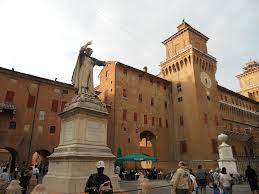
ferraraSitting at breakfast this morning in Ferrara, Italy, I had time to reflect a little on the whirlwind trip that Sherrylee and I have just completed in Italy.  It started down south in the boot heel and finishes when we fly from Pisa to France.  During our six days so far, we have been in contact with six churches, meeting with their leaders and often having an opportunity to speak to the entire church, to talk about their work and if LST might be of any help to them.

In virtually every case, we found Christians who wanted to grow, who wanted to be a brighter light, but were faced with significant challenges.  I don’t suppose that is much different from most smaller churches anywhere in the world.

We also met some wonderful Italian saints:  Pino and Evalina, Angelo, Alessandro, Paolo, Umberto, Marco, Luca—these are just a few of the names that I can spell, but there were many more sweet people.

And I don’t want to neglect mentioning the wonderful American couple that we met in Florence, David and Debbie Woodruff.  About five years ago, they gave up their comfortable life and home in the States to take on the work of directing the Avanti Italia program.

Avanti Italia was begun in the late 80s by former Italian missionaries to encourage young Americans to give two years of their life in missionary service, specifically in Italy for the encouragement of the Italian Churches of Christ.

The program was housed in the former Florence Bible School building in Scandicci, just outside of Florence.  I don’t know how many young people have gone through this program, but surely, each one has had a life-changing experience.

Different directors have had different programs, but they have all included outreach among the Italian young people, service to the Italian churches in the vicinity, and service to the community in general.

David, the current director, told us that the seven current Avanti Italia workers offer English conversation classes to about 80 people currently. In addition, one day a week they are encouraged to just pick someone they have met and spend extra time with them, developing a deeper relationship.

And another day each week is “work” day, when they let their hands do the talking.  In the last five years, with the help of their workers, the Woodruffs have completed much of a needed remodeling and updating of the Scandicci facility.

Maybe therein lies part of the answer for why anyone would want to go to Italy to do Christian mission work.  What sense does it make to go to one of the most “Christian” nations in the world?

Houses fall into ruin over time. Even those houses that are lived in and maintained need a fresh look, a renewal.  Our experience in countries like Italy is that

  • reading the story of Jesus again is a special blessing to many who would claim a church, but who have never really read the story for themselves.
  • A relationship of a deeply committed Christian can encourage a weaker or nominal believer to a closer walk.
  • Some people have never personally chosen faith in Jesus for themselves. Our conversation may be the first time they have ever been asked whether they really believe that Jesus is the Son of God.
  • Some people know the story and are true believers but they have never experienced the family of God as it can be experienced in a small congregation, where every member is known and cared for.
  • Every country has those who come as guests or visitors and who are not part of the Christian tradition at all.  Two of the young people in the church in Ferrara were born in Ukraine of Russian-speaking parents, but have been in Italy since they were small children.  They are thankful for those who told their family about Jesus and did not assume that everyone knows who He is.

I know of no church that is not plagued by human frailty and error. I would not presume to know when God blows out candlesticks.  I tend to lean more toward Jesus’ teaching in the parable of the weeds in Matthew 13:

24 He put another parable before them, saying, “The kingdom of heaven may be compared to a man who sowed good seed in his field, 25 but while his men were sleeping, his enemy came and sowed weeds among the wheat and went away. 26 So when the plants came up and bore grain, then the weeds appeared also. 27 And the servants of the master of the house came and said to him, ‘Master, did you not sow good seed in your field? How then does it have weeds?’ 28 He said to them, ‘An enemy has done this.’ So the servants said to him, ‘Then do you want us to go and gather them?’29 But he said, ‘No, lest in gathering the weeds you root up the wheat along with them. 30 Let both grow together until the harvest, and at harvest time I will tell the reapers, Gather the weeds first and bind them in bundles to be burned, but gather the wheat into my barn.’”

I’m thankful for this week in Italy and for every Christian here. 

Low_Hanging_Fruit“Low-hanging fruit” is one of those business idioms that comes close to being a cliché which good writers would try to avoid. I assume it comes from working in orchards, where pickers have no trouble getting the fruit that hangs low on the tree, but that getting above their own reach requires much greater effort—even ingenuity!

I’m sitting here in Turkey thinking about this metaphor in reference to foreign missions among churches of Christ—just wondering if we as a fellowship have been guilty of generally going for the low-hanging fruit.

Before I go any further, I want to categorically recognize the personal sacrifice and commitment of every Christian who left his/her home to go to a foreign mission site. My thinking is more about us as a fellowship, not the individual efforts of our finest who have gone where they were called.

Individuals from Churches of Christ left the country before the turn of the 20th century, but not many, and they are less remembered than those that went to Japan and East Africa, names like McCaleb, Benson, Andrews, Shewmaker, Merritt, families whose work has been legendary into our own time. These first major efforts at foreign missions were a test not only for the individuals who went, but also for the still provincial churches that supported them.

The next great wave of missions was the post-WW II era, those many who went to war-ravaged Europe and Japan especially, preaching to thousands, feeding and clothing people who had lost everything. By the 1960s, these countries had re-emerged materially, which meant they were no longer receptive, so churches in the states became less interested in these fields and looked for new places to work!

Fortunately, South America especially, but also Central America captured our imagination.  The great Brazilian team effort became the new model and standard for foreign missions.  The strength of the churches in Brazil testifies to the quality of work done during the first twenty-five years.  Argentina, Venezuela, Guatemala, Honduras, Ecuador, these countries have stood out perhaps among the Latin American countries—but ask any of those who worked there if response is the same now as it was then. After you ask that question, ask if the interest among US churches in that part of the world is as great as it was then.  I do believe that these two questions correlate.

The 1990s saw the collapse of the Soviet Union. Christians and resources poured into all of Eastern Europe.  For all of the interest in these countries just two decades ago, only Ukraine continues to capture any attention in the States.  Yes, there are still workers in Hungary, Romania, Albania, Bulgaria, Russia, Kazakhstan—thank God—but very, very few and the work is very difficult. Reception is slow now, and so the interest of the American church has waned.

Our attention turns: CHINA!! I love working in China and we (LST) love sending people to China. The spread of the faith in China is dynamite!

And don’t forget Africa! Interestingly, all the reports are that Africa has become the most Christian continent on earth.  In 2010, Christianity Today reported 470 million Christians in Sub-Saharan Africa. One in five of all Christians live in Africa. So, does anyone else find it interesting that Africa continues to be the #1 mission site for American Churches of Christ?

I’m sitting here in Turkey wondering where we are? I’m wondering where the Church is that has a vision for the Muslim world.  It will need to be a lifetime vision—probably longer! Who is thinking about Afghanistan, Iran, Iraq, Egypt, Algeria, Libya, Tunisia?  I just saw a CNN report that Morocco is one of the tourist-friendliest places in the world! Could that mean something for a visionary church?

Where are those who will have the same foresight as our brethren who formed Eastern European Missions or Continent of Great Cities (for South America) or China Vision to focus the Church’s attention on those sites.

I know I’m writing in huge brushstrokes and that there are individuals and individual congregations who have this kind of vision.

But, can we as a fellowship see beyond the low-hanging fruit? Can churches of Christ do the hard work in hard places for many, many years? Can we commit to sowing seeds that may not bear fruit for generations?

It’s not in our nature—but it is in our Spirit! 

anti-CatholicThe historian Arthur Schlesinger, Sr. said that Anti-Catholicism is “the deepest-held bias in the history of the American people”(Gibson, The Coming Catholic Church, HarperCollins 2004). That’s a very strong statement in the face of both our racial biases and our economic and political biases.

You might test your own level of Anti-Catholic bias by your response to the naming of the new pope Francis I yesterday.  Check which box fits your response:

____ Totally disinterested. This has nothing to do with me.

____  Very put off by all the pomp and media attention.

____  Visceral distaste for anything Roman Catholic

____  Mildly interesting political/historical event

____  Deeply moved

Many thought anti-Catholicism was dead in American politics after John Kennedy’s election, but wasn’t it interesting how it resurfaced with John Kerry’s run! I also found it tell-tale that popular evangelicals could find their way along the path from cult to Christian for a Mormon presidential candidate, but could not make the same journey for a Catholic candidate.

According to what I have read, Anti-Catholicism came to America from Great Britain with the earliest Protestant settlers who were either religiously at war with the “Whore of Babylon” or the “Anti-Christ,” or they were early conspiratists, fearing a Vatican-controlled world dominance.  (During JFK’s run for office, I personally heard both of those strains of anti-Catholicism from our pulpits!)

The 19th century version of Anti-Catholicism derived more from immigration issues.  Whereas the United States had been predominantly and pervasively Protestant, waves of Irish Catholics, Polish Catholics, and Italian Catholics began to change the landscape and threaten the national culture in more than just religion. Many Americans do not know that Anti-Catholicism was a core component of the Ku Klux Klan’s identity.

Maybe this is a good time to re-think your own mindset toward Roman Catholics. Even in the very “liberal” circle of our fellowship which is prepared to accept into fellowship anyone who says Jesus is Lord—that’s usually how it is stated—I’ve noticed that they rarely include Roman Catholics in their circle. It’s pretty easy to include all those Christians who sing the same praise songs, have the same kinds of buildings, and who are more likely to fellowship us.

Does anyone doubt that Roman Catholics believe that Jesus is Lord? Our experience in Germany as missionaries was that we had much more in common with the Roman Catholics than we did with the Protestant church.  The Catholics believed that Jesus is the Son of God, that He rose from the grave, that He is coming back for His own. They believe the Bible is the Word of God, inspired by the Holy Spirit. Catholics baptize for the forgiveness of sin, take communion every Sunday, and they believe in the power of prayer.

The Protestant Church in Germany does not hold to any of the above! Some in the Protestant Church do—I don’t want to demonize them—but most of the pastors do not believe in the resurrection, and as Paul said, if you don’t believe that then you hope in vain!

Of course, after almost 2000 years of history, the Roman Catholic church has picked up a lot of tradition, a lot of doctrinal diversity, and a lot of human fraility. My brother-in-law, who has become a Catholic priest, says that it is the best of churches and the worst of churches.

Here’s what I know. The Roman Catholic church has had missionaries telling the story of Jesus in every country of the world long before—sometimes centuries before—my church sent anyone! They stand for Jesus, for obedience to the Word, for morality, and for peace in a belligerent world like few Christian churches have done.

I do not believe all they teach or practice; I really do not like it that I am excluded from communion with my brother-in-law.  But I will not pretend that the 1.3 billion Catholic believers in the world do not know Christ.

I am praying for the new pope that he will follow Christ and that he will lead his flock nearer to God.  That’s my prayer for him and for you as well.