Feeds:
Posts
Comments

Fred Luter, Jr. First African-American President of SBC.

I’ve been fascinated by all that has come out of the Southern Baptist Convention which was held June 19-20 in New Orleans this year.  Southern Baptists are the largest denomination in the United States with over 16 million members in 2010.

Prior to the Civil War, the Southern Baptists separated from the Northern Baptists over the issue of slavery. After the Civil War, most black Baptists churches separated themselves from the Southern Baptists and started the National Baptist Convention.

During the last half of the 20th century, the SBC began moving away from its southern distinctions, becoming both more racially diverse and again more national, with representation in at least forty different U.S. states.

The biggest public news to come out of this year’s convention was the election of Fred Luter, Jr., as the first African-American president of the convention.  Although there are only 3400 black churches in the SBC, Luter, minister for the First Baptist Church in New Orleans, was elected “with overwhelming affirmation, sustained applause and no verbal opposition” (BP News).  Although some critics point out that this is a very small step –and a late step—in developing greater diversity, surely we can agree that Luter’s election is a positive move for a church virtually denominated by racism for so many years.

The biggest controversyat the SBC was the battle to determine how Calvinistic real Baptists are.  Interestingly enough, some are surprised that any Baptists are Calvinist,  while others would argue that all Baptists came out of Calvinism.

John Piper, Mark Driscoll, Tim Keller

In 2009, Time magazine named “The New Calvinism” one of the ten ideas changing the current world (3/12).  Only 10% of current Southern Baptist pastors say they are Calvinists, but surprisingly, over 30% of recent SBC seminary graduates identify themselves as such. The future seems to be moving towards Calvinism among the Baptists.

Because of that look into the future of their denomination, just before the SBC convention in New Orleans, a well-renowned group of Baptist leaders published a paper entitled,  “A Statement of the Traditional Southern Baptist Understanding of God’s Plan of Salvation,” in which they tried to state for the record what Southern Baptist accept and reject about Calvinism.  At the convention, the word heresy was thrown around—just to demonstrate how emotional and divided the Baptists are on this theme.

Churches of Christ and most restoration movement churches simply reject Calvinism out of hand. Many argue that the restoration movement was a reaction to the Calvinism of the churches its leaders were leaving.

What this means is that most average members in our fellowship have never even heard of TULIP, nor would they be tempted by any of its positions even if they had.  That general indifference does not mean, however, that our younger generation of preachers especially are unaffected by the teachings of men like John Piper, Mark Driscoll, Tim Keller, and others.

I’m going to come back to Calvinism soon, but I do want to say now that I do believe that we may have been so afraid of those biblical words predestination and election that we have had a tendency to selectively limit God—and imposing limits on God I find to be extraordinarily presumptuous!

Finally, the biggest speech of the SBC convention may have been delivered by David Platt, author of Radical: Taking Back Your Faith From the American Dream and Radical Together: Unleashing the People of God for the Purpose of God, two books widely read and discussed in evangelical circles.

David Platt

Platt had been criticized for statements he had made at a conference in Austin which seemed to suggest that he had serious issues with the “sinner’s prayer.”  Questioning the “sinner’s prayer” for Baptists is like throwing stones at Billy Graham and all the great evangelists. In addition, his perceived criticism of the “sinner’s prayer” seemed to his critics to align him with the “Calvinist stars” of the Southern Baptist,  so Platt felt the need to speak to that criticism during the Pastors Conference of the SBC convention.

His speech was entitled “What I Really Think About the ‘Sinner’s Prayer,’ Conversion, Mission, and Deception.”  Fortunately, he posted the text of his address in his blog on 6/28/2012 and it was re-posted by Christianity Today at its web-only site.  Click here for the full text.

Why am I bothering to report on the Southern Baptist to you, most of whom are not Southern Baptist?  What difference does it make what David Platt thinks?  If you are asking these questions, then you need to get on Twitter and just listen to our younger preachers.

At lectureships just this year—the nearest thing Churches of Christ have to conventions—I have heard and sometimes participated in discussions of lingering racism in our congregations, especially the lack of recognition and platform for younger, minority preachers.  I have heard the serious debate over the existence of Hell and the questioning of the need for evangelism.  These conversations are our version of these same issues the Baptists are discussing.

Why am I interested in the SBC convention?  Because their public issues will be our issues in the near future—if they aren’t ours already!

The word story is a key word to understanding the post modernist generation.  Earlier generations had other words. I think the word for my generation was journey; everybody was on a journey and everything was a journey.

But journeys have given way to stories now.  Now everyone has their own story and life is a narrative. Your witness is your story; your upbringing is your story; your history is your story. Preaching has moved from exegesis or exhortation to story telling.

The King James Bible (1611) uses the word story only in two obscure passages in 2 Chronicles. The American Standard Version (1901) never uses the word story  in this way, but The Message ( 2002) uses the word story  161 times! 

Hymns are a place where the generations meet around the word story, not necessarily in the great anthems, but in some of the more populist hymns of the 19th century.  Here are some that you will probably recognize

Tell Me the Old, Old Story (1866) with lyrics by Katherine Hankey.

Tell me the old, old story of unseen things above,
Of Jesus and His glory, of Jesus and His love.
Tell me the story simply, as to a little child,
For I am weak and weary, and helpless and defiled.

Tell me the story slowly, that I may take it in,
That wonderful redemption, God’s remedy for sin.
Tell me the story often, for I forget so soon;
The early dew of morning has passed away at noon.

Tell me the story softly, with earnest tones and grave;
Remember I’m the sinner whom Jesus came to save.
Tell me the story always, if you would really be,
In any time of trouble, a comforter to me.

Tell me the same old story when you have cause to fear
That this world’s empty glory is costing me too dear.
Yes, and when that world’s glory is dawning on my soul,
Tell me the old, old story: “Christ Jesus makes thee whole.”

Refrain

Tell me the old, old story, tell me the old, old story,
Tell me the old, old story, of Jesus and His love.

Interestingly enough, she also wrote the words to I Love To Tell the Story.  “I love to tell the story of unseen things above . . . .pretty post modern—except for the word above!

Then there is Tell Me The Story of Jesus, written by Fanny Crosby around 1880:

Tell me the story of Jesus,
Write on my heart every word.
Tell me the story most precious,
Sweetest that ever was heard

But one of my favorite hymns from my childhood which still occasionally surfaces is the rousing, almost dramatic  O Listen To Our Wondrous Story, sometimes titled What Did He Do?.  The words were written by James Gray around 1903, but, in this instance, the marriage of the words with the music by William Owen, a worker in the slate quarries of Wales in the mid-1800s, was what really made the hymn work.

I especially loved the antiphonal chorus, where the women sing, “Who saved us from eternal loss?” and before they even finish the question, the men are responding with the certain answer, “Who but the Son upon the Cross!”   As we most often sang it, the first questions were sung softly, with each succeeding question and answer a little louder, until the final triumphant response was full volume.

The final verse makes the question of story very personal: Will you surrender to the Savior, to his scepter humbly bow?   So journey and story meet in the certainty of Jesus and His Cross and the necessary response that it requires from me!

I love this song still:

O listen to our wondrous story,
Counted once among the lost;
Yet One came down from Heaven’s glory,
Saving us at awful cost!

No angel could His place have taken,
Highest of the high though he;
The loved One on the cross forsaken,
Was One of the Godhead three!

And yet this wondrous tale proceedeth,
Stirring heart and tongue aflame!
As our High Priest in Heav’n He pleadeth,
And Christ Jesus is His Name!

Will you surrender to this Savior?
To His scepter humbly bow?
You, too, shall come to know His favor,
He will save you, save you now.

Refrain

Who saved us from eternal loss?
Who but God’s Son upon the cross?
What did He do?
He died for you!
Where is He now?
In heaven interceding!

What are the goals you have for your church?  Aside from the very specific goals of painting the auditorium or getting new elders next year, would any of these be your goals?

  • More of our members get into the Word
  • Greater prayerfulness
  • Increased generosity
  • Greater personal engagement

I can’t imagine any healthy, growing church that is not keenly conscious of the need to grow in these areas almost all of the time!

I know several churches that are doing The Story series this year to encourage serious Bible study. Another church is reading the entire Bible in ninety days together, with Sunday sermons tied into the weekly reading.

Has your church done the forty days of prayer exercise?  We did it for our neighborhood a few years ago. Some do it for special contributions or special outreach events.  Or has your church done a twenty-four hour prayer vigil. Many African churches have these on a monthly basis.

Generosity is tougher on our congregations. You might have done a Dave Ramsey series or Crown Ministry if you are at a larger church.  Smaller churches seem to be limited to the occasional sermon which encourages generosity.

Unfortunately, the 80-20 Rule still prevails at most congregations, no matter what area of body life that we talk about.  Eighty percent of the members do 20% of the work and 20% of the members do 80% of the work.  Giving and praying seem to follow the same 80-20 pattern.  So we hire involvement ministers to motivate us to do what should be the most natural functions of every member of the body, that is, to do actively what we were created in the body to do!

What if you could lead your church into one opportunity, one activity, one exercise, or one ministry that would address all of these critical spiritual needs at once, AND what if you could expect a 70% success rate with the members, AND what if it was something in which virtually ALL of your members could participate regardless of age, Christian experiences, family situations, or most other external factors?

Have you read Dr. Craig Altrock’s book called The Shaping of God’s People:  One Story of How God Is Shaping the North American Church Through Short-Term Missions The Shaping of God’s People:  One Story of How God Is Shaping the North American Church Through Short-Term Missions His book is the result of his dissertation research for some of our finest scholars at Harding School of Theology.

What makes this study so important is that his conclusions are not just anecdotal or random, but rather these results are disciplined, quantitatively verifiable, and peer-reviewed conclusions.

A group of approximately 800 short-term mission workers who had participated in a foreign short-term mission with Let’s Start Talking, including people whose experience was up to twenty years prior to the study, were asked to report in a variety of ways on how their short-term mission experience affected them.  The briefest of summaries is as follows:

  • 77.5% reported that they read Scripture more often and more missionally than they did before their short-term mission trip.
  • 86.1% reported that they pray differently–more intentionally and specifically after their short-term mission.
  • 72.6% reported that they are more generous, that they give more to support the missions of their churches after their short-term mission project.
  • 72.6% reported that they are more involved in their church, especially outreach activities, after their short-term mission project.

What this says to me is that the church that wants to dramatically reverse the 80-20 ratio in their church should make good short-term mission experiences not just one of many opportunities, but rather an expectation for all the members of the body, something that everyone will do.

Good short-term missions experiences will transform first your members, then your congregation! 

Brother Slater was a kind of celebrity at our church when I was a boy. He and his wife Sister Slater would sit toward the front on the left side of the auditorium. As a young boy, all I knew was that he had written Walking Alone At Eve, which was one of my favorite songs.

William Washington Slater was more than a celebrity; he was a great saint and servant of God. Born in 1885 in Arkansas, Will’s family moved to Indian Territory in 1890 to farm. Like many boys of his time, his formal schooling ended in the fourth or fifth grade, but not his desire for learning.

By the time he was 18, his special interest in music was apparent.  The story is told of his saddling and riding a mule fifteen miles every Saturday to attend singing schools, so he could become a better song leader.  He later decided he wanted to preach as well, so he soon became a preacher-song leader, preaching gospel meetings and leading singing for other great preachers.

He married Nettie Washington in 1910, and they had five children. Three of his daughters went to church at Eastridge Church of Christ, where I grew up, so I knew them and several of their children. Thelma Slater married Wade Banowsky and one of their sons William Slater Banowsky became president of University of Oklahoma and Pepperdine University.

I remember the quiet announcement at church that Brother Slater had died while preaching a meeting in Arkansas in 1959. According to accounts of his last day, he had preached his sermon and, as was his custom, offered to stay after church and sing with any who wanted to join him.  Someone asked him to lead a song entitled “This Is Someone’s Last Day.” Before leading it, he reminded the church to pay attention to the truth of the message, not knowing that it was his very own last day.

Walking Alone At Eve (1917) was one of Will Slater’s earliest songs.  As in many older hymns, it is God’s creation that inspires worship. I imagine country folks walking or riding in their wagons home from an evening of preaching and singing. As it grows dark and the stars start popping out, this might be one of the songs that they would sing.

Walking alone at eve and viewing the skies afar,
Bidding the darkness come to welcome each silver star;
I have a great delight in the wonderful scenes above,
God in His power and might is showing His truth and love.

Sitting alone at eve and dreaming the hours away,
Watching the shadows falling now at the close of day;
God in His mercy comes with His Word He is drawing near,
Spreading His love and truth around me and everywhere.

Closing my eyes at eve and thinking of Heaven’s grace,
Longing to see my Lord, yes meeting Him face to face;
Trusting Him as my all where-so-ever my footsteps roam,
Pleading with Him to guide me on to the spirits’ home!

The chorus is that simple, ubiquitous longing for rest with God.  Resting is the reward for working hard. I wonder why we don’t sing many songs about rest anymore?  The melody of the chorus is simple, not a passionate cry, but a quiet, simple longing.

O for a home with God, a place in His courts to rest,
Sure in a safe abode with Jesus and the blest;
Rest for a weary soul once redeemed by the Savior’s love,
Where I’ll be pure and whole and live with my God above!

I don’t really know why, but I have sung this song to all of our kids as I rocked them to sleep.  Perhaps it was singing at the end of the day, usually in a darkened room, and the simplicity of the melody—I’m not quite sure why it became one of those songs I sang to them, but it did.

I do know that it cleanses your soul to hold your little God-gifts on your shoulder and to sing about being pure and whole and living with God. The congruity of those precious moments with this melody has always been redemptive for me.

Great hymns do improve our walk with God. 

It’s graduation time, a wonderful time for parents to be very proud of what their kids have done, a time to brag on them and show off all their trophies to the grandparents and friends!

But wait!  Did you think I was talking about high school or college graduates?  No, I was talking about kindergarten and elementary school graduates!

It was the trophy thing that threw you, wasn’t it! But by the time an almost 7-year-old boy starts first grade, he could easily have half a dozen trophies for soccer, more for T-ball, and some for basketball. In addition, there are likely ribbons and medals, all displayed on the mantle with a couple of cap-and-gown graduation pictures, one from pre-school and one from kindergarten.

For a couple of decades now, our society has been very concerned about children growing up with

Self-confidenceSelf-regard

Self-worth

Self-love

Self-awareness

Self-esteemGood self-concept

Self-respect

Self-acceptance

Good self-image

Some are wondering if we aren’t using the word self much too often.

Recently, David McCullough, Jr., an English teacher in Wellesley High School in Massachusetts delivered the commencement speech for the high school graduates.  In the course of his address, he told the graduates and their parents, “You are not exceptional,”  and shocked people enough to cause a national uproar.

How dare he say that my child might be average! The nerve of a teacher to evaluate my child by some standard.  How could he sweep through our houses and make all of our kid’s trophies vanish?

I have some personal experience relevant to this topic from my own days in the classroom. For twenty years, I taught English to college freshmen and sophomores, and my annual evaluations were generally quite good—especially taking into account that I taught required general education courses that most students were poorly prepared for and didn’t want to take.

I noticed, however, in the last three or four years of teaching that some new comments started appearing in my evaluations that I had not seen before. Students started saying that I was not showing them proper respect and that I did not listen to them.

I took these comments very seriously, but was puzzled as to what I was doing differently. I prided myself on good relationships with my students, with lots of open discussion and exchange of ideas.  What was I doing suddenly that made them feel disrespected??

After probably a year of introspection as well as seeking the counsel of my colleagues, I came to the conclusion that I had really not changed, but that the students had changed.  My students were coming into the classroom with two completely new assumptions for which I was unprepared:

  • Assumption One:  The opinions of a student are as authoritative and valid as those of the professor.
  • Assumption Two:  It is disrespectful for a professor to suggest that a student’s opinion might not be right or might benefit from further research, especially in front of other students.

I know there are professors who act like they are the Alpha and Omega of all knowledge, but, you’ll have to take my word, that I am not of that ilk. Yet, some of my students had that impression and it really bothered me.  In fact, I haven’t been in the classroom for almost ten years now, and it still bothers me!

What we are asking ourselves is do we really build healthy self-confidence by giving every kid a trophy or are we promoting a sense of entitlement and rewarding mediocrity.  Here are a few symptoms of kids who might have learned the latter from our trophy mentality:

  • I should get a good grade just for coming to class.
  • I should get a good grade for turning in the work, regardless of the quality of that work.
  • Everybody should get to score a goal.
  • Children’s ideas about parenting are as valid as parents’ ideas about parenting.
  • What? I have to practice to make the team!
  • “You can’t tell me I’m wrong! That’s just your opinion!”

Sherrylee’s Aunt Jane, a long-time teacher and counselor at Greater Atlanta Christian School, once gave us good advice, saying, “A child does not become confident through compliments, but through competence.”

 Somehow this should all be easier for Christians because our confidence and sense of being loved comes from Him, not from ourselves.  A sense of entitlement is erased by His grace, which rewards us with what we do not deserve, but because of His Goodness, not ours.  Our striving for excellence grows out of a sense of worshipful gratitude.  Our motivations are Him-centered, not self-centered.

Teaching our children, both with words and deeds, about God is the only way to give them real confidence and competence.  And then, someday, as the song says, we’ll bow down and lay our trophies at His wounded feet.

A good place for conversation.

We need a new word! We’ve called them retreats, advances, weekends, and other things, but we need a good positive word that implies building a collection of common experiences with people that we go to church with, but that we don’t really know that well outside of church.

I’m writing as the sun is coming up on Sunday morning over Lake Granbury. The sky is that pinkish orange in the east, the birds are awake, so the cicadas are toning it down, lest they become breakfast for the birds. The morning breeze is just enough so that I can sit here on the balcony in my pajamas and be comfortably cool on what may be one of the hottest days of this year by late afternoon. We’ll be home by then!

Sherrylee and I have spent the weekend with three other couples and one single man, all members of our small group from church. Two couples we have known for several years; one couple joined our group just nine months ago, and the single man came into our lives even more recently.

For two years now, we have been saying that the only way to really get to know people at church is to share common experiences outside of church—but that’s easier said than done.  Finally, about four months ago, we committed to this weekend—and still two other couples could not make it work.

Our goal was to be together, to get to know each other, to build each other up, and to build an album of common experiences that will grow more meaningful as we live and worship and serve together in the future.

If you are younger, you might be surprised to learn that it is hard for older people to make new friends—real friends, not just new acquaintances.  Sherrylee and I moved to Fort Worth eleven years ago. We left the place where our kids grew up and went to school, so we left their friends and the parents of their friends with whom we had shared so many school programs, soccer games, and musicals.  We left our friends and colleagues at Oklahoma Christian, our friends at church, all of the people who knew us and our history for the previous two decades.

We came to a new place, but one where I had grown up, so I knew people, and people have known me and my family from my youth. We came to a wonderful church—but most of the people had friends already, and almost everyone had family near.  At our age, people are spending lots of time with either elderly parents, newly married children, or—best of all—grandkids!  And many have all of the above to fill their lives!

Sherrylee and I are doing the same—which doesn’t leave a lot of time and opportunity to build those more-than-superficial friendships that characterize most of our relationships at church.

And yet we still not only long for deeper relationships, we need them for our own spiritual well-being.

So our small group committed to this weekend away together, and it has been wonderful.  Here are a few suggestions in case you might want to do something similar.

  1. Get out of town, but not so far away that it costs a lot to get there or you spend all your time traveling. We opted for Granbury—about an hour outside of Ft. Worth—over East Texas which is much prettier—for this reason alone.
  2. Watch your costs, but don’t make it so cheap or primitive that you are spending all your time trying to save money or be comfortable.  We rented a house from VRBO.com for much less per person than we could have stayed at a resort or hotel. Staying at a house gives you a big living room where you can all sit around and talk,a kitchen and table where you can prepare meals and sit down together without worrying about restaurant disturbances—whenever you want to! And it gives you enough privacy for more intimate conversations if needed.
  3. Don’t overplan your schedule.  Sherrylee made sure I didn’t overplan, which is probably my tendency.  Having a pretty open schedule let us make plans as we go, creating more shared experiences. That doesn’t mean you shouldn’t line up a few options ahead of time, however.
  4. Don’t cut your time too short!  We arrived about 3:30 on Friday and will leave by noon today (Sunday), all we could squeeze out of the weekend since most of us still have to go to work on Monday.  A one-day Saturday outing might have worked, but having two evenings to sit around and especially a full morning on Saturday was perfect.
  5. Don’t leave God out of your fun together!  We’ve talked about church, we’ve discussed our own spiritual issues, and we have prayed together. These things all happened pretty spontaneously in our group.  In addition, however, we brought the Gospel of John DVD, a wonderful word-for-word visual rendition of the gospel,  and watched it each evening before we went to bed. This morning after breakfast, we will watch Jesus celebrating His last Passover supper and finish the story as John tells it, after which we will break bread together and pass our own cup just as Jesus did.  We will ask for God’s blessing on our community as Jesus did on His small group the night before He died.
  6. Don’t do it just once.  Make the building of common experiences a tradition in your small group or with those you want to grow near.

The sun is up now, so I have to go help with French toast.  Don’t give up on having real friendships.  Maybe all you need is a trip to Granbury.

Last evening, I went to one of our regular restaurants to pick up supper and take it home.  I had to ask for the menu, even though we have eaten there dozens of times over the last decade, and I thought to myself: shouldn’t I know the menu by now?

But the fact is that the menu has changed several times over the last ten years. I don’t mean just a new item or two replacing something that no one ever ate; rather, I’m talking about new menus that mean you can’t even remember what the old menu was anymore!

The latest iteration, however, was not about new items, but about combinations of items. For just $20 you can have your choice of appetizers from a pre-selected list, plus any two entrées, again from a selected list. That’s the combination package that I chose, but there were other groupings as well. Lots of choices!

Have you walked down the cereal aisle lately at the grocery store? And it is a whole aisle—because there are so many different brands and kinds of breakfast cereal. I’m a Cheerios person myself, but now I have to choose between original, Honey Nut, Multi Grain, Apple Cinnamon, Banana Nut, Chocolate, Dulce de Leche, Multi Grain Peanut Butter, Cinnamon Burst, Frosted, Fruity, Oat Cluster Crunch, and Yogurt Burst Cheerios.

Choices—lots of choices—are inherent in the mentality of our culture.  It wasn’t always so.  I remember when we only had three TV channels, not hundreds, and  most people drove either a Chevrolet or Ford.

The Keurig Brewing System is a great example of how we function today.  Keurig advertises its machines as “single cup” brewers of coffee, tea, and other hot drinks.  From what I can gather, Keurig offers about a dozen different versions of its machines from which to choose, both residential and commercial, as well as over 250 different flavors of beverages.

So instead of making a pot of coffee which you drink out of your favorite mug each morning, you get to walk into the kitchen just barely awake and decide whether you want coffee, tea, or hot chocolate, then decide whether you want a breakfast blend of coffee or a real man’s roast, then decide whether you want an expresso-size or mug-size coffee, then punch a button and all your dreams come true! After that cup,  you decide whether you want another cup—and your decision tree starts all over again.

And people love having all those choices every time they want a cup of coffee! 

Church leaders tend to resist lots of choices.  Many, many choices mean messy organization, messy vision, messy budgets, messy theology.  Church leaders want simple church, single purpose, focused activities, and unified vision.

If you have tension in your church between elders and ministers and/or leaders and members, chances are good that it has to do with those who want choices and those who don’t.

If you are a church leader, think about these things:

  • The Apostle Paul had only seven points of unity in his letter to the Ephesians: One body, one Spirit, one hope, one Lord, one faith, one baptism, and one God.  If we insist on unity on these points, we have apostolic backing.  If we go beyond this list, we are on our own!
  • This need for lots of choice is a generational difference—and the younger generation always wins because they live longer than you do!  When you are gone, they are going to sing the songs of their choice, meet when they want to, in the groups they like.  If it is not in defiance of Paul’s unities, don’t try to force everyone to eat Original Cheerios just because it is your favorite!
  • Allow yourself to see choices at church as something positive. I bet you don’t just watch network TV anymore—if you watch TV at all. When we got our first “other” channel in the DFW area, they showed the same movie in prime time for three nights in a row. Now you have your choice of around 75 thousand movies on Netflix at any time of the day or night. So many choices allow us to choose good movies now, not just the ones some program director wants us to see.  And that’s good!

Sherrylee’s Grandmother Blackman is famous in our family for saying when asked about raising teenagers, “If it’s not a sin, let them do it!”

That’s not bad advice for church leaders.  

Just about three weeks ago, the world remembered the 100th anniversary of the sinking of the Titanic in April 1912.  I suspect that few events have impacted the psyche of the modern world like the sinking of this unsinkable ship, along with the tragic and needless deaths of over 1500 people, including some of the richest and most prominent people of their times.

One of the stories that persists in connection with the Titanic is that the string ensemble played Nearer My God To Thee until the very last moments before the ship sank, a story, whether true or not, certainly perpetuated by most of the movies about the Titanic, including the latest James Cameron Titanic (1997).

My memory of this great hymn places it among what we would have called communion songs, those songs sung just before serving the Lord’s Supper. As a boy, I remember this as being a very quiet time in our service, the lights dimmed, usually no music—just remembering the Lord’s death until He comes.

I’m sure it’s the mentioning of the cross in the first verse that made it seem appropriate for communion:

Nearer, my God, to Thee, nearer to Thee!

E’en though it be a cross that raiseth me;

Still all my song shall be nearer, my God, to Thee,

Chorus: Nearer, my God, to Thee, nearer to Thee!

It never really suggested imminent death to me, even though that appears to be the context in which it has been most often used.  Besides the Titanic story, this hymn is also associated with the death of two American presidents: William McKinley and James A. Garfield.

James A. Garfield

In 1881, just sixteen years after the assassination of Abraham Lincoln, Garfield, the 20th president was shot in Washington, D.C., ironically, in the presence of Robert Todd Lincoln, the former president’s son.  He died 80 days later.  Nearer My God To Thee was played during his funeral procession.

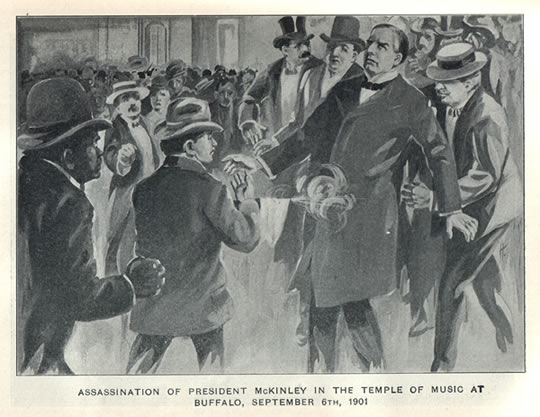
Twenty years later, President William McKinley was shot while visiting the Pan American Exhibition in Buffalo, N.Y. . Here is the report from The Life of William McKinley (1916)

SUNSHINE in the sky above and gladness in the heart of the President brightened the morning of the 6th day of September, 1901. It was to be a holiday: a visit to Niagara Falls in the forenoon, a reception to the people in the afternoon. In joyous mood McKinley passed the hours of the excursion, his nature never more serene.  . . . As he approached, the President extended his hand;—but the proffered friendliness was met by two pistol shots which rang out from the revolver concealed in the seemingly bandaged hand. Instantly several of the guards seized the assailant and bore him to the ground. As they did so, one of them, kneeling by the head of the prisoner, glanced upward and saw the President, still standing, supported by friends, and gazing with an indescribable look of wonder and reproach.

While he was being helped to a chair the Secret Service men dragged the prisoner to the center of the temple and there some one struck him squarely in the face. Seeing this, the spirit of the Master, whom he had served all his life, came upon the stricken President, and he cried in a tone of pity, “Don’t let them hurt him.”

The friends now gathered about the wounded man were fanning him with their hats and watching anxiously to discern if possible the full extent of his injury. But the President’s mind was not upon himself. He was thinking of the beloved wife, who had leaned upon him so many years and whom he had always shielded so tenderly against the slightest care. As the Secretary bent over him, he whispered, tremblingly, “My wife—be careful, Cortelyou, how you tell her—oh, be careful!”

The president was rushed into emergency surgery:

     At such a time as this, the very essence of the human spirit, which may have shrunk for a lifetime from exposure to the eyes of men, is likely to assert its presence. From the time he was ten years old, President McKinley had unreservedly, but without ostentation, put his trust in God. It was the richest, deepest thought of his inner soul, and now, as he closed his eyes, realizing that he was about to sleep, perhaps to wake no more, his lips began to move and his wan face lighted with a smile. It was the same trust that now supported him. “Thy kingdom come, thy will be done,” he murmured. The surgeons paused. Tears came into the eyes of those about the table. “For thine is the kingdom, and the power and the glory, forever, Amen.” With these words he passed into unconsciousness, while the earnest surgeons sought with all their skill to prolong his life.

McKinley seemed to do well immediately after the surgery and all were very hopeful, but suddenly, a week after the operation, he took a fatal turn for the worse:

In the afternoon of Friday the President knew that the time had come for him to bid farewell to the world. He called the surgeons to his bedside and said, “It is useless, gentlemen, I think we ought to have prayer.” His eyes were half closed and again the smile of sublime faith in the future illuminated his features. A solemn silence fell upon the assembled doctors and nurses and tears could not be restrained. The dying President moved his lips and again it was the Lord’s Prayer that welled from his overflowing heart. The twilight descended and the room grew dark.

 The room was silent. The President put his arm around his wife and smiled at her. The family group and intimate friends about the bedside watched and waited. Then the lips moved again and the worn face became radiant. The inner soul was speaking once more and was voiced in the lines of his favorite hymn:—

“Nearer, my God, to Thee,
Nearer to Thee,
E’en though it be a cross—”

Fainter and fainter came the words until the whisper could scarcely be heard. Then a moment of silence. “That has been my inextinguishable prayer,” he murmured, almost inaudibly.

Perhaps one mark of the greatest hymns are those hymns which speak for our souls in the most critical moments, those we choose when our own words fail usNearer My God To Thee has been one of those hymns and will continue to be if we don’t forget it.

Nearer, my God, to Thee, nearer to Thee!

E’en though it be a cross that raiseth me;

Still all my song shall be nearer, my God, to Thee,

Chorus: Nearer, my God, to Thee, nearer to Thee!

Though like the wanderer, the sun gone down,

Darkness be over me, my rest a stone;

Yet in my dreams I’d be nearer, my God, to Thee,

Chorus

There let the way appear steps unto heav’n;

All that Thou sendest me in mercy giv’n;

Angels to beckon me nearer, my God, to Thee,

Chorus

Then with my waking thoughts bright with Thy praise,

Out of my stony griefs Bethel I’ll raise;

So by my woes to be nearer, my God, to Thee,

Chorus

Or if on joyful wing, cleaving the sky,

Sun, moon, and stars forgot, upwards I fly,

Still all my song shall be, nearer, my God, to Thee 

Lyrics:  Sarah Flower Adams (1841)

Tune:   “Bethany” Lowell Mason (1856)

Rick Atchley just finished an extraordinary series of teachings called Hearing God, in which he raised some of the hard questions with which the most serious Christians wrestle, like

  • Does God really speak to us today? And, if so, how?
  • How can I improve my hearing?
  • How should one recognize that it is God speaking?
  • What do I think when I hear nothing at all?
  • What keeps us from hearing God?

All six of these lessons are available to you at http://www.thehills.org/index.cfm/PageID/1523/index.html .

Fifty years ago, few people in our movement were very uncomfortable talking about hearing God’s voice.  We were pretty convinced that God spoke to  Abraham, Moses, and the prophets, but that after the cross, He lost his voice and  resorted to just writing His message down by means of the Holy Spirit. And once he put the last period on the Book of Revelation, He had no need to say anything else, so He has not been heard from since.

As is often the case, fear drove us to these theological conclusions.  If God continued to speak, then it might be possible that He

  • Might tell someone else something He hadn’t told us!
  • Might change the pattern that we had discovered in the New Testament!
  • Might talk to someone not in our fellowship, which would suggest His endorsement.


Of course, we protected ourselves from our fears with theological headphones—noise-cancelling headphones that let us hear only the sounds we wanted to hear. Because of our fears, many Christians only recognize God’s handwriting, not His voice.


Let me just say this: there are false prophets who claim to be the voice of God; there are ungodly voices that want to capture our hearts;  and that some have not only distorted His voice but even forged His handwriting, producing “new” messages from God.  These forgeries, both oral and written, began even during the first century, so from then until now, Christians have been warned:  Do not believe every spirit, but test the spirits to see whether they are from God, because many false prophets have gone out into the world” (1 John 4:1)

So what does the voice of God sound like?  I wouldn’t speak for anyone else, but in my own life His voice has always been recognizable, even when indescribable.  I know that doesn’t make any sense, so let me elaborate.

Recognizing the voice of God is easier when you are familiar with what He has said before. By His grace and mercy, we have a whole library of His conversations, His speeches, and His meditations.  If you want to recognize His voice, you will become intimately familiar with what it sounds like.

This familiarity is also your protection against false voices:  the sheep listen to his voice. He calls his own sheep by name and leads them out. When he has brought out all his own, he goes on ahead of them, and his sheep follow him because they know his voice. But they will never follow a stranger; in fact, they will run away from him because they do not recognize a stranger’s voice” (John 10:3-5)

My other suggestion to you is to learn to be quiet and wait. 

First, be quiet!  In those times when you are keenly aware of your need to hear God’s voice, perhaps before a big crisis or at a crossroads, stop talking because it is almost impossible to talk and listen at the same time.  In place of talking, listen to what you know to be His voice by reading His message—even ones that you don’t think apply to your situation.  His Word is living and dynamic.  How often have I been surprised by some arbitrary reading that spoke directly to my need!

Secondly, and even harder sometimes, just wait!  If you haven’t heard His voice, don’t do anything until you have!  Don’t let your need to know, or your need for security, or your action plan or schedule dictate when God must speak—or else you’ll act without hearing His voice.  In my experience, It has never been a good idea to give God deadlines.

The last two weeks have been wild at LST. Major changes started happening with our staff: some needed to leave, others needed to shift, and perhaps we need to hire.  In addition, big financial decisions need to be made almost immediately to adjust our spending for the last half of our year to meet our budget, decisions that will mean some shifts in how we do core activities.  On top of all of that, our landlord walked in two weeks ago and said that they were closing our building down and we needed to move by August!

Two weeks ago, Sherrylee said, it feels like God’s asking us to reinvent the ministry! I heard that word as the voice of God. Rick said last week in his last lesson, “Until God speaks, you have not heard the last word,” and those were God’s voice for me.  Some of our staff members had wishes and desires that made the answers to personnel shift decisions pretty obvious to me—and they were God’s voices.

Regarding our new location and office space—His voice is not clear yet, so we are waiting to hear.  That doesn’t mean sitting around the office doing nothing. No, we are looking at properties almost every day and will continue until His answer is clear.

Don’t be afraid! You can recognize His voice. God gave you the headset (maybe heartset would be a better word) you needed when He gave you the gift of His Spirit.

Here’s the last word:   The person without the Spirit does not accept the things that come from the Spirit of God but considers them foolishness, and cannot understand them because they are discerned only through the Spirit. 15 The person with the Spirit makes judgments about all things . . . . (1 Corinthians 2:14-15).


The Shero Family

For the last five days, Sherrylee and I have had the privilege of hosting Phillip and Laura Shero and their three children in our home.  They are long-time missionaries in Uganda and currently involved in a huge project, launching Livingstone International  University, a Christian liberal arts. If you are interested in learning more about their project, go to this Youtube site and watch their three-minute video: http://www.youtube.com/watch?v=URyp-r7l6TI

The Sheros are just the latest in a whole series of missionary families that we have hosted in our home from a single overnight to 4-5 months.  Most are on furlough, some are returning to the U.S. permanently, and some are “regulars” who stay just short bursts once or twice every year.  Regardless of how long they stay or what country they have come from, they have always been a blessing to us—and we do our best to be a blessing to them as well.

We are eager to host them well because we have been so well hosted in our travels. The gift of hospitality comes naturally for some—but not for all, so a few minutes ago, I asked Sherrylee and the Sheros to just name some things that are important to remember when hosting missionaries for several days or weeks.  Here’s the result of our brainstorming:

  1. Don’t own them! Just because they stay in your home doesn’t mean that you are supposed to plan for them, organize them, or protect them from other church members.  In fact, having them in your home may very well mean you see less of them than other people!
  2. Give them a key to your house!  The key needs to be more than just symbolic, it needs to mean real  freedom to do whatever they need to do, to come and go as they please, and to not have to depend on you. (And don’t expect to get it back. I’m sure there are keys to our house on every continent!)
  3. Make everything that you need easily available for them. If you have two cars, can you loan them one?  Give them your security key and password for your home wifi network.  Show them where all of the remotes for the TV, DVR, etc. are and in what order to use them.  If you use it in daily living, make sure they can also use it!
  4. Give them the space they need to pack, unpack, and repack.  Especially the missionaries to Africa carry back huge amounts of luggage filled with essentials that are unavailable to them except when on furlough in the States. For days before they leave, they may have 10-15 loads of goods they are trying to pack into the same number of airline-regulation trunks, perhaps in your loft or den or their bedrooms and the halls.
  5. Don’t go shopping with them! Missionaries may need to spend a year’s worth of money today to get what they need, but they don’t know if you understand why they need to buy 10 pairs of shoes. And maybe they need to buy a certain brand of electronics because that brand is repairable in their country and the cheaper or better brand that you prefer is not—but they don’t want to have to explain every decision like this that they need to make.  It’s just so much easier if you are not there.
  6. Don’t insist on feeding them! Missionaries often eat around the clock because they are always being invited to breakfasts, lunches, coffees, dinners, for desserts, and meetings in between with snacks! At their “home,” they often would just like to skip a meal or just have Cheerios for breakfast, or grill themselves a cheese sandwich for lunch.
  7. If you REALLY want to do something special for them, have a group of the people they need to visit with—as large a group as your house will accommodate—over to your house.  If they have 10 couples that want to spend time with them, that is 10 meals out or 10 days of long evenings with kids that are tired, or 5 visits and 5 disappointed couples.  You can do something HUGE for them if you would invite their 10 couples over for a grill out or just for dessert and prayer time—but with lots of time for everyone to have a few minutes with your guests.
  8. Invite them to do something fun!  Offer to take them to a ball game or play golf or go to a movie or take them to your favorite fishing hole.  Sometimes they have so much they have to do, that they don’t feel like they can take time for themselves.  Make them an offer—but it has to be one they can refuse without feeling guilty.
  9. Treat them as part of your family.  Let them raid the refrigerator, come down in their pajamas, leave their bed unmade, get up whenever they want to—treat them as you would want to be treated!
  10. Finally, and this is directly from Phillip Shero:  Serve them Blue Bell Ice Cream—preferably cookies and cream!

Having missionaries in your home is truly having the opportunity to entertain angels; these messengers of God will bless you richly!  Just don’t do it “unaware” of their special needs.