Feeds:
Posts
Comments

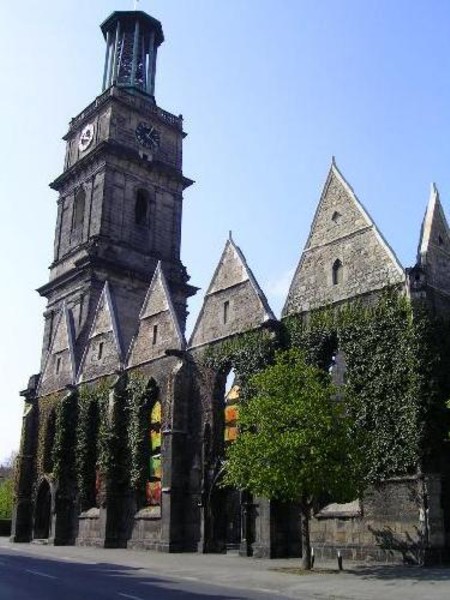
Aegidien Church in Hanover, Germany

You aren’t surprised, are you, that the people who start something called “Let’s Start Talking” find themselves in conversations with lots of people all the time about lots of different things.  Would you like a quick look at our conversation itinerary?

Hannover, Germany was our home for six years and where all three of our children were born. Along with two other couples, we moved here in 1973 to begin a new church plant.  That church grew and thrived for 20 years, long after all of us Americans had left. The Hannover church even helped in planting two other churches in Peine and Hildesheim, both cities about 30-45 minutes by autobahn from Hannover.

In the mid to late 90s, the devil got into the Hannover church through divorce, immorality, petty jealousies and blew it completely apart.  Many of the members have remained faithful and belong either to one of the offspring in Hildesheim and Peine, or they attend another church. Some seem to have completely abandoned their faith.  Those who really suffered, however, were the children of the members.

Even if we just have one day, Sherrylee and I have always made a point to keep the love and the conversations alive that we share with our brothers and sisters in this region.  But, as you will see, the conversations can be gut-wrenching.

  •  “How are your kids?”  The Hannover church was mostly young families, so there were lots of children. Today most of them are in their early 20s, marrying, finishing educational goals—and only a few of them are active believers! Most of those children do not attend church and do not appear to be living in any kind of faith.  The ones who have chosen faith are spoken of almost as miracles—like God has been especially gracious to them.  The others are all still held up to God in prayer by loving parents—at least by the parents who are themselves still believers.
  • “What do you hear about _________?” Surprisingly, many from the disintegrated Hannover church still keep up with each other. Some have moved away, a few of the older members have died, and only a handful want nothing to do with those friends from the past.  I believe that even these occasional relationships are remnants of the strong love that existed in the Hannover Gemeinde.

Those conversations were only the front door then to these conversations which were much more difficult and sometimes painful:

  • “I  feel betrayed by the people who abandoned their faith?”  Those who so casually leave a church family probably have no idea that they cause real pain,–but they do, and it is a pain that can endure for years!
  • Why don’t those other people love me anymore just because I don’t worship with them?  This conversation usually grows out of a longing for the intimacy that has been lost.  Sometimes even those who have abandoned the community suffer from this loss of intimacy. It’s not unusual for them to blame those that they themselves rejected!
  • How can I have a relationship with her when she is still living in sin?  The broken mess that sin creates can be forgiven, but the consequences  for relationships are very difficult to heal. The people can be redeemed, but the mess is often permanent—at least until Jesus comes and makes all things whole!  We had several conversations this time about how Christians should respond to the enduring brokenness that sin leaves behind.

Happily, we were able to have breakfast with Don and Cindy Roehrkasse and Kyle and Susan Bratcher who lead the church in Hildesheim. Randy and Katie Smelser and Amanda Knapp, the American workers in Peine, joined us around a true love feast!

Amanda and her husband David are fairly new, but the other three couples have worked with these churches from their beginnings!  Our conversations with them were not about the past, but about the future

  • people they were studying with,
  •  plans for developing native leadership in the church,
  •  the possibility of a new church plant in Celle

And, of course, we talked about Let’s Start Talking!

So Thursday from dawn until well after dusk, we talked.  We talked and prayed and cried and laughed and dreamed and wondered—because that’s just what Christians do with each other.

“We believe, therefore we speak!”


Hamburg

We left half of our toiletries in Belgium with Hans and Ans!  Fortunately, the Brazles are coming to Rothenburg, so we may be able to have deodorant again by Sunday.  Just joking!!

Tip: The more methodical you are in packing, the less likely you are to leave things! Scattering and rearranging your packing, that is, putting your toothbrush in a different bag or putting dirty clothes where your socks used to be, almost guarantees leaving something behind somewhere!

Our visit with the church of Christ in Hamburg was wonderful.  This congregation, planted in the early 1950s, is one of the most mature and stable in Germany. They have four elders and a pretty stable history.  About seven years ago, when the International Church of Christ dissolved, a number of committed young couples joined this church’s work and have been a blessing.

I suspect that this church has been in the phase of church development that I described in the last posting where it is mostly focused on church life and inward things.  Sure, they have continued to have gospel meetings and other types of evangelism that were effective forty years ago, but these activities were church habits and no one really expects them to reach new people in this century.

That’s why we at Let’s Start Talking are excited about their invitation to receive a team next summer. LST veterans Steve and Val McLean from Santa Barbara, CA are very close friends with one elder couple here, so they have been informing the Hamburger (yes, that’s what people from Hamburg are called!) about LST for years.  Finally, the church has invited them to come and actually do LST here!

Much of the maturity and stability of the Hamburg church is a direct result of the lifelong efforts of Dieter and Eva Alten.   I wish I could write their whole story for you, but someone else will have to do that.  I’ll tell you what I know though.

Dieter was one of the very young men converted by the first American workers in Germany after WW II. Very early, he and his wife Eva moved to Hamburg where they worked with Don Finto in the new church planted by Weldon Bennett.  Don left to return to the States and Dieter and Eva stayed.

Sometime in the mid-seventies, an American Christian who had the Dale Carnegie franchise in West Germany was ready to go back to the States, so he transferred it to Dieter. This gave Dieter both greater influence and greater financial stability. I know American workers whom Dieter gifted with free courses; I’m sure he did the same for German workers.

And even while being the national director of Dale Carnegie, he continued to hold meetings, to do training and mediation for churches of Christ throughout Germany.  He was a regular guest speaker in Hannover when we were planting a church there!

Eva is gone now. Dieter is 83 years-old and suffers some speech impediment because of a stroke a few years back, BUT he serves as an elder, he attends every service (Sunday and Wednesday both!), and he preaches on occasion.  I was told that although he can no longer speak as spontaneously, he writes out his sermons which have the same depth and are as full of encouragement as ever!

We visited Dieter briefly, told stories from old times and laughed together. His eyes are full of life. I’m not sure he really remembered us—but that really doesn’t make too much difference.  We will always remember him.

We read together some verses, highly appropriate for Dieter, from Psalm 92:

The righteous will flourish like a palm tree, they will grow like a cedar of Lebanon; planted in the house of the LORD, they will flourish in the courts of our God. They will still bear fruit in old age, they will stay fresh and green, proclaiming, “The LORD is upright; he is my Rock, and there is no wickedness in Him.

Thank you, Dieter, for bearing fruit and for staying fresh and green!  And, thank you, Lord, for your servant Dieter Alten!

I think Belgium has a government, but I’m not sure.

This small divided country went at least 482 days without a government because the French-speaking parties and the Flemish-speaking parties could not—would not agree on how to go forward. Belgium is a parliamentary democracy, but without any single party having a super majority and governing independently, the only way to form a government is by coalition, that is, several parties joining together and agreeing to share power.

A country with no government because of radically self-interested political parties—now there is a lesson to be learned here, for us Americans and for us Christians.

Sherrylee and I have spent the last four days in Belgium and the Netherlands, visiting our good friends Paul and Carol Brazle in Antwerp and Hans and Ans van Erp in the Eindhoven church.  The times are interesting in both of these established works.

Maturing church works have different problems than church plants. Although both of these works are approximately twenty-five years old, they are reaching critical stages in their existence.

All of Western Europe should probably be classified as post-Christian, meaning that the forms of Christianity still permeate society, but personal faith and relationship to God through Christ is relatively uncommon.  Christianity is generally viewed as an old superstition that a more enlightened society has moved beyond.

Bringing the Good News of Jesus to Europeans requires patience. Those missionaries who choose to serve here are often choosing to leave home and stay for decades, not years!

Paul and Carol Brazle have been in Belgium since 1986, faithfully representing Jesus among the Flemish-speaking people.  The church they serve in Antwerp has been evangelistic and has fluctuated between 20-50 members over the years, depending on the Christians who move away and/or move back.

Currently they are ministering to a much larger group of people because of the influx of Africans into Europe. A group of Christians from Ghana began collecting, then growing, until they far outnumbered the other nationalities in the Antwerp church.  Along with the blessing of new members came the struggles of trying to be one church and blend Euro-American church culture with Afro-Ghanaian church culture.

You’d be surprised at how strongly everyone feels about how church is conducted—or maybe you wouldn’t!  I’m talking about totally innocuous questions like how you start songs, what melodies to use with a set of words, what to do with the children during worship times, what time will the service really start on Sunday—all mostly cultural issues, but ones that can create tension, especially if anyone insists on their own answer to the question!

And I have not yet mentioned any issues!  The church in Antwerp—all parties—are doing their best to be one church and not take the easy way of just splitting into two groups who do whatever they each are most comfortable doing.

The Dutch church of Christ in Eindhoven was begun about 1987, when Hans and Ans invited us to bring an LST group there. They have grown in the ensuing years to be a model church in Europe in many ways. Eindhoven has always been an indigenous church, self-supporting, self-ministering, and quite international as well.

At yesterday’s service, we had Belgians, Chinese, Africans, Americans—and Dutch people, singing, praying, and breaking bread together.  Their challenge now stems from their success as a church.

This wonderful church family may be reaching that time in a church’s life when they are so busy taking care of their own needs that they quit reaching out to others.  I’ve seen this happen many times in European churches. Usually the church plant is very evangelistic, fresh and enthusiastic until they reach30-50 people coming regularly.  Then church life begins to take all of their energy just to care for one another. Besides,  there is much less threat of painful rejection when only working among yourselves—so they quit reaching out!

Typically, this church will continue to feel good about itself for a while longer, maybe even grow more because of its good reputation, but then it begins to decline and no one understands why!  Decline, however, is inevitable when the community of believers is no longer consciously and intentionally shining the light into the darkness.

Some think this pattern is absolutely determined and unavoidable, but I do not. These two good churches have good leaders, people of great faith, and my prayer is that they will continue to depend on His power and Spirit for guiding the flocks which they oversee.

3 Do nothing out of selfish ambition or vain conceit. Rather, in humility value others above yourselves, 4 not looking to your own interests but each of you to the interests of the others. Philippians 2:3-4

Would it make a difference in the Belgian government, would it make a difference in our churches, if we really believed and practiced what Paul taught the early church in Greece?

If you fly into a new country, but only stay in the airport, you can’t put a pin in your map for having been in that country!  International airports are notoriously void of anything representative of local cultures.

You deplane (I really don’t like all these nouns turned into verbs!), stand in windowless rooms with only legal posters on the walls as you wait to have a completely silent passport officer check your passport. If they talk to you at all, they only want to know where you come from, where you are going, and how long you are going to be in their country.  Only in Israel did they actually ask the names of the people we would be visiting.

The passport officer then stamps your passport, waves you through so that you can go get your luggage in the prayer room—I mean, the baggage claim area!

In most countries you have two or three choices of exit doors from baggage claim. One says “Nothing To Declare;” another says “Something To Declare”—I’ve never seen anybody go straight to that line—and then in some countries you have special lines for special citizens. In Europe, both in the passport lines and customs, if you are a citizen of a European Union country, you bypass the more stringent controls for those of us who are “Other passports”. It’s a good lesson in humility for us Americans.

Of course, we do the same thing –maybe worse as non-citizens come to the U.S.  I find our passport and customs controls among the most rigorous.

Now to make choosing the correct line even more interesting, there are some countries who introduce a random search element to the process.  One country we have visited has each person hit a big button which lights up the green Go or red Stop light. Randomly, I suppose, you get the red light and must open all your suitcases.

I’m pretty sure most customs officials work off of profiling passengers. You can bet on some scruffy student being stopped.  Yesterday, upon arriving in Frankfurt from Turkey, we faced immediate passport control by the police before getting ten feet into the airport, then again at the normal passport control. For the first time in thirty years as well, there were German customs officials actually stopping people and looking in their luggage.  I’m pretty sure it was because we were flying in from Istanbul.

If you haven’t seen The Terminal (2004) with Tom Hanks, you should rent it today!  Everything that has to do with the official side of entering a foreign country is perfectly believable!

Today, Sherrylee and I start the last two weeks of this trip. Today we drive to Antwerp, then to the Netherlands, then to Germany for about 10 days, finishing our trip with the American-European Retreat in Rothenburg.

Now, instead of talking with potential LST sites, we are visiting workers and sites that we have worked with for many years with one exception.  But relationships are everything, so we look forward to visiting to encourage them and to find out how we can serve them better.

I apologize if you need now to pull those pins out of the map for places you just flew through the airport! No cheating! You can’t count that country unless you have really had a conversation with someone other than the passport officer!

And if you need help finding that conversation partner, we at Let’s Start Talking would love to help you!

What are your experiences in international airports?

Antalya, Turkey

I’m having a Whopper Jr and a diet coke for breakfast in Antalya, Turkey, because that’s all there is at the airport at 8am! That’s not entirely true. At the Turkish restaurant next door, I could have ordered a Doner sandwich—basically a gyro sandwich—with Turkish coffee, but that option didn’t seem any better to me.

Did you know that very few countries in the world have special breakfast foods? Most people eat the same kind of food for as many meals as they may eat in any given day: soup, rice, beans, noodles, bread, cold cuts, cucumbers, tomatoes—all very common breakfast foods around the world.

Whopper Jrs are not common breakfast food in any country!!

We came to Turkey in 2002 with the first LST team here—really one of the very first entries into Turkey by churches of Christ since the early 1970s, when our M’s—you don’t use that word in Turkey– were all forced out.

Andrew and Katie were part of that first LST team, and now they have lived for almost four years in Antalya as full-time workers.  We had breakfast with them at our hotel—which did serve fried eggs (right next to the eggplant salad!)—and then Andrew took us to the English Center where he and others are offering conversational English classes to university students.

They can’t use LST materials because our Bible-based materials are too political!  Yes, political is the word the school officials use to describe the orientation of Christians in Turkey.  That surprised me! Religious, sectarian, infidels, heretics these words would not have surprised me, but political did.

As Andrew explained it to us, the greatest fear in the Muslim world is not a religious fear; rather, it is a cultural and political fear. They are afraid they will lose their culture and their control of their own political situation.  Christianity represents a threat to all of these in their minds.  It is the encroachment of Western dress, western morals, western politics, just western-ness into their ancient ways of living and thinking.

Being a political threat makes work for Christians in Turkey much more difficult.

As Andrew was dropping us off near the place where Christians meet in Antalya, a Turkish woman walked up to him and asked if anyone was in the church office.  It was actually a holiday so no one was around, but Andrew asked if he could help her.  She replied that she needed help. She felt trapped in Islam and was smothering. Could he help her?

Very kindly, Andrew asked a few more questions and then told her that his wife would call soon to talk to her. Women must be taught by women in this country. Katie will share the Good News with this woman in need.

The clash between countries and cultures may seem insurmountable, but Christians reaching out in love and in the name of Jesus to people in need will never be stopped by pejorative labels.

I’m really glad Andrew and Katie are here!

Mark and Sherrylee with Alex and Eleni Merrilytos overlooking Corinth.

We did not see the Parthenon! We did not see the Acropolis or the Agora! We did better than that!

We met the church in Athens, in fact, churches: a Greek-speaking church, a Bulgarian-speaking church, and an English-speaking church. In addition, we broke bread with Russian Christians, American Christians, a wonderful group of women from the Philippines who work in Greece, one brother from Nigeria, and one from Ghana.

The Omonia church of Christ in Athens is a church with open front doors! And the world is coming in! Alex and Eleni Melirrytos are the Greek couple who minister to all these groups.. There are other leaders who work very hard in all of the larger ethnic groups, but they are the responsible servants of God!

The congregation has existed for many years and has gone through lots of different phases. The current phase is challenging! The neighborhood has deteriorated badly. Other evangelists have led this church in years past, but have gone. The current economic situation in Greece has resulted in many of the foreign members of this church returning to their own countries or to other countries to find work.  And, of course, the inevitable personal situations have accumulated here as they do almost everywhere, always being heavy baggage to carry for those who live with the consequences.

Sherrylee and I fell in love with this church! It’s authentic! The people are devoted to God and to one another–and they are talking about forgetting what is behind and pressing forward. Paul would be proud of them.

The Greeks are dramatic! They can talk loudly—almost shouting—and their body language is BIG, and they can be all talking at the same time!  And ney means “Yes,” but sounds like “No”! We laughed so hard because we could never tell if they were mad or just loving on each other!  Alex and Eleni were the worst—and the BEST!

They took us to see Ancient Corinth on Monday—a little over an hour away from Athens by car, but probably three to four days walk for Paul and his entourage. That hour driving gave us time to talk about all the possibilities for LST in Athens, especially what the challenges might be.

What a beautiful setting on the sea. No wonder Paul stayed in Corinth so long!  Of course, there are only small areas excavated, still you can believe you are walking on the same street Paul did when he went to buy groceries. The Bema, or Place of Judgment, mentioned in Acts 18 has been identified and is being restored, so we could see where Paul stood before Gallio, the proconsul of Achaia.

Alex sneaked me down a back path to the ruins of the theater which are really closed off to the public, but we wanted to see the place discovered in 1929  where Erastus’ name and title are inscribed. This is almost certainly the Erastus mentioned in Romans 16 who was the director of public works.

What do you think they serve in ancient Corinth for lunch? Gyros, of course! What were you expecting???

After a pretty late lunch, we went to Cenchreae, where there is precious little left of Phoebe’s hometown, mostly just ruins of a church being swallowed by the sea.  But almost next door is a beautiful camp hotel where Christians in Greece gather once or twice a year for Bible study, retreats, and warm (probably dramatic!) fellowship. We are definitely going to try to get an invitation to be on their program!

Almost 2000 years ago, right here in Athens, Paul said,

From one man he created all the nations throughout the whole earth. He decided beforehand when they should rise and fall, and he determined their boundaries. His purpose was for the nations to seek after God and perhaps feel their way toward him and find him—though he is not far from any one of us. (Acts 17:26-27)

I’m thankful for every Christian in Greece and am praying for every person from every land that God has brought to Greece so they could seek Him and perhaps find Him!

Maybe you will be one of those people someday, coming with LST to Greece to talk to people about the unknown God and His Son Jesus!

Jerusalem is like no other city that I have ever visited! Not the beauty, not the variety, not the landscape, not even the history—all of the usual things that people talk about when evaluating Vienna or Prague or St. Petersburg or Bangkok, or Beijing—no, perhaps it is the spiritual confrontation and the emotional upheaval on every corner that sets Jerusalem apart.

At the Wailing Wall, people wail! I was prepared for the praying and the rocking and the reading of Torah, but I was not prepared for the wailing! These are not the first Jews who have wept over Jerusalem.

The Tomb of David is one of the most artificial of sacred sites, a site that really no one believes to be anything but a fabricated holy site, and yet there were not just tourists, but worshippers there! No one is fooled, but still some fill a need to believe and worship!

At first we were all a bit disappointed with the Via Dolorosa—the Way of the Cross—supposedly tracing Jesus’ steps from the Place of Judgment in front of Pilate to the tomb of Joseph of Arimathea. First we were told that any real steps that Jesus might have taken would be about 65 feet below the level of the street upon which we were walking. That’s not so bad.  Then as we walked, we realized that virtually every step was lined with shops of all kinds—not just tourist shops, but all kinds of shops.

Instead of carrying a cross like a few pilgrims were doing or stopping soberly to read the crucifixion story step by step, most people on the Via Dolorosa everyday were trying to make a buck—that is, a shekel! Perhaps it was time to drive the money changers out of the temple!!  BUT . . .

. . . then it occurred to us that even on the very day of crucifixion, this street probably was not so different. The way was lined with shopkeepers who possibly noticed the soldiers marching down the street, followed by some poor guy going to be crucified.  And then they went back to their customers. After all, it was the third person today they were going to crucify!

That the monotony of the mercantile just went right on at the very hour that Jesus walked to the cross just messes with your emotions a little, doesn’t it!

The church of the Holy Sepulcher completely covers the traditional Mount Calvary, Golgotha, and the tomb of Jesus! Nice to visit, but it didn’t move me really because if there is anything true about the place, it is totally covered up by the attempt of Christians to protect it, to give it significance, to magnify—maybe even to proclaim.

I wonder what we are slowly hiding because of our needs to protect, to make significant, to magnify?

Our last stop—at three o’clock on Friday afternoon–in Jerusalem was the Garden Tomb, first suggested as the real site of Jesus’ burial just a little over one hundred years ago. A British organization has created a quiet, beautiful garden to surround this first century tomb. Whether or not this particular site has any greater claim to veracity than the more traditional site, the garden and the garden tomb are much more emotionally satisfying. A wonderfully Christian British lady who had taken her three-week holiday to work at the site gave us not only a wonderful tour but her testimony of faith. To find heartfelt faith, full of joy that “He is not here; he is risen” was a special gift.

And so it is with so many “holy” sites in Israel. Most of them have some rationale for their designation; few of them are anything but slightly educated guesses; but all of them are someone’s attempt to remember the work of God! You don’t have to believe in them or worship in them to be thankful that someone wants to remember and glorify God.

“It’s complicated!” Every Israeli, every Palestinian, every Arab, every Christian we talked with in Israel and Jordan, every one of them at some time in the conversation said the same thing, “It’s complicated!” Whether we were talking about the politics of the region, about faith, or about life in general, their answer was the same, “It’s complicated.”

For the political conflicts, for the social struggles, for the religious division, they are all right! We have been able to find nothing but complication.

Thank God for the simple, uncomplicated truth: He is risen!  Those who believe this truth do not need to wail.

Today I learned that the Bible was even truer than I thought it was!

We spent two nights in Amman, Jordan among the children of Ben-Ammi, the son of Lot and “the father of the Ammonites of today” (Genesis 19:38). Our friend and sister from Germany Veronika (who often comments on this blog!) but who has lived in Jordan for 17 years had arranged for us to meet with three leaders of a local church in Amman to talk about LST.  Jordan is a country with religious freedom, but just by virtue of being such a small minority, Christians in Amman have to be bold and creative. These men are involved mostly in training Jordanians to plant and lead churches. Perhaps they will invite LST and someday you can come here and join them in their boldness!

Open your Bible to Deuteronomy 34 and read the first eight verses about the death of Moses.  It’s not an unfamiliar passage to me, but visiting Mount Nebo opened my eyes to how true it is. I had read the words “There the Lord showed him the whole land—from Gilead to Dan . . . “ and I had always understood it to be either just metaphorically looking over the Jordan and seeing that part of the promised land you can see which would represent the whole land—or sometimes I even considered the possibility that Moses saw everything miraculously with the eyes of God!

Never did I think you could see the whole land from Nebo—but you can!  With the wind whipping around the mountain top, we hung on to the railing that Moses did not have and looked across the Jordan valley. On our left we saw the Dead Sea. On our right we saw the Sea of Galilee. The maps in my Bible never prepared me for that sight!

Everything is downhill toward the Dead Sea! We spent a couple of hours at Petra, the city of the Nabateans built into the red rocky gorges left by ancient winds and waters. After several days of awesome moments with sites of Jesus and Moses, it was a little disconcerting to go into such a pagan past, but our very last stop in Petra was a pagan temple that had been converted into a rock church in later centuries.

We sang Amazing Grace and listened to the words and music reverberate against the stones that had heard and seen so much for centuries. If those stones survive for thousands more years, I pray they will release the words of amazing grace over and over again to those who will hear!

Sherrylee talked us into riding camels back to the entrance of Petra. I know Rebekah rode a camel from her home to meet Isaac for the first time. I hope she was a better rider than we or she probably was in no shape to be very impressive when she dismounted. I’m quite sure that was a once-in-a-lifetime experience for all of us!

To cross between Jordan and Israel is no easy feat in today’s world. Joshua needed a small miracle and so do many people today! We paid extra for what they call VIP service at the border—slightly embarrassing, but it certainly eased the waiting in line and the hassle.

Being VIPs gave us a little extra time to add Qumran to our trip, where we looked into the very caves where the Dead Sea scrolls were discovered. Sherrylee was the one who pointed out the incongruity of having lunch in the very place where Jesus fasted for forty days.

Before we even caught our breath, our van drove past Jericho and went up to Jerusalem, passing the Inn of the Good Samaritan. I hope we didn’t miss anyone on the side of the road.

We finished this marvelous day in Bethlehem–not a city of peace any more, I’m afraid. We dutifully went to the Church of the Nativity, where hundreds were standing in line to see the traditional site of Jesus’ birth. It’s just a silver star on the floor far below ground level today. Joseph and Mary would not have recognized it. But they wouldn’t have wanted to wait in the long lines to check it out anyway!

Next year—no, tomorrow in Jerusalem! Our last day in Israel and another opportunity to meet with Christians here to see if LST can be of any help.

P.S. I plan to post a few pictures soon! The ones of Sherrylee and me on camels may or may not be included!


On Monday night, we met for dinner with the minister and his wife for a church in Nazareth. The town where Jesus grew up is now mostly Arabic and Muslim, with just a remnant of Christians—but then those who saw him grow up among them rejected Jesus then as well, didn’t they!

What a pleasure it was to talk with this man and his wife about their faith and their work. We heard stories from him about his being forced to sleep in unlocked cars as a young man because his family disowned him—literally drove him out of his house and put him on the streets for being baptized in the name of Jesus. Now these two Christians have served faithfully for over twenty years in Nazareth and in their congregation, they have between 40-60 neighbors who break bread together each Sunday until He comes again.

Our real purpose in coming to Israel and to Jordan was to visit with them about Let’s Start Talking and whether we might be helpful to them in their work in Nazareth. They were quite excited about the possibility and are now informing the other church leaders about the possibility of partnership with us.

I did not realize that Galilee was a region of mountains and valleys—but mostly mountains. Our hotel was on the shore of the Sea of Galilee. I woke yesterday, looked out the window and saw the Golan Heights directly across the sea. You will remember that these mountains are the militarized buffer zone between Syria and Israel. The morning was so still that it was hard to imagine the fighting and the loss of life on these mountains.

We left for Jordan early in the morning, but stopped for a short boat ride on the Sea of Galilee. On the boat with us was a youth group from a Baptist church in Dallas! In fact, even at breakfast in our hotel that morning, I had noticed that the tables were mostly reserved for religious groups from all parts of the world! Christian tourists! Christian pilgrims!

This collection of world Christians was even more obvious at sites like the mountain where Jesus delivered the Beatitudes. Most of that mountain is now fields of banana trees, but the higher area has been claimed by the Catholic church and turned into a beautiful garden surrounding a church. In every corner, we heard singing, praying, and the words of the beatitudes being read—in many languages. The obvious devotion of so many Christians was very encouraging!

We met the same crowds with the same spirit just a few hundred yards away at both the beach where Jesus had breakfast with his disciples after the resurrection and where he redeemed Peter by asking him three times if he loved him!

Of course, nobody really knows the exact site of any of these events. These traditional sites, however, have been traditional sites mostly since the 4th century, but some are described even in earlier writings. I’m not too concerned about authenticity because these are certainly the same mountains that Jesus walked beside and, this is definitely the same sea that he walked upon.

As moved as I have been by the sense of history, I must confess not being as emotionally overwhelmed by the “holiness” of the land as many other of my fellow pilgrims. I’m pretty sure it is because I have seen where Jesus has been in many countries. I have seen Jesus work in Thailand. I have heard His words in Russia. I have worshipped in His presence in Ecuador. We have talked with people in Rwanda who have been healed by Jesus.

Jesus came in the flesh and pitched his tent in Israel for a few short years. I believe that with all my heart! But He is not dead and buried here. He is alive, and He has never stopped showing compassion, never stopped administering grace and truth throughout the world.

This country was chosen as the manger for Jesus. Cows ate from the manger before Jesus was born; cows ate from it the day after Joseph, Mary, and Baby Jesus left. The manger was not immediately plated with gold and preserved as a holy relic! Neither should Israel be gold plated.

Jesus, not the manger, is the Holy One!

Today we stood on Mount Carmel in Israel, the home of King David’s wife Abigail and the place where Elijah did battle with the prophets of Baal (1Kings 18). It’s a great story of face-to-face altar combat, with Elijah talking smack to the false prophets and then destroying them—literally.

What did surprise me though was what could be seen from the top of Carmel. Looking southwest you can see Caesarea, which is located on the Mediterranean coast of Israel. Turning just a bit to your left you can see the mountains of ancient Samaria. Continuing in the same direction, Mount Gilboa rises above the valley, yes, the place where King Saul fought his last battle, then fell on his sword (1 Samuel 28-31). Without even moving your feet, but just by shifting your eyes to the left you see “the hill of Moreh” where Gideon did battle with the Midianites (Judges 7) and then Mount Tabor, where the judge Deborah sent Barak into battle (Judges 4).

One more slight turn in the same direction and you see the modern city of Nazareth nestled in the mountains above the plain of Jezreel.  The trees block your view further north or the list of geographical sites associated with biblical history would just keep going on, I’m sure.

It’s not that one can see these sites at all, rather that you can stand in one place and see all of these places at one time! 

I wonder if Elijah, while waiting on Mount Carmel for the prophets of Baal to get through with their empty incantations and gyrations, looked around and thought about all that God had already done to show Himself to people.

Imagine Jesus, Joseph, and Mary on their way to Jerusalem, walking down from their mountain home in Nazareth into the valley of Jezreel and Joseph pointing to this mountain and that mountain and this river and that rock and this pillar and over there—teaching Jesus the history of Israel every time they turned a new corner on their journey.

Perhaps God picked such a small and insignificant piece of His Creation for this very reason—for proximity, so that the very mountains He created could tell the stories of His marvelous ways!