Feeds:
Posts
Comments

After a brief hiatus, I am returning to the blog series on Standards of Excellence for Short-Term Missions. If you would like to read or re-read the previous posts in this series, please look for them in the Categories box to the right of this column.

Yesterday at a local airport hotel, I met with eighteen LST workers for what we call an EndMeeting. EndMeetings are mostly for our workers, but we collect their host site evaluations at that time as well. LST has insisted that all our workers participate in EndMeetings in spite of the extra cost in both time and money because an excellent short-term mission project always will include thorough follow-up with both the workers and the mission sites.

Follow-up with the Mission Site

At LST, we ask every mission site to complete an evaluation form that asks all of the hard questions.  If we don’t ask the hard questions, then we will only get the answers that we want to hear—which will not reflect the truth!  And if we don’t hear the truth, how will we know if we have been helpful, if we have served the Kingdom well, or if we have brought glory to God?

Here are some of the questions every short-term mission project should always ask as follow-up to their mission project:

  1. Did you receive all the information you needed from your visiting group in order to prepare for them well? Did you receive it in time to prepare well? What would you like to have had prior to their coming that you did not receive this time?
  2. Was the visiting group a good number for you? Did they seem prepared for the work they came to do? Did they adjust culturally? Did they seem to get along with each other well? Were their leaders/sponsors cooperative?
  3. Did the mission project meet your goals for it? Were you happy with the local churches involvement? What would you do differently with a similar group?
  4. How will you follow-up this mission project?  Is there anything the group should have done that would make your follow-up more effective?

I once read an article about a plumbing company that always followed up its house calls with the request for a simple evaluation by the customer: how would you rate our service on a scale of 1-10? What made this plumbing company outstanding was that although they almost always got an excellent evaluation, they were not satisfied with a 9.5 average. They always asked, “What could we have done that would have earned us a 10?” The difference between good and great work for God is often just that extra .5 that can only be achieved with the determination to be a 10 for God! That is the attitude that all involved in the leadership of short-term missions should have.

Tomorrow, I will finish this post with suggestions on ways to follow-up with the workers themselves.


Not many remakes really stand well against the original, but the 2010 version of The Karate Kid is so true to the original that it holds its own.  Jaden Smith has a great screen presence, but is so small—even for the 12-year-old he is portraying–that it makes the physical punishment, the teacher-student relationship, and especially the little romantic involvement a little unbelievable for me. It is easier to imagine this particular story with an older teen like Daniel (Ralph Macchio) was in the 1984 version.

With younger actors, this movie feels more like a young kids movie, probably for 10-14 year-old boys. I wish they had left out the 12 year-olds kissing, and I thought the beatings and hitting were too harsh for this film’s intended audience—or maybe it was just the parents of the kids watching who were closing gasping.

I also found myself wishing they had not set up the Chinese as villains. Maybe I’ve seen too many Asian mob movies, but I’m not much for any film that encourages negative ethnic or nationalistic stereotypes to children, who might internalize a negative response to certain nations, much like kids did about Germany and Japan after WWII because of constant exposure to war movies and cartoons that were used as propaganda during and long after the end of the war.

I did love the beautiful photographic tour of China, although the narrative relationship of those trips was pretty thin.  I don’t know if the kids will even notice the scenery, but perhaps it will stick as somewhere they would like to go someday—to see the lady standing on one leg with the big snake in front of her!!

Here are some topics for talking to your kids after you’ve seen this movie together.

  1. Are the Chinese people mean? I’d love to know what your kids say if you ask them this question. Can they differentiate between the bullies and the Mr. Han—who is also Chinese? This conversation goes to my statement above about helping our children recognize good and bad are not national or ethnic characteristics.
  2. What would you do if kids tried to bully you like those boys did? Dre could have walked away from even the first fight, but he didn’t. He did not have to throw the bucket of liquid stuff on the boys to antagonize them. Most of the time, we have a choice about fighting. That’s the first lesson kids need to learn. Secondly, fighting generally leads to more fighting.  What finally won the respect of the bullies was not beating them up; it was achievement, excellence, competency, and courage—with integrity.
  3. “No weakness. No pain. No mercy.” This motto of the bad Kung Fu master is a great teaching moment to show that Jesus was the exact opposite. He gave Himself up, He suffered pain for us, and He is full of mercy!    Even our children will likely meet those coaches/instructors/mentors who think that there is one ethical standard for church and another for “real life,” where you do whatever it takes to win.
  4. You don’t get good at something without a lot of hard work. This fits in with our children learning delayed gratification.  If you haven’t read Outliers by Malcolm Gladwell, you should.  He argues that the great successes of people are a result of a minimum of 10,000 hours of practice for which other people either don’t have the opportunity or the patience.
  5. Was it more important for Dre to win or to continue in the match? It wouldn’t have been as good a movie for sure if he had lost, but it might have been truer to life for most people. We should acknowledge to our kids that life is not fair. Sometimes people cheat, and they hit us hard, and it hurts.  Our first choice—and maybe the only choice—is to either get up and continue, or to stay down and quit.  Even if you get up, you may not win—ask the US Soccer team about that! But you have greater self-respect and respect from others, if you choose to get up!

Good movies create real emotions. The Karate Kid is a good film, which is why audiences have clapped and cheered at the end of the film. You will have fun checking your own emotional responses against the ones your kids have. That will be the stuff of great conversation.

Unless you knew me when I was 16 or 17 years old, you probably don’t know that I was a pretty decent young baseball player. I pitched and hit well, although “Barber” Cobb—whose barbershop was where the action was in Smithfield, Texas, always thought I was a better catcher.

When we moved to Germany to do mission work, baseball was one of those things I was keenly aware of sacrificing, not so much playing baseball, but specifically, I knew I would not be coaching my yet unborn sons’ little league teams in Germany. What I didn’t know was that I was about to fall in love with a whole new sport Fuβball.

I remember going down to the TV lounge at language school in Prien, Germany, every Wednesday night to watch the little black-and-white TV when a Fuβball or soccer game was on. Now I had played some version of soccer in elementary YMCA sports, but not nearly the organized version that children today play, so I knew almost nothing about it. Not only was I learning vocabulary–little words like Tor (goal), Ecke (Corner), and big, German words like Schiedsrichter (referee) and Abseitsposition (offsides position), but I was also learning something central to German culture. It wasn’t a question of whether I liked soccer or not, it had to be learned, just like the German language.

There were no Germans in language school—obviously–so when I watched, it was with classmates from countries like Japan, Romania, Italy, Venezuela, Greece. They did not know the vocabulary either—but they knew the game! I remember the night it dawned on me that I was the only real soccer illiterate in the room.

The historical cultural isolation of the United States throughout our history has had some positive results, but one of the negatives is that when we go out into the world beyond our borders, we have trouble with the languages that other people speak—and I’m talking not only about their verbal language, but also their cultural languages. In the best case scenarios, this has led to simple misunderstandings, but in worst cases, it has led to what the rest of the world calls American imperialism.  For us Americans, it just feels like the American way!

Sidestepping the political potholes, I want to suggest to you that to be a World Christian, you as an American have to learn to speak the language of world culture.  Here are just a few examples of what I am talking about

  1. The World Cup – This tournament is the largest followed sporting event in the world. Over one billion people will watch the final game, which is at least 10 times the number that watch the Super Bowl in a good year. If you want to have a conversation with someone in Ghana or Ukraine or Brazil or Japan, soccer is a world topic of conversation.
  2. Metrics – Most Americans are exposed to the metric system sometime in school. A few scientific disciplines even use it regularly, but most of us are helpless when we go to other countries and need to cook in a metric oven or to know if 20 degrees is coat weather or shorts.
  3. Exchange – How often have I seen LST team members walk up to an exchange window, hand the man a handful of money and walk away with whatever they receive back, totally clueless as to what just happened or how much they have. Yesterday, I had a desperate email from a team that had exchanged dollars into Euros, which are one of the currencies that are stronger than the US dollar, so for 100 USD, they had received 70 Euro. To them, this meant that they had lost 30% of their money by exchanging. This is a good example of how Americans can be either victimized or made fearful by their own inability to speak the language of world culture.
  4. Major world cultural events – The example that I want to use for you is one that only a few will have ever heard of, yet just this year the Eurovision Song Contest, in its 55th year, was shown around the world and live-streamed on the Internet. Thirty-nine countries entered songs and artists, vying for the best song in the world! It’s like American Idol on steroids!

So why should Americans care about any of these kinds of things? Well, maybe Americans can get by with being culturally isolated, but World Christians cannot! If we want to connect with people, speak to their hearts, share their lives, then we have to know where they live and learn their languages.

We Americans must resist the temptation to exchange the “Go into all the world” command for “Come meet me in my comfortable building or home and speak my language if you want to know about Jesus.” And we should start becoming such a people with those in our own country who don’t speak our cultural languages.

Question: What other world events should World Christians know about?

“Pity the fool” – I can still hear our 10-year-old son laying this line from the original A-Team­ television show that ran from 1983-86. I must admit that I was not a regular viewer, but for some random reason, we saw it last night in Flagstaff, AZ, on our way home to Texas—and we both enjoyed it.

Virtually all of the characteristics of the TV show are maintained in the film: same characters, same plotlines, new high-tech ways of exploding things—and everything explodes—and, although some people die, it is so cleanly done, you sometimes wonder if they were killed or not!  We laughed a lot, and although the film was a bit too long, maybe it was just because it was midnight when it was over!

The main audience for this film is probably 10-15 year-old boys and then the mid-thirties guys who want to relive their childhood. No matter which children we are talking about, here are a few things that would make good conversation about the film.

  1. Make sure everyone knows the movie is really a cartoon! Just like the coyote gets boulders dropped on him and Elmer Fudd’s rifle blows up in his face, there is lots of violence but it is not real—and not intended to be.
  2. What a great film to instill the value of team work! Much of the film is spent getting the team together—twice—after being split apart.  The bad guys even put them in different countries because they know that individually they are harmless; together they are impossible to stop.
  3. It’s a great opportunity to talk about how you deal with conflicts of conscience. B.A. Baracus (the Mr. T character) becomes a pacifist in a stint in prison and tells the team that he can’t kill anybody anymore.  He sticks to his position even though he is threatened with death and could easily fight his way out of it.  What a great ethical situation to talk about. Of course, Hannibal is able to share another viewpoint and the real Baracus comes back, but even that is an opportunity to talk about how we train our consciences.
  4. Take the opportunity to teach your kids about Gandhi and the non-violence movement that he used to overthrow the British in India.  Both Baracas and Hannibal use Gandhi to ground their philosophies, so it is a natural time to teach about a man who changed western culture. I myself would extend that conversation to Dr. Martin Luther King and the civil rights movement. Dr. King consciously imitated Gandhi, so there is an obvious connection.

Don’t get too heavy though. It is just a cartoon.  Let the kids enjoy it.

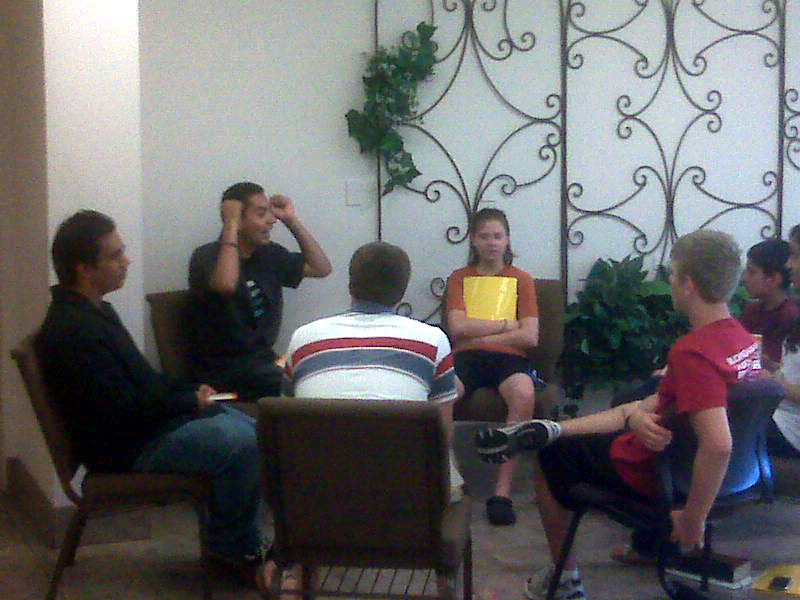
Fifteen minutes ago I left the fellowship room of the North County Church of Christ, which is hosting an LST YoungFriends group from Dallas. The group in the fuzzy picture is just one of five, composed of teens from the Dallas youth group, some of the North County church teens, and some teens from the community. They are in their C-Groups (Conversation Groups), talking about the story of Jesus and about their lives.  And this is Monday afternoon of summer vacation!

LST YoungFriends is just a mission package for church youth mission trips. What makes it pretty unique is that it is evangelistic! Yes, YoungFriends includes community projects: tomorrow the group is working in a food distribution program; Wednesday it is going to give sandwiches to the homeless in San Diego; and, Friday the group will visit a school in a lower income and higher risk area of Escondido. But what makes YoungFriends different is that the group is partnering with the local teens to offer a way to talk about their own faith—or lack of it.

We did a little review of their training this morning before the first C-Group. We talked about the skepticism local teens might have about joining C-Groups and how to try to alleviate their fears.  We talked about being sensitive to talking about our stuff with kids that have much less. We practiced good relationship-building practices, like share from your own life first, and then let others share as they become comfortable with you and trust you.  I can’t wait to listen to the debriefing from these first groups today, to hear what this Dallas youth group has learned from just the first day of truly reaching out to others from their own lives and with the story of Jesus.

But my question to you today is this: why is an evangelistic youth mission trip so unusual? Take your pick from the following suggestions:

  1. Few adults, including parents and youth ministers, have evangelistic experiences, so they do not even think about it for their young people.
  2. Service projects are easier to plan and more predictable. Anything that involves interaction with people on the other end is a little more difficult to pull off.
  3. Some adult leaders have had such bad personal experiences with combative evangelism or forced evangelism, that they really don’t believe in any form of active evangelism any more.
  4. Doing something evangelistic sounds much more challenging to our teens and might be harder to sell to them!
  5. Some don’t think the kids know enough to tell anyone else about Jesus. Many of the kids in the youth group have not made their own decision for Jesus.

If you have other suggestions, I’d love to hear from you.  What I do know is that our young people MUST find their own faith and learn to verbalize it in a way that communicates to their peers, or we adults will have failed to raise our children in the Way of the Lord!

So allow me the moment of euphoria, watching this bunch of very normal Dallas teenagers, being silly, being loud, but being like Jesus in a very special way, sharing their faith with someone who needs to hear.

American highways are remarkably free from roadkill! Yesterday we drove 934 miles and I don’t remember seeing anything dead on the road at all. Did you know that most of the roadkill in Australia are kangaroos! And you see a  lot. In fact, many people have those big cowcatchers—I don’t know what else to call them—on the front of their vehicles because hitting roos on the roads is so common.

You’ll remember from yesterday that Sherrylee and I decided at the last minute to drive to California to help with an LST YoungFriends project at the North County Church of Christ in Escondido, just north of San Diego. You can read about the first 446 miles in yesterday’s posting—but you can start here also. The great thing about journeys is that they have an official starting place, of course, but today’s start is just as much of a start as yesterday’s start.  There must be a sermon there somewhere!

After a quick stop at the ubiquitous Wal-Mart in Pecos, Texas, we got on the road again. Sherry enjoys reading aloud while I drive, so she suggested reading the Catechism of the Roman Catholic Church. Yes, we are pretty weird, but don’t worry, we balanced it with a Robert Ludlum novel later in the day.

We have been reading and talking about Roman Catholicism for some time, since her brother recently became a Catholic priest.  Yesterday, most of our reading and conversation was on sacramentalism, but that is a topic for another blog.

The amazing thing about driving in Texas is that when you get to El Paso, your halfway to California. Of course you have to speed past the sand dunes in Monahans, the Davis Mountains and Fort Davis, McDonald Observatory near Alpine, and the many great Tex-Mex restaurants along the way or you will just turn around and say, “Why would I ever want to leave Texas!!”

The only thing I really found interesting in New Mexico was driving through Lordsburg.  Who knows what classic journey film has Lordsburg as the stagecoach’s final destination?

Now Arizona has Tombstone and Yuma, but we missed the 3:10 train. I forgot about the time zone change! We didn’t stop, but if we go back that way, I’m planning to try to stop and sightsee.

At some stop, we balanced our morning catechesis with an audiobook from Cracker Barrel (where else?) called The Bourne Deception—the full 17.5 hour/15 disc version. Pretty good deal for $3.50!  It was so good that we skipped supper. Our only interruptions were the Border Patrol control points—something we had never seen before.

The Board Patrol check Points reminded me of the Arizona controversy. We were waved through easily, but I couldn’t help but think about it being a different story if we had been Latino—either of us.  I’m all for controlling our borders better to prevent illegal aliens from entering, but if you have ever been a foreigner in a foreign country (stranger in a strange land is the biblical phrase) and been discriminated against, you would know how humiliating and offensive any form of profiling or discrimination is.

When Sherrylee and I lived in Germany and were looking for an apartment, we would occasionally call about one that looked great to us, only to be hung up on because we were aliens with an accent. That was almost as bad as the people who used the less formal language forms when talking to us as if we were either children or stupid. Well, you can see that I am sympathetic with aliens from my own experience of being one.

You have time to think about many things on a road trip!

Roadtrips

Sherrylee and I love road trips!  I’m talking about where you throw stuff in the car, take off, and drive for hours and hours.  In this day of instant gratification, which includes getting to places quickly from wherever we are, road trips seem a thing of the past, but since I’m writing this in the breakfast room of a Holiday Inn Express in Pecos, Texas—8 hours from Fort Worth and 12 hours from Escondido, CA.—I want to tell you about ours, so you can see what you think.

Yesterday about 11am, we decided that I needed to go to Escondido, where LST is sending a YoungFriends group from Dallas for a week-long mission trip. We sometimes do this to simply provide a little help to both the group sponsor and the hosting church. Since our daughter Emily and her family are in Escondido, Sherry wanted to go too, but have you looked at last minute ticket prices lately! She suggested that we leave right away and drive—1394 miles—19+hours!  In less than 10 minutes, we had decided to do it—so we agreed to leave at 2pm.

She went to the Hair Cabin for whatever, and I tied up stuff at the office, then stopped the mail for 10 days, ate lunch with the staff, and went home to pack.  Packing for road trips is soooooo easy because you don’t have to worry about weight, you don’t have to worry about how many ounces of liquid, you can take your good shoes, your running shoes, AND your flipflops—and they don’t even have to go in the suitcase. The best of all is being able to hang your clothes in the backseat. What a luxury!

We were almost giddy as we drove out of the city right before rush-hour traffic—about 3:30, not 2pm—but that’s OK.  The first thing we did was play the alphabet game. What—you’ve never played. You have to find all the letters in proper sequence, call out the word that contains the letter—which means your opponent can’t use that letter in that word—and you can’t look backwards!  Oh, yes, and it has to be on a sign, not anything moving.  Sherry and I are fierce competitors, so I will confess to one tense moment when we both saw the J in Justin Boots at the same time. I think I really beat her, but it was so early in the trip, we agreed to both claim it as a tie—any sacrifice for matrimonial harmony!  Ultimately my generosity paid off because I found the Z in pizza just outside of Abilene and won.  We’ll see what happens today!

And we always stop at Crackerbarrel restaurants on road trips—mostly because of all the fun things you can do there!  First, you can walk around and say, “Who do you think would buy something like that?” Then we look at the pictures on the wall and see if any of our forefathers are memorialized in their antique pictures—well, those pictures are of somebody’s people!! Don’t laugh.  Then we always try to beat the little triangle peg game that they put on each table.  Sherry was obsessed yesterday, so I cheated and found a clue on the internet about where to start that let both of us beat it once—but then we couldn’t repeat, so I bought her one to bring on the trip as we left. Oops, now I know who buys that stuff!!

Don’t forget to go to the bathroom at Crackerbarrel—except be careful. In nine out of ten Crackerbarrels, the men’s room is on the left and the women’s on the right, which only sets us Stammkunden up for an embarrassing moment if we ever walk into the exception! I’ve done it several times, I confess.

Next we listened to 4-5 episodes of Garrison Keillor’s Stories from Lake Wobegon podcasts off the ITouch that my kids gave me several years ago! What great kids. We tried listening to Cost of Discipleship by Dietrich Bonhoeffer, which I had downloaded for free a couple of months ago. It was a little heavy for the mood yesterday, but it might work today.  If not, we’ll stop at the next Crackerbarrel and rent an audiobook on CD—see why we always go there!

We pulled into Pecos, Texas about 11:15 last night, couldn’t find the hotel, drove around until we found something open where we could ask. Soon we were in our room—but the toilet was broken—so then we were in another room, tired, but glad we were on the road—together!

I wonder what today will bring?

A missions minister and I were having lunch one day because his church wanted to begin requiring training for all people they supported on short-term missions. He knew that the Let’s Start Talking teams had a reputation for being well-trained, so he was looking for ideas.

When I told him that the college students that go with LST receive approximately 45 hours of training in preparation for 3-6 week mission trips and that church members going for two weeks receive 20 hours, he literally went pale! His church now requires one Sunday afternoon of training for their short-term workers—which is more than most churches provide or require!

The problem is not that short-term mission leaders do not believe in training, it is that nobody wants to spend the time and energy that it takes to do it. Appropriate training is essential, however, for an excellent short-term mission trip.  Here are some of the characteristics of appropriate training:

Appropriate training prepares the workers for their spiritual work as well as their physical work. While getting materials together or practicing songs or going over assignments or role-playing conversations is appropriate and essential, many of our volunteers are spiritually ill-prepared for the challenges of mission work.  Many have never verbalized their own faith, so they have difficulty responding to questions like “Why do you believe Jesus is the Son of God?” Many Christians don’t know where to start with someone who does not believe the Bible is the Word of God.  When challenged, unprepared Christians may begin to doubt their own faith or to move toward a “all-roads-lead-to-heaven” faith.  Mission trips are spiritual pressure-cookers and tend to bring our spiritual weaknesses to the surface. Spiritual as well as physical preparation is essential.

Appropriate training includes how to work together with others! Just as “personality issues” (a euphemism for any number of our own selfish desires) are a major source of trouble between Christians at home, put 5-6 people together 24/7 for even 2-3 weeks in close quarters under less than ideal circumstances and see how long it takes for the facades of Christian charity to fall.

Appropriate training includes cross-cultural awareness and sensitivity. Who is telling the volunteers about appropriate dress? Who is preparing the team for the toilet facilities? Who is preparing the group for worship in a foreign language without translation? Who is training the workers how to “look and learn”—that is, watching and imitating the local Christians in situations that are unexpected or unfamiliar.

Appropriate training happens before, during, and after the short-term mission trip. Most training needs to be done before the team leaves, but while on the field, situations and questions arise that catch short-term workers off guard. Who helps them sort through their questions and feelings?  And who helps them know how to return home?  LST conducts EndMeetings with all of our workers in which we help them frame their experience, to know how to report about it, and to know how to deal with reverse culture shock.

Appropriate training is done by qualified trainers. This one is so obvious that I just want to warn against one danger, i.e., the person who is the cultural expert because they have been in the country for a week a couple of years ago—you know what I mean! If you haven’t got qualified trainers, find some and bring them in—it’s worth it.

I’m convinced that appropriate and high quality training is why the request for LST teams is still high after thirty years!  The lack of such training is why churches quit sending and people quit going.  Invest the time and energy into appropriate training and you will bring God more glory and honor!  The added value to good training is that what you learn for the mission field always is still valid when you return home!!

LST once had a team in Madagascar. The evangelist’s daughter was kidnapped in front of the church building where the college team was working by a local gang, looking for a reward. After just a couple of hour,  the girl managed to escape unharmed. The family reported the name of the gang leader to the police who arrested and jailed him immediately. The gang leader, however, bribed his way out of jail and vowed to kill the minister and his family. The LST team was staying in the home of this family.

What would your church/organization do now?

Here are the two most important questions for you to consider?

  1. Are you as a church/organization prepared to deal with this situation for your church members—which means, do you have the personnel, funds, and a plan to take care of your people?
  2. Secondly, how quickly can you implement your plan?

Just to ease your mind, I’ll tell you that within the hour, LST immediately moved the team into a high security hotel, and then flew the team out of the country within twenty-four hours. In addition, LST staff met them in France, let them talk through their experience and their fears, then arranged for them to finish the last three weeks of their mission trip with a church in southern France. When they returned home, not only was the team emotionally and physically healthy, but they also couldn’t stop talking about how God worked it all out for good—whew!

Make sure that either your church or organization has both an Emergency Management Plan and the personnel and funds to implement it twenty-four hours a day while your team is on the field.  Here is a short list of the type of emergencies that you should be prepared to handle:

  1. Travel emergencies – lost documents, canceled flights, unexpected fees, passenger error (goes to wrong airport, checks in too late, etc.)
  2. Medical emergencies – accidents, illness on site, flare up of pre-existing conditions, sudden death
  3. Political emergencies — political violence, curfews, closed airports, police harassment (one LST team suddenly was required to get special visas), political extortion (demanding bribes).
  4. Natural emergencies – typhoon, flooding, earthquake,
  5. Team emergencies – unexpected death or emergency at home, emotional/spiritual breakdown, unexplainable hostility (often culture shock), immoral behavior, disregard of authority, misuse of people or funds.

Emergencies don’t happen often. In thirty years of sending short-term mission teams, LST has dealt, however, with everything mentioned above at least once. You can’t remove all threats, you can’t prevent all emergencies—even with the best preparation and training—but you can be intelligently prepared for the inevitable.

P.S. If you would like a copy of the Let’s Start Talking Emergency Management Policy, I would be happy to send you one. It’s too long to post here. Just email me at LST@LST.org with Emergency Management Policy in the subject line.

Prince of Persia (2010) is based on a 1989 video game, so the obvious audience for the film is young teens—probably boys more than girls. Parents and grandparents who take their kids and grandkids will not be embarrassed or bored.

You will probably find it a diminished, postmodern Indiana Jones film, by which I mean lots of humor, snakes, whips, a beautiful but slightly treacherous girl, and supernatural weapons of mass destruction. Jake Gyllenhaal is not Harrison Ford, but Ben Kingsley makes a great villain and Alfred Molina has some very funny lines. The ostrich races are a great touch.

As you drive home from the film with the minivan full of kids, here are some conversation starters that might help the kids think about the film both intelligently and spiritually.  Remember, these are conversation topics, not lecture topics—oops, got a little preachy, didn’t I J!

  1. You don’t have to be born a prince to be a prince! Dastan was a street kid with nothing but a strong sense of justice and right. Then he was an adopted kid with lots of stuff, but no power or future. He continued to stand out and become the best of the brothers because of his courage and his character. Kids don’t all start out equal; many start with huge disadvantages, but all can become people who others look up to, people who do good and not evil.
  2. Beauty can be used for good or evil! This is a great topic for boys and girls both. The princess had great beauty which gave her both opportunity and power.  She had to make many choices of whether to use it for good causes that helped others or just for her own benefit. And sometimes her beauty got her into trouble. Beauty can’t be the goal; beauty is just a tool to be used for good or bad.
  3. Good people have bad things happen to them. Dastan did not try to kill his father, but he is blamed for it and has to run. The city of Alamut is conquered even though it had not rebelled. Life is not fair, so the only real question is what you do when you are treated unfairly.
  4. Stand up for what you believe to be right. In real life you don’t get a do-over! In the film Dastan knows from the beginning that attacking the city is wrong, but he lacks the self-confidence to speak up against his older brothers. In the film, he gets a second chance, but in real life that rarely happens. Teach your children to be strong and courageous and to not be afraid. Stand up and speak up for what is right—all the time.

If your teens are a little older and would like something really challenging, ask them if they know  the prince of Persia story in the Bible. Then when you get home, point them to Daniel 10 and let them think about the role of angels in spiritual warfare.  You won’t have the answers to all of their questions, but it’s a great chapter to open our eyes to the unseen realities of the world we live in as well.

Prince of Persia is a typical Disney film, very clean with just a touch of violence to rate it for older children. And by the way, don’t miss the small political jabs in references to taxes and WMDs.