Feeds:
Posts
Comments

Posts Tagged ‘family’

They went across the lake to the region of the Gerasenes. 2When Jesus got out of the boat, a man with an evil spirit came from the tombs to meet him. 3This man lived in the tombs, and no one could bind him any more, not even with a chain. 4For he had often been chained hand and foot, but he tore the chains apart and broke the irons on his feet. No one was strong enough to subdue him. 5Night and day among the tombs and in the hills he would cry out and cut himself with stones.

In modern terms, how would you describe this man?  Try staying away from psychological/pathological terms and try finding normal words for how someone in your circle with these symptoms might be described.  Here’s my attempt:

There was a Guy who had a pretty normal childhood, but somewhere along the way, he got into bad stuff—made really bad choices. It cost him everything!  First, he lost his family and friends; he had no one who could deal with his demons, so he ended up by himself.  Then he just went out of control—no boundaries, abusive, into stuff that damaged his body and soul. Sure, some people tried to help with interventions and rehab, but he could not be contained. He broke away from all of that, deeply depressed, and continuing to do destructive things.  No one saw any real hope or future for this Guy.

6When he saw Jesus from a distance, he ran and fell on his knees in front of him. 7He shouted at the top of his voice, “What do you want with me, Jesus, Son of the Most High God? Swear to God that you won’t torture me!” 8For Jesus had said to him, “Come out of this man, you evil spirit!”

One day this Guy is confronted on the streets by a random Jesus-person and it scares him to death! He first yells at this Jesus-person to get away, he threatens him and tries to intimidate him, but the Jesus-person just won’t go away. The guy says, “What do you want with me, man? You are killing me! I’m not like you. I used to be, but I don’t even remember what it is like to be like you—and it is too painful to even try!  Do you have any idea who I am?”

The Jesus-person says, “This is not who you are. You are full of the wrong stuff. Are you happy? Are you who you want to be?”

The Guy says, “I am who I am! I am nothing. I don’t know you, but you are killing me! Even if I tried, I can’t get back to where you are . . . . “

The Jesus-person replies, “You are right. Even if you tried, you couldn’t get back. But just listen to my story for a minute.” Then he covers the person with the love of God and the blood of Christ, destroying the old Guy and watching the creation of the New Guy.

As Jesus was getting into the boat, the man who had been demon-possessed begged to go with him. 19Jesus did not let him, but said, “Go home to your family and tell them how much the Lord has done for you, and how he has had mercy on you.” 20So the man went away and began to tell in the Decapolis[c]how much Jesus had done for him. And all the people were amazed.

After a time, the Jesus-person needed to leave. The New Guy says, “I want to go with you! You are the best thing that ever happened to me—and I need you!”

The Jesus-Person replied, “I love you, brother, but you have a new task and a new message. You need to go home!”

The New Guy says, “There is nothing for me at home. Don’t send me away. I don’t have anyone!  I’ve hurt my family so badly, I can’t go back. They hate me!”

“You are not the same person. Go just introduce yourself to them again slowly. They probably won’t believe that it is you, but give them time. Tell them what God did for you!  Better yet, show them what God did for you. ”

“They will never believe me!  They’ll never love me again. They will never change”

Jesus-Person says, “That’s what you told me when I first met you. It is not you who will convince them. It’s the Story you are going to tell. If it can change you, it can change them too.”

So, of course, the New Guy went home—and what do you know—everything the Jesus-Person said happened. People were amazed.

Read Full Post »

Did you remember the Cats and Dogs movie from 2001?  This 2010 version is basically the same plot without so many humans involved in the film. Even a couple of the characters (Butch and Mr. Tinkles) are carryovers from the 2001 film, but it really doesn’t matter if you remember or not. The new rendition  is a pretty forgettable movie.

In spite of a few moments of homage to James Bond films (the opening credits), to the Hannibal Lekter films (Mr. Tinkles’ muzzled in Alcatraz), and to Mission Impossible (final scene), the plot is so slow and predictable as to be uninteresting for the parents and grandparents who must attend with the kids. The kids themselves may enjoy the action –but not all that much either. Cats and Dogs: The Revenge of Kitty Galore (2010) did not leave my grandkids talking about the film at all—and that is the litmus test for me.

Just in case your kids do want to talk about the film, let me make some brief suggestions about topics that could develop into good conversations for you.

1. Revenge : What do you think about getting back at people for something they do to you? Lots of literature and lots of movies use revenge as the primary motivation. I bet you can name five or six films without even thinking hard—but what kind of world do we live in if everyone seeks revenge for the wrongs done to them?   That conversation can stay in your neighborhood or go all over the world. Ultimately, don’t we come back to God saying, “Revenge is mine,” and waving us off of revenge (Romans 12:19)?

2. People often do bad things because of bad things that happened to them. I don’t think that excuses badness, but it might turn “villains” into real people rather than just cartoon characters. Why does Kitty Galore want revenge? What if that accident had not happened? Would she have been as evil?  Maybe if someone had apologized, or bought her a beautiful fur coat as penance, or just loved her ugliness more . . . . What action could have changed the direction of her life?

3. Cats and dogs can live with each other! You could take this topic into race or alternative life styles, but for my grandkids, I’d leave it just where it was in the movie—boys and girls! My three grandsons—all  under 8–delight in terrorizing any girl of any size! I don’t know where this comes from, but we spend a lot of time teaching that girls are not objects to be pinched, chased, used as prisoners, scared with bugs, etc. Just seems to me that the younger they learn to respect girls, the better off they will be.

4. Why shouldn’t people try to crush the opposition, people who aren’t like them, or don’t believe like they do? It’s always to create a better world, isn’t it! This may be for kids a bit older, but they do hear a lot of this “crushing” talk from adults. Think about the “crushing” type comments they might overhear from you about the opposing political party, about people in different economic strata, about foreigners in our country, about . . . . you fill in the blank. To honor and respect people VERY different from us is challenging. Kids need to hear from you that “crushing the opposition” is rarely a Christian virtue.

It’s not a great film, but if you see it, at least you now have a few ideas for pretty important conversations with your kids.  That might be worth it.

Read Full Post »

“It all begins  . . .  with a choice.”  And so I felt last night when Sherrylee wanted to go see the third Twilight movie.   We told our friends at supper that we were doing it so we could still have intelligent conversations with our daughter and daughters-in-law as well as the young women on our staff. We entered the theater with low expectations, but we were both pleasantly surprised by the film. For us, this episode in the Twilight Saga films was far and away the best.

Lest I end up with either a stake or a silver bullet (depending on your lifestyle) through my heart, let me just say that I have not read any of the books, so my only information is from the films themselves. My second disclaimer is that I am a male, and these movies are 100% for near-adolescent girls through women whose self-image is 18-25—and I truly do not mean that disparagingly. Don’t we all think of ourselves younger—locked in at a certain age—which makes crossing those birthday milestones that force you to re-think your age just that much more painful!

One of the reasons we had expected less from this film was anticipation that it was all about the war between Victoria’s army of vampires and the Cullen Clan–don’t you love the names! Clans conjure up images of either wild west feuds or Braveheart—but it wasn’t; rather, it did focus on the main characters and their choices—mostly choices about love.  Talking about love choices with your teenage girls should be fun!  I think I would start with questions, not comments. Try these questions and then listen to what they say. After that, you might get to make an observation or two—that’s your choice!

1. Why does Bella love Edward? He’s a pretty face, he’s an “older man,” he’s chivalrous (I’m sure they won’t use that word!), but he also tries to control her and he’s only as passionate as a cold guy can be! So what’s the attraction? . . . You are going to learn a lot about your girls if you can get them to answer this question with something besides giggles.

2. Why does Bella love Jacob? Jacob is the opposite of Edward in many ways. He’s more physical and more physically attractive, warm, same age, much more passionate, and less “mental”—meaning driven more by his feelings than his mind.  Which one appeals to your daughters? Again, if you can listen, you will learn a lot.

3. How can Bella love both of them? You may get some answers that lead to a conversation about attraction versus love—with your girls being more or less able to differentiate. You might also get hit with a taste of the postmodern (or millennial) , that is, you can’t help who you fall in love with, so you are just a passive pawn in a universe driven by nothing. This is a great opportunity to start the real meat of the conversation about love being a choice.

4. Love is a choice! Ok, finally you get to make a statement—and this is really an important one.  Especially this film shows the personal choices that not only Bella, but all of the characters are making. Bella is choosing Edward, not only out of great romantic love, but also because she has always felt like an outsider and powerless and with the Cullens, she feels like an insider and powerful!  Edward is choosing to do the most selfish thing he has ever done, endangering Bella’s soul because he loves her (This might lead to a great conversation on whether this is really love!)  Jacob chooses to fight for Bella’s love because he loves her and believes he is better for her.  (Here’s a thought question: Would Jacob turn Bella into a Wolf if he thought it would cost her something as precious as her soul??) True motivations are always complicated.

5. Is Bella making good choices? I’m not really fond of this character. She’s broody and conflicted, too much so for my tastes.  I don’t like it that she tries to take Edward to bed. (BTW, if I had teenage daughters I would tell them that very few guys will resist if a girl comes on that strong. The boys should—but very few will! ) I understand her conflict with marriage—so typical of young people today who are mostly the product of broken marriages—but I don’t like her choice of not marrying.   I do like that she respects her parents; but she doesn’t really listen to them enough—another bad choice.  She, like many kids, is not a bad person, but  I see her making lots of bad choices . . . . so how does a girl not make these or other bad choices?

6. In our story, does God have a role in any of these choices? Take every opportunity to remind your teens (and yourself) that any story that leaves God out is not the story we want to live out.  That’s our number one choice that should frame ALL other choices. You don’t have to preach a sermon—just let your kids know that for a Christian, this is the most important choice of all.

As I said, those of you who have read all the books may have a completely different view of motivations; I’m only talking about what I see in the films.  Apparently at least two more sequels are already in the pipeline: Breaking Dawn, Part One and Part Two. Whether you are a Twilight fan or not, your daughters/granddaughters probably are, so I’d suggest you use the opportunity to listen first, then talk about love and choices.

And it wouldn’t hurt you Dads/Granddads to be a part of this conversation either! Suck it up and see it! (Oops, wrong metaphor!)

Read Full Post »

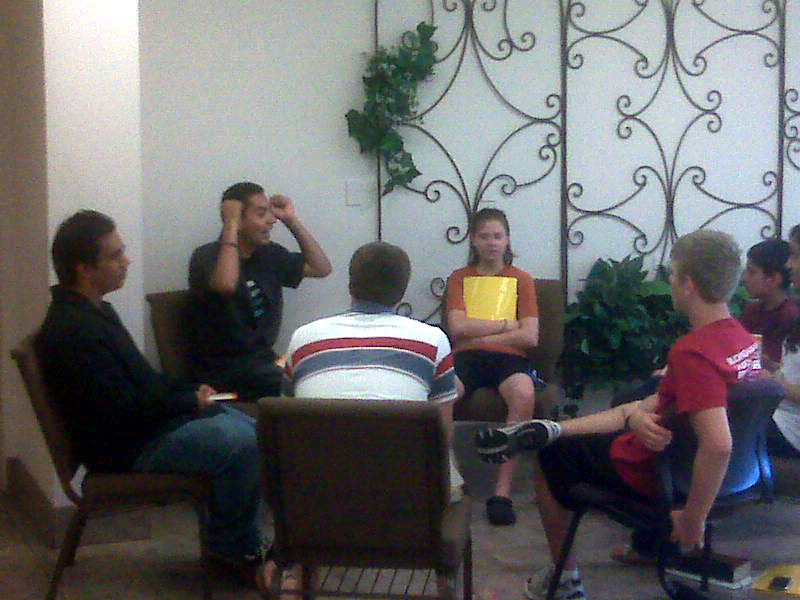
Fifteen minutes ago I left the fellowship room of the North County Church of Christ, which is hosting an LST YoungFriends group from Dallas. The group in the fuzzy picture is just one of five, composed of teens from the Dallas youth group, some of the North County church teens, and some teens from the community. They are in their C-Groups (Conversation Groups), talking about the story of Jesus and about their lives.  And this is Monday afternoon of summer vacation!

LST YoungFriends is just a mission package for church youth mission trips. What makes it pretty unique is that it is evangelistic! Yes, YoungFriends includes community projects: tomorrow the group is working in a food distribution program; Wednesday it is going to give sandwiches to the homeless in San Diego; and, Friday the group will visit a school in a lower income and higher risk area of Escondido. But what makes YoungFriends different is that the group is partnering with the local teens to offer a way to talk about their own faith—or lack of it.

We did a little review of their training this morning before the first C-Group. We talked about the skepticism local teens might have about joining C-Groups and how to try to alleviate their fears.  We talked about being sensitive to talking about our stuff with kids that have much less. We practiced good relationship-building practices, like share from your own life first, and then let others share as they become comfortable with you and trust you.  I can’t wait to listen to the debriefing from these first groups today, to hear what this Dallas youth group has learned from just the first day of truly reaching out to others from their own lives and with the story of Jesus.

But my question to you today is this: why is an evangelistic youth mission trip so unusual? Take your pick from the following suggestions:

  1. Few adults, including parents and youth ministers, have evangelistic experiences, so they do not even think about it for their young people.
  2. Service projects are easier to plan and more predictable. Anything that involves interaction with people on the other end is a little more difficult to pull off.
  3. Some adult leaders have had such bad personal experiences with combative evangelism or forced evangelism, that they really don’t believe in any form of active evangelism any more.
  4. Doing something evangelistic sounds much more challenging to our teens and might be harder to sell to them!
  5. Some don’t think the kids know enough to tell anyone else about Jesus. Many of the kids in the youth group have not made their own decision for Jesus.

If you have other suggestions, I’d love to hear from you.  What I do know is that our young people MUST find their own faith and learn to verbalize it in a way that communicates to their peers, or we adults will have failed to raise our children in the Way of the Lord!

So allow me the moment of euphoria, watching this bunch of very normal Dallas teenagers, being silly, being loud, but being like Jesus in a very special way, sharing their faith with someone who needs to hear.

Read Full Post »

Family is the core unit of Creation and the best metaphor for the church of God.  So why should it surprise anyone that families are just great on short-term mission trips.  When Sherrylee and I started LST, our children were 7, 5, and 3, and they went with us every summer. At that time, we got lots of people asking if it was a good use of money to take the children. Terrible question—as if it would be better use of God’s money for Dad or Mom to leave for weeks at a time.  Here’s what we learned about taking families on short-term mission trips!

  1. Your children can have no better Christian experience than first seeing Mom and Dad sharing their faith, then later, working beside them. If you care at all that your children find their own faith and don’t reject yours, then sharing short-term mission projects with them is the best opportunity.
  2. Children are a magnet in foreign countries. Wherever we would go, people gathered around our children, loved on them, wanted to talk to them. This brought us into contact with people in a very natural and friendly way that we would have otherwise never met.
  3. Whole families are a rarity in mission churches. Many women without their husbands find their way to our mission churches. Or you have a college student without parents.  The example of Dad and Mom with their kids all worshipping and serving God together is very special to those we serve.
  4. Multigenerational families are even more special! The only thing better than the whole family going together is the whole family with Grandpa and Grandma—who are probably in the prime of life—and faith.  LST has sent many three-generation family units, so we know the impact on those we serve.  Our daughter and her new husband went with her Grandparents to the Ukraine nine years ago—and they still tell stories about it.
  5. Taking whole families requires sacrifices on everyone’s part, but since when were sacrifices bad for anyone! Our middle child was a baseball player. Every year, we left the country after 2-3 weeks of summer baseball season, which was hard on him.  We always signed him up, bought the uniform, and paid the fees so he could play the 3 or 4 games that happened before we left, but we did not let it keep us home.  We did buy newspapers everyday so he could keep up with the baseball scores, and we made special arrangements with Americans overseas to record the mid-summer All-Star Game. Then when we came through, we made a big deal out of watching it together.  Was it a sacrifice? Yes! But he learned very early that in our family, God’s work came first. And today he is a man of God, which is all we could have prayed for.

I am convinced that if we learn as a family to serve God first, we will do church better. First the little family, then the big family.

Read Full Post »

« Newer Posts