Feeds:
Posts
Comments

Posts Tagged ‘hymns’

Brother Slater was a kind of celebrity at our church when I was a boy. He and his wife Sister Slater would sit toward the front on the left side of the auditorium. As a young boy, all I knew was that he had written Walking Alone At Eve, which was one of my favorite songs.

William Washington Slater was more than a celebrity; he was a great saint and servant of God. Born in 1885 in Arkansas, Will’s family moved to Indian Territory in 1890 to farm. Like many boys of his time, his formal schooling ended in the fourth or fifth grade, but not his desire for learning.

By the time he was 18, his special interest in music was apparent.  The story is told of his saddling and riding a mule fifteen miles every Saturday to attend singing schools, so he could become a better song leader.  He later decided he wanted to preach as well, so he soon became a preacher-song leader, preaching gospel meetings and leading singing for other great preachers.

He married Nettie Washington in 1910, and they had five children. Three of his daughters went to church at Eastridge Church of Christ, where I grew up, so I knew them and several of their children. Thelma Slater married Wade Banowsky and one of their sons William Slater Banowsky became president of University of Oklahoma and Pepperdine University.

I remember the quiet announcement at church that Brother Slater had died while preaching a meeting in Arkansas in 1959. According to accounts of his last day, he had preached his sermon and, as was his custom, offered to stay after church and sing with any who wanted to join him.  Someone asked him to lead a song entitled “This Is Someone’s Last Day.” Before leading it, he reminded the church to pay attention to the truth of the message, not knowing that it was his very own last day.

Walking Alone At Eve (1917) was one of Will Slater’s earliest songs.  As in many older hymns, it is God’s creation that inspires worship. I imagine country folks walking or riding in their wagons home from an evening of preaching and singing. As it grows dark and the stars start popping out, this might be one of the songs that they would sing.

Walking alone at eve and viewing the skies afar,
Bidding the darkness come to welcome each silver star;
I have a great delight in the wonderful scenes above,
God in His power and might is showing His truth and love.

Sitting alone at eve and dreaming the hours away,
Watching the shadows falling now at the close of day;
God in His mercy comes with His Word He is drawing near,
Spreading His love and truth around me and everywhere.

Closing my eyes at eve and thinking of Heaven’s grace,
Longing to see my Lord, yes meeting Him face to face;
Trusting Him as my all where-so-ever my footsteps roam,
Pleading with Him to guide me on to the spirits’ home!

The chorus is that simple, ubiquitous longing for rest with God.  Resting is the reward for working hard. I wonder why we don’t sing many songs about rest anymore?  The melody of the chorus is simple, not a passionate cry, but a quiet, simple longing.

O for a home with God, a place in His courts to rest,
Sure in a safe abode with Jesus and the blest;
Rest for a weary soul once redeemed by the Savior’s love,
Where I’ll be pure and whole and live with my God above!

I don’t really know why, but I have sung this song to all of our kids as I rocked them to sleep.  Perhaps it was singing at the end of the day, usually in a darkened room, and the simplicity of the melody—I’m not quite sure why it became one of those songs I sang to them, but it did.

I do know that it cleanses your soul to hold your little God-gifts on your shoulder and to sing about being pure and whole and living with God. The congruity of those precious moments with this melody has always been redemptive for me.

Great hymns do improve our walk with God. 

Read Full Post »

Just about three weeks ago, the world remembered the 100th anniversary of the sinking of the Titanic in April 1912.  I suspect that few events have impacted the psyche of the modern world like the sinking of this unsinkable ship, along with the tragic and needless deaths of over 1500 people, including some of the richest and most prominent people of their times.

One of the stories that persists in connection with the Titanic is that the string ensemble played Nearer My God To Thee until the very last moments before the ship sank, a story, whether true or not, certainly perpetuated by most of the movies about the Titanic, including the latest James Cameron Titanic (1997).

My memory of this great hymn places it among what we would have called communion songs, those songs sung just before serving the Lord’s Supper. As a boy, I remember this as being a very quiet time in our service, the lights dimmed, usually no music—just remembering the Lord’s death until He comes.

I’m sure it’s the mentioning of the cross in the first verse that made it seem appropriate for communion:

Nearer, my God, to Thee, nearer to Thee!

E’en though it be a cross that raiseth me;

Still all my song shall be nearer, my God, to Thee,

Chorus: Nearer, my God, to Thee, nearer to Thee!

It never really suggested imminent death to me, even though that appears to be the context in which it has been most often used.  Besides the Titanic story, this hymn is also associated with the death of two American presidents: William McKinley and James A. Garfield.

James A. Garfield

In 1881, just sixteen years after the assassination of Abraham Lincoln, Garfield, the 20th president was shot in Washington, D.C., ironically, in the presence of Robert Todd Lincoln, the former president’s son.  He died 80 days later.  Nearer My God To Thee was played during his funeral procession.

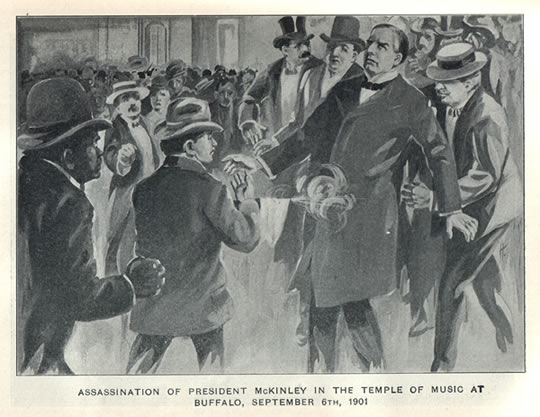
Twenty years later, President William McKinley was shot while visiting the Pan American Exhibition in Buffalo, N.Y. . Here is the report from The Life of William McKinley (1916)

SUNSHINE in the sky above and gladness in the heart of the President brightened the morning of the 6th day of September, 1901. It was to be a holiday: a visit to Niagara Falls in the forenoon, a reception to the people in the afternoon. In joyous mood McKinley passed the hours of the excursion, his nature never more serene.  . . . As he approached, the President extended his hand;—but the proffered friendliness was met by two pistol shots which rang out from the revolver concealed in the seemingly bandaged hand. Instantly several of the guards seized the assailant and bore him to the ground. As they did so, one of them, kneeling by the head of the prisoner, glanced upward and saw the President, still standing, supported by friends, and gazing with an indescribable look of wonder and reproach.

While he was being helped to a chair the Secret Service men dragged the prisoner to the center of the temple and there some one struck him squarely in the face. Seeing this, the spirit of the Master, whom he had served all his life, came upon the stricken President, and he cried in a tone of pity, “Don’t let them hurt him.”

The friends now gathered about the wounded man were fanning him with their hats and watching anxiously to discern if possible the full extent of his injury. But the President’s mind was not upon himself. He was thinking of the beloved wife, who had leaned upon him so many years and whom he had always shielded so tenderly against the slightest care. As the Secretary bent over him, he whispered, tremblingly, “My wife—be careful, Cortelyou, how you tell her—oh, be careful!”

The president was rushed into emergency surgery:

     At such a time as this, the very essence of the human spirit, which may have shrunk for a lifetime from exposure to the eyes of men, is likely to assert its presence. From the time he was ten years old, President McKinley had unreservedly, but without ostentation, put his trust in God. It was the richest, deepest thought of his inner soul, and now, as he closed his eyes, realizing that he was about to sleep, perhaps to wake no more, his lips began to move and his wan face lighted with a smile. It was the same trust that now supported him. “Thy kingdom come, thy will be done,” he murmured. The surgeons paused. Tears came into the eyes of those about the table. “For thine is the kingdom, and the power and the glory, forever, Amen.” With these words he passed into unconsciousness, while the earnest surgeons sought with all their skill to prolong his life.

McKinley seemed to do well immediately after the surgery and all were very hopeful, but suddenly, a week after the operation, he took a fatal turn for the worse:

In the afternoon of Friday the President knew that the time had come for him to bid farewell to the world. He called the surgeons to his bedside and said, “It is useless, gentlemen, I think we ought to have prayer.” His eyes were half closed and again the smile of sublime faith in the future illuminated his features. A solemn silence fell upon the assembled doctors and nurses and tears could not be restrained. The dying President moved his lips and again it was the Lord’s Prayer that welled from his overflowing heart. The twilight descended and the room grew dark.

 The room was silent. The President put his arm around his wife and smiled at her. The family group and intimate friends about the bedside watched and waited. Then the lips moved again and the worn face became radiant. The inner soul was speaking once more and was voiced in the lines of his favorite hymn:—

“Nearer, my God, to Thee,
Nearer to Thee,
E’en though it be a cross—”

Fainter and fainter came the words until the whisper could scarcely be heard. Then a moment of silence. “That has been my inextinguishable prayer,” he murmured, almost inaudibly.

Perhaps one mark of the greatest hymns are those hymns which speak for our souls in the most critical moments, those we choose when our own words fail usNearer My God To Thee has been one of those hymns and will continue to be if we don’t forget it.

Nearer, my God, to Thee, nearer to Thee!

E’en though it be a cross that raiseth me;

Still all my song shall be nearer, my God, to Thee,

Chorus: Nearer, my God, to Thee, nearer to Thee!

Though like the wanderer, the sun gone down,

Darkness be over me, my rest a stone;

Yet in my dreams I’d be nearer, my God, to Thee,

Chorus

There let the way appear steps unto heav’n;

All that Thou sendest me in mercy giv’n;

Angels to beckon me nearer, my God, to Thee,

Chorus

Then with my waking thoughts bright with Thy praise,

Out of my stony griefs Bethel I’ll raise;

So by my woes to be nearer, my God, to Thee,

Chorus

Or if on joyful wing, cleaving the sky,

Sun, moon, and stars forgot, upwards I fly,

Still all my song shall be, nearer, my God, to Thee 

Lyrics:  Sarah Flower Adams (1841)

Tune:   “Bethany” Lowell Mason (1856)

Read Full Post »

The words are a little archaic, but the hymn O Love That Wilt Not Let Me Go has always been one of my favorites.  The melody begins rather simply but moves quickly to a quietly triumphal—not a Sandi-Patty-rock- the-world–conclusion!

George Matheson (1842-1906) was a Scottish minister. While studying theology and with a promising theological career in front of him, in his twentieth year, he went completely blind.  Not only did his blindness block his academic ambitions, but the story is that his fiancé also left him, not being willing to be burdened with a blind husband for the rest of her life.

He was quite a successful pastoral minister who was served himself by his devoted sister.  When George was forty years old, his sister married and left him on his on. It was on the occasion of his sister’s wedding that George penned the words O Love That Wilt Not Let Me Go.!

O Love that wilt not let me go,

I rest my weary soul in Thee;

I give Thee back the life I owe,

That in Thine ocean depths its flow

May richer, fuller be.

First the loss of his sister’s care, rekindling no doubt the painful reminder of his own lost love, and all of this framed with his lost sight would have left many people bitter and angry. Matheson acknowledges the weariness of loss, but finds the ocean waves of God’s steadfast love life-giving as opposed to diminishing.

O Light that foll’west all my way,

I yield my flick’ring torch to Thee;

My heart restores its borrowed ray,

That in Thy sunshine’s blaze its day

May brighter, fairer be.

I love the “flick’ring torch” line. Our energies are too often spent trying to walk through life by the light of our flickering torch, when we could walk in the sunshine’s blaze with great confidence if we would yield.

O Joy that seekest me through pain,

I cannot close my heart to Thee;

I trace the rainbow thru the rain,

And feel the promise is not vain,

That morn shall tearless be.

The great hymns acknowledge pain rather than pretending that this world is tearless!  But Believers know that Joy is seeking us, not trying to allude us! Matheson may even suggest his own struggles with Joy because pain in this time can be a defining reality that we are tempted to close our hearts to Joy in doubt that it really exists.  Matheson traces the rainbow—not here a symbol of accomplished salvation, but rather a reminder of a sure promise!

O Cross that liftest up my head,

I dare not ask to fly from Thee;

I lay in dust life’s glory dead,

And from the ground there blossoms red

Life that shall endless be.

  A hymn that begins with a Love that will never let go ends with the Cross, a dying place.  Matheson’s hymn reminds us that we cannot circumvent the Cross—we dare not ask to fly from it—because only on that Cross do we find the Love that will never let us go—ever!

Amy Grant has a popular, somewhat bluesy version of the song with saxophones. I like a little more traditional version, but I don’t like at all the artists who turn it into a slow, sad dirge.

Matheson once described his life as “an obstructed life, a circumscribed life… but a life of quenchless hopefulness, a life which has beaten persistently against the cage of circumstance, and which even at the time of abandoned work has said not “Good night” but “Good morning.”

The pain is present, but there is nothing sad about this hymn!


Read Full Post »

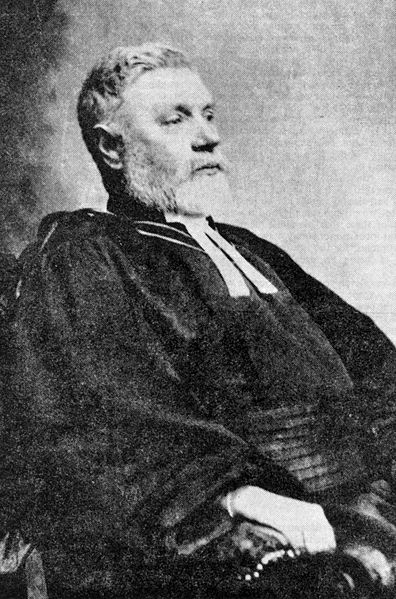
Edward Mote

In our post-modern love of all things new, coupled with the disregard, if not disdain, of all things old, I hope that some of the wonderful contemporary Christian music will still be sung 200 years from now.

You know that I walk most mornings and try to both pray and listen to God during that very quiet time. One of the half-dozen songs that I regularly sing (very quietly) to myself as I walk is the hymn My Hope Is Built On Nothing Less, written by Edward Mote around 1834.

Edward Mote was at first in the cabinetry business which explains the framing metaphors in the first verse of the song—something I missed completely until I really focused on the words in recent years.

I dare not trust the sweetest frame, but wholly lean on Jesus’ name.   These words still challenge me to think about the other things I construct in my life to give me stability! Sometimes these constructs are quite sweet as the song says, like family, friendships, even church—but all structures constructed from temporal materials by human hands will eventually fail.

Sweet parents die and leave us alone; the best of spouses turns out to be just as human as I am; friends drift away, and even the warmest church fellowship can cool—nothing is the same yesterday, today, and forever, except  Everlasting God!

I love this song because it does not try to dispose lightly of the ‘whelming flood . . .  when all around my soul gives way.  But Mote captured in the words—at least for me—not the inevitable eternal victory with Jesus that will make everything right, but rather the Beistand that is the very nature of Jesus.

Sorry to use the German word, but it is just better than any I can think of in English at the moment. Beistand is literally “standing beside” .  It’s not rescue from the ‘whelming flood, but rather  that Jesus gives—my Hope and stay!  I am not alone—ever—regardless—in spite of!

Jesus came in the flesh and dwelt among us! “I am with you always!”

And what a beautiful expression of the grace of God: When He shall come with trumpet sound . . . dressed in His righteousness alone, faultless to stand before His Throne!  I love the repetition of He, His, His!  It’s all about Jesus—from the Beginning to End—and to the New Beginning!

The music carries the message so well in the chorus: staying on the same note, lifted off the bottom of the scale: On Christ the Solid . . . then climbing one worshipful step up to the Rock I Stand . . . for me a very musical expression of personal  stability in Jesus!

My Hope is built on nothing less than Jesus’ blood and righteousness. . . . that’s my prayer and my declaration this beautiful Sunday morning!

Just a little historical note: Edward Mote was such a faithful minister that at the end of his preaching career, the church wanted to give him literally the keys and title to the church building.  Reportedly, his reply was, “I do not want the cha­pel, I on­ly want the pul­pit; and when I cease to preach Christ, then turn me out of that.”

He didn’t need the security of ownership. He enjoyed the security of faithful Hope!

Read Full Post »

While a student at Harding in the late 60s, Owen Olbricht, director of Campaigns Northeast,  introduced me to the hymn Great Is Thy Faithfulness. We sang it often in devotionals, sometimes in parks, and even once on a local TV station.

Yesterday, after receiving some especially good news, Sherrylee started quietly singing this great hymn again—and I joined in. Her voice is much lower than mine, so when she starts a song, her natural pitch leaves me no choice but to sing the tenor to it. Regardless, however, of who sings which part, that particularly hymn has been a special blessing to us at significant moments in our journey for many, many years now.

Great is thy faithfulness, Oh God, my Father. . . . Thou changest not. . . .where thou hast been, thou forever wilt be!   If you know our story, you know that Sherrylee and I feel like our mission time in Germany were some of the best and most formative years of our lives, but that made it all the harder when overnight literally we found ourselves on a plane back to the U.S.. We felt like we had been ripped out of home, dreams, church, mission—all those things that give purpose to life. How could things change so quickly, so drastically! 

This song reminded us then that God had not changed. He was still in control. He knew where we lived. He knew our pain. He had not abandoned us—nor we Him, so in spite of a traumatic upheaval in our lives, God had not changed and was not far from us.

Summer and winter and springtime and harvest . . . join with all nature in manifold witness to thy great faithfulness, mercy, and love.  Life has seasons. Our time in Germany was a wonderful time, but so were our twenty-two years in Oklahoma. We had serious doubts about whether Oklahoma was really where we should be! After all, we were missionaries, not Sooners!  But God was faithful and took that season in Oklahoma and shaped that moment into a wonderful place to raise our family, a meaningful ministry with students at Oklahoma Christian, and a place and time for Let’s Start Talking to take root and grow.

And now in the fall and winter season of our life, the mercy and love of God is even more evident. We continue to love deeply the work we have been given; we are surrounded by not only a God-called team of co-workers, but grown, faithful children– and grandkids who are being taught God’s faithfulness every day.  What more could anyone ask for.  God is faithful, full of mercy and love.

Morning by morning new mercies I see! Strength for today . . . The more I learn as I walk along the journey with God, the less I worry about tomorrow—not because there is less uncertainty, not because there is less catastrophe around the corner, but just because I think I’ve learned that God only takes care of us one day at a time! 

It has something to do with the same reason he gave the Israelites only one day’s worth of manna every day (except on the Sabbath). It’s Jesus in the garden praying in spiritual pain for what was going to happen the next day.  It’s Noah not knowing if and when the dove would return!

As Executive Director of LST, I’m often asked about our five-year plan: where do you want LST to be in five years?  Or we sit and talk about how wonderful it would be if the ministry were supported with an endowment, so that we did not live each year hand to mouth like we have for the last thirty-one years!

My personal fear is that sometimes we are trying to build barns and create our own security rather than depending on the Lord day by day. 

Fortunately, the Lord has never given us that kind of security, not personally nor in the ministry—and I keep thinking that maybe day by day, morning by morning, maybe that is supposed to be enough!

If you don’t know this great hymn, find it on YouTube and listen to it and learn it, so that every day of your life, you have these words in your heart and on your lips:

Great Is Thy Faithfulness, O God, My Father!

Read Full Post »

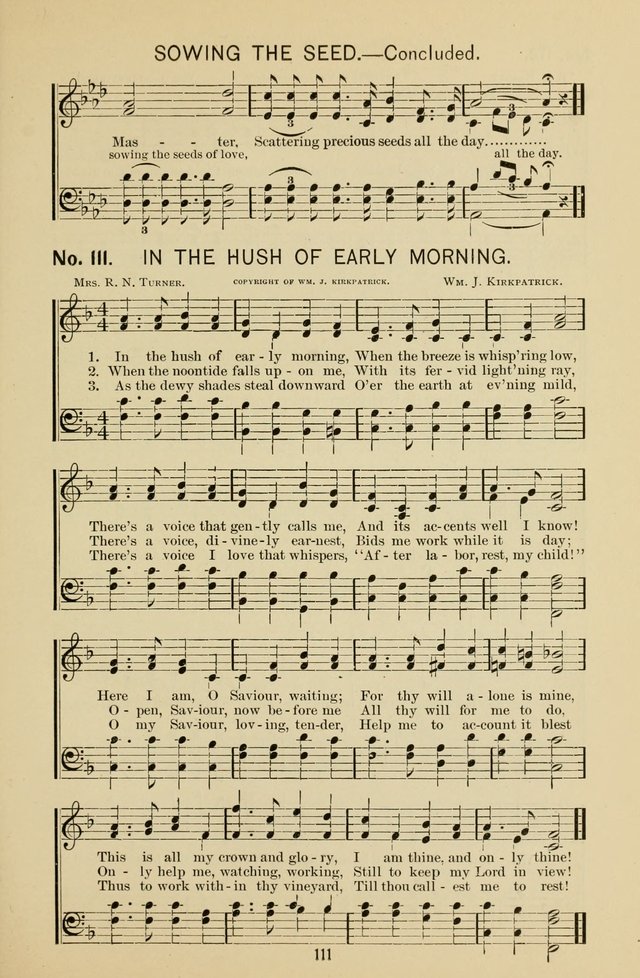
In The Hush of Early Morning!

Every Sunday morning for the four years I was in college at Harding, I got up about 7am, got dressed, and drove an hour and a half to Formosa, Arkansas, where I preached for the Church of Christ there.

Every Sunday morning for four years, at 7am, my radio alarm would go off to wake me up. No buzzer, no rock station. In Searcy, every Sunday morning at 7am the local religious program would begin with a hymn as its program opening.

So every Sunday morning for four years at 7am, I awoke to the following words:

In the hush of early morning, /When the breeze is whisp’ring low,

There’s a voice that gently calls me,/And its accent well I know!

Here I am, O Savior, waiting; For Thy Will alone is mine,

This is all my crown and glory,/I am Thine and only Thine.

Every Sunday morning for forty years now, if it is a quiet Sunday morning, that is, no phone call wakes me, no children crying, no illness requires immediate attention, if it is a quiet Sunday morning, I wake with these words and that soft melody in my head.

Actually, it’s embedded even deeper, because often, when it is not Sunday, and  I get up early to walk, if it is still quiet in our neighborhood, those words come first to mind—sometimes I even sing as I walk.

In a time when even our worship together on Sunday seems to need to be loud and the goal seems to be to pump us up into a holy frenzy, in a time when most of those who aren’t going to church I meet walking are plugged into something that drowns out the quiet, let’s be careful that with all of our self-created noise, we don’t drown out the voice that gently calls us.

Starting Sunday, the Lord’s Day, with quiet surrender: “Here I am, O Savior, waiting; For Thy Will alone is mine”

. . . well, I think I’ll quit talking now and just be quiet for a while longer.

Read Full Post »

We used to sing lots of songs that drew on nature to praise God, much as David did in his psalms. I have been trying to think of modern praise songs that draw on the beauty of nature as the illustration of God’s goodness and power, but haven’t thought of many whose primary metaphor is nature! Some, like Shout to the Lord, use the psalms as a basis for their lyrics and would certainly fall into this category. You probably know many more.

Some great hymns like How Great Thou Art, This Is My Father’s World, For the Beauty of the Earth, All Creatures of Our God and King, Fairest Lord Jesus, The Spacious Firmament, The Heaven’s Declare the Glory of God, even Eternal Father, Strong to Save have been sung by Christians for decades, if not centuries, because the creation was intended to not only show us but to convince us of the divinity of the One Creator God! Science has stolen nature from Christianity in the last hundred years, as if beauty and majesty were an accident.  But you and I don’t believe that. We believe that every single wildflower, every sparrow, every grain of sand on the seashore is the expression of God’s gracious love and of his absolute and ultimate power! Perhaps Christians should reclaim nature for its own hymnody again!

San Juan Mountains

Here in Colorado, the mountains have overwhelmed us. I’ve been thinking today about the song Unto the Hills which has been a favorite of mine for almost my entire life—pretty strange, growing up in the flat plains of Texas, but it’s true!

Here are the words of the song, which, of course, is taken from Psalm 121:

Unto the hills around do I lift up
My longing eyes;
O whence for me shall my salvation come,
From whence arise?
From God the Lord doth come my certain aid,
From God the Lord, who heaven and earth hath made.

He will not suffer that thy foot be moved:
Safe shalt thou be.
No careless slumber shall His eyelids close,
Who keepeth thee.
Behold, He sleepeth not, He slumbereth ne’er,
Who keepeth Israel in His holy care.

Jehovah is Himself thy keeper true,
Thy changeless shade;
Jehovah thy defense on thy right hand
Himself hath made.
And thee no sun by day shall ever smite;
No moon shall harm thee in the silent night.

From every evil shall He keep thy soul,
From every sin;
Jehovah shall preserve thy going out,
Thy coming in.
Above thee, watching, He whom we adore
Shall keep thee henceforth, yea, for evermore.

And don’t you love the verses in The Psalms that use the mountains and rivers to express extreme praise for God—like Psalm 98!

Let the sea resound, and everything in it,
the world, and all who live in it.
8 Let the rivers clap their hands,
let the mountains sing together for joy;
9 let them sing before the LORD!

When you visit the Konigsee in Germany, a large alpine lake surrounded by huge mountains, the little electric boat stops in the middle of the lake and one of the crew pulls out a trumpet and begins to play a simple melody—pausing after every phrase for you to hear the mountains echoing every single note of the song—not just once, but several times.  The mountains multiply the music!

I think of this when I think of the mountains singing as the rivers clap their hands. The mountains are multiplying the music of the saints, sending it up to God from the highest places.  And the rivers are clapping their joyful accord! Now that is praise!

We leave Colorado tomorrow and are on the road for a couple of days, so it will be sketchy as to whether I can get online. If not, I will see you again Sunday or Monday and we’ll catch up!

Read Full Post »

« Newer Posts