Feeds:
Posts
Comments

Posts Tagged ‘Let’s Start Talking Ministry’

Unless you knew me when I was 16 or 17 years old, you probably don’t know that I was a pretty decent young baseball player. I pitched and hit well, although “Barber” Cobb—whose barbershop was where the action was in Smithfield, Texas, always thought I was a better catcher.

When we moved to Germany to do mission work, baseball was one of those things I was keenly aware of sacrificing, not so much playing baseball, but specifically, I knew I would not be coaching my yet unborn sons’ little league teams in Germany. What I didn’t know was that I was about to fall in love with a whole new sport Fuβball.

I remember going down to the TV lounge at language school in Prien, Germany, every Wednesday night to watch the little black-and-white TV when a Fuβball or soccer game was on. Now I had played some version of soccer in elementary YMCA sports, but not nearly the organized version that children today play, so I knew almost nothing about it. Not only was I learning vocabulary–little words like Tor (goal), Ecke (Corner), and big, German words like Schiedsrichter (referee) and Abseitsposition (offsides position), but I was also learning something central to German culture. It wasn’t a question of whether I liked soccer or not, it had to be learned, just like the German language.

There were no Germans in language school—obviously–so when I watched, it was with classmates from countries like Japan, Romania, Italy, Venezuela, Greece. They did not know the vocabulary either—but they knew the game! I remember the night it dawned on me that I was the only real soccer illiterate in the room.

The historical cultural isolation of the United States throughout our history has had some positive results, but one of the negatives is that when we go out into the world beyond our borders, we have trouble with the languages that other people speak—and I’m talking not only about their verbal language, but also their cultural languages. In the best case scenarios, this has led to simple misunderstandings, but in worst cases, it has led to what the rest of the world calls American imperialism.  For us Americans, it just feels like the American way!

Sidestepping the political potholes, I want to suggest to you that to be a World Christian, you as an American have to learn to speak the language of world culture.  Here are just a few examples of what I am talking about

  1. The World Cup – This tournament is the largest followed sporting event in the world. Over one billion people will watch the final game, which is at least 10 times the number that watch the Super Bowl in a good year. If you want to have a conversation with someone in Ghana or Ukraine or Brazil or Japan, soccer is a world topic of conversation.
  2. Metrics – Most Americans are exposed to the metric system sometime in school. A few scientific disciplines even use it regularly, but most of us are helpless when we go to other countries and need to cook in a metric oven or to know if 20 degrees is coat weather or shorts.
  3. Exchange – How often have I seen LST team members walk up to an exchange window, hand the man a handful of money and walk away with whatever they receive back, totally clueless as to what just happened or how much they have. Yesterday, I had a desperate email from a team that had exchanged dollars into Euros, which are one of the currencies that are stronger than the US dollar, so for 100 USD, they had received 70 Euro. To them, this meant that they had lost 30% of their money by exchanging. This is a good example of how Americans can be either victimized or made fearful by their own inability to speak the language of world culture.
  4. Major world cultural events – The example that I want to use for you is one that only a few will have ever heard of, yet just this year the Eurovision Song Contest, in its 55th year, was shown around the world and live-streamed on the Internet. Thirty-nine countries entered songs and artists, vying for the best song in the world! It’s like American Idol on steroids!

So why should Americans care about any of these kinds of things? Well, maybe Americans can get by with being culturally isolated, but World Christians cannot! If we want to connect with people, speak to their hearts, share their lives, then we have to know where they live and learn their languages.

We Americans must resist the temptation to exchange the “Go into all the world” command for “Come meet me in my comfortable building or home and speak my language if you want to know about Jesus.” And we should start becoming such a people with those in our own country who don’t speak our cultural languages.

Question: What other world events should World Christians know about?
Read Full Post »

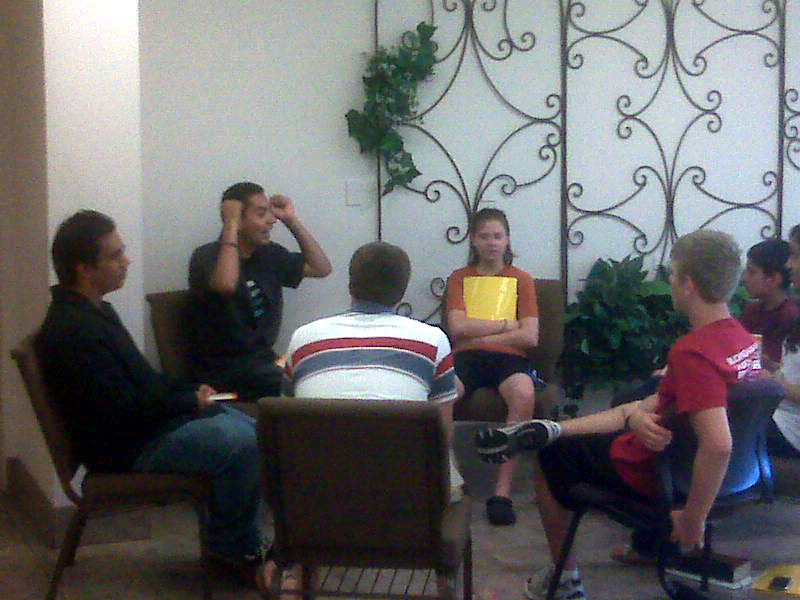
Fifteen minutes ago I left the fellowship room of the North County Church of Christ, which is hosting an LST YoungFriends group from Dallas. The group in the fuzzy picture is just one of five, composed of teens from the Dallas youth group, some of the North County church teens, and some teens from the community. They are in their C-Groups (Conversation Groups), talking about the story of Jesus and about their lives.  And this is Monday afternoon of summer vacation!

LST YoungFriends is just a mission package for church youth mission trips. What makes it pretty unique is that it is evangelistic! Yes, YoungFriends includes community projects: tomorrow the group is working in a food distribution program; Wednesday it is going to give sandwiches to the homeless in San Diego; and, Friday the group will visit a school in a lower income and higher risk area of Escondido. But what makes YoungFriends different is that the group is partnering with the local teens to offer a way to talk about their own faith—or lack of it.

We did a little review of their training this morning before the first C-Group. We talked about the skepticism local teens might have about joining C-Groups and how to try to alleviate their fears.  We talked about being sensitive to talking about our stuff with kids that have much less. We practiced good relationship-building practices, like share from your own life first, and then let others share as they become comfortable with you and trust you.  I can’t wait to listen to the debriefing from these first groups today, to hear what this Dallas youth group has learned from just the first day of truly reaching out to others from their own lives and with the story of Jesus.

But my question to you today is this: why is an evangelistic youth mission trip so unusual? Take your pick from the following suggestions:

  1. Few adults, including parents and youth ministers, have evangelistic experiences, so they do not even think about it for their young people.
  2. Service projects are easier to plan and more predictable. Anything that involves interaction with people on the other end is a little more difficult to pull off.
  3. Some adult leaders have had such bad personal experiences with combative evangelism or forced evangelism, that they really don’t believe in any form of active evangelism any more.
  4. Doing something evangelistic sounds much more challenging to our teens and might be harder to sell to them!
  5. Some don’t think the kids know enough to tell anyone else about Jesus. Many of the kids in the youth group have not made their own decision for Jesus.

If you have other suggestions, I’d love to hear from you.  What I do know is that our young people MUST find their own faith and learn to verbalize it in a way that communicates to their peers, or we adults will have failed to raise our children in the Way of the Lord!

So allow me the moment of euphoria, watching this bunch of very normal Dallas teenagers, being silly, being loud, but being like Jesus in a very special way, sharing their faith with someone who needs to hear.

Read Full Post »

American highways are remarkably free from roadkill! Yesterday we drove 934 miles and I don’t remember seeing anything dead on the road at all. Did you know that most of the roadkill in Australia are kangaroos! And you see a  lot. In fact, many people have those big cowcatchers—I don’t know what else to call them—on the front of their vehicles because hitting roos on the roads is so common.

You’ll remember from yesterday that Sherrylee and I decided at the last minute to drive to California to help with an LST YoungFriends project at the North County Church of Christ in Escondido, just north of San Diego. You can read about the first 446 miles in yesterday’s posting—but you can start here also. The great thing about journeys is that they have an official starting place, of course, but today’s start is just as much of a start as yesterday’s start.  There must be a sermon there somewhere!

After a quick stop at the ubiquitous Wal-Mart in Pecos, Texas, we got on the road again. Sherry enjoys reading aloud while I drive, so she suggested reading the Catechism of the Roman Catholic Church. Yes, we are pretty weird, but don’t worry, we balanced it with a Robert Ludlum novel later in the day.

We have been reading and talking about Roman Catholicism for some time, since her brother recently became a Catholic priest.  Yesterday, most of our reading and conversation was on sacramentalism, but that is a topic for another blog.

The amazing thing about driving in Texas is that when you get to El Paso, your halfway to California. Of course you have to speed past the sand dunes in Monahans, the Davis Mountains and Fort Davis, McDonald Observatory near Alpine, and the many great Tex-Mex restaurants along the way or you will just turn around and say, “Why would I ever want to leave Texas!!”

The only thing I really found interesting in New Mexico was driving through Lordsburg.  Who knows what classic journey film has Lordsburg as the stagecoach’s final destination?

Now Arizona has Tombstone and Yuma, but we missed the 3:10 train. I forgot about the time zone change! We didn’t stop, but if we go back that way, I’m planning to try to stop and sightsee.

At some stop, we balanced our morning catechesis with an audiobook from Cracker Barrel (where else?) called The Bourne Deception—the full 17.5 hour/15 disc version. Pretty good deal for $3.50!  It was so good that we skipped supper. Our only interruptions were the Border Patrol control points—something we had never seen before.

The Board Patrol check Points reminded me of the Arizona controversy. We were waved through easily, but I couldn’t help but think about it being a different story if we had been Latino—either of us.  I’m all for controlling our borders better to prevent illegal aliens from entering, but if you have ever been a foreigner in a foreign country (stranger in a strange land is the biblical phrase) and been discriminated against, you would know how humiliating and offensive any form of profiling or discrimination is.

When Sherrylee and I lived in Germany and were looking for an apartment, we would occasionally call about one that looked great to us, only to be hung up on because we were aliens with an accent. That was almost as bad as the people who used the less formal language forms when talking to us as if we were either children or stupid. Well, you can see that I am sympathetic with aliens from my own experience of being one.

You have time to think about many things on a road trip!

Read Full Post »

Sherrylee and I love road trips!  I’m talking about where you throw stuff in the car, take off, and drive for hours and hours.  In this day of instant gratification, which includes getting to places quickly from wherever we are, road trips seem a thing of the past, but since I’m writing this in the breakfast room of a Holiday Inn Express in Pecos, Texas—8 hours from Fort Worth and 12 hours from Escondido, CA.—I want to tell you about ours, so you can see what you think.

Yesterday about 11am, we decided that I needed to go to Escondido, where LST is sending a YoungFriends group from Dallas for a week-long mission trip. We sometimes do this to simply provide a little help to both the group sponsor and the hosting church. Since our daughter Emily and her family are in Escondido, Sherry wanted to go too, but have you looked at last minute ticket prices lately! She suggested that we leave right away and drive—1394 miles—19+hours!  In less than 10 minutes, we had decided to do it—so we agreed to leave at 2pm.

She went to the Hair Cabin for whatever, and I tied up stuff at the office, then stopped the mail for 10 days, ate lunch with the staff, and went home to pack.  Packing for road trips is soooooo easy because you don’t have to worry about weight, you don’t have to worry about how many ounces of liquid, you can take your good shoes, your running shoes, AND your flipflops—and they don’t even have to go in the suitcase. The best of all is being able to hang your clothes in the backseat. What a luxury!

We were almost giddy as we drove out of the city right before rush-hour traffic—about 3:30, not 2pm—but that’s OK.  The first thing we did was play the alphabet game. What—you’ve never played. You have to find all the letters in proper sequence, call out the word that contains the letter—which means your opponent can’t use that letter in that word—and you can’t look backwards!  Oh, yes, and it has to be on a sign, not anything moving.  Sherry and I are fierce competitors, so I will confess to one tense moment when we both saw the J in Justin Boots at the same time. I think I really beat her, but it was so early in the trip, we agreed to both claim it as a tie—any sacrifice for matrimonial harmony!  Ultimately my generosity paid off because I found the Z in pizza just outside of Abilene and won.  We’ll see what happens today!

And we always stop at Crackerbarrel restaurants on road trips—mostly because of all the fun things you can do there!  First, you can walk around and say, “Who do you think would buy something like that?” Then we look at the pictures on the wall and see if any of our forefathers are memorialized in their antique pictures—well, those pictures are of somebody’s people!! Don’t laugh.  Then we always try to beat the little triangle peg game that they put on each table.  Sherry was obsessed yesterday, so I cheated and found a clue on the internet about where to start that let both of us beat it once—but then we couldn’t repeat, so I bought her one to bring on the trip as we left. Oops, now I know who buys that stuff!!

Don’t forget to go to the bathroom at Crackerbarrel—except be careful. In nine out of ten Crackerbarrels, the men’s room is on the left and the women’s on the right, which only sets us Stammkunden up for an embarrassing moment if we ever walk into the exception! I’ve done it several times, I confess.

Next we listened to 4-5 episodes of Garrison Keillor’s Stories from Lake Wobegon podcasts off the ITouch that my kids gave me several years ago! What great kids. We tried listening to Cost of Discipleship by Dietrich Bonhoeffer, which I had downloaded for free a couple of months ago. It was a little heavy for the mood yesterday, but it might work today.  If not, we’ll stop at the next Crackerbarrel and rent an audiobook on CD—see why we always go there!

We pulled into Pecos, Texas about 11:15 last night, couldn’t find the hotel, drove around until we found something open where we could ask. Soon we were in our room—but the toilet was broken—so then we were in another room, tired, but glad we were on the road—together!

I wonder what today will bring?

Read Full Post »

A missions minister and I were having lunch one day because his church wanted to begin requiring training for all people they supported on short-term missions. He knew that the Let’s Start Talking teams had a reputation for being well-trained, so he was looking for ideas.

When I told him that the college students that go with LST receive approximately 45 hours of training in preparation for 3-6 week mission trips and that church members going for two weeks receive 20 hours, he literally went pale! His church now requires one Sunday afternoon of training for their short-term workers—which is more than most churches provide or require!

The problem is not that short-term mission leaders do not believe in training, it is that nobody wants to spend the time and energy that it takes to do it. Appropriate training is essential, however, for an excellent short-term mission trip.  Here are some of the characteristics of appropriate training:

Appropriate training prepares the workers for their spiritual work as well as their physical work. While getting materials together or practicing songs or going over assignments or role-playing conversations is appropriate and essential, many of our volunteers are spiritually ill-prepared for the challenges of mission work.  Many have never verbalized their own faith, so they have difficulty responding to questions like “Why do you believe Jesus is the Son of God?” Many Christians don’t know where to start with someone who does not believe the Bible is the Word of God.  When challenged, unprepared Christians may begin to doubt their own faith or to move toward a “all-roads-lead-to-heaven” faith.  Mission trips are spiritual pressure-cookers and tend to bring our spiritual weaknesses to the surface. Spiritual as well as physical preparation is essential.

Appropriate training includes how to work together with others! Just as “personality issues” (a euphemism for any number of our own selfish desires) are a major source of trouble between Christians at home, put 5-6 people together 24/7 for even 2-3 weeks in close quarters under less than ideal circumstances and see how long it takes for the facades of Christian charity to fall.

Appropriate training includes cross-cultural awareness and sensitivity. Who is telling the volunteers about appropriate dress? Who is preparing the team for the toilet facilities? Who is preparing the group for worship in a foreign language without translation? Who is training the workers how to “look and learn”—that is, watching and imitating the local Christians in situations that are unexpected or unfamiliar.

Appropriate training happens before, during, and after the short-term mission trip. Most training needs to be done before the team leaves, but while on the field, situations and questions arise that catch short-term workers off guard. Who helps them sort through their questions and feelings?  And who helps them know how to return home?  LST conducts EndMeetings with all of our workers in which we help them frame their experience, to know how to report about it, and to know how to deal with reverse culture shock.

Appropriate training is done by qualified trainers. This one is so obvious that I just want to warn against one danger, i.e., the person who is the cultural expert because they have been in the country for a week a couple of years ago—you know what I mean! If you haven’t got qualified trainers, find some and bring them in—it’s worth it.

I’m convinced that appropriate and high quality training is why the request for LST teams is still high after thirty years!  The lack of such training is why churches quit sending and people quit going.  Invest the time and energy into appropriate training and you will bring God more glory and honor!  The added value to good training is that what you learn for the mission field always is still valid when you return home!!

Read Full Post »

LST once had a team in Madagascar. The evangelist’s daughter was kidnapped in front of the church building where the college team was working by a local gang, looking for a reward. After just a couple of hour,  the girl managed to escape unharmed. The family reported the name of the gang leader to the police who arrested and jailed him immediately. The gang leader, however, bribed his way out of jail and vowed to kill the minister and his family. The LST team was staying in the home of this family.

What would your church/organization do now?

Here are the two most important questions for you to consider?

  1. Are you as a church/organization prepared to deal with this situation for your church members—which means, do you have the personnel, funds, and a plan to take care of your people?
  2. Secondly, how quickly can you implement your plan?

Just to ease your mind, I’ll tell you that within the hour, LST immediately moved the team into a high security hotel, and then flew the team out of the country within twenty-four hours. In addition, LST staff met them in France, let them talk through their experience and their fears, then arranged for them to finish the last three weeks of their mission trip with a church in southern France. When they returned home, not only was the team emotionally and physically healthy, but they also couldn’t stop talking about how God worked it all out for good—whew!

Make sure that either your church or organization has both an Emergency Management Plan and the personnel and funds to implement it twenty-four hours a day while your team is on the field.  Here is a short list of the type of emergencies that you should be prepared to handle:

  1. Travel emergencies – lost documents, canceled flights, unexpected fees, passenger error (goes to wrong airport, checks in too late, etc.)
  2. Medical emergencies – accidents, illness on site, flare up of pre-existing conditions, sudden death
  3. Political emergencies — political violence, curfews, closed airports, police harassment (one LST team suddenly was required to get special visas), political extortion (demanding bribes).
  4. Natural emergencies – typhoon, flooding, earthquake,
  5. Team emergencies – unexpected death or emergency at home, emotional/spiritual breakdown, unexplainable hostility (often culture shock), immoral behavior, disregard of authority, misuse of people or funds.

Emergencies don’t happen often. In thirty years of sending short-term mission teams, LST has dealt, however, with everything mentioned above at least once. You can’t remove all threats, you can’t prevent all emergencies—even with the best preparation and training—but you can be intelligently prepared for the inevitable.

P.S. If you would like a copy of the Let’s Start Talking Emergency Management Policy, I would be happy to send you one. It’s too long to post here. Just email me at LST@LST.org with Emergency Management Policy in the subject line.

Read Full Post »

Just today, Guatemala is preparing for a volcanic eruption and a tropical storm; Belize is flooding, as is El Salvador. Tajikistan has an outbreak of polio, and there are still travel warnings out for Thailand and Sri Lanka. In addition, a major earthquake has struck the Philippines.  Only this last item is listed in the CNN headlines however.  Whoever is organizing your short-term mission should be aware of the natural, political, and cultural risks and have a plan for dealing with them.

Natural risks  – Christians should not be fearful! Being informed, however, and measuring the risks are not acts of fear. It is unfortunate to be stranded in Cambodia because of a typhoon, but it is foolish not to know that July and August are peak months for typhoons in Cambodia and to have a plan in the event one occurs. It is foolish not to know that malaria is also dangerous in Asia and the Americas and not just Africa. Many travel sites, but especially the government-sponsored Center For Disease Control (www.cdc.gov) and the U.S. State Department (www.state.gov) have important information for evaluating natural risks.

Political risks – Christians should not be fearful! Being informed, however, and measuring the risks are not acts of fear.  LST has had workers in Moscow during a political coup, in Yugoslavia when civil war broke out, and most recently, in Thailand during the political unrest and violent demonstrations. In reality, there are very few truly stable governments in the world. How do you make good decisions about going/sending into foreign areas where there is almost always some level of political unrest?

  1. Rely on more than just the U.S. media to stay informed. LST is a member of OSAC –the Overseas Security Advisory Council (www.osac.gov). This agency is run by the Bureau of Diplomatic Security in the U.S. State Department and publishes daily information on all trouble spots around the world. The information is primarily gleaned from foreign newspapers.
  2. In this last trouble in Thailand, LST actually evacuated two teams early because the violence had spread unpredictably. We were aware of surprising developments at least 12 hours before hearing it on U.S. news because we were following local news sources on Twitter (www.twitter.com)
  3. Believe the local Christians with whom you are working. I have found local Christians to be more cautious and more concerned for the potential safety of their guests than the guests themselves. This also means that if they say to come ahead because it is safe, that may be compelling.

Cultural risks – Christians should not be fearful! Being informed, however, and measuring the risks are not acts of fear. Remember the boy who was caned in Singapore for keying a car! Did you know it is illegal to chew gum in Singapore? Do you know what the three T’s are in China that workers should avoid conversations about with locals (Taiwan, Tibet, and Tiananmen)? Do you know that pickpockets work every subway in the world?  Do you know that your passport is the only way to positively identify yourself in a foreign country?

Someone in your church/organization should be responsible for researching cultural risks at your hosting site and then all participants should not only be informed, but trained to avoid risky situations and risky behaviors. Risk prevention begins long before your mission trip.

Standards of Excellence in Short-Term Missions require an appropriate risk management plan. Preventing emergencies is 90% of any plan. Next I will write about your plan for handling emergencies once they occur.

Read Full Post »

It’s Memorial Day—and I’m working—as is most of the LST staff. We would all rather be taking the holiday off like our friends, BUT Mondays are big travel days for Let’s Start Talking teams. Four teams are leaving today for Brazil, Germany (2x), and Uganda respectively, and five teams are returning to the States from Europe, Argentina, and Panama.

Travel days are high risk days. Just this month, we have had lost passports, floods, canceled flights, and airline strikes to deal with on flight days—so part of our risk management plan at LST is to always have enough staff available on travel days—regardless of holidays—to make sure that we can take care of our workers if an emergency should arise.

Does your church and/or your short-term mission organization have a plan to reduce the risks associated with groups of people—traveling—to foreign countries? This starts with a good screening process for those who want to go in your group.

  1. Are the people who want to go healthy enough? You probably think first about physical risks, but those are the easiest to prepare for—a few special vaccinations or pills will eliminate those problems. Do you also screen for people with emotional or spiritual concerns? The associated risks are much greater with these!
  2. Does the potential worker have a submissive spirit? Lots of people who want to do missions are not willing to submit. They are not team players. There is a place for these people in the kingdom, but you probably don’t want them on your team because they ignore instructions or boundaries and create huge risks for the entire group.
  3. Are they willing to be trained? Self-made missionaries are the worst!! No matter what kind of mission experiences someone may have had, they should be eager for preparatory training for your mission project. Somebody throw the flag, if they are not.
  4. Do other people want them to go? Fundraising for a mission project is one of the best screening devices.  In 99 out of 100 instances, people who have difficulty raising funds for their mission trip also have other issues that make them difficult.  Why don’t their family, friends, and church family step up to support this person—this is a legitimate question to ask. Of course, there is always the exceptional case—but, in my experience, exceptional cases are the exception!
  5. Do they have the gifts that match the planned goals of this particular mission? For LST trips, people need to be comfortable making conversation with people one-on-one.  They need to be native English speakers—yes, and even Texans can qualify!  What are the specific gifts needed for the mission you are planning?

Screening potential workers is a very important step in reducing risk potential.  Tomorrow, I will write about reducing political/cultural risks for your short-term mission.

Read Full Post »

Whether you are a church organizing your own short-term mission or you are an individual Christian wanting to join a short-term mission project, you need to be concerned about the comprehensive administration of the short-term mission. The SOE uses this broad term to include the following:


  1. Integrity of the organizers
  2. Competency of the organizers, especially in the area of risk management, and
  3. Capability to support and deliver of the organizers.

Let’s look at these standards in three rapid-fire blogs.

4A – INTEGRITY

Yesterday, we had a fairly lengthy discussion about which countries to advertise as LST sites for 2011. It is tempting to use “attractive” countries in our promotion, even if we seldom send teams there.  A few weeks ago, we debated at length a video clip that showed an LST worker reading with small children. Little children are huge emotional magnets for recruiting workers—but only seldom do our workers read with young children, so it is not typical of the LST experience.  These were discussions to insure LST’s integrity.

Is there honesty in promotion of your short-term mission? Check the motivations you appeal to in your promotion? Check the description of activities as compared to what the work will primarily be.  Is the host culture as needy, as irreligious, as unhealthy, as secure as it is described?

The world of advertising that we live in has skewed our sense of honesty—not to the point of lying, but to spinning the truth.  Speak the truth…in love, and you will honor God!

Is there transparency in all areas of the finances? How have the costs for this short-term mission been established? By whom?  How carefully are funds collected and dispersed? Is there an accounting process that includes accountability to someone external to this particular project? Do all participants have access to financial information?

LST has three people who do nothing but work with the finances and accounting for the monies we receive and dispense. There are strict protocols in our office about who can open an envelope with money in it, for instance, and that same person cannot record and deposit that money. Each LST team does simple accounting with the money that they are using in their LST project.

Then we have a yearly audit by an outside accounting firm, who spends days in our office, going through receipts, deposits, even the accounting books of the individual LST teams that went overseas.  Their audit is something that LST will provide to anyone who requests it. In addition, LST files a Form 990 with the Internal Revenue Service, that discloses again all important financial information—and much more. The Form 990 is public information and accessible to everyone! It’s like publishing your personal income tax filing on the internet.

Are the results of the short-term mission reported honestly and accurately? Sometimes results are vague because the organizers had no measurable goals; that is double trouble in my opinion! Other times results are skewed to justify the expense and effort. That is dishonest. Most often, results are simply not tracked or measured.  Not measuring, not assessing is not honest either. How do you know you encouraged the host church? How do you know people grew spiritually?

Nothing alienates people from Christian missions faster than the hint, the whiff of dishonesty! If you are the organizer, you must ensure integrity at every level. If you are joining a team, make sure the organizers are transparent to a fault.

Next #4b:: Appropriate Risk Management

Read Full Post »

My son was part of a short-term mission trip several years ago that was building a church building in a third world country.  After working for about a week, digging the footing for the concrete stone building, pouring the concrete for the foundation, and then building up the wall about 2-3 feet, someone realized that they had not put any doors on the building!

I know, you are thinking that this was a freudian slip, but, in fact, the story becomes worse. So the Americans spent the rest of the mission time, tearing down a major portion of the wall that they had just built and rebuilding the wall, this time with gaps for doors.

The rest of the story I cannot verify firsthand, but my understanding is that another group went to the same area a year or two later, and the church had torn the whole building down because it never met either their needs or their standards.  There is a message in this story for those who would plan short-term missions projects.

Just having manpower and money will not get you to the goal. Mutual design is also imperative. Without reflecting on any real person’s motivations, my best guess is that the Americans showed up with a plan. The locals were asked to validate it, which they did because what else can you do in the face of money and power!  The results speak for themselves.

Mutually planning the mission activity is the only way to hope for an effective outcome. Sure, mutual design does not guarantee a positive outcome, but it certainly increases the prospects.  By mutual design, we are talking again about a partnership between American Christians and hosting nationals with (to borrow from the French!) liberty, equality, and fraternity on both sides.

Here are some reasonable questions for both parties to ask in preparation for any short-term mission trip:

  1. What are the common goals of both guests and hosts? Is the primary goal to please the host or to please the American guests? Is there a way to plan the mission so that both sides feel like their expectations will have been met?  Before an LST project ever occurs, an LST representative sits down with the hosting leader/leaders and tries to describe in their context what might occur when an LST team arrives. We talk about how we spend money, how teams are typically housed, what each day looks like, what the teams typically do on Sundays–no part of the project is intentionally left out.  Then we listen to how they believe an LST team could work best in their context. Where there are differences, we make great effort to work them out–or we both agree that perhaps some other form of mission would be better for this particular site.
  2. What preparation and follow-up are expected from the hosts/guests? What are the hosts/guests expected to do both before and after the mission project? LST projects expect the host church to advertise prior to the team’s arrival, for instance. How they advertise is left to the expertise of the local Christians? If both of us find this acceptable, we go forward with our planning!  Local Christians are expected to make plans for follow-up to LST projects. LST teams are expected to leave all contact information necessary for follow-up with the local churches. When one of our teams does not do this, we think the mission church has a right to be upset with us!
  3. Who pays for what? Unfortunately, fairly simple questions like this create much of the havoc on short-term mission trips. LST promises to pay for all food, local transportation, laundry, and the social events that are part of a typical LST project. Hosts are asked to arrange for housing and advertising.  Some hosts have no housing options that they can afford, in which case we ask them to work out mutually acceptable housing arrangements with us BEFORE our team arrives. Often their solution is a nice American-style hotel–which we most often decline because we can’t afford that either. So we continue to dialogue until either there is a mutually acceptable solution or there is no solution; in the end, we both know that we have made a mutual effort to find a mutually acceptable solution, but have failed–usually with a promise to try again next year.

Standards of Excellence in Short-Term Missions puts great emphasis on the ability of both the American guests and the national hosts to implement what they have accepted as their responsibility.  When there has been full liberty to both negotiate and to decline, when there has been equality assumed by both partners, and when brotherly love (fraternity) is the framework of every conversation and interaction, then nothing short of a REVOLUTION will be the result–a revolution that both we and God will delight in!

Read Full Post »

« Newer Posts - Older Posts »