Feeds:
Posts
Comments

Posts Tagged ‘LST’

The towers had fallen, the Pentagon was on fire, but no one knew what was going to happen next. We had a small TV at the LST office, and as much as we tried to work that day, we all kept drifting back to the TV to watch the reports. 

We didn’t express our personal fears at first, but eventually someone voiced the question of who will want to get on an airplane and fly to a foreign country now? What impact did these terrorists make on the willingness of Christians to go into the world?

I had just finished writing the lead article for LST’s Fall newsletter. It was no longer the right tone, so I sat down and wrote the following:

September 11 re-shaped the world in which all of us live.  Our priorities have shifted as individuals and as a nation; the same is true at Let’s Start Talking.  This newsletter was ready on September 10—but some of it was no longer appropriate by the end of the next day.  If we took a little longer in saying to you what is on our hearts, we knew you would understand.

After the initial shock and outrage came a longer period of deeply felt grief. So many dead and missing, so much destruction, our shattered sense of security at home—the horrific reminder that this world is ruled for a time still by the Prince of Darkness—what could we do but grieve!

While grieving, however, we learned something about how to respond to tragedy and darkness.  You too probably noticed the many people running for their lives, running away from falling buildings, from death and destruction.  Everyone was running away—except for the Rescuers!  In the midst of the crisis, hundreds of firemen and police ran towards death and destruction in hopes of saving a few!  The actions of these men and women changed the future for many others.

The metaphor is powerful.  As Christians, we wear the badge of Jesus Christ, serving as Rescuers for God!  We cannot stay home and protect our own interests; we dare not retreat from going into all the world; we must not isolate or insulate our churches, our outreach, our missionaries, or ourselves in the face of darkness and destruction.  Because of the badge God gave us, because of the Name He lets us wear, we must run towards the darkness, into the danger, and look for those few that can be saved.

We at Let’s Start Talking will not forget the example set by the firemen and other rescue workers in New York.  We are calling on God to make us strong and courageous this year. We need you to go with us and support this army of God more than ever!

For those who wear the badge, the job is not yet done! Ten years later, people are still dying in darkness, buried under steel rafters of Sin. No one worried about cost, distance, or duration. Whatever it takes, wherever they are, however long it takes–those were the parameters on 9/11!

We wear the badge. We have only one choice—only one desire:  to run toward the ashy darkness with the hope of leading one more person out of destruction into light! 

Read Full Post »

I’m not entering THE BEST LST STORY EVER contest, but I hope you will!  I do, however, have several stories that I want to share with you over the next two weeks as we move toward our big weekend of September 23-24!

If you are a new follower of my blog, you might enjoy reading the series I wrote last year at this time: “A Personal History of Let’s Start Talking” http://wp.me/pO3kT-7U

Santo Domingo

One of Our Best Travel Stories

In 1994, LST was scheduled to go to work with the church in Santo Domingo, Dominican Republic, for the first time.  It has long been our practice to visit sites before we send teams there in order to make sure that both we and the local Christians/missionaries know what the expectations and commitments are going to be.  LST never goes to work with any church or missionary without an invitation, but a few hours of face-to-face conversation have saved us from many awkward and/or difficult situations.

Our travel agent prepared our agenda and sent the tickets to our office. We threw them into a drawer until the day before we left, but when we did look at them, we noticed that she had us flying first to Miami and then to Caracas, Venezuela, and spending the night there.

I called to confirm this, and she said she was sorry but there were no direct flights from Miami to Santo Domingo!

 And so we left the next day for Santo Domingo via Miami and Caracas.

As we waited in the Miami terminal for our Caracas flight, I noticed on the flight board several flights from Miami direct  to Santo Domingo. I actually called the travel agent from the airport and told her what I saw, but she assured me that she had researched it and we still had to go through Caracas. OK!

We boarded the Caracas flight, flew four hours to get there, then spent the night in a hotel that provided security both from the airport and back because of the threat of highway bandits.

Our adventure began again the next day when we arrived at the international part of the Caracas airport, tickets in hand for the flight to Santo Domingo—but as I looked at the flight board, I didn’t see our flight.  Our flight was VE 122 at 9:25am  and the only flight to Santo Domingo on the board was VD 121 at 9:15am.  Well, it was Latin America, so we just thought someone had made a mistake on the tickets. In these pre-9/11 days, those kinds of errors happened occasionally and were usually no big deal.

We had no trouble checking in for VD 121 to Santo Domingo, boarded the plane—a pretty small plane—and took off right on time at 9:15am.  About thirty minutes into the flight, however,  we started to land. Nobody was upset, so I wasn’t either. It didn’t seem to be an emergency. In fact, we picked up a few passengers on this unscheduled stop and then took off about forty-five minutes later.

Finally we arrived in Santo Domingo, Dominican Republic—about an hour later than our itinerary said we would—and were met by very gracious, but puzzled missionaries.

After our sincere apologies for being late and causing them so much trouble, I mentioned that we had had an unscheduled stop between Caracas and SD. They said, “Why did you fly through Caracas?”

“Because you have to from Miami.”

“No you don’t! There are six or seven direct flights every day from Miami to Santa Domingo!”

“No way!”

It took only a few more minutes to unravel what had happened . . . . have you figured it out?

Our travel agent had written our tickets for Santo Domingo, VENEZUELA, not Santo Domingo, Dominican Republic.  Santo Domingo, Venezuela, is a small town buried in the Andes—not where we wanted to go.

The hilarious part is that with our ticket to this little Andean village town, we had managed to the WRONG flight on the WRONG airlines at the WRONG time—and got to our desired destination!

God moves in mysterious ways—and so do Mark and Sherrylee!

I’ve got another LST story about flying to Siberia that I will tell you next.

Read Full Post »

Lost Luggage

Summer Mondays are the most exciting day of the week at Let’s Start Talking!  Beginning the first Monday of May and extending through the last Monday of August,  this first day of the work week is a day when we try to make sure that all LST staff members are totally accessible—and, if they are not out of the country on an LST project, they should be in the office.

We discourage taking comp days or vacation days on Summer Mondays.  This year the 4th of July fell on Monday—but the LST office was open!

Summer Mondays require our full attention at LST because Summer Mondays are big travel days, and travel days can be very unpredictable.  Let me explain.

This year LST will organize approximately 120 different short-term mission projects to 25-30 different countries.  Between 60-70% of these projects will happen between May and August. It used to be even more.

For the first twenty-five years, LST was primarily working with university students, so summer months were the only times they were available for short-term missions.  About five years ago, however, we started focusing on recruiting from churches. Not only was the pool of potential workers much larger, but adult church members were not locked into the summer months as the students were, so many could go in the Fall and/or Spring!

In 2010, LST sent twice as many adult church members on LST projects than university students!  In 2011, LST will have recruited, trained, and sent approximately 500 workers, with about 160 of those being college students and the rest being church members.

In spite of this demographic shift, the summer months are still the heaviest travel time.  And because Monday is not only the day of departure for teams, but also the day that all of the student teams return to the U.S., it is the day when things go wrong!

Just a few weeks ago, a campus minister was traveling with his team to China. They flew from their homes to Los Angeles, where they were to catch their international flight.  When you check in for an international flight, the agents always make sure you have a valid passport and the proper visa—because if the airlines take you to a country and you are denied entry, then they have to fly you back immediately at their own expense. (That happened to me once on a flight from Rome to Tirana, Albania, shortly after that country opened up!)

The campus minister and his team made it through security and all the way to their gate, but while they were waiting to board their international flight, someone stole his passport which contained his visa to enter China!  He, of course, could not continue, so they called LST—as they should have—for help.

Well, the team went on without him, but we were able to help him replace his passport and get a replacement visa from the Chinese—and re-book his ticket, so that he was able to fly out on Wednesday—just two days late to his project.  That’s a typical Monday issue for LST.

Just a couple of weeks ago, one of our church workers in Asia  fell and hurt her back enough that the week before she and her team were to return, she could not sit or walk at all. She actually conducted her reading sessions while lying flat on the couch!  But how does she get to the airport with her luggage, sit in Economy seating for 15-20 travel hours in order to get home from Asia??  To make this particular problem even more interesting , our staff member that was coordinating with her team was in Rwanda, Africa, on her own project. Nevertheless, she did a great job staying in touch with the worker in Asia and our office, so that we were able to get this worker home with minimum discomfort.  That’s a Summer Monday’s work for you!

Flight cancellations for storms or mechanical difficulties are just pretty routine on Mondays. The LST team doesn’t even break a sweat for those blips on the screen, we have faced them so often! Lost luggage and lost tickets are a cake walk!

Right now we are dealing with a harder situation with a new LST site, hosted by American missionaries to an island in the Mediterranean.  We felt like this new work was going to be difficult from the beginning because the church was very small and the avenues for recruiting Readers very limited, so we asked two of our most seasoned workers to go first and try to work out the difficulties. They have done a fabulous job—but it has still been difficult even for them. Many Readers are refugees, others are just short-term visitors to the island, so few of the Readers have been dependable about keeping their appointments.

In addition, the host missionary’s wife has had to have surgery on the island for a pretty serious condition, so both he and she are not able to do all for the project that they certainly had intended to do. Next week a student team of five is scheduled to go to this site, so we have spent the last week trying to decide if they should still go. Today, Summer Monday is the day that we will meet and make that final decision.  Pray that we are wise! If the team does not go, much preparatory work and effort seem lost, and there will be people on the island who do not hear the Good News!

Summer Mondays are great days to watch God work!  

Read Full Post »

Let’s Start Talking approaches churches on almost a daily basis, asking for a few minutes at one of their assemblies to present to that church’s members opportunities  to be involved in short-term missions.  We do not ask for money, we do not ask for any long-term commitments, nor do we ask for anything that would detract from that church’s current mission efforts.   We do not need the sermon time. Class time, time before or after a service, even Wednesday night would be wonderful!

Why is it so hard to get an opportunity to tell the Body of Christ about specific requests from mission churches who are asking for help in telling the story of Jesus to their neighbors?

One of the most common reasons we hear when churches say that now is not a good time is that their mission work/mission committee is not functioning or is in disarray and they don’t know what they are doing, so let them get their act together and they will get back to LST.  I can’t remember when we have ever been called back at a later date by a church that had pulled themselves together.

In the previous post, we talked about questions that a strong church with a good mission program—at least in their own eyes—might ask in order to be sure they were not deceiving themselves, being satisfied with a mediocre mission effort when they desire and are capable of a great mission effort.

Now I’d like to talk with those church leaders/members in smaller churches, with either no real mission program or one in disarray as described above!  Let’s ask some hard questions and see where the answers lead us!

1.       Why is your church small?  Myriad reasons come to mind as to why a church might be small, some perfectly healthy and other reasons very unhealthy.  Some healthier reasons might include being a new church plant, being in an unchurched area where growth is slow. Unhealthy reasons might include because you are the only right ones, or you like to do things one way—your way.  I do challenge you to list ten reasons why your congregation is small—then evaluate those reasons for health.

2.      How are you trying to grow?  And holding Sunday services does not count.

3.       To what part of the Great Commission are you devoting your available resources?  Sherrylee and I met with a church recently in a resort area that often has no more than five members present, yet they rent a church building for Sundays and pray mostly for Christian tourists to attend. After the service the 4-5 members all went out to eat together, without inviting any of us guests to go with them.  Does this picture feel wrong to you?

4.       What could you do that would increase your “strength”? Could you merge with another church? I was in a small Texas town of about 1500 people recently that had four churches of Christ listed in the phone book. I believe we went to the largest with a membership of about 150. I wonder how long it has been since anyone made overtures about merging with any of the other congregations?   My only solace was that the Baptist had 17 churches in the same phonebook.  Human frailty is not denominational.

5.       What opportunities do you have because you are small that a large church might not have? What if the whole church supported that one young person or the just-retired couple to prepare for missions!  You don’t have anyone?—then why don’t you adopt a new Christian who has a strong desire to serve abroad, but no church home.  Find them through one of the Christian university mission departments.

I’ve worshipped in many small churches all over the world.  Small is not the same as weak.  The fact that eighty percent of American churches of Christ have fewer than a hundred members is often quoted as an excuse, but I keep hearing the words of the Messenger to the little church in Asia Minor, which he described as having just a “little strength.”  To this church he says, “I have placed before you an open door that no one can shut!” (Revelation 3:8)

Rethinking your mission efforts may start—for large or for small churches—with rethinking who you are and why you exist at all.  I do believe that when you know why it is worth all the time and effort to be church together, you will have a much better perspective for pursuing the mission of every church!


Read Full Post »

Today is Sherrylee’s birthday. I won’t tell you which one, but she would!  All I will say is that she was barely 19 when we married which will be 40 years ago in April!

In the last three posts, I’ve spent a little time talking about people who I’ve learned from through recent experience, so surely you are expecting me to tell you about Sherrylee!

First of all, to answer the most frequent of all questions: she likes her unusual name and uses the full thing in any formal situation, whether written or orally. Now her family calls her Sherry, so that’s what I usually call her too, unless I’m introducing her to other people.  She’s fine with both, but I just thought I’d get that question out of the way!

I actually woke up this morning thinking about how to tell you what I’ve learned from Sherry. As in any marriage, most of what you learn is so intrinsic to your personalities that it is hard to separate out into simple categories, but the more I thought about it, the one thing that recurs most often in what I have learned from Sherry, the one word that seemed to be a part of every descriptive phrase that occurred to me, that word was PASSION.

I grew up in a family that was all about subduing emotions and keeping passion under control. If you got too loud or too rowdy or too opinionated or too enthusiastic, you might . . . . surface! Or somebody might misunderstand you, or you might upset someone, or you might do something that was out of bounds.  You might sin! In retrospect, I would say there was a good bit of fear of some kind that ruled all of our emotions and/or actions. I’m not talking about paranoia; I’m just talking about “self-control.”

Her fearlessness was part of what attracted me to Sherrylee!  I was a senior at Harding and she was a junior in high school the first time we met. I was five years older at a time in life when that could be pretty intimidating to some people—but not to Sherrylee. She was not intimidated in the least! She was not afraid.  I’ll never forget the day in Scranton, PA on Campaigns Northeast when she arrived a little late to the team devotional. I was sitting on the front row of the church building by myself. We had just barely begun to know that we liked each other, and she marched down to the front of the building in front of the whole group to sit with me—as if we belonged together! You could hear the gasps literally—but I loved it—and her!

Sherrylee has taught me how to be passionate about people! Just a couple of days ago, we were walking back to our hotel in New Orleans about 10:30 at night when we walked past this young man in a mardi gras costume who was obviously very drunk. He was cursing into his phone very loudly and trying to tell someone where to pick him up off the streets—without success.  We walked about 20 feet past him, when Sherrylee turned to me and said “We need to help that guy!” So we turned around and went back—which we do fairly often nowadays. I walked up and asked if we could help him—that’s the way I am. Sherrylee came right behind me, said, “Let me have your phone and I’ll tell them where you are.” She took his phone, talked to his mother, and gave her directions to pick up her son.  I love Sherry for being so sensitive and yet so bold about helping others. I’m trying to learn more from her.

Sherrylee has taught me to be passionate in marriage! No, this won’t be X-rated because I’m not talking any more about sex than I am about our daily life together.  I think I could have been the kind of husband that loved his wife, but neglected her in ministry. From Day One of our marriage, Sherry has fought that tendency in me. She has passionately pursued me; she passionately pursued ministry with me! And I know that much of her motivation for doing so was so that we did not lose the passionate love with which we began our marriage!  I love her for that!

Sherrylee has taught me to be more passionate about God! When we were first married, I may have had a slight edge on her since I had majored in Bible and had four years of studying the Bible with people and two years of campus ministry, BUT I knew when I married Sherrylee that she had a great mind, an unlimited intellectual curiosity, and a deep and passionate love of God.

She is the one now who reads the N.T. Wright tomes! She is the one who still raises the deepest questions at the dinner table.  In fact, it is a standing tradition among our grown children to bet on how long we will be at table before Mom raises a deep theological question that she has been thinking about!

Sherrylee has taught me about passionate people who love God. She often raises her hands in praise; she often tears up with passion during worship. She prays earnestly—and often. She claps—loudly—and with extra rhythms! She wants to be in the front of the church, in the middle of the worship, talking afterwards to as many people as possible!

I have had so much to learn! And still do. She still teaches me daily not to be afraid, to forget about myself, and to let my deeper feelings show.

Happy birthday, Sherrylee! You have filled my life—and the lives of many, many people–with passion that is clearly the reflection of God’s passionate love for you.


Read Full Post »

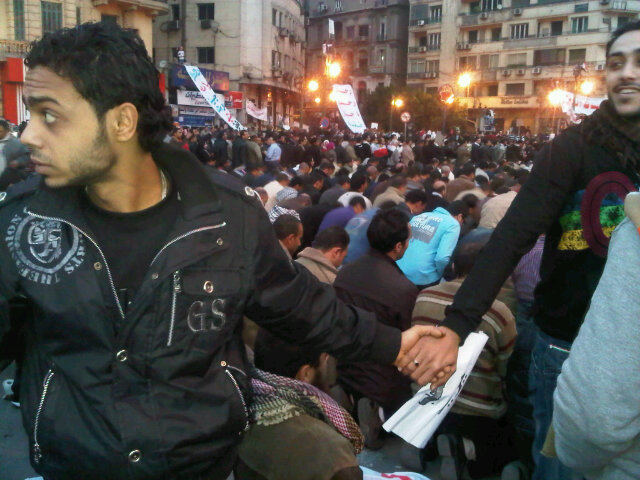
Did you hear the broadcast from Egypt on Sunday that told of Coptic Christians conducting mass in Tahrir Square?  What caught my attention was the report that Muslims surrounded the Christians in order to protect them while they worshipped. (Reuters, February 6 2011).

This action follows many reports of Egyptian Christians protecting Muslim men in the same square as they prayed last Friday. Coptic Christians make up approximately ten percent of the population of Egypt, perhaps the largest Christian community in the Arab world. (For background information, you might want to read this article from Foreign Policy.)

Have you heard about the big controversy among some Christians over whether Christian churches should rent church space to Muslims to conduct their prayer services. What do you think your church would do?

Recently, Christianity Today has featured several articles that raised questions about the relationship between Islam and Christianity as well as between Muslims and Christians.

Why We Opened Our Church to Muslims | A response to “Muslims in Evangelical Churches.” (January 27, 2011)

Muslims in Evangelical Churches | Does loving your neighbor mean opening your doors to false worship? (January 3, 2011)

From Informant to Informer | The “son of Hamas” senses God in his life before coming to Christ. (June 8, 2010)

Dispute in Dearborn | Small ministry creates big waves at Arab festival. (August 18, 2010)

Out of Context | Debate over ‘Camel method’ probes limits of Muslim-focused evangelism. (March 31, 2010)

How Muslims See Christianity | Many Muslims don’t understand Christianity—especially the idea of salvation by grace through faith. (March 1, 2000)

The above list appears in a lengthy article discussing the use of the phrase “Son of God” in Bible translations used in Muslim countries. It is an excellent discussion of the difficulties inherent in cross-cultural evangelism (Christianity Today, February 4, 2011).


If you are having trouble even reading the word Muslim without thinking terrorist, then I think you are a pretty normal American Christian.  Unfortunately, I think the dominate word in that last phrase is American, not Christian. But it is very difficult for many of us to separate the flag from the cross, isn’t it!

I am encouraged that in the middle of the political tumult, Christians in Egypt have acted like Christians to those who sometimes even persecute them.  I’m equally thrilled to see Muslims responding favorably to the Christians.

It begins to sound like the early chapters of Acts, you know those verses that describe the good that the first followers of Jesus did among the people who had killed Jesus (2:47) and the “good favor” that ensued from the entire community.

We and LST have been involved in faith-sharing work with Muslims for many years now. Our first experiences were in western Europe–which is struggling with a mushrooming Muslim population. Then later we began work in places that were secular politically though Muslim culturally, both in Asia and Africa.   I have no personal experience in the fundamentalist Arab Muslim countries, but I do know people who have worked there.

So I have many more questions than I have answers, but I am more and more convicted that not only is vilification of Muslim people wrong, but that either intentionally or indifferently ignoring them is equally ungodly.

I am convicted—as you are, I believe—that God so loved the Muslim world as well as the Christian world that He sent His only Son to die for the whole world!  Isn’t that what you believe too?

So how does that change anything for you today?


Read Full Post »

Clint Loveness, a friend and Let’s Start Talking participant has created a great story video that speaks about young people, video games, and missions. You probably want to share this with your teens and grandteens!  It’s just over four minutes, so click below and enjoy it.

http://www.youtube.com/watch?v=JJGuAInoOlk

Read Full Post »

Introduction

About a year and a half ago, Sherrylee and I were in Africa for Let’s Start Talking. We were visiting either sites where we regularly send LST teams or new sites that had requested teams, but with whom we had had no personal contact.  It is impossible to tell if a new site is appropriate and/or prepared for LST teams without these personal contacts, so site visits are a regular part of our life.

Though it may sound paradoxical to those only vaguely familiar with missions, Let’s Start Talking has not had much history in Africa.  Two factors have contributed to this: first, LST is an urban ministry and most of the mission work done in Africa by churches of Christ is rural.

The second reason is that most of the missions done by churches of Christ has been in the English-speaking part of Africa, which limits the attraction of LST’s offer to help people with their English—at least, that’s what we thought.

A third reason that probably lies far behind the other two is that much of Africa is already Christian—at least superficially. LST works better where people come who have either little exposure to Christianity (Thailand or China) or they have had so much that they are apathetic toward the Christian message (western Europe).

However, we have tried to be open to where the Lord knows we should go, so when many invitations come from African national evangelists, we visit to see if we are called to work with them.  In the last five or six years, therefore, we have developed some deep relationships with certain national churches in Africa.

However, working in Africa brings a whole new set of questions and experiences for us personally and for LST. I shared some of this on Facebook notes before I started blogging, but I’ve been thinking more about these questions and wanted to share them with you.


My First Question About Missions in Africa

In the Gambia, we were told that it cost about $300/year to send a child to school. Many children don’t go to school because their parents do not have that kind of money. We met the same situation in Kenya.

Also the drought/famine in Kenya was heartbreaking. African ministers told about people in their communities who had nothing to feed their children, so they abandon them rather than watching them die.

Almost every day, we were confronted with some situation in which we felt like we should just pull out our wallet and fix somebody’s life–at a rather nominal cost to us personally.

We visited with Larry and Hollye Conway who are part of the “Made In The Street” ministry in Nairobi–a fantastic work btw. They have worked in Africa for about 25 years now. Sherrylee asked Hollye what the hardest part of her work was, and she said it was knowing when to give in love and when to withhold in love.

Jesus did not feed every crowd, raise every person who died, heal every sick person–but sometimes he did. I wonder how he made his choices.  Jesus is the one who said, “The poor you have with you always,” justifying the use of funds for something that seemed frivolous to others in the group.  But I always feel guilty if I am even tempted to quote that verse in any context!!

My experience is that it is often inappropriate for Americans to just walk in and start throwing money at every need they see, whether they are individual, institutional, or social.  But I can’t imagine that ignoring needs in the name of any philosophy of missions is right.

So that’s my question! How can we help the poor and needy, and how do we balance meeting their physical needs with meeting their spiritual needs.

I don’t know the answer, but I do know that it is not either one or the other! Feeding them, housing them, and healing them does not change eternity for them. But not feeding them, housing them, or healing them may change eternity for us.

What are your answers?


Read Full Post »

I promised to tell some of the stories behind the LST Expectations and Commitments, formerly known as the Guidelines.

First, I want to say that almost all of the stories come from the 1980s when Let’s Start Talking was just beginning, and we were learning how to do short-term missions in a very new way!

Secondly, all of these stories revolve around people who were 19 or 20 years old and have since become very mature, responsible people.  These early stories should not reflect on them anymore than they do on Sherrylee and me and Let’s Start Talking now.

Too Much Wine

At the same time when most of the home churches of our students still preached and proscribed total abstinence from all alcoholic drinks,  Western European Christians virtually all drank beer frequently and had an occasional glass of wine.

Almost without exception our first workers were offered beer and/or wine during those early LST projects by their hosts!  One of our young women who had never even tasted wine before saw a glass poured for her at her host’s dinner table one special evening. Panicking a little, she decided that she would just down that one glass quickly and get rid of the problem. Of course, her host immediately poured another glass, which the student chugged as well!  She really doesn’t remember much of the rest of the evening.

After hearing this story, we decided it was just better to insist on abstinence, thus Expectation #7 – Protect the integrity of your testimony!

Too Much Romance

It was the very day their team was leaving for Germany on an early LST project.  They had been dating for some time at college and had come to a critical point in their relationship.  He was ready to ask her to marry him. She was trying to figure out how to break up with him!

As it sometimes happens, she found exactly the right moment to break up with him just before they boarded the plane for their six-week LST project together!  He cries for the entire flight, while she talks to a young Air Force officer that she just happened to be seated next to.

After this team had been on the field for about a week, Sherrylee and I get an emergency phone call! Come to Hildesheim! The entire team is engulfed in civil war, with the guys on His side and the girls on Her side!

Sherrylee and I drove up from Mannheim, met with the team, laid His and Her’s relationship out in the open and tried to bring some peace and harmony to the team. By the end of a very long evening, everyone is crying, everyone is hugging, so sorry for the trouble that has been caused. Everyone is going to do what is right. He is going to be stronger!

We leave, but before the second week is over, we get another emergency phone call from the team! It’s not working! He can’t eat; he can’t sleep; he is so heart-broken that sometimes he can’t even get through a conversation with His readers. She on the other hand is just having a great time—which makes Her team members mad who now almost all feel sorry for Him.

We drive up there and offer Him a little break—a few days away from the team so he can pull Himself back together!  He accepts, and we make the arrangements for Him and take Him to a friend’s home for a few days.

In the meantime, we learn that it makes all the guys mad that He is “punished” by being taken away from the team, when She is the problem!

Anyway, after just 24 hours, He calls us and says he feels so much better and has rejoined the team. Thanks for having given Him such good advice and support!”  So, we think, maybe they will hold together until the end of the project, which is now just three weeks away.

Three or four days later, we get the call and NOTHING is working right, so we drive back up to Hildesheim, move Him off of that team permanently, and place Him with another team about four hundred kilometers away.  It’s not ideal, but it is the best we can come up with.

The Hildesheim team seems to improve with some of the tension relieved. We visit the young man on His new team, who, in general, is better as well—especially since one of girls on the new team has started paying Him special attention!!

Well, two weeks later, all of our LST teams meet at a Frankfurt hotel for our EndMeeting before we fly back the next day. We meet together, pray together, and just celebrate what God has done during the summer!

After the meeting is over, He comes up and wants to talk to me privately. As He explains it to me, before He and She ever left the States on this project, they had planned to travel around a little together, visiting friends in Italy. He wanted to know what I thought He should do in light of the current situation.

I told him, “GO HOME! Are you crazy? After all you guys have been through—what are you thinking??

Against my advice, He and She traveled together to Italy.

Three months later, they were engaged.

In May of the next year I performed their wedding ceremony!!

Unbelievable!

But as we have pointed out to our workers each year since, what was the effect on the mission project? So, because of this incident—and many similar others, LST has a very strict no Romance policy—sometimes called affectionately our NO LOVE policy.  Today it is Expectation #5 – Use all of your time for developing spiritual relationships and none of it for romantic relationships.

Btw, He and She had many happy years of marriage until He died of a brain tumor just a few years ago. They were faithful Christians, leaders in their churches, all of their years together.

Lord, forgive me the sins of my youth!


Read Full Post »

Sherrylee and I have been traveling all day yesterday and today, visiting with LST board members and with LST leaders.  We are now in Santa Barbara—what a beautiful place—and finishing preparations to host an Intensive Training Weekend for several teams from Pepperdine University that begins tomorrow.

Intensive Training Weekends have been part of the LST training plan since the very beginning. The very first one was held in the winter of 1982. One of the team members had a cousin who had a “lake house” that they would make available to us.  My experience with lake houses was that they were luxurious recreational homes, usually in a resort-type setting.

This lake house was on Voss Lake in western Oklahoma, a man-made pond without a tree within 100 miles! The house did have plumbing, but it was separated from the main house, and the wind came whistling down the plains right through the outer walls of this lake house!  And it was in the single digits outside and sometimes in!

Nevertheless, we had a great time and most of the training elements that we still use would found their genesis at this first primitive retreat. We passed information about Germany to the team members, we did team building activities, we had very meaningful devotional time, and we built stronger relationships.

Thirty years later, our Intensive Training weekend is much better conceived, but quite similar to the original. Teams experience about 36 hours of LST project simulation, designed to help them understand who their team is, why they are going, and how they can have a successful mission project.

As team members come in the door, they are met by “customs officials,” who check their passports, their paperwork, and who see if they have brought too much luggage! At their orientation, they reset their watches to “LST Time”—about four hours later than local time—and the fun begins!

Because the teams are going overseas, no overhead projected songs are used for worship and  no checking email or texting is allowed; in addition,  a fifty-pound pink suitcase is awarded to teams that must carry  it around for a while, just to learn how heavy and burdensome too much luggage can be.

The highlight of the weekend may be the field training, when each team is given about fifteen tasks to accomplish on their own (This is why we try to get away from their home city, so that they will be unfamiliar with local sites and resources). They may be asked to interview a stranger and ask them what people in their country think about Jesus. They likely have to find out how much it costs to take public transportation for the retreat center to the local airport, or they may have to find the address and phone number of the nearest American embassy—without using the internet.  Every task has some parallel to either a task or decision that the team might be confronted with on the mission field.

They have a very small budget for lunch and they have to all agree on what they will eat. They also have to all try some food that they have never eaten before. It’s all fun, but it’s also a little challenging.

As the hosts of the weekend, we are not only hoping to create an environment where teams get to know each other better, where they catch the LST spirit (which we pray is the same as the Spirit of Christ), but we hope also to  observe which teams might have issues.

For instance, one year, a student arrived at the weekend who had totally disregarded the luggage limit that we had imposed.  When he was told that some of his stuff was going to be “confiscated,” he got angry and left!  Better to deal with that kind of spirit in training than have the same spirit create an incident with the mission church in some foreign country!

We often have interpersonal team issues that have been mostly ignored when people are not together every day, but that surface pretty quickly under the pressure of sitting together, eating together, and sleeping in the same room in sleeping bags on the floor of a church building together. Better to deal with them here than in the pressure cooker of the mission field.

At most of our Intensive Training weekends for students, we gather at 6am on Sunday (10am LST time!) for multi-cultural worship. We start with a Herzlich Wilkommen, and then proceed to a song in Portuguese.  Scripture may be read in Spanish, followed by a prayer in Japanese.  At some point, where we can arrange it, someone preaches for 10-15 minutes in a foreign language, followed by an English explanation of the lesson.

Communion is often taken by coming to the front as a team, praying with your arms around each other, sometimes sharing one cup—or a few! This hour is precious and one that impacts everyone!

The only major element of the weekend that I have not described is our session on Expectations and Commitments. That particular session comes with so many stories that it deserves its own post!

Look for the next post on “Stories Behind the Expectations and Commitments”.


Read Full Post »

« Newer Posts - Older Posts »