Feeds:
Posts
Comments

Posts Tagged ‘pop culture’

“Pity the fool” – I can still hear our 10-year-old son laying this line from the original A-Team­ television show that ran from 1983-86. I must admit that I was not a regular viewer, but for some random reason, we saw it last night in Flagstaff, AZ, on our way home to Texas—and we both enjoyed it.

Virtually all of the characteristics of the TV show are maintained in the film: same characters, same plotlines, new high-tech ways of exploding things—and everything explodes—and, although some people die, it is so cleanly done, you sometimes wonder if they were killed or not!  We laughed a lot, and although the film was a bit too long, maybe it was just because it was midnight when it was over!

The main audience for this film is probably 10-15 year-old boys and then the mid-thirties guys who want to relive their childhood. No matter which children we are talking about, here are a few things that would make good conversation about the film.

  1. Make sure everyone knows the movie is really a cartoon! Just like the coyote gets boulders dropped on him and Elmer Fudd’s rifle blows up in his face, there is lots of violence but it is not real—and not intended to be.
  2. What a great film to instill the value of team work! Much of the film is spent getting the team together—twice—after being split apart.  The bad guys even put them in different countries because they know that individually they are harmless; together they are impossible to stop.
  3. It’s a great opportunity to talk about how you deal with conflicts of conscience. B.A. Baracus (the Mr. T character) becomes a pacifist in a stint in prison and tells the team that he can’t kill anybody anymore.  He sticks to his position even though he is threatened with death and could easily fight his way out of it.  What a great ethical situation to talk about. Of course, Hannibal is able to share another viewpoint and the real Baracus comes back, but even that is an opportunity to talk about how we train our consciences.
  4. Take the opportunity to teach your kids about Gandhi and the non-violence movement that he used to overthrow the British in India.  Both Baracas and Hannibal use Gandhi to ground their philosophies, so it is a natural time to teach about a man who changed western culture. I myself would extend that conversation to Dr. Martin Luther King and the civil rights movement. Dr. King consciously imitated Gandhi, so there is an obvious connection.

Don’t get too heavy though. It is just a cartoon.  Let the kids enjoy it.

Read Full Post »

American highways are remarkably free from roadkill! Yesterday we drove 934 miles and I don’t remember seeing anything dead on the road at all. Did you know that most of the roadkill in Australia are kangaroos! And you see a  lot. In fact, many people have those big cowcatchers—I don’t know what else to call them—on the front of their vehicles because hitting roos on the roads is so common.

You’ll remember from yesterday that Sherrylee and I decided at the last minute to drive to California to help with an LST YoungFriends project at the North County Church of Christ in Escondido, just north of San Diego. You can read about the first 446 miles in yesterday’s posting—but you can start here also. The great thing about journeys is that they have an official starting place, of course, but today’s start is just as much of a start as yesterday’s start.  There must be a sermon there somewhere!

After a quick stop at the ubiquitous Wal-Mart in Pecos, Texas, we got on the road again. Sherry enjoys reading aloud while I drive, so she suggested reading the Catechism of the Roman Catholic Church. Yes, we are pretty weird, but don’t worry, we balanced it with a Robert Ludlum novel later in the day.

We have been reading and talking about Roman Catholicism for some time, since her brother recently became a Catholic priest.  Yesterday, most of our reading and conversation was on sacramentalism, but that is a topic for another blog.

The amazing thing about driving in Texas is that when you get to El Paso, your halfway to California. Of course you have to speed past the sand dunes in Monahans, the Davis Mountains and Fort Davis, McDonald Observatory near Alpine, and the many great Tex-Mex restaurants along the way or you will just turn around and say, “Why would I ever want to leave Texas!!”

The only thing I really found interesting in New Mexico was driving through Lordsburg.  Who knows what classic journey film has Lordsburg as the stagecoach’s final destination?

Now Arizona has Tombstone and Yuma, but we missed the 3:10 train. I forgot about the time zone change! We didn’t stop, but if we go back that way, I’m planning to try to stop and sightsee.

At some stop, we balanced our morning catechesis with an audiobook from Cracker Barrel (where else?) called The Bourne Deception—the full 17.5 hour/15 disc version. Pretty good deal for $3.50!  It was so good that we skipped supper. Our only interruptions were the Border Patrol control points—something we had never seen before.

The Board Patrol check Points reminded me of the Arizona controversy. We were waved through easily, but I couldn’t help but think about it being a different story if we had been Latino—either of us.  I’m all for controlling our borders better to prevent illegal aliens from entering, but if you have ever been a foreigner in a foreign country (stranger in a strange land is the biblical phrase) and been discriminated against, you would know how humiliating and offensive any form of profiling or discrimination is.

When Sherrylee and I lived in Germany and were looking for an apartment, we would occasionally call about one that looked great to us, only to be hung up on because we were aliens with an accent. That was almost as bad as the people who used the less formal language forms when talking to us as if we were either children or stupid. Well, you can see that I am sympathetic with aliens from my own experience of being one.

You have time to think about many things on a road trip!

Read Full Post »

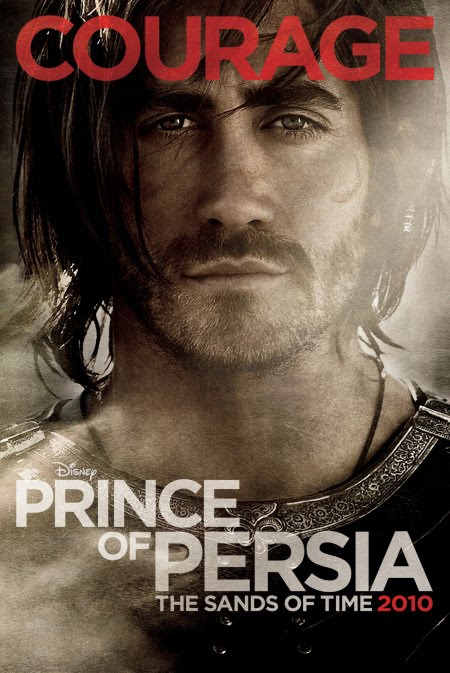
Prince of Persia (2010) is based on a 1989 video game, so the obvious audience for the film is young teens—probably boys more than girls. Parents and grandparents who take their kids and grandkids will not be embarrassed or bored.

You will probably find it a diminished, postmodern Indiana Jones film, by which I mean lots of humor, snakes, whips, a beautiful but slightly treacherous girl, and supernatural weapons of mass destruction. Jake Gyllenhaal is not Harrison Ford, but Ben Kingsley makes a great villain and Alfred Molina has some very funny lines. The ostrich races are a great touch.

As you drive home from the film with the minivan full of kids, here are some conversation starters that might help the kids think about the film both intelligently and spiritually.  Remember, these are conversation topics, not lecture topics—oops, got a little preachy, didn’t I J!

  1. You don’t have to be born a prince to be a prince! Dastan was a street kid with nothing but a strong sense of justice and right. Then he was an adopted kid with lots of stuff, but no power or future. He continued to stand out and become the best of the brothers because of his courage and his character. Kids don’t all start out equal; many start with huge disadvantages, but all can become people who others look up to, people who do good and not evil.
  2. Beauty can be used for good or evil! This is a great topic for boys and girls both. The princess had great beauty which gave her both opportunity and power.  She had to make many choices of whether to use it for good causes that helped others or just for her own benefit. And sometimes her beauty got her into trouble. Beauty can’t be the goal; beauty is just a tool to be used for good or bad.
  3. Good people have bad things happen to them. Dastan did not try to kill his father, but he is blamed for it and has to run. The city of Alamut is conquered even though it had not rebelled. Life is not fair, so the only real question is what you do when you are treated unfairly.
  4. Stand up for what you believe to be right. In real life you don’t get a do-over! In the film Dastan knows from the beginning that attacking the city is wrong, but he lacks the self-confidence to speak up against his older brothers. In the film, he gets a second chance, but in real life that rarely happens. Teach your children to be strong and courageous and to not be afraid. Stand up and speak up for what is right—all the time.

If your teens are a little older and would like something really challenging, ask them if they know  the prince of Persia story in the Bible. Then when you get home, point them to Daniel 10 and let them think about the role of angels in spiritual warfare.  You won’t have the answers to all of their questions, but it’s a great chapter to open our eyes to the unseen realities of the world we live in as well.

Prince of Persia is a typical Disney film, very clean with just a touch of violence to rate it for older children. And by the way, don’t miss the small political jabs in references to taxes and WMDs.

Read Full Post »

In celebration of our first anniversary (April 1972), Sherrylee and I drove our little Chrysler Simca down the autobahn from our home in Munich, Germany, to the city of Verona in northern Italy. It was just far enough away that we could do this on a long weekend and a short budget. And since both of us were English majors, well what more needs to be said.


Perhaps this is the reason that we saw Letters To Juliet last night when we could have seen Robin Hood. We don’t go to much fluff, having avoided all the latest round of Nicholas Spark tear-jerkers and their lookalikes. Perhaps it was that we had my in-laws with us, and they hardly go to the movies at all. When both of you are in your 80s, I suppose you have seen everything!

Nevertheless, we entered with low expectations and left having thoroughly enjoyed one of the best fluffy movies that I have seen in a long time.

The plot is absolutely predictable: a young woman (Amanda Seyfried) goes to Verona with her fiancé on a pre-honeymoon, where she becomes involved with the local women who respond to lovers’ notes left under Juliet’s balcony. She discovers a note that has been hidden for over fifty years, answers it, which leads to an older British woman (Vanessa Redgrave) and her grandson (Chris Egan) coming to Verona to find Lorenzo!

You can imagine much of the rest, so I won’t spoil it for you, but let me tell you what made the film delightful. First, Vanessa Redgrave does an amazing job of not letting her character—the woman chasing love lost 50 years ago—become schmaltzig. Instead she plays her role with extraordinary sensitivity, perhaps more than the film deserves—but it makes her character believable and sympathetic.

Amanda Seyfried may have started as a Mean Girl (2004), but most recently she has taken on roles that exploit her very blonde innocence—and I don’t mean that disparagingly. I enjoyed her in Mama Mia and again in this film, where she manages to pull off a very tricky role. Her character Sophie has to show disappointment in love, ambition, intelligence, abandonment, but most of all vulnerability. With only a few exceptions, I thought she was fun to watch.

Her counterpart is Chris Egan, playing a stuffy, British prig who is captured by Sophie’s winsomeness. Franco Nero, the famous Italian actor, enters on a white horse….yes, it is true—without any damage to the film whatsoever.

It is a very clean, little romantic comedy—nothing that embarrassed my in-laws at all—and some scenes that are quite funny.  (I do wish they had just said the word “marry” once.)The beautiful Italian countryside and the scenes of Verona and Siena are just about worth the price of the tickets alone.

For a light, fun, clean night out, you won’t be disappointed with Letters To Juliet.

Read Full Post »

On the drive to work this morning, I listened to a radio commercial for a fire ant treatment that made me cringe. In a typically ironic way, the voice was warning fire ants to prepare for excruciating pain, horrifying deaths, mass murder, and violence beyond compare.  Now I’m no friend of fire ants, but something about this commercial offended me greatly. It seemed the emotional appeal of the commercial was to a violent, sadistic pleasure that someone believes is common enough among people to sell their product.

Then I remembered a report in March on a French documentary called Le Jeu De La Mort (The Game of Death) that explored the same idea.  Eighty participants were recruited for what they believed to be a TV game show. With gala décor and typically sexy host and hostesses, these “contestants” were asked to inflict electrical shocks to another contestant when a wrong answer was given.  The intensity of the shocks increased until the tortured contestant quit screaming and simply went limp—died—maybe.  The tortured contestant was an actor and no real shocks were administered, but the eighty contestants did not know this until afterwards.

Of the eighty contestants, only sixteen refused to inflict pain. The others followed the instructions given them and inflicted pain on the victim to the point of death.  Unbelievable!

I wanted to dismiss this as filmmaking—smoke and mirrors—but then I had a flashback to psychology classes at Harding, and with the miracle of internet, I found reference to the Milgram Obedience Experiment in the 1960s, which in a more controlled environment and with a more scientific protocol performed the same experiment in the same manner. The only real difference was that instead of a TV host telling a “contestant” what they should do, it was a “scientist” in a white jacket giving the orders at Yale.

In the 60s, sixty-two percent of the people administered electrical shocks to the victim. In 2010, over 8o percent complied.  The frightening fact is that we live in a world de-sensitized to torture and horrific violence through every form of mass media that we experience.  From Jack Bauer to anime to computer gaming to WWF, inflicting pain and suffering is as common as . . . turning on TV.

If we laugh at an innocuous commercial about insecticide, how far are we from pulling the torture switch ourselves?

Read Full Post »

On May 24, the eight-year run of 24 will come to an end.  Since November of 2001, U.S. viewers as well as millions around the world have watched Jack Bauer save the world one more time—and all in a twenty-four hour time period.  The fast-paced, twisting, often tortuous plots kept audiences returning week after week, sometimes even after long pauses between series. How will we survive without 24???

Sherrylee and I discovered  MI-5 a couple of years ago, and through our Netflix subscription have rented seven out of the eight series made. Let me recommend it to you as replacement therapy.

MI-5 is the U.S. title for the British series produced by BBC One titled Spooks.  (MI-5 is the counter-terrorism group of the Special Intelligence Services (SIS) in the UK.  James Bond worked for MI-6—the international branch.) First airing just a few months after 24 began, it met with the same kind of reception in the UK, but not always for the same reasons.  Since you are undoubtedly familiar with 24 if you are reading this, let me mention some of the key areas where MI-5 is different.

MI-5 is not constrained by the ticking clock. One of the reasons for the demise of 24 is the ticking clock. The show has always strained credibility because everything had to be accomplished within twenty-four hours. Kim was kidnapped two or three times in the first 24 hours. Jack is often shot and tortured and must recover instantaneously for the clock to continue.  Freeing the scripts from this artificial restraint allows for much greater complexity.

MI-5 develops more deeply the personal lives of the characters. The attempts to give Jack feelings and/or romantic involvements have been mostly just distractions from the action. MI-5, on the other hand, actually uses the virtual impossibility of serious relationships with anyone outside of the spook business as an artful way of developing even secondary characters and making the audience care about them. From the first season until the last, the private lives of characters are played out against the backdrop of terrorist threats to Great Britain in a very satisfactory way.

MI-5 is an ensemble of characters, not just a support team for one main character. In certain episodes of MI-5, it might be the Jack Bauer counterpart Tom Quinn (Matthew Macfadyen) or Adam Carter (Rupert Penry-Jones) that the plot revolves around, but other episodes will focus more on the Director of MI-5 Harry Pierce (Peter Firth) or it might even be a lesser character like Jo Portman (Miranda Raison). More interesting characters provide more storyline possibilities, which are exploited very effectively in MI-5. And since danger is at the heart of the profession, the series continues then courageously, even when major characters are suddenly. . . . killed.

MI-5 explores more realpolitik. 24 has been good with exploring some moral questions that combatants always face, i.e., can bad things accomplish the greater good, the use of torture for obtaining information, the question of personal responsibility to do right in the face of orders to do wrong?  MI-5 explores all of these topics as well, but is also able to ask questions about specific government policies, like extraordinary rendition, covert operations of terror in other countries, political cover-ups, even economic policies and their effect on international relations. Some of the most interesting episodes have been the racial conflicts reflected in UK society, especially home-grown radical Islamists.

I will warn you that Americans, often referred to as the Brits “special friends” or their “cousins,” are rarely portrayed in a favorable light. If you are squeamish about how even our foreign friends really feel about us, you might best stick with reruns of 24. On the other hand, if you can bear it, it is an interesting lesson in perspective.

MI-5 is currently running on many PBS channels, but I suggest you either purchase the series online or get it through a subscription service like Netflix.   My one piece of advice, however, is to use the subtitle routine on the disk, at least until your ear becomes accustomed to the accents.  I do believe the British series will do a brilliant job of weaning you off of Jack Bauer—so you can survive to fight another day!

Read Full Post »

« Newer Posts