Feeds:
Posts
Comments

Archive for the ‘Christian Culture’ Category

woodsDecember 21, 2012 is the shortest day and the longest night of the year. No wonder that we celebrate the Light coming into the world during December.  It’s a dark month.

As many of you know, I was a professor of English for twenty-four years, so occasionally, some of that personal history sneaks into this blog.  Almost every year on this day, I think about Robert Frost’s poem “Stopping by Woods on a Snowy Evening” because the scene depicted occurs on “the darkest evening of the year.”

Probably only a few of you know, however, that for about a year, I was quite a Frost scholar! To complete my MA degree at the University of Mississippi in 1971, I submitted a pretty extensive thesis study of the dark side of Robert Frost. One of the traits of Frost’s poetry that attracted me was his apparent, even folksy accessibility–which easily disguised the depth of the poet’s conflict.

I know, that sounds too much like an English professor, doesn’t it!  Let me show you what I mean with this very familiar poem.

Stopping by Woods on a Snowy Evening

Whose woods these are I think I know.
His house is in the village, though;
He will not see me stopping here
To watch his woods fill up with snow.

My little horse must think it queer
To stop without a farmhouse near
Between the woods and frozen lake
The darkest evening of the year.

He gives his harness bells a shake
To ask if there is some mistake.
The only other sound’s the sweep
Of easy wind and downy flake.

The woods are lovely, dark, and deep,
But I have promises to keep,
And miles to go before I sleep,
And miles to go before I sleep.

On the surface, this poem appears to describe a person sleighing home on a dark night, who stops to take in the woods filling up with snow. Oh what I lovely sight, but he must be on his way because there is much more to do.  What a nice little poem!

But let me lead your thinking along a different path to understanding the poem with just a few easy questions:

  1. Is this poem about the driver, the horse, the woods, or the snow?
  2. Which of these lines represents the primary dramatic tension or the “conflict” in the poem?
  • “He will not see me stopping here”
  • “To stop without a farmhouse near”
  • “Between the woods and frozen lake”
  • “But I have promises to keep”

3. If I tell you that “the woods” are almost always the scene of danger, despair, or treachery in American literature, does it change your understanding of the poem?

“The darkest evening of the year” was a day not chosen by accident.

Yesterday, I had conversations about friends whose children are threatened by divorce, about the tragedy at Newtown, about the imminent loss of aging parents, about the early loss of a dear spouse—just about the temptation to disappear into the woods, lovely, dark and deep.

It’s not the promises that I have made, but the promise in the Light of Bethlehem that offers a reason to keep traveling those miles before we sleep.

Some people make a big deal out of the fact that pagans had winter celebrations about the same time that Christians now celebrate the birth of Christ even though we know how unlikely this date is as the real time of his birth.  Perhaps it is true that pagans danced around trees, gave gifts, and had some mythological character that appeared down their chimneys.  That is not Christmas! At least, it is not what a Christian celebrates.

When Christians remember the birth of Jesus in December, they completely hijack and transform pagan rituals into what is real and true. You can’t take Christ out of Christmas for a Christian. You can ban the words in public, but the Word became flesh and dwelt among us! It is our breath of Life!

And so today, the 21st of December 2012,  this very short day will be followed by a very long night. The darkness of the world we live in is dark and deep.

Will you go to the woods or will you take the journey, walking in the Light—the Light of Bethlehem?
Read Full Post »

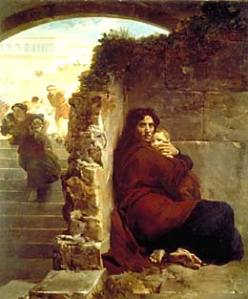
Massacre of the InnocentsThe Massacre of the Innocents is a part of the Christmas story that we rarely include because of its horror.  The Newtown tragedy, touching the same nerve, forces us to recall pain.

Herod, sometimes called the Great, had been elected king of the Jews by the Roman senate around 40 BC. His jealousy for his throne is well documented historically and proven unquestionably by his execution of his wife and two sons, whom he suspected of plotting against him.

Herod is the king to whom the magi turned to find exactly where the new “king of the Jews” would be born.  As Matthew tells the story, in order to protect baby Jesus, the wise men were told by God not to return and report to Herod , and Jesus’ father Joseph was told to flee to Egypt. According to Matthew:

 “Herod was furious when he realized that the wise men had outwitted him. He sent soldiers to kill all the boys in and around Bethlehem who were two years old and under, based on the wise men’s report of the star’s first appearance” (Matthew 2:16-17)

Most scholars now think that the number of children killed was probably under 20—about like Newtown—not a big number—unless it is your child!

Anne Rice, in her historical novel based on the early life of Jesus Christ the Lord: Out of Egypt used a very interesting insight to carry part of the plot. As she imagined the family of Joseph and Mary, living in Egypt for several years, she portrayed them never mentioning to Jesus why they moved to Egypt, lest he be burdened with a sense of guilt for his birth causing the death of the other children born in Bethlehem about that time.

Three hundred thousand children were killed in the Rwandan genocide of 1994, most with machetes, not guns.

Over a million Jewish children were killed between1939-45 by the Nazis. Most of them were gassed or died from disease or other consequences of a concentration camp.

You can add to that million perhaps another half million children whose parents were gypsies or other Nazi-deemed inferior races.

Lest we think that only others do such things, think about how many African children died being transported as slaves to the Americas. Or what about the last great battle against the American Indians at Wounded Knee, where the U.S. 7th cavalry killed 90 men and 230 women and children.

One estimate is that at least 20% of the soldiers in the U.S. Civil War were under 18 years old, a war in which over 700,000 soldiers died, which would mean 140,000 were just children.

The problem is not gun control; the issue is not mental health; and killing children is not primarily an American problem.

The disease is the reality of evil! The symptoms present themselves quite often violence—especially violence toward the innocent!

With very difficult diseases, sometimes we start by trying just to relieve the symptoms. We can begin fighting evil by opposing violence in our culture.

  • How many of your favorite TV shows depend on violence to carry the plot?
  • And what about the video games that you play—or that you let your children play?
  • And what language do you use to talk about those you disagree with politically? Morally? Do you use peacemaker language or abusive, invective language?
  • And are you all about fights and wrecks and doing damage at sporting events?

Every Christian should take inventory of their own lifestyle and become acutely sensitive to the intersections–in whatever degree–with violence.

Regarding the problem of evil, only God can defeat evil, and He has, but there are still some battles to fight.

Did you know that Robert E. Lee surrendered on April 9, 1865, but that President Johnson didn’t declare the Civil War ended until May 9, and that the last Confederate general did not surrender until June 23?

Jesus defeated the Enemy completely on his day of resurrection, but until He comes again, more children will die because of Evil.

And so the Christmas story of the Massacre of the Innocents does have a place today! Although Herod may have thought he won the battle, the baby he sought to destroy would win the war just 33 years later.

The children who died in Bethlehem and the parents who grieved them, and we who grieve losses, can take comfort knowing that Evil does not win!

Read Full Post »

Fear! Fear! Fear!

THE FISCAL CLIFF!!  SERIAL KILLERS!!  CRISIS!!  DOOMSDAY!!  KILLER WHALE!!  BEWARE!!  OMG!!  WAR ON MEN !!  SITUATION DIRE !! BRAIN DAMAGE !!  SAVE THE PLANET!!  And that is all off just one internet page of headlines for today!!  How much worse could it get?headlines2

If you haven’t seen the drama video from Belgium, please take less than two minutes to watch it!  (You can skip the advertisement at the beginning, if you want.)  The reason this is so funny is because we are bombarded with “drama” at every turn.

Why is “drama” the only way to get our attention?  The longer I think about this, the more answers I get—which probably means there are lots of right answers—and that it is . . . well . . . complicated.  I’ll share with you what I think.

  • We are addicted to conflict. You can take the sweetest Disney movie or Winnie the Pooh or Beatrice Potter stories and you will always find conflict.  We think in terms of contrasts, distinctions, and variances.  We need differences to distinguish one thing from the other.  We don’t know how to tell a story without conflict.
  • Schadenfreude! Such a great German word to describe one’s pleasure at someone else’s misfortune.  The definition sounds more malevolent than it usually is, but it does suggest our darker, selfish nature.  “Boy, I’m glad I don’t have to handle that person’s child!”” I’m glad I wasn’t on that plane.”  There is a subtle pleasure in the fact that the misfortune happened to someone else and not to me!
  • Vicarious experience of danger!  One of my favorite movie scenes of all time is in Clear and Present Danger (1994) when the American government representative’s convoy is attacked by a drug cartel’s army in the narrow streets of a poor South American city. The big black vehicles roaring through the streets with a large police escort look invincible, but all it takes is one bad guy disguised as a motorcycle patrolman to turn the scene into mayhem! I can’t imagine how diplomats could watch this scene; it would be my worst nightmare.
  • Drama motivates others to action!  Which gets you out of your chair, the “consequences of last year’s indecisive tax measures” or the looming “fiscal cliff?”  Just the more dramatic phrase suggests danger, death, destruction—which must be avoided at all cost!!  Drama motivates.
  • Fear may be our most compelling emotion!  Fear of loss, fear of death, fear of pain! Fear seems to be built into us physically and as with our other senses, we like to overstimulate, tintilate ourselves for our own pleasure.

As Christians we know we are engaged in a great spiritual drama! Good versus evil is everywhere around us—even within us! So how does a Christian respond to a world driven by drama and conflict, but of a completely different nature?

  • Christians do not need an addiction to conflict because we know the Great Conflict has already been decided.(Spoiler alert!)  Good (God) wins!  (Knowing how the conflict ends makes all the difference, doesn’t it!)
  • Christians do not need to calm themselves with shadenfreude because having their own salvation assured, they are free to focus on the ultimate good of all others.
  • Christians do not need to seek vicarious danger because every day in our real lives, we are watching for our real enemy who “prowls around like a roaring lion, looking for someone to devour” (1 Peter 5:8). The intense fear of the lions in The Ghost and the Darkness (1996) is heightened as they take on the even more dangerous metaphor for evil itself!
  • While some Christians continue to be motivated primarily by fear, our goal is to be motivated by the opposite of fear, which is love. John says, perfect love expels all fear. If we are afraid, it is for fear of punishment, and this shows that we have not fully experienced his perfect love” (1 John 4:18)  Perhaps the test is to ask yourself whether you are motivated more by love or by fear—to do anything?

If you are one who writes or speaks or provokes others to think or to do, be careful about manipulating artificial conflict or dramatic words to create fear. FDR said the only thing we have to fear is fear itself.  Scripture is full of God’s messengers saying, “Be strong and courageous, and do not be afraid!”  Fear is not a harmless emotion.

Jesus said,Don’t be afraid of those who want to kill your body; they cannot touch your soul. Fear only God . .  .” (Matthew 10:28).

Read Full Post »

Remember the sarcastic comments that followed the first state or two that legalized same-sex marriage?  Remember those who said, “So what’s next—polygamy? Abandonment of age requirements for consensual sex?  Why not sex with animals?”

That all seemed pretty outrageous at the time—until today! Today I was reading through Spiegel Online, the online version of a leading, serious German news magazine, and was shocked with the headline “Germany To Ban Sex With Animals.”

Here is the brief summary: “The German government plans to ban zoophilia — sex with animals — as part of an amendment to the country’s animal protection law, but faces a backlash from the country’s zoophile community, estimated to number over 100,000.”

And I had not known that zoophilia had been legal while we lived in Germany in the 1970s, but apparently it had been legalized in 1969.  The current government is trying, however, to appeal to the greater number of animal rights activists who are lobbying to protect animals from activities that are “inappropriate to their species.”

The zoophiles have organized themselves into a pressure group called ZETA (Zoophile Engagement for Tolerance and Information) and have been quoted as saying, “We see animals as partners and not as a means of gratification. We don’t force them to do anything.”

“People have tried to create the false impression that we hurt animals,” said Michael Kiok, who lives with an Alsatian dog called Cessie. He is quoted in this article as saying he had had  “special feelings for animals ever since he was four or five and that the fascination took on erotic elements in his teens.”

Here’s the link if you want to read the whole article: http://www.spiegel.de/international/zeitgeist/germany-plans-to-outlaw-sex-with-animals-a-869402.html

Lest we be outdone by the Germans: did you see the recent ABC 20/20 special on the polygamist family in Utah that just published their story in a book entitled Love Times Three? Not only are they willing to risk prosecution by “coming out” but they are also hoping with their story to change the laws in the U.S. to make polygamy legal. In fact, the family argues that they are a “typical, albeit large, modern American family.” You can read the companion article to the TV special here: http://abcnews.go.com/US/modern-polygamist-family-risking-jail/story?id=14956226#.ULQgiYdaSSp

At least we still protect our children—unless you are in Mexico where the age of consent is 12, or Japan where it is 13. Many countries and some U.S. states let 14 year-olds have consensual sex; the federal law in the U.S. sets the age at 16.

India has a big controversy going on right now with some legislators attempting to raise the age of consent from 16 to 18, a move which at least one high court termed “regressive and draconian!” http://www.indianexpress.com/news/bill-to-raise-age-for-consensual-sex-regressive-court/948994

As far as I can tell, only a few Muslim countries have made it illegal to have sex outside of marriage. I thought that was the Christian teaching! 

I suspect that we Christians are reaping the harvest from centuries of teaching against sex to the point that we have no real theology of sexuality.  Just raise the issue in your life group of what is wrong with polygamy or zoophilia. Talk about how old children should be before you should assume that they are sexually active.  Ask if being in love makes all of the above OK?

Ask if sexual activity in every form is a human right, that if denied by law, is an act of oppression.  Ask if consensuality is the only test to apply to any form of co-sexuality.

Ask your group about raising children gender neutral?  And if your group doesn’t know what that means, go get some younger people to join your group!

If you are really brave, ask your teenagers at church, or your student group at the campus ministry the same questions.

We live in a time when everyone does what is right in their own eyes, just like Israel did during the time of the judges in the Old Testament (Judges 21:25) because they had no king.

Unless we have a King, there are no definitive answers to these questions. There are only your answers—and my answers—and their answers—and someone’s answers!  That’s all—if you don’t have a King.


.

Read Full Post »

Halloween was never a big deal as a boy—always just some costume thrown together from what we had—nothing outrageous, certainly not frightening.

Our own children lived a totally different story. Halloween grew more important somehow between the 50s and the 80s. I remember some pretty elaborate attempts at costumes—Charlie Chaplin’s tramp, Pumpkin princess, Pippi Longstocking, and the most memorable of all Tumnus the Fawn from Chronicles of Narnia.

Sherrylee stuck pointy ears on 8-year-old Philip’s ears, Spanish moss on his bare chest for fawn-like hair, and brownish panty hose for fawn-legs and sent him to school for the Halloween costume parade. Before 10am, we had received a call from his school reporting that his costume had fallen completely apart—and off– and he needed some clothes–quickly! Any psychological issues our children have may stem from Halloween!

I had a great conversation yesterday with a mother who hates Halloween, not just for the pressure of creating the perfect costume for each child every year, but partly for spiritual reasons—and I think there is something here to think about too!

  • Although there will always be those who find similar pagan traditions for every holiday, the Halloween tradition here in the U.S. grows out of Christian roots—as does the anti-Halloween tradition.  The Puritans opposed Halloween because it was Roman Catholic. The Irish/Scotch immigrants—mostly Catholics—brought the tradition with them to America during the 19th century waves of immigration.
  • Halloween has completely lost any religious overtones because All Saints Day (November 1) is no longer a holiday and only barely a religious day for only the more catholic churches.
  • Witches, ghosts, and goblins have been disneyfied into cute little magical creatures for our children. They are not represented as nor perceived to be representatives of Satan nor empowered by him.  In fact, they are often even champions of good (Little Witch, Casper, etc.).
  • People that were certainly at one time religious symbols can be transformed over time into purely seasonal characters—like Santa Claus. In the 19th century, Americans blended St. Nicolaus (a real person) and Father Christmas (a myth) into Santa Claus and nobody really thinks of him as a religious representative at all.

Having defended  ghosts, Santa Claus, and little witches a little bit, I want to make something very clear:  anything that appears to be satanic, occultist, or spiritually evil should be fiercely avoided.  Satan is real, and if angels are real, then demons are as well.

I take very seriously the words from Jude 8-10: 

In the very same way, on the strength of their dreams these ungodly people pollute their own bodies, reject authority and heap abuse on celestial beings. But even the archangel Michael, when he was disputing with the devil about the body of Moses, did not himself dare to condemn him for slander but said, “The Lord rebuke you!” 10 Yet these people slander whatever they do not understand, and the very things they do understand by instinct—as irrational animals do—will destroy them.

I do not go to movies about Satan; I do not read books about Satan or demons—not for entertainment. I do not believe Satan should be or will be trivialized.  Stay alert! Watch out for your great enemy, the devil. He prowls around like a roaring lion, looking for someone to devour” (1 Peter 5:8)

Halloween has become one of the biggest party nights of the year, not just for children as you may think, but for the young adult crowd. The 24/7 Wall Street Morning Newsletter (10/29/2012) reported that over 10 billion dollars will be spent on Halloween in 2012. Much evil will be disguised as Halloween fun again this year.

Tonight we will go trick-or-treating with our grandkids, and they will be dressed as Star Wars heroes and other imaginary characters.  I’m confident that it is wholesome fun for them—but we all need to be alert—watching out that we are not deceived.

Many of you will have your own parties, so I offer you the same suggestion: have fun, but watch out. Don’t be deceived by the father of lies.

Have a happy hallowed evening!

Read Full Post »

Having a big decision to make sends some people to bed. Others are so confident in their judgment that they can immediately decide without a second thought.

Being a Christian decision-maker should make you more confident, but, in fact, introduces the “pleasing-God” factor, which for some people can shoot the level of anxiety about a big decision off the charts.

Yesterday, I woke up knowing exactly what I needed to do about a big decision that has been in the works at Let’s Start Talking.  If I share it with you, it is not because I think it is the only way to make big decisions, but rather because it is a way that has worked for me for many years now. Perhaps there is something that will help you with your big decisions.

The Acts 1 Model for Decision-Making

 “It’s not for you to know the time or place”

 Over a year ago, we knew that we would possibly be asked to vacate the office space that LST has occupied for the last eleven years.  Highway construction outside our door threatened to take our building. Eventually the State of Texas took only part of our parking lot, so we seemed to have dodged the first bullet. Although all but one of the other tenants in our building left, we stayed put, enjoying our space and our exceptional rental terms.  No decision was required, so no decision was made.  Don’t let the fear of what might happen force you into decisions. No need to either fear the need to control the future or pretend you can; God does.

“Therefore it is necessary to choose “

About two months ago, an owner representative walked in and told us that they were closing our building permanently and we would need to vacate the premises by August. The possibility had become our new reality, so now a decision was required.

“. . . one of the men”

We immediately started looking at the most obvious choices for new office space, i.e., highrise office buildings in our current neighborhood.  Some we liked the space, some we liked the price, some we liked the location, BUT in the beginning of our search, we did not know what was most important to us. We only found that out as we looked around and gathered information.

What we discovered was that LST was a family, not a corporation, so “corporate” space did not feel right to us.  In our current office, you can park outside our door and walk right into Julie’s office and reception area.  We discovered as we searched that we did not want to be a name on the elevator index and a door at the end of the hall on the fourth floor.

The eleven in Jerusalem knew they had to make a choice, but when they established the criteria for the choice—someone who had been in the group with Jesus the whole time from John’s baptism to the resurrection—the options became clearer.

“So they nominated two men”

We don’t know how big the pool was. We do know there were 120 in Jerusalem and over 500 witnesses of the resurrection in Galilee, so there could have been many, but the Eleven only found two that met the final criteria.

Knowing that we needed our own “family” space narrowed our office-space search to stand alone small office buildings.  With the first few that we looked at, we started feeling much better about our choices.

Be open to the unexpected

There is no mention that the Eleven started with a short list of their friends. I can imagine that they were surprised by the two finalists.

After all of our looking, the first property that really captured our imagination was not for lease; it was for sale! We had not considered trying to purchase property until we saw a building that was perfect for us!  As we crunched numbers, it became clear to us that at the right price, purchasing space would be much less expensive for us than leasing.  Even considering the possibility of purchasing our own space opened up new buildings to view.  Was God moving us in a new direction?

“For one of these must become . . . .”

It is the middle of July now, and our time is running out. We may have no more than six weeks left in our current office, although we have asked for more.  It’s time to choose!

The Eleven did all their homework, narrowing the choice to just two men. Then they prayed and cast lots.

We have searched and looked and learned and discovered –and we have narrowed our choices to two buildings, both we think would be wonderful.  There are also obstacles still and uncertainties—otherwise there would be no choice—but we have prayed that God would make the decision clear. It’s time to start deciding.

“Then they cast lots . . . .”

There is no element of chance in casting lots. God is fully in control. If you believe in the sovereignty of an immanent God, big decisions are not that scary.  For me, “casting lots” is waiting until the answer is clear.  I don’t know how God does that. Some might call it the promptings of the Spirit; others would say God spoke to them; and I’m ok with however you want to describe it as long as you give glory to God.  What I know is that I wait until I know what the answer is. And over and over again, God has led me through big decisions in this way.

“And the lot fell to  . . . “

How can you be sure that casing lots works? Does it require faith?  Of course, it does. But that is what I’m sharing with you. You can trust God; it doesn’t all depend on you!

As I said earlier, I woke up yesterday and had an answer. I knew exactly what we should do, walked into the office and shared the answer with co-workers who all confirmed it.  And now we have given the process over to God to make the final decision about where LST will live.

We’ve identified the decision to be made, we’ve gathered all the information and facts that we could, we’ve been open to new possibilities, we’ve prayed and narrowed the choices.  We’ve done all we can do.  And now we believe God will show us His way.

Let Acts 1 be your instructions, and let God be in control and you will have that peace that passes understanding.


Read Full Post »

Fred Luter, Jr. First African-American President of SBC.

I’ve been fascinated by all that has come out of the Southern Baptist Convention which was held June 19-20 in New Orleans this year.  Southern Baptists are the largest denomination in the United States with over 16 million members in 2010.

Prior to the Civil War, the Southern Baptists separated from the Northern Baptists over the issue of slavery. After the Civil War, most black Baptists churches separated themselves from the Southern Baptists and started the National Baptist Convention.

During the last half of the 20th century, the SBC began moving away from its southern distinctions, becoming both more racially diverse and again more national, with representation in at least forty different U.S. states.

The biggest public news to come out of this year’s convention was the election of Fred Luter, Jr., as the first African-American president of the convention.  Although there are only 3400 black churches in the SBC, Luter, minister for the First Baptist Church in New Orleans, was elected “with overwhelming affirmation, sustained applause and no verbal opposition” (BP News).  Although some critics point out that this is a very small step –and a late step—in developing greater diversity, surely we can agree that Luter’s election is a positive move for a church virtually denominated by racism for so many years.

The biggest controversyat the SBC was the battle to determine how Calvinistic real Baptists are.  Interestingly enough, some are surprised that any Baptists are Calvinist,  while others would argue that all Baptists came out of Calvinism.

John Piper, Mark Driscoll, Tim Keller

In 2009, Time magazine named “The New Calvinism” one of the ten ideas changing the current world (3/12).  Only 10% of current Southern Baptist pastors say they are Calvinists, but surprisingly, over 30% of recent SBC seminary graduates identify themselves as such. The future seems to be moving towards Calvinism among the Baptists.

Because of that look into the future of their denomination, just before the SBC convention in New Orleans, a well-renowned group of Baptist leaders published a paper entitled,  “A Statement of the Traditional Southern Baptist Understanding of God’s Plan of Salvation,” in which they tried to state for the record what Southern Baptist accept and reject about Calvinism.  At the convention, the word heresy was thrown around—just to demonstrate how emotional and divided the Baptists are on this theme.

Churches of Christ and most restoration movement churches simply reject Calvinism out of hand. Many argue that the restoration movement was a reaction to the Calvinism of the churches its leaders were leaving.

What this means is that most average members in our fellowship have never even heard of TULIP, nor would they be tempted by any of its positions even if they had.  That general indifference does not mean, however, that our younger generation of preachers especially are unaffected by the teachings of men like John Piper, Mark Driscoll, Tim Keller, and others.

I’m going to come back to Calvinism soon, but I do want to say now that I do believe that we may have been so afraid of those biblical words predestination and election that we have had a tendency to selectively limit God—and imposing limits on God I find to be extraordinarily presumptuous!

Finally, the biggest speech of the SBC convention may have been delivered by David Platt, author of Radical: Taking Back Your Faith From the American Dream and Radical Together: Unleashing the People of God for the Purpose of God, two books widely read and discussed in evangelical circles.

David Platt

Platt had been criticized for statements he had made at a conference in Austin which seemed to suggest that he had serious issues with the “sinner’s prayer.”  Questioning the “sinner’s prayer” for Baptists is like throwing stones at Billy Graham and all the great evangelists. In addition, his perceived criticism of the “sinner’s prayer” seemed to his critics to align him with the “Calvinist stars” of the Southern Baptist,  so Platt felt the need to speak to that criticism during the Pastors Conference of the SBC convention.

His speech was entitled “What I Really Think About the ‘Sinner’s Prayer,’ Conversion, Mission, and Deception.”  Fortunately, he posted the text of his address in his blog on 6/28/2012 and it was re-posted by Christianity Today at its web-only site.  Click here for the full text.

Why am I bothering to report on the Southern Baptist to you, most of whom are not Southern Baptist?  What difference does it make what David Platt thinks?  If you are asking these questions, then you need to get on Twitter and just listen to our younger preachers.

At lectureships just this year—the nearest thing Churches of Christ have to conventions—I have heard and sometimes participated in discussions of lingering racism in our congregations, especially the lack of recognition and platform for younger, minority preachers.  I have heard the serious debate over the existence of Hell and the questioning of the need for evangelism.  These conversations are our version of these same issues the Baptists are discussing.

Why am I interested in the SBC convention?  Because their public issues will be our issues in the near future—if they aren’t ours already!

Read Full Post »

It’s graduation time, a wonderful time for parents to be very proud of what their kids have done, a time to brag on them and show off all their trophies to the grandparents and friends!

But wait!  Did you think I was talking about high school or college graduates?  No, I was talking about kindergarten and elementary school graduates!

It was the trophy thing that threw you, wasn’t it! But by the time an almost 7-year-old boy starts first grade, he could easily have half a dozen trophies for soccer, more for T-ball, and some for basketball. In addition, there are likely ribbons and medals, all displayed on the mantle with a couple of cap-and-gown graduation pictures, one from pre-school and one from kindergarten.

For a couple of decades now, our society has been very concerned about children growing up with

Self-confidenceSelf-regard

Self-worth

Self-love

Self-awareness

Self-esteemGood self-concept

Self-respect

Self-acceptance

Good self-image

Some are wondering if we aren’t using the word self much too often.

Recently, David McCullough, Jr., an English teacher in Wellesley High School in Massachusetts delivered the commencement speech for the high school graduates.  In the course of his address, he told the graduates and their parents, “You are not exceptional,”  and shocked people enough to cause a national uproar.

How dare he say that my child might be average! The nerve of a teacher to evaluate my child by some standard.  How could he sweep through our houses and make all of our kid’s trophies vanish?

I have some personal experience relevant to this topic from my own days in the classroom. For twenty years, I taught English to college freshmen and sophomores, and my annual evaluations were generally quite good—especially taking into account that I taught required general education courses that most students were poorly prepared for and didn’t want to take.

I noticed, however, in the last three or four years of teaching that some new comments started appearing in my evaluations that I had not seen before. Students started saying that I was not showing them proper respect and that I did not listen to them.

I took these comments very seriously, but was puzzled as to what I was doing differently. I prided myself on good relationships with my students, with lots of open discussion and exchange of ideas.  What was I doing suddenly that made them feel disrespected??

After probably a year of introspection as well as seeking the counsel of my colleagues, I came to the conclusion that I had really not changed, but that the students had changed.  My students were coming into the classroom with two completely new assumptions for which I was unprepared:

  • Assumption One:  The opinions of a student are as authoritative and valid as those of the professor.
  • Assumption Two:  It is disrespectful for a professor to suggest that a student’s opinion might not be right or might benefit from further research, especially in front of other students.

I know there are professors who act like they are the Alpha and Omega of all knowledge, but, you’ll have to take my word, that I am not of that ilk. Yet, some of my students had that impression and it really bothered me.  In fact, I haven’t been in the classroom for almost ten years now, and it still bothers me!

What we are asking ourselves is do we really build healthy self-confidence by giving every kid a trophy or are we promoting a sense of entitlement and rewarding mediocrity.  Here are a few symptoms of kids who might have learned the latter from our trophy mentality:

  • I should get a good grade just for coming to class.
  • I should get a good grade for turning in the work, regardless of the quality of that work.
  • Everybody should get to score a goal.
  • Children’s ideas about parenting are as valid as parents’ ideas about parenting.
  • What? I have to practice to make the team!
  • “You can’t tell me I’m wrong! That’s just your opinion!”

Sherrylee’s Aunt Jane, a long-time teacher and counselor at Greater Atlanta Christian School, once gave us good advice, saying, “A child does not become confident through compliments, but through competence.”

 Somehow this should all be easier for Christians because our confidence and sense of being loved comes from Him, not from ourselves.  A sense of entitlement is erased by His grace, which rewards us with what we do not deserve, but because of His Goodness, not ours.  Our striving for excellence grows out of a sense of worshipful gratitude.  Our motivations are Him-centered, not self-centered.

Teaching our children, both with words and deeds, about God is the only way to give them real confidence and competence.  And then, someday, as the song says, we’ll bow down and lay our trophies at His wounded feet.

Read Full Post »

A good place for conversation.

We need a new word! We’ve called them retreats, advances, weekends, and other things, but we need a good positive word that implies building a collection of common experiences with people that we go to church with, but that we don’t really know that well outside of church.

I’m writing as the sun is coming up on Sunday morning over Lake Granbury. The sky is that pinkish orange in the east, the birds are awake, so the cicadas are toning it down, lest they become breakfast for the birds. The morning breeze is just enough so that I can sit here on the balcony in my pajamas and be comfortably cool on what may be one of the hottest days of this year by late afternoon. We’ll be home by then!

Sherrylee and I have spent the weekend with three other couples and one single man, all members of our small group from church. Two couples we have known for several years; one couple joined our group just nine months ago, and the single man came into our lives even more recently.

For two years now, we have been saying that the only way to really get to know people at church is to share common experiences outside of church—but that’s easier said than done.  Finally, about four months ago, we committed to this weekend—and still two other couples could not make it work.

Our goal was to be together, to get to know each other, to build each other up, and to build an album of common experiences that will grow more meaningful as we live and worship and serve together in the future.

If you are younger, you might be surprised to learn that it is hard for older people to make new friends—real friends, not just new acquaintances.  Sherrylee and I moved to Fort Worth eleven years ago. We left the place where our kids grew up and went to school, so we left their friends and the parents of their friends with whom we had shared so many school programs, soccer games, and musicals.  We left our friends and colleagues at Oklahoma Christian, our friends at church, all of the people who knew us and our history for the previous two decades.

We came to a new place, but one where I had grown up, so I knew people, and people have known me and my family from my youth. We came to a wonderful church—but most of the people had friends already, and almost everyone had family near.  At our age, people are spending lots of time with either elderly parents, newly married children, or—best of all—grandkids!  And many have all of the above to fill their lives!

Sherrylee and I are doing the same—which doesn’t leave a lot of time and opportunity to build those more-than-superficial friendships that characterize most of our relationships at church.

And yet we still not only long for deeper relationships, we need them for our own spiritual well-being.

So our small group committed to this weekend away together, and it has been wonderful.  Here are a few suggestions in case you might want to do something similar.

  1. Get out of town, but not so far away that it costs a lot to get there or you spend all your time traveling. We opted for Granbury—about an hour outside of Ft. Worth—over East Texas which is much prettier—for this reason alone.
  2. Watch your costs, but don’t make it so cheap or primitive that you are spending all your time trying to save money or be comfortable.  We rented a house from VRBO.com for much less per person than we could have stayed at a resort or hotel. Staying at a house gives you a big living room where you can all sit around and talk,a kitchen and table where you can prepare meals and sit down together without worrying about restaurant disturbances—whenever you want to! And it gives you enough privacy for more intimate conversations if needed.
  3. Don’t overplan your schedule.  Sherrylee made sure I didn’t overplan, which is probably my tendency.  Having a pretty open schedule let us make plans as we go, creating more shared experiences. That doesn’t mean you shouldn’t line up a few options ahead of time, however.
  4. Don’t cut your time too short!  We arrived about 3:30 on Friday and will leave by noon today (Sunday), all we could squeeze out of the weekend since most of us still have to go to work on Monday.  A one-day Saturday outing might have worked, but having two evenings to sit around and especially a full morning on Saturday was perfect.
  5. Don’t leave God out of your fun together!  We’ve talked about church, we’ve discussed our own spiritual issues, and we have prayed together. These things all happened pretty spontaneously in our group.  In addition, however, we brought the Gospel of John DVD, a wonderful word-for-word visual rendition of the gospel,  and watched it each evening before we went to bed. This morning after breakfast, we will watch Jesus celebrating His last Passover supper and finish the story as John tells it, after which we will break bread together and pass our own cup just as Jesus did.  We will ask for God’s blessing on our community as Jesus did on His small group the night before He died.
  6. Don’t do it just once.  Make the building of common experiences a tradition in your small group or with those you want to grow near.

The sun is up now, so I have to go help with French toast.  Don’t give up on having real friendships.  Maybe all you need is a trip to Granbury.

Read Full Post »

Smithfield Cemetery

Memorial Day used to be called Decoration Day in most places in the United States.  This annual event probably started as a memorializing of soldiers who fell during the Civil War, at first only the Union soldiers and then, a little later, even the slain Confederate soldiers.  Somewhere around the beginning of the 20th century, the general public adopted the event for their dead loved ones, regardless of military experience.

I had about twenty minutes to kill yesterday before my haircut appointment, so I decided to walk through the cemetery that abuts the parking lot to the hair salon.  The sign says “Historical Smithfield Cemetery,“  a notice that piqued my curiosity about why it was historical.  I found two graves of interest to me. The first was the grave of Eli Smith, recognized as the donor of the land for the church and cemetery and for whom the original town of Smithfield had been named.  The second I stumbled upon, but was glad I did, was for Clarence Cobb , “The barber of Smithfield for 65 years” as the marker read.

“Barber” Cobb cut my hair for all of my teenage years. I would ride my bicycle to Smithfield, walk in his little barbershop, get my burr haircut (we call it a buzz now, I think), get my neck shaved with the strap razor, and talk local baseball.  Good memories of small, insignificant moments—maybe that is what Memorial Day is about.

Memorial Day is not really a religious holiday, like Christmas or Easter–it’s more like Veterans Day—but maybe it should be!  How should Christians feel about those they have buried?  I’ve long felt like our tradition does not have a very highly developed theology of death.

At most we do some lip service to deceased Christians resting in Abraham’s bosom, drawing on Jesus’ teaching on the rich man and Lazarus (Luke 16:19ff).  We certainly believe in the resurrection of the dead, but are uncertain about how physical that resurrection is.  We believe and preach eternal reward and eternal damnation, but we can’t really imagine either and both bring with them divisive questions.

I experienced one of the more shocking expressions of Christian theology in Germany during the 70s when the son of our landlord was killed in a car accident.  Shortly, thereafter, his father died of lung cancer inside the ambulance outside of our office.  We attended both funerals at the local protestant church (Evangelische Kirche), and in neither funeral was there mention of resurrection or heaven; the deceased live only in the hearts of their loved ones.

Is Memorial Day only about our memories of the dead?  Are our loved ones and those we honor still dead in those coffins under the ground upon which we stand?

I’ve come to believe very strongly and very literally in the words Jesus spoke to Martha, “The one who believes in me will live, even though they die; and whoever lives by believing in me will never die“(John 11).

What a difference it makes if we believe the deceased are alive! 

If the dead are alive, then

  • Perhaps we should view death as a transition from life to life– not such a big transition–one completed with no significant loss.
  • Perhaps we should view dying as more of a “laying off” or a “putting down” rather than “being robbed.”
  • Perhaps we should not mourn as those who have no hope.  We do not mourn that a planted seed will be transformed into a beautiful flower. We do not mourn the loss of a precious seed because we know that it was intended for planting (1 Corinthians 15:35-44).
  • Perhaps we should be more aware that the Body of Christ lives, including those members who no longer live with us!  The saints and witnesses of Revelation are all quite active in the plan and will of God, working on behalf of the saints and witnesses who breathe.
  • Perhaps we would be less afraid, knowing that Death has lost its sting.

Because “the last enemy to be destroyed is death” (1 Corinthians 15:26), Memorial Day is safe and secure, as are the funeral homes and cemetery owners.  Our appointment with dying is unavoidable.

But  what would be different for you if on this Memorial Day, you remembered that those by whose graves you stand are alive—very much alive?


Read Full Post »

« Newer Posts - Older Posts »