Feeds:
Posts
Comments

Archive for the ‘Traveling Thoughts’ Category

The Church of Christ in Ternopil, Ukraine, meets in property next to a huge city park that celebrates Ukrainian war heroes, most of whom died in 1944. The church that worships in that nearby building celebrates every Sunday One who is alive.

Of all the eastern European countries that opened up after the breakup of the Soviet Union, Ukraine seems to be the single one where Churches of Christ are not just thriving, but growing with a post-Pentecost fervor.  Much, if not most, of what Eastern European Missions does is in Ukraine; other “eastern European” efforts now locate most of their work in Ukraine, whereas 15 years ago they would have been active in several other countries.

I’m not saying that there is not good work in Russia, Romania, Albania, Bulgaria, Hungary, Czech Republic, Slovenia, and Serbia, not to mention Kazakhstan and Croatia. While most of these countries have excellent works, they have become slow and difficult in comparison to how it was in the early years after the Wall fell, and so the fervor for those countries has waned among American churches in general.

Not so in Ukraine, especially eastern Ukraine!  Schools of preaching, television evangelism, school programs, along with strong national leaders, all are resulting in new churches being planted throughout eastern Ukraine, as I understand the reports. You still hear about American churches sending preachers, teachers, and others to Ukraine—and when you do, you can be 99% sure they are going to Kiev and eastern Ukraine.

The one exception might be Ternopil, however, which lies in western Ukraine!

Part of the reason why we visit new LST sites is to determine how healthy the churches are who have invited our teams, so we also ask about their history to determine the path they have taken to be where they are today.  This church has followed an especially unusual path—and I’m not even sure they know it.

Their history as a congregation starts after the borders opened, when Stephen Bilak returned to his own country to continue preaching the Good News. He had been doing it by radio for many years before he was permitted to re- enter the country in person.  Thereafter, Christians in Michigan made Ternopil their personal mission site and came on their own many times.  The church grew, and about twelve years ago, bought property. With their own hands they constructed a wonderful facility with an unusually large auditorium, offices, and classrooms, but also with a large apartment—two sleeping areas, two full bath/showers, great kitchen. The apartment itself is not so unusual , but that they built it for the people who would be coming to help them was extraordinarily unusual and unselfish faith on their part!

Since then Brady Smith, missionary in Lausanne, Switzerland and Stephan Bilak’s son-in-law, has continued to come regularly to teach and serve this church.  The Minter Lane church in Abilene has sent many to Ternopil and see themselves as a mentoring church to the Ukrainian congregation. Professors from Abilene Christian have come to teach and train.

Are you getting the picture?  A lot of Christians with many and varied resources have come and worked with and served this single congregation over its twenty-year history!

The amount of attention paid to Ternopil is highly unusual. There is no church in Lviv, for instance, which is the much larger city into which one flies going to Ternopil, which is about a two-hour drive on a very bad road away! Why Ternopil and not Lviv?

When I try to come up with an explanation for eastern Ukraine’s mission efforts thriving as opposed to western Ukraine’s single thriving effort, one correlation appears to me especially obvious, that is, where many workers have gone for many years and where American churches have provided strong financial support, the churches are thriving.

Where individuals have worked with little support, either in personnel and/or financial resources, the work seems weak.

Or even worse, that area has been deemed unreceptive

Many people know missions in Ukraine better than I, so there may be other factors and explanations.  I know the work in Kiev has been a rollercoaster ride, with lots of good things and lots of disappointment. I’m pretty sure that is because from the first days of the work in Kiev by Churches of Christ, there was division among the churches over a whole slate of issues.   It was sometimes a little hard to know that we were Christians by our love for one another!

I’m so thankful for the church in Ternopil, for the strong and faithful leadership, for their fearless desire to grow the kingdom in their hometown.  And I’m thankful for all those partners in the Gospel over many years who have supported and mentored and served this church without making it dependent nor stealing its great passion for Christ.

And, who is willing to start a work in Lviv?  LST will help!
 

Read Full Post »

Why would missionaries’ kids become missionaries when they grow up?

Haven’t they seen how living in a foreign place makes you weird?  Haven’t they experienced the long, heart-rending absences from family, baseball, and apple pie?  Don’t they know how insecure they have lived their whole lives with their parents’ income entirely based on the charity of people they hardly knew and who hardly knew them?  Don’t they know how much better they could have lived if their dad had had a real job?

But everywhere we travel in the world, including Scotland where we are today, we meet our frontline missionaries, and an unusually large number of them are the kids of missionaries.

Today Sherrylee and I spent several wonderful hours with most of the members of the mission team in Falkirk, Scotland.  About eighteen months ago, they began arriving to plant a new work in this small but important city which lies about in the middle between Glasgow and Edinburgh. One dad and mom with four kids are on the team, two single women, and two young married couples.

Currently, about 30 people gather weekly in Falkirk—which is the sign of a blessed work among western European church plants.  Among their latest attempts to reach out to those they live among is to invite an LST team for this coming summer.  The Scots do speak English, but many of the immigrants and international students in Scotland do not, so this team sees them as an opportunity—and I think they are right.

One of the characteristics of growing mission churches throughout the world, as I have observed, is that they are not jealous of their national identity, but rather have completely open doors and open hearts to whomever God brings them.  This team loves the Scottish people, but they also love the Polish people and the Chinese, and the many other nationalities that God has brought to Scotland.  They believe and are acting upon Acts 17:24

 From one man he made every nation of men, that they should inhabit the whole earth; and he determined the times set for them and the exact places where they should live.  God did this so that men would seek him and perhaps reach out for him and find him, though he is not far from each one of us.

Robin and Chrissy Vick are members of this wonderful team. Robin is the son of missionary parents, and his love for the mission of God is evident. He talked about his commitment to Scotland, that he declined opportunities to join mission teams to other places, that he and Chrissy prayed and prayed for team members to join them, but were committed to go without others if so called.

Why do missionary kids become missionaries?  Here are a few of the reasons as I see it!

  • They learn very early in life that God loves the whole world, not just the U.S., not just the western world, not just the free world, not even just the Christian world, but the WHOLE world!
  • They learn the special skills that are needed to navigate foreign places. They know that languages, dialects, accents can be learned and used appropriately. They understand about visas, and negotiating foreign airports. They are not put off when their money is not green and the coins have pictures of foreign rulers on them with holes in the middle.
  • They are not afraid of other systems. So what if their kids go to European schools! So what if they have socialized medicine! So what if their country has a parliament and a queen instead of a president and a congress.
  • They know the answer to the question that so many potential American missionaries hear: why do you need to go over there? Don’t we have plenty of people here that need to hear the gospel?  They know that not only does Nashville have plenty who still need to hear the gospel, but there are thousands of Christians living in Nashville with huge resources to do that work.  And how many are living in Falkirk? And what are the resources.  That’s why they choose Scotland!

Not all missionary kids become missionaries.  But many do—and we should all give thanks for them and for their parents!

And some of you young parents might want to think about moving!!


Read Full Post »

I understand why some people just refuse to travel internationally! CONTROL!  The fact is that when you are traveling long distances and to foreign countries, you are forced daily to realize that you are not in control of your life at all!

Sherrylee and I are traveling in Europe for the next couple of weeks.  Virtually every year since the beginning of Let’s Start Talking, we have made what we call “site visits.” Typically, these are either visiting with missionaries/churches who have strong interest in inviting LST teams, but with whom we have had no previous relationship.  In other words, they don’t really know us and we don’t really know them. Rather than risk sending a team to a host that is not what they appear to be or who does not really understand how we work and what an LST team needs, we have found it essential to see these new sites and meet the people to whom we may send teams.

Our first stop this year is Scotland!  Several churches in Scotland have FriendSpeak programs which have proven to be very effective with the immigrant population in Scotland, but this is our first invitation to send an LST team.

Tomorrow night then I leave for Ternopil, Ukraine, for a couple of days, then to Athens, Greece, where we have just begun working in 2012, and then to Italy where we will meet with three different sets of workers near Florence and Rome.

We sandwiched this trip between work we had to do in Mississippi and Tennessee and more work in Washington and California, where we will go after Rome.  Then we fly back to Nashville, where we started our international travel twenty-four hours ago, to pick up our car.

We stayed at a particular hotel near the Nashville airport because they agreed to let us park our car there for a month without extra charge.  I was just slightly skeptical about this arrangement being too good to be true, so I checked with the desk person when I checked in and was completely reassured.

As we were checking out again, I thought I would just remind the new person at the desk of our arrangement . . . at which point she says, “Well, that will be $7/day and have you filled out the paperwork!”  That was the first reminder that we are not really in control!

The second incident was just as unavoidable. Flights from the U.S. to London often arrive earlier than scheduled because the jet stream speeds the flights going west to east. On this day when we had a fairly tight connection at London Heathrow, our plane was put into a holding pattern for twenty minutes because of congestion at the airport.

Then, with just barely time to make our connection, the British version of TSA pulled my carry-on off the conveyor because I had a Kindle in it.  The innocent bag sat there, waiting to be hand inspected for about 15 minutes. Then they take everything  out, swab it for explosive dust, run all my electronics through the scanner again—as they are calling out our name at the nearby gate for final boarding.

We missed our connection to Edinburgh!  A very nice BA agent was able to rebook us for about two hours later.

One of the things we have learned over the years is that most things that go wrong in international travel can be fixed without much damage—not everything, but most things. With a little friendly conversation, the hotel agreed to waive the extra charges because of the misunderstanding, and the re-booking agent at Heathrow gave us breakfast vouchers which he didn’t have to do!

Such kind gestures should remind us that we are not in control of the good things that happen either! In New York City of all places, we had a four-hour layover at JFK before we boarded our British Airways flight to London. A very nice BA agent broke all the rules and invited us to spend those hours in the First Class lounge! Then she gave us vouchers for a free supper in the lounge, and then she asked if she could take our boarding passes and try to get us better seats!

She just joined the Travel Agent Hall of Fame!

So being out of control works both ways, which is something those afraid of losing control often forget.  Sure, things go wrong—but perhaps if we also gave up taking credit for all the good things that happen to us, we’d better realize the pleasure of being completely in the hands of our sovereign, loving  God.

If He is in control, then what have I to fear?


Read Full Post »

Yesterday, April 11 was our anniversary—and this year it was the first day of a month of traveling together for LST. I can’t say for sure, but it is probably not the first time we have been traveling on our anniversary.  The blessing is that Sherrylee and I have done most of our traveling together over our forty-one years of marriage.

 In fact, we traveled together quite a lot while we were dating. We started dating in the summer/fall of 1969 and that Christmas we drove together from Fort Walton Beach, Florida,–her home—to my home in Fort Worth, Texas, 775 miles, spending one night with her uncle Richard’s family in Gretna, New Orleans on the way.  Within the next 12 months, we drove to Atlanta, to Missouri, to Searcy, and back and forth from Oxford, Mississippi, where I was working, so from the beginning, we have enjoyed the road.

Since then we have driven and flown uncountable miles, and certainly 90% of them have been together, so surely we have something to share about traveling with your spouse—or just traveling together and making it work!

  1. 1.       Traveling together doesn’t mean you travel the same way. Sherrylee and I pack differently, so we always opt for two small suitcases instead of one larger one. We have an understanding that we don’t pack into each other’s suitcases unless there is no other choice.  It just makes things work better.
  2. 2.       Sherrylee is more spontaneous, so I decide where we are going to spend the night, and she works out what we do along the way.  That satisfies my need to know where we are going and hers for having surprises along the way.
  3. You never have more time to talk about your life than when you are on a long trip. Every major crisis or decision in our life has taken hundreds, if not thousands, of miles to talk through.
  4. Don’t start the deep talking in the first hour of your trip. It takes a little time to decompress from packing up and getting out the front door before you are really relaxed enough to start taking on heavy topics.
  5. Road trips are great places to share audiobooks.  In the states, we have used Cracker Barrel book rentals, but now you can just rent online, download into your MP3 player and listen in the car.  Podcasts are also something that we listen to together in recent years. We especially like News from Lake Wobegon by Garrison Keillor—which is a free subscription.
  6. I’m OK when she wants to sleep for a couple of hours, and she’s OK when I want to listen to a ballgame. She usually reads magazines while I listen, and I usually think while she sleeps. (I know that makes me sound weird, but I’m basically an introvert with a very active interior life!)
  7. Our one big area of conflict after all these years has to do with someone’s definition of SHOPPING as recreation! Smartphones with lots of apps are an answer to prayer! I find a place in almost any kind of store and entertain myself while Sherrylee shops.

As you have noticed, most of these suggestions have to do with road trips—which we both strongly recommend to you. But traveling by air has its own set of lessons. For instance:

  1. Trust your spouse to have brought her passport/ID and don’t keep asking about it.
  2. You can get aisle seats across from each other, so everyone gets the seat they want.
  3. You can get lots of reading done at the gate, while your spouse browses the Duty Free store.
  4. Sometimes one of you is a little more anxious about ticketing, security, customs, and immigration  (me!) than the other (Sherrylee), so you might need to give them a little more space during those moments!

After all the miles, we love each other more and would always choose to travel together rather than apart.  As you can read between the lines, we’ve had our meltdowns while traveling—like the time Sherrylee threw the map out the window because I wasn’t following her instructions!  Now she doesn’t take it as personally because I don’t always do what the navigation system says to do either!!

So, go jump in the car and go somewhere with the one you love the most. It’s great for your marriage! And if you find yourself on the road on your 41st anniversary, may you be as happy as we are!

Read Full Post »

Traveling Thoughts

This week, Sherrylee and I are beginning one month of travel inside and outside of the U.S..

As always, I will try to share thoughts and let you make the trip with us, but regularity can be a problem when traveling (don’t snicker!), so I beg for your patience. 

Read Full Post »

My computer is having trouble, which has meant that I did not have good internet access, so I’m going to finish this series of traveling thoughts today even though we don’t actually leave Europe until Thursday.

Our granddaughter Cassidy flew by herself (again) from Dallas to Frankfurt, where we picked her up last Friday.  Since she was three or four years old, Mimi (Sherrylee) has been reading her the Madelein books about the little group of orphan girls who live in Paris and always walk in two straight lines!  We’ve told Cassie many times that someday we would take her to Paris, so this year we did.

Cassie slept in the backseat while we drove from Frankfurt to Paris.  Although she slept through most of the countryside, when she woke up told her all about World War I which had been fought in much of that region. The French have many new signs commemorating different nations who fought in France, probably as preparation for remembering the centennial of the beginning of the “war to end all wars” in 2014.

We had a dream Saturday in Paris: petit d’ jeuner, Notre Dame, Sant Chapelle, Musee D’Orsay, and the Louvre—being typical Americans and seeing lots instead of looking closely, but somehow it seemed to work better with a 12-year-old granddaughter, and this was all about her!

We finished the day with a trip to the summit of the Eiffel Tower on a perfectly clear night. I have to admit having been in Paris three or four times before and never really enjoying it that much. Somehow seeing it all through Cassie’s eyes on a beautiful sunny day has totally convinced me what an awesome city Paris is!  (See, I can even talk “teenager”!)

Our last three days in Europe have been at the Euro-American Retreat, held each year in Rothenburg ob der Taube.  About 140 Europeans and Americans, most of whom live in Europe, come together to be refreshed by worship and fellowship.  We try to come whenever we are in Europe in November.

Yesterday was a typical afternoon, where after the morning sessions, we had lunch with John and Beth Reese, who direct World Bible School. Then we took Tony and Leslie Coffey from Dublin, Ireland, as well as Paul, Carol, and Jesse Brazle (Antwerp) to Dinkelsbuehl, another walled city not far from Rothenburg that Sherrylee and I knew about.

We talked and talked, walked and talked, stopped for coffee and Kuchen (Black Forest cake), and even shopped a bit before heading back for the evening sessions.

Tonight is first the teen banquet and then the children’s singing program. Cassie honored us with an invitation to go with her to the banquet!  Tomorrow we pack up and start getting ready to go.

The small German towns of Reichenbach and Linden Fels will be our last stops on the way to Frankfurt, so that we can show Cassie where her great-great-great grandfather was born and where his family left to come to the United States in 1848.  Some things are better shown than told about—ancestors definitely belong in that category!

Happy Thanksgiving to all of you!  God is so good. Seeing so much of the world just makes me ever so much more grateful to Him for the richness of His blessings. He didn’t have to make anything beautiful or loving or fun—and, in fact, He made so MUCH that is beautiful and loving and fun!

Thank you, Lord!

Read Full Post »

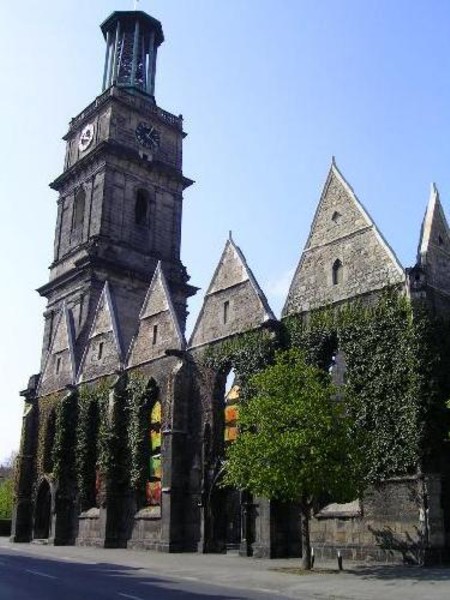
Aegidien Church in Hanover, Germany

You aren’t surprised, are you, that the people who start something called “Let’s Start Talking” find themselves in conversations with lots of people all the time about lots of different things.  Would you like a quick look at our conversation itinerary?

Hannover, Germany was our home for six years and where all three of our children were born. Along with two other couples, we moved here in 1973 to begin a new church plant.  That church grew and thrived for 20 years, long after all of us Americans had left. The Hannover church even helped in planting two other churches in Peine and Hildesheim, both cities about 30-45 minutes by autobahn from Hannover.

In the mid to late 90s, the devil got into the Hannover church through divorce, immorality, petty jealousies and blew it completely apart.  Many of the members have remained faithful and belong either to one of the offspring in Hildesheim and Peine, or they attend another church. Some seem to have completely abandoned their faith.  Those who really suffered, however, were the children of the members.

Even if we just have one day, Sherrylee and I have always made a point to keep the love and the conversations alive that we share with our brothers and sisters in this region.  But, as you will see, the conversations can be gut-wrenching.

  •  “How are your kids?”  The Hannover church was mostly young families, so there were lots of children. Today most of them are in their early 20s, marrying, finishing educational goals—and only a few of them are active believers! Most of those children do not attend church and do not appear to be living in any kind of faith.  The ones who have chosen faith are spoken of almost as miracles—like God has been especially gracious to them.  The others are all still held up to God in prayer by loving parents—at least by the parents who are themselves still believers.
  • “What do you hear about _________?” Surprisingly, many from the disintegrated Hannover church still keep up with each other. Some have moved away, a few of the older members have died, and only a handful want nothing to do with those friends from the past.  I believe that even these occasional relationships are remnants of the strong love that existed in the Hannover Gemeinde.

Those conversations were only the front door then to these conversations which were much more difficult and sometimes painful:

  • “I  feel betrayed by the people who abandoned their faith?”  Those who so casually leave a church family probably have no idea that they cause real pain,–but they do, and it is a pain that can endure for years!
  • Why don’t those other people love me anymore just because I don’t worship with them?  This conversation usually grows out of a longing for the intimacy that has been lost.  Sometimes even those who have abandoned the community suffer from this loss of intimacy. It’s not unusual for them to blame those that they themselves rejected!
  • How can I have a relationship with her when she is still living in sin?  The broken mess that sin creates can be forgiven, but the consequences  for relationships are very difficult to heal. The people can be redeemed, but the mess is often permanent—at least until Jesus comes and makes all things whole!  We had several conversations this time about how Christians should respond to the enduring brokenness that sin leaves behind.

Happily, we were able to have breakfast with Don and Cindy Roehrkasse and Kyle and Susan Bratcher who lead the church in Hildesheim. Randy and Katie Smelser and Amanda Knapp, the American workers in Peine, joined us around a true love feast!

Amanda and her husband David are fairly new, but the other three couples have worked with these churches from their beginnings!  Our conversations with them were not about the past, but about the future

  • people they were studying with,
  •  plans for developing native leadership in the church,
  •  the possibility of a new church plant in Celle

And, of course, we talked about Let’s Start Talking!

So Thursday from dawn until well after dusk, we talked.  We talked and prayed and cried and laughed and dreamed and wondered—because that’s just what Christians do with each other.

“We believe, therefore we speak!”


Read Full Post »

I think Belgium has a government, but I’m not sure.

This small divided country went at least 482 days without a government because the French-speaking parties and the Flemish-speaking parties could not—would not agree on how to go forward. Belgium is a parliamentary democracy, but without any single party having a super majority and governing independently, the only way to form a government is by coalition, that is, several parties joining together and agreeing to share power.

A country with no government because of radically self-interested political parties—now there is a lesson to be learned here, for us Americans and for us Christians.

Sherrylee and I have spent the last four days in Belgium and the Netherlands, visiting our good friends Paul and Carol Brazle in Antwerp and Hans and Ans van Erp in the Eindhoven church.  The times are interesting in both of these established works.

Maturing church works have different problems than church plants. Although both of these works are approximately twenty-five years old, they are reaching critical stages in their existence.

All of Western Europe should probably be classified as post-Christian, meaning that the forms of Christianity still permeate society, but personal faith and relationship to God through Christ is relatively uncommon.  Christianity is generally viewed as an old superstition that a more enlightened society has moved beyond.

Bringing the Good News of Jesus to Europeans requires patience. Those missionaries who choose to serve here are often choosing to leave home and stay for decades, not years!

Paul and Carol Brazle have been in Belgium since 1986, faithfully representing Jesus among the Flemish-speaking people.  The church they serve in Antwerp has been evangelistic and has fluctuated between 20-50 members over the years, depending on the Christians who move away and/or move back.

Currently they are ministering to a much larger group of people because of the influx of Africans into Europe. A group of Christians from Ghana began collecting, then growing, until they far outnumbered the other nationalities in the Antwerp church.  Along with the blessing of new members came the struggles of trying to be one church and blend Euro-American church culture with Afro-Ghanaian church culture.

You’d be surprised at how strongly everyone feels about how church is conducted—or maybe you wouldn’t!  I’m talking about totally innocuous questions like how you start songs, what melodies to use with a set of words, what to do with the children during worship times, what time will the service really start on Sunday—all mostly cultural issues, but ones that can create tension, especially if anyone insists on their own answer to the question!

And I have not yet mentioned any issues!  The church in Antwerp—all parties—are doing their best to be one church and not take the easy way of just splitting into two groups who do whatever they each are most comfortable doing.

The Dutch church of Christ in Eindhoven was begun about 1987, when Hans and Ans invited us to bring an LST group there. They have grown in the ensuing years to be a model church in Europe in many ways. Eindhoven has always been an indigenous church, self-supporting, self-ministering, and quite international as well.

At yesterday’s service, we had Belgians, Chinese, Africans, Americans—and Dutch people, singing, praying, and breaking bread together.  Their challenge now stems from their success as a church.

This wonderful church family may be reaching that time in a church’s life when they are so busy taking care of their own needs that they quit reaching out to others.  I’ve seen this happen many times in European churches. Usually the church plant is very evangelistic, fresh and enthusiastic until they reach30-50 people coming regularly.  Then church life begins to take all of their energy just to care for one another. Besides,  there is much less threat of painful rejection when only working among yourselves—so they quit reaching out!

Typically, this church will continue to feel good about itself for a while longer, maybe even grow more because of its good reputation, but then it begins to decline and no one understands why!  Decline, however, is inevitable when the community of believers is no longer consciously and intentionally shining the light into the darkness.

Some think this pattern is absolutely determined and unavoidable, but I do not. These two good churches have good leaders, people of great faith, and my prayer is that they will continue to depend on His power and Spirit for guiding the flocks which they oversee.

3 Do nothing out of selfish ambition or vain conceit. Rather, in humility value others above yourselves, 4 not looking to your own interests but each of you to the interests of the others. Philippians 2:3-4

Would it make a difference in the Belgian government, would it make a difference in our churches, if we really believed and practiced what Paul taught the early church in Greece?

Read Full Post »

If you fly into a new country, but only stay in the airport, you can’t put a pin in your map for having been in that country!  International airports are notoriously void of anything representative of local cultures.

You deplane (I really don’t like all these nouns turned into verbs!), stand in windowless rooms with only legal posters on the walls as you wait to have a completely silent passport officer check your passport. If they talk to you at all, they only want to know where you come from, where you are going, and how long you are going to be in their country.  Only in Israel did they actually ask the names of the people we would be visiting.

The passport officer then stamps your passport, waves you through so that you can go get your luggage in the prayer room—I mean, the baggage claim area!

In most countries you have two or three choices of exit doors from baggage claim. One says “Nothing To Declare;” another says “Something To Declare”—I’ve never seen anybody go straight to that line—and then in some countries you have special lines for special citizens. In Europe, both in the passport lines and customs, if you are a citizen of a European Union country, you bypass the more stringent controls for those of us who are “Other passports”. It’s a good lesson in humility for us Americans.

Of course, we do the same thing –maybe worse as non-citizens come to the U.S.  I find our passport and customs controls among the most rigorous.

Now to make choosing the correct line even more interesting, there are some countries who introduce a random search element to the process.  One country we have visited has each person hit a big button which lights up the green Go or red Stop light. Randomly, I suppose, you get the red light and must open all your suitcases.

I’m pretty sure most customs officials work off of profiling passengers. You can bet on some scruffy student being stopped.  Yesterday, upon arriving in Frankfurt from Turkey, we faced immediate passport control by the police before getting ten feet into the airport, then again at the normal passport control. For the first time in thirty years as well, there were German customs officials actually stopping people and looking in their luggage.  I’m pretty sure it was because we were flying in from Istanbul.

If you haven’t seen The Terminal (2004) with Tom Hanks, you should rent it today!  Everything that has to do with the official side of entering a foreign country is perfectly believable!

Today, Sherrylee and I start the last two weeks of this trip. Today we drive to Antwerp, then to the Netherlands, then to Germany for about 10 days, finishing our trip with the American-European Retreat in Rothenburg.

Now, instead of talking with potential LST sites, we are visiting workers and sites that we have worked with for many years with one exception.  But relationships are everything, so we look forward to visiting to encourage them and to find out how we can serve them better.

I apologize if you need now to pull those pins out of the map for places you just flew through the airport! No cheating! You can’t count that country unless you have really had a conversation with someone other than the passport officer!

And if you need help finding that conversation partner, we at Let’s Start Talking would love to help you!

What are your experiences in international airports?

Read Full Post »

Antalya, Turkey

I’m having a Whopper Jr and a diet coke for breakfast in Antalya, Turkey, because that’s all there is at the airport at 8am! That’s not entirely true. At the Turkish restaurant next door, I could have ordered a Doner sandwich—basically a gyro sandwich—with Turkish coffee, but that option didn’t seem any better to me.

Did you know that very few countries in the world have special breakfast foods? Most people eat the same kind of food for as many meals as they may eat in any given day: soup, rice, beans, noodles, bread, cold cuts, cucumbers, tomatoes—all very common breakfast foods around the world.

Whopper Jrs are not common breakfast food in any country!!

We came to Turkey in 2002 with the first LST team here—really one of the very first entries into Turkey by churches of Christ since the early 1970s, when our M’s—you don’t use that word in Turkey– were all forced out.

Andrew and Katie were part of that first LST team, and now they have lived for almost four years in Antalya as full-time workers.  We had breakfast with them at our hotel—which did serve fried eggs (right next to the eggplant salad!)—and then Andrew took us to the English Center where he and others are offering conversational English classes to university students.

They can’t use LST materials because our Bible-based materials are too political!  Yes, political is the word the school officials use to describe the orientation of Christians in Turkey.  That surprised me! Religious, sectarian, infidels, heretics these words would not have surprised me, but political did.

As Andrew explained it to us, the greatest fear in the Muslim world is not a religious fear; rather, it is a cultural and political fear. They are afraid they will lose their culture and their control of their own political situation.  Christianity represents a threat to all of these in their minds.  It is the encroachment of Western dress, western morals, western politics, just western-ness into their ancient ways of living and thinking.

Being a political threat makes work for Christians in Turkey much more difficult.

As Andrew was dropping us off near the place where Christians meet in Antalya, a Turkish woman walked up to him and asked if anyone was in the church office.  It was actually a holiday so no one was around, but Andrew asked if he could help her.  She replied that she needed help. She felt trapped in Islam and was smothering. Could he help her?

Very kindly, Andrew asked a few more questions and then told her that his wife would call soon to talk to her. Women must be taught by women in this country. Katie will share the Good News with this woman in need.

The clash between countries and cultures may seem insurmountable, but Christians reaching out in love and in the name of Jesus to people in need will never be stopped by pejorative labels.

I’m really glad Andrew and Katie are here!

Read Full Post »

« Newer Posts - Older Posts »