
Feeds:
Posts
Comments

Remember the sarcastic comments that followed the first state or two that legalized same-sex marriage?  Remember those who said, “So what’s next—polygamy? Abandonment of age requirements for consensual sex?  Why not sex with animals?”

That all seemed pretty outrageous at the time—until today! Today I was reading through Spiegel Online, the online version of a leading, serious German news magazine, and was shocked with the headline “Germany To Ban Sex With Animals.”

Here is the brief summary: “The German government plans to ban zoophilia — sex with animals — as part of an amendment to the country’s animal protection law, but faces a backlash from the country’s zoophile community, estimated to number over 100,000.”

And I had not known that zoophilia had been legal while we lived in Germany in the 1970s, but apparently it had been legalized in 1969.  The current government is trying, however, to appeal to the greater number of animal rights activists who are lobbying to protect animals from activities that are “inappropriate to their species.”

The zoophiles have organized themselves into a pressure group called ZETA (Zoophile Engagement for Tolerance and Information) and have been quoted as saying, “We see animals as partners and not as a means of gratification. We don’t force them to do anything.”

“People have tried to create the false impression that we hurt animals,” said Michael Kiok, who lives with an Alsatian dog called Cessie. He is quoted in this article as saying he had had  “special feelings for animals ever since he was four or five and that the fascination took on erotic elements in his teens.”

Here’s the link if you want to read the whole article: http://www.spiegel.de/international/zeitgeist/germany-plans-to-outlaw-sex-with-animals-a-869402.html

Lest we be outdone by the Germans: did you see the recent ABC 20/20 special on the polygamist family in Utah that just published their story in a book entitled Love Times Three? Not only are they willing to risk prosecution by “coming out” but they are also hoping with their story to change the laws in the U.S. to make polygamy legal. In fact, the family argues that they are a “typical, albeit large, modern American family.” You can read the companion article to the TV special here: http://abcnews.go.com/US/modern-polygamist-family-risking-jail/story?id=14956226#.ULQgiYdaSSp

At least we still protect our children—unless you are in Mexico where the age of consent is 12, or Japan where it is 13. Many countries and some U.S. states let 14 year-olds have consensual sex; the federal law in the U.S. sets the age at 16.

India has a big controversy going on right now with some legislators attempting to raise the age of consent from 16 to 18, a move which at least one high court termed “regressive and draconian!” http://www.indianexpress.com/news/bill-to-raise-age-for-consensual-sex-regressive-court/948994

As far as I can tell, only a few Muslim countries have made it illegal to have sex outside of marriage. I thought that was the Christian teaching! 

I suspect that we Christians are reaping the harvest from centuries of teaching against sex to the point that we have no real theology of sexuality.  Just raise the issue in your life group of what is wrong with polygamy or zoophilia. Talk about how old children should be before you should assume that they are sexually active.  Ask if being in love makes all of the above OK?

Ask if sexual activity in every form is a human right, that if denied by law, is an act of oppression.  Ask if consensuality is the only test to apply to any form of co-sexuality.

Ask your group about raising children gender neutral?  And if your group doesn’t know what that means, go get some younger people to join your group!

If you are really brave, ask your teenagers at church, or your student group at the campus ministry the same questions.

We live in a time when everyone does what is right in their own eyes, just like Israel did during the time of the judges in the Old Testament (Judges 21:25) because they had no king.

Unless we have a King, there are no definitive answers to these questions. There are only your answers—and my answers—and their answers—and someone’s answers!  That’s all—if you don’t have a King.

.
The President’s choice to come out for same-sex marriage disappoints me greatly, not really because of the politics, but rather because of what it says about the moral predicament in our country.  I am strongly in favor of equal civil rights for all Americans, regardless of their immorality, unless, of course they cross the line into criminal behavior—and even then, they should have equal access to the processes of law.

The poll numbers show an American public divided almost 50-50 on the issue. What really disturbs me even more than what the president did is that polls also show that 71% of 18-29 year-olds support gay marriage. I was pretty shocked one day in the LST office to hear a wonderful Christian young woman say, “I wish God hadn’t come down so hard on homosexuality!”   I suspect what these numbers show for young Christians (who certainly have to be in the 71% mix) is their sensitivity to social justice issues in conflict with what might appear to be the more restrictive biblical imperatives.

Before I write another paragraph, let me state that God so loved the world that He gave His Son!  God’s love is all-inclusive, me with my sin and you with yours.  And the Creator God who defines the essence of reality (Truth) by His Word has set homosexuality outside of that which is pronounced “Good!”  The question is not about choice, nor about love, nor about equal rights, but rather about submission.  The question for all of us is whether we live out “not my will, but Thine be done!”

I’m also disappointed in us for making the 50 Shades of Grey trilogy the best-seller on everyone’s list. Romance novels have always sold well, so that’s nothing new, but this particular trilogy seems to be a hit because of its kinky eroticism—especially aimed toward women’s fantasies apparently. I haven’t read it, but here just before Mother’s Day to have all the best-seller lists led by what the reviewers often refer to as “mommy porn” is a sad commentary on us!

Both of these phenomena are possible partly because we Christians have separated our physical bodies—including our sexuality—from our understanding of the image of God, the incarnation (God in us), and the indwelling of God’s Spirit¸ which makes our bodies a temple!

This skewed thinking probably starts as teenagers, when we are taught which sexual activity is right and wrong, but never hear anyone say that sex is for anything other than fun! And adults/church are always trying to keep kids from fun things, so how is sex any different.

I also firmly believe that we Christians have also completely removed the “holy” from holy matrimony.  Although held in church buildings, most of our marriages are secular services, sometimes with an occasional nod toward God who is sitting in the back of the auditorium.

Three things I would like to see:

  1. I’d like for our children to be taught that their bodies are the temple of God. I think once that is our predominant message, we will learn how to help them understand the implications for their life.
  2. Secondly, I would like to see us appear before the throne of God in our wedding ceremonies and not just come to the marriage altar and sign a legal document.
  3. And, lastly, I would like to see us re-mystify our sexuality, acknowledging it as a God-breathed gift, not only for our personal benefit, but because creating and loving is a reflection of God in us!  The oneness of sex is the same mystery as the oneness of God. The joy and pleasure of that oneness should be transcendent, not sado-masochistic.

I pray for the president; I pray for us.

Do you need to spend ten hours on learning Chinese if you are going to go to China for a two-week missions project?  Do you need to spend five sessions learning about Communism for your mission trip to Albania?  If you are the missions ministry leader at your church or the youth minister in charge of the teen mission trip,  and you believe that everyone who goes on a short-term mission should go equipped—which I hope and pray you do–, how do you determine the best way to equip those workers going out from your church.

Let’s look in the next few posts at some suggestions about the content of training for short-term mission teams.

God first!

Everyone who goes on a short-term mission needs to be prepared spiritually! Just like you get vaccinations and take vitamins before the trip, you need to help your workers bolster their spiritual health before they go.  They need prophylactic preparation to prevent spiritual sickness, they need instruction on managing their spiritual health while they are there, and then they need to know what to do if they get sick.

  • Talk about motivations for going—and be honest because most people have multiple motivations, including adventure, travel, self-improvement, improvement of personal skills, and—of yes, helping someone else to know Jesus!  Preparation should include acknowledgement of these motivations along with a healthy way to prioritize them.  Acknowledging the lesser motivations helps remove any guilt or shame workers might otherwise carry with them. Good preparation will help them know ways to focus their motivations so that their activities will be both appropriate and effective for reaching their higher goals!
  • Talk about the spiritual goals for this trip. It is not enough to just hope that somehow conducting a VBS will make an impact for Christ. How will you know if you have made a difference or not? Do you have short-term and/or long-term goals? Are you planting seeds or harvesting because of what others have done before you?
  • What spiritual challenges might workers meet?  Most short-term mission projects are mountain-top experiences for the workers, but in every mission situation, there are also inherent possibilities for spiritual challenges.  If your workers are prepared for those challenges, they are more likely to overcome them effectively.

                For instance, sometimes workers are confronted by “differentness” at the mission site: different doctrines, different rites, different styles of worship–and it shakes up their spiritual world for a while. Other workers are challenged when they try to verbalize their own faith and fail to do so adequately. Some workers find moral temptations more alluring away from home and are challenged!

I’ve often said that being on a mission field is like being in a pressure cooker and any little crack in your spiritual armor may be put under enough pressure to split wide open and leave you very vulnerable.  Preparation for such challenges before a worker goes should give him/her an opportunity to check for cracks!

  • What role will praise and prayer play? If you will have daily times together for praise and prayer—and I hope you will—then you will need to prepare for those times before you go!  Nothing is more discouraging than haphazardly prepared devotionals with half-baked thoughts and dashed-off prayer to cap it off.  Nothing is more encouraging than good time with God and your fellow workers, when you are giving thanks, praising Him, listening for His instructions for the day, interceding with Him for those people with whom you are working, and asking Him to work powerfully through you.

Putting a spiritually healthy team on the plane, a team prepared for spiritual challenges while on the field, must be one of the highest priorities for your mission preparations.

The Church of Christ in Ternopil, Ukraine, meets in property next to a huge city park that celebrates Ukrainian war heroes, most of whom died in 1944. The church that worships in that nearby building celebrates every Sunday One who is alive.

Of all the eastern European countries that opened up after the breakup of the Soviet Union, Ukraine seems to be the single one where Churches of Christ are not just thriving, but growing with a post-Pentecost fervor.  Much, if not most, of what Eastern European Missions does is in Ukraine; other “eastern European” efforts now locate most of their work in Ukraine, whereas 15 years ago they would have been active in several other countries.

I’m not saying that there is not good work in Russia, Romania, Albania, Bulgaria, Hungary, Czech Republic, Slovenia, and Serbia, not to mention Kazakhstan and Croatia. While most of these countries have excellent works, they have become slow and difficult in comparison to how it was in the early years after the Wall fell, and so the fervor for those countries has waned among American churches in general.

Not so in Ukraine, especially eastern Ukraine!  Schools of preaching, television evangelism, school programs, along with strong national leaders, all are resulting in new churches being planted throughout eastern Ukraine, as I understand the reports. You still hear about American churches sending preachers, teachers, and others to Ukraine—and when you do, you can be 99% sure they are going to Kiev and eastern Ukraine.

The one exception might be Ternopil, however, which lies in western Ukraine!

Part of the reason why we visit new LST sites is to determine how healthy the churches are who have invited our teams, so we also ask about their history to determine the path they have taken to be where they are today.  This church has followed an especially unusual path—and I’m not even sure they know it.

Their history as a congregation starts after the borders opened, when Stephen Bilak returned to his own country to continue preaching the Good News. He had been doing it by radio for many years before he was permitted to re- enter the country in person.  Thereafter, Christians in Michigan made Ternopil their personal mission site and came on their own many times.  The church grew, and about twelve years ago, bought property. With their own hands they constructed a wonderful facility with an unusually large auditorium, offices, and classrooms, but also with a large apartment—two sleeping areas, two full bath/showers, great kitchen. The apartment itself is not so unusual , but that they built it for the people who would be coming to help them was extraordinarily unusual and unselfish faith on their part!

Since then Brady Smith, missionary in Lausanne, Switzerland and Stephan Bilak’s son-in-law, has continued to come regularly to teach and serve this church.  The Minter Lane church in Abilene has sent many to Ternopil and see themselves as a mentoring church to the Ukrainian congregation. Professors from Abilene Christian have come to teach and train.

Are you getting the picture?  A lot of Christians with many and varied resources have come and worked with and served this single congregation over its twenty-year history!

The amount of attention paid to Ternopil is highly unusual. There is no church in Lviv, for instance, which is the much larger city into which one flies going to Ternopil, which is about a two-hour drive on a very bad road away! Why Ternopil and not Lviv?

When I try to come up with an explanation for eastern Ukraine’s mission efforts thriving as opposed to western Ukraine’s single thriving effort, one correlation appears to me especially obvious, that is, where many workers have gone for many years and where American churches have provided strong financial support, the churches are thriving.

Where individuals have worked with little support, either in personnel and/or financial resources, the work seems weak.

Or even worse, that area has been deemed unreceptive

Many people know missions in Ukraine better than I, so there may be other factors and explanations.  I know the work in Kiev has been a rollercoaster ride, with lots of good things and lots of disappointment. I’m pretty sure that is because from the first days of the work in Kiev by Churches of Christ, there was division among the churches over a whole slate of issues.   It was sometimes a little hard to know that we were Christians by our love for one another!

I’m so thankful for the church in Ternopil, for the strong and faithful leadership, for their fearless desire to grow the kingdom in their hometown.  And I’m thankful for all those partners in the Gospel over many years who have supported and mentored and served this church without making it dependent nor stealing its great passion for Christ.

And, who is willing to start a work in Lviv?  LST will help!

I watched the President’s State of the Union speech last night. Very intentionally, President Obama framed his more controversial and political proposals with non-controversial, military bookends. He started with the removal of troops from Iraq and finished with the elimination of Osama bin Laden.  At every mention of the troops with their sacrifices and victories, both sides of Congress and all visitors stood and applauded.

 If there is one thing upon which Americans generally agree, it is that the country stands behind the troops on the ground!  Even when we disagree over why they are there or how long, no one ever goes on record saying our soldiers did a terrible job!

I couldn’t help but wonder if the American church of Christ feels that same way about its boots on the ground! I’m talking about the foot soldiers we send out to combat the kingdom of darkness all over the world—aka missionaries.

Times were when these soldiers of the cross seemed to be highly respected.  Missionaries like McCaleb, Shewmaker, Benson, and later Gatewood, Hare, and Bixler were well-known names with heroic stature in our churches.  Because of the big splash the Brazil team made in the early sixties and because of their innovative approach, they too continue to enjoy notoriety, especially in older, established churches.

I wonder how many of us can name five missionaries that have entered their field in this millennium—or even the last quarter century?  Unless you are on a mission committee that sent some recent workers or a teacher of missions, or working in a missions organization, I’m afraid of the results!

Our churches are still committed to missions, and we are still sending out new missionaries, so what has changed?  Here is a short list of some of the things I fear have reduced our enthusiasm for the troops:

  • Because it is now more expensive to go abroad than to work at home, churches are choosing more domestic mission projects.
  • Also because of economics, churches are choosing to support national preachers instead of Americans. National preachers are viewed as requiring much less support, no travel funds, and no benefits!  What a deal!
  • Foreign mission work is seen more as a competitor to local work. This sometimes has economic roots and sometimes geo-political.  When the nation is tired of foreign entanglements, the church becomes tired of them as well.
  • Because of fewer services per week, i.e., many churches only meeting Sunday morning for a general assembly, with other meetings done in classes or in homes, fewer are willing to open their pulpits for missionary reporting.  The average member in the pew has very little exposure to the work and sacrifice of current missionaries.
  • Mission work is low on the ladder of ministerial respect.  Fairly or unfairly, one hears the comment that people go to the mission field who can’t make it or who don’t want to fit in at home.   Test yourself: rank in value to the kingdom the following types of ministers:  mega-church preachers, small church preachers, youth ministers, campus ministers, worship ministers, church planters, and foreign missionaries.
  • A nineteenth-century attitude toward foreign missions predominates, which says missionaries should go to third-world countries and live in poverty, working only with people who are physically needy.  Interestingly enough, as Africa has become one of the most Christian continents on the planet, it has become an even greater magnet for American mission work! If there are more Christians in Africa than in the United States, perhaps American missionaries should be choosing to go other places. (I’m not saying that we should not continue to aid African Christians in their work. American Christians still have much more wealth than African Christians.)

This list is certainly not exhaustive, but perhaps will stimulate the conversation about missions among us.

I would love to see the day return when foreign missionaries are greeted with standing ovations, when churches line up to invite them to speak of their work, when mission committees bang on the doors of Christian colleges and missions organizations, looking for good people to send to their mission points.

What can you do to raise the stature of those soldiers of the cross who serve faithfully and sacrificially in the spiritual battlefields of this world?

A Last Prayer for 2012

top-10Each year during the days between Christmas and New Year’s, I like to publish the ten posts from the previous year that more of you read and shared with others.  This gives me a break during the holidays and gives you a chance to catch up with something that you might have missed.  Or you might remember a certain post and want to share it with others now. Or you may just want to see what others are reading.
No matter what you do with them, I have only hoped that my words and thoughts have stimulated you to think–and maybe even create yourself.

Please feel free to comment on these posts as well. Your comments are always welcome and always stimulating.

Here is my prayer for you which I found here and have reworded a bit to make it appropriate for us:

Come, long-expected Jesus. Excite in us a wonder at the wisdom and power of Your Father and ours. Receive our prayer as part of our service of the Lord who enlists us in God’s own work for justice. 

Come, long-expected Jesus. Excite in us a hunger for peace: peace in the world, peace in our homes, peace in ourselves. 

Come, long-expected Jesus. Excite in us a joy responsive to the Father’s joy. We seek His will so we can serve with gladness, singing and love. 

Come, long-expected Jesus. Excite in us the joy and love and peace it is right to bring to the manger of our Lord. Raise in us, too, sober reverence for the God who acted there, hearty gratitude for the life begun there, and spirited resolution to serve the Father and Son. 

We pray in the name of Jesus Christ, whose advent we hail. Amen

Out of the stump of David’s family will grow a shoot—
    yes, a new Branch bearing fruit from the old root.
And the Spirit of the Lord will rest on him—
    the Spirit of wisdom and understanding,
the Spirit of counsel and might,
    the Spirit of knowledge and the fear of the Lord.
He will delight in obeying the Lord.
    He will not judge by appearance
    nor make a decision based on hearsay.
He will give justice to the poor
    and make fair decisions for the exploited.
The earth will shake at the force of his word,
    and one breath from his mouth will destroy the wicked.
He will wear righteousness like a belt
    and truth like an undergarment.

In that day the wolf and the lamb will live together;
    the leopard will lie down with the baby goat.
The calf and the yearling will be safe with the lion,
    and a little child will lead them all.
The cow will graze near the bear.
    The cub and the calf will lie down together.
    The lion will eat hay like a cow.
The baby will play safely near the hole of a cobra.
    Yes, a little child will put its hand in a nest of deadly snakes without harm.
Nothing will hurt or destroy in all my holy mountain,
    for as the waters fill the sea,
    so the earth will be filled with people who know the Lord.

In that day the heir to David’s throne
    will be a banner of salvation to all the world.
The nations will rally to him,
    and the land where he lives will be a glorious place.

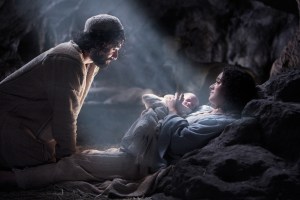
Nativity Interestingly, just about a month ago, I wrote about this passage in a blog entitled “The Story of A Dead Tree.” You might want to go back and read that today, although it was written more with the divisiveness of the November election in mind than the Advent.

On the other hand, Jesus was born into a world where Jews hated Gentiles, Jews hated Samaritans, Jews hated Romans, and everyone hated Jews.

He was born into a world where his own disciples wanted to call down fire from heaven on those who opposed Him.

He was born into a world where a ruler ordered all the boy babies killed to protect his throne.

He was born into a world where he and his parents became refugees in a foreign country for fear of their own lives.

He was born into a world where a friend would betray him for 30 pieces of silver.

He was born into a world where his cousin would be beheaded to please a dancing girl and her mother.

He was born into a world where the religious leaders tried to protect their own power by killing someone again whom Jesus had raised from the dead rather than acknowledging the miracle of his resurrection.

He was born into a world where most people just came for what they could get from him—like food or the thrill of seeing something miraculous—but who all abandoned him when he needed them.

He was born into a world of beggars, unclean lepers, self-righteous priests, hypocrite teachers of the law, second-class women, slaves, political oppressors, zealots, traitors, murderous politicians, extreme poverty, rampant divorce, abortion, perversion, pedophiles, famine, the occult, terrorists, false messiahs–a world much like ours.

And his birth set in motion the fulfillment of this prophecy of a peaceable kingdom  in Isaiah 11.

And someday, when justice is complete, when peace and harmony reign, and when every knee bows to confess that Jesus is Lord, “the land where He lives will be a glorious place.”

On this the last Sunday before Christmas, as you break bread and take the cup, remember the baby, the heir to David’s throne, who became the “banner of salvation to all the world.”

Come, Lord Jesus.

woodsDecember 21, 2012 is the shortest day and the longest night of the year. No wonder that we celebrate the Light coming into the world during December.  It’s a dark month.
As many of you know, I was a professor of English for twenty-four years, so occasionally, some of that personal history sneaks into this blog.  Almost every year on this day, I think about Robert Frost’s poem “Stopping by Woods on a Snowy Evening” because the scene depicted occurs on “the darkest evening of the year.”

Probably only a few of you know, however, that for about a year, I was quite a Frost scholar! To complete my MA degree at the University of Mississippi in 1971, I submitted a pretty extensive thesis study of the dark side of Robert Frost. One of the traits of Frost’s poetry that attracted me was his apparent, even folksy accessibility–which easily disguised the depth of the poet’s conflict.

I know, that sounds too much like an English professor, doesn’t it!  Let me show you what I mean with this very familiar poem.

Stopping by Woods on a Snowy Evening

Whose woods these are I think I know.
His house is in the village, though;
He will not see me stopping here
To watch his woods fill up with snow.

My little horse must think it queer
To stop without a farmhouse near
Between the woods and frozen lake
The darkest evening of the year.

He gives his harness bells a shake
To ask if there is some mistake.
The only other sound’s the sweep
Of easy wind and downy flake.

The woods are lovely, dark, and deep,
But I have promises to keep,
And miles to go before I sleep,
And miles to go before I sleep.

On the surface, this poem appears to describe a person sleighing home on a dark night, who stops to take in the woods filling up with snow. Oh what I lovely sight, but he must be on his way because there is much more to do.  What a nice little poem!

But let me lead your thinking along a different path to understanding the poem with just a few easy questions:

  1. Is this poem about the driver, the horse, the woods, or the snow?
  2. Which of these lines represents the primary dramatic tension or the “conflict” in the poem?
  • “He will not see me stopping here”
  • “To stop without a farmhouse near”
  • “Between the woods and frozen lake”
  • “But I have promises to keep”

3. If I tell you that “the woods” are almost always the scene of danger, despair, or treachery in American literature, does it change your understanding of the poem?

“The darkest evening of the year” was a day not chosen by accident.

Yesterday, I had conversations about friends whose children are threatened by divorce, about the tragedy at Newtown, about the imminent loss of aging parents, about the early loss of a dear spouse—just about the temptation to disappear into the woods, lovely, dark and deep.

It’s not the promises that I have made, but the promise in the Light of Bethlehem that offers a reason to keep traveling those miles before we sleep.

Some people make a big deal out of the fact that pagans had winter celebrations about the same time that Christians now celebrate the birth of Christ even though we know how unlikely this date is as the real time of his birth.  Perhaps it is true that pagans danced around trees, gave gifts, and had some mythological character that appeared down their chimneys.  That is not Christmas! At least, it is not what a Christian celebrates.

When Christians remember the birth of Jesus in December, they completely hijack and transform pagan rituals into what is real and true. You can’t take Christ out of Christmas for a Christian. You can ban the words in public, but the Word became flesh and dwelt among us! It is our breath of Life!

And so today, the 21st of December 2012,  this very short day will be followed by a very long night. The darkness of the world we live in is dark and deep.

Will you go to the woods or will you take the journey, walking in the Light—the Light of Bethlehem?

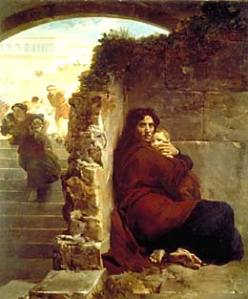
Massacre of the InnocentsThe Massacre of the Innocents is a part of the Christmas story that we rarely include because of its horror.  The Newtown tragedy, touching the same nerve, forces us to recall pain.

Herod, sometimes called the Great, had been elected king of the Jews by the Roman senate around 40 BC. His jealousy for his throne is well documented historically and proven unquestionably by his execution of his wife and two sons, whom he suspected of plotting against him.

Herod is the king to whom the magi turned to find exactly where the new “king of the Jews” would be born.  As Matthew tells the story, in order to protect baby Jesus, the wise men were told by God not to return and report to Herod , and Jesus’ father Joseph was told to flee to Egypt. According to Matthew:

 “Herod was furious when he realized that the wise men had outwitted him. He sent soldiers to kill all the boys in and around Bethlehem who were two years old and under, based on the wise men’s report of the star’s first appearance” (Matthew 2:16-17)

Most scholars now think that the number of children killed was probably under 20—about like Newtown—not a big number—unless it is your child!

Anne Rice, in her historical novel based on the early life of Jesus Christ the Lord: Out of Egypt used a very interesting insight to carry part of the plot. As she imagined the family of Joseph and Mary, living in Egypt for several years, she portrayed them never mentioning to Jesus why they moved to Egypt, lest he be burdened with a sense of guilt for his birth causing the death of the other children born in Bethlehem about that time.

Three hundred thousand children were killed in the Rwandan genocide of 1994, most with machetes, not guns.

Over a million Jewish children were killed between1939-45 by the Nazis. Most of them were gassed or died from disease or other consequences of a concentration camp.

You can add to that million perhaps another half million children whose parents were gypsies or other Nazi-deemed inferior races.

Lest we think that only others do such things, think about how many African children died being transported as slaves to the Americas. Or what about the last great battle against the American Indians at Wounded Knee, where the U.S. 7th cavalry killed 90 men and 230 women and children.

One estimate is that at least 20% of the soldiers in the U.S. Civil War were under 18 years old, a war in which over 700,000 soldiers died, which would mean 140,000 were just children.

The problem is not gun control; the issue is not mental health; and killing children is not primarily an American problem.

The disease is the reality of evil! The symptoms present themselves quite often violence—especially violence toward the innocent!

With very difficult diseases, sometimes we start by trying just to relieve the symptoms. We can begin fighting evil by opposing violence in our culture.

  • How many of your favorite TV shows depend on violence to carry the plot?
  • And what about the video games that you play—or that you let your children play?
  • And what language do you use to talk about those you disagree with politically? Morally? Do you use peacemaker language or abusive, invective language?
  • And are you all about fights and wrecks and doing damage at sporting events?

Every Christian should take inventory of their own lifestyle and become acutely sensitive to the intersections–in whatever degree–with violence.

Regarding the problem of evil, only God can defeat evil, and He has, but there are still some battles to fight.

Did you know that Robert E. Lee surrendered on April 9, 1865, but that President Johnson didn’t declare the Civil War ended until May 9, and that the last Confederate general did not surrender until June 23?

Jesus defeated the Enemy completely on his day of resurrection, but until He comes again, more children will die because of Evil.

And so the Christmas story of the Massacre of the Innocents does have a place today! Although Herod may have thought he won the battle, the baby he sought to destroy would win the war just 33 years later.

The children who died in Bethlehem and the parents who grieved them, and we who grieve losses, can take comfort knowing that Evil does not win!


“Arise, Jerusalem! Let your light shine for all to see.
    For the glory of the Lord rises to shine on you.
Darkness as black as night covers all the nations of the earth,
    but the glory of the Lord rises and appears over you.
All nations will come to your light;
    mighty kings will come to see your radiance”  (Isaiah 60:1-3).

matchOne of my early memories is standing in the Big Room in Carlsbad Caverns when the guide turned out the lights to let you see—or better said—not see what total darkness is really like. You can move your hand in front of your face and see not a hint of . . . anything. The darkness made me afraid! And it froze me! I couldn’t move—because you could not see—anything!

I wonder if they still do this or if some government entity has stopped this practice for safety reasons?  It wasn’t safe, it wasn’t pleasant, it wasn’t good to be in total darkness.

The guide kept talking as the lights were off, and it seemed like forever, but he did not leave us in total darkness very long.  Rather quickly he lit a normal kitchen match–and the transformation was amazing and complete.

That one little match threw enough light into this huge cavernous room to see!  I could see other people; I could see a direction to walk if I needed to; I could see my hand now.  Much I couldn’t see, but I could see enough to feel much better!

That match only burned for a few seconds. Then he switched on his flashlight, making a bigger and more sustained light, but nothing compared to that glorious moment when he turned on the big switch and lit up the whole cavern again.  I remember a sense of relief:  now I can move again!

“Darkness as black as night covers all the nations of the earth.”  You remember from Genesis 1 that God spoke a word and created light to overcome the darkness. But then something terrible happened: “God’s light came into the world, but people loved the darkness more than the light, for their actions were evil” (John 3:19).  The world became dark again by its own choice this time. We turned off the light, but could not turn it on again.

As that small match in the caverns banished darkness—but not completely—so Noah and Moses and Isaiah—even the nation of Israel—were small matches of light in the darkness, all offering hope of the full light.

Then God turned the big light on. “The Word gave life to everything that was created, and his life brought light to everyone”(John 1:4).  The Enemy thought he could blow out the Light on the cross. The Light was hidden three days in the tomb, but then the Light came back on in our world and will never be put out again: “The light shines in the darkness, and the darkness can never extinguish it” (John 1:5).

Sure, there are corners of darkness still left in the world, corners where evil likes to live, but when God comes again, there will be no more darkness.

Have you ever wondered why Jesus apparently was born in the middle of the night?  Or why a star led the way instead of a fiery cloud or something more spectacular?  Have you ever wondered why the angels appeared in the night sky to the shepherds to announce the birth of Jesus to the world?

Jesus was born in the middle of the dark night to dispel the darkness! Jesus was born in the night to dispel your darkness and mine! He is the Light of the world!

That’s the Good News and why we can be so happy at Advent!