Feeds:
Posts
Comments

The biggest hindrance to Christian youth and college students participating in short-term missions is their parents. I really hate to say that but after thirty years of recruiting college students for summer mission projects, I know this to be true.

Here are a few thoughts for Moms and Dads to think about to help them be more comfortable with what their young people want to do for God.

1. If your goal for your child is that he/she holds on to—even grows in—the faith you have tried to share with them, you need to let them go when they feel called. A great study done by a psychology professor at Abilene Christian University may be all I need to cite:  His study of 25,000 young people in churches of Christ showed that a “summer mission experience” was the top factor correlating with those students who continued in their faith after high school.

2. Before you ask your child to be “sensible” and …….(you fill in the blank with summer school, job, visit Grandma, internship, etc), you should ask yourself what message you are sending about the place of the kingdom in his/her life. Young people tend to “walk by faith” a little more naturally than we adults who have learned what the worst case scenarios are and who try to cover ourselves with insurance against such.

3. Check to see if you are afraid for yourself or are you afraid for your child. Some parents have not traveled much, never been out of the country, never had a passport (even if you are governor of Alaska!). No wonder you are a bit anxious about releasing your student to go to China or Africa or ………  Millions of Americans go overseas every year—for much less important reasons that sharing their faith.   “Be strong and courageous and do not be afraid.” We have to teach our children Christian bravery.

4. You don’t want to teach your children fear of random violence! One year we had a grandmother who offered to pay her granddaughter to stay safely in Oklahoma.  While the daughter was safely in Germany, the Edmond post office massacre occurred near her “safe” home in Oklahoma.  Unless we want to be crippled by fear, we cannot be live our lives afraid of random violence.


5. The best response to your child is to say YES–and to go with them! There is no better activity for Mom and/or Dad than to share some special time serving with your young person in serving the Lord.  Yes, you can do that any weekend at home, but to really step out on faith together, going somewhere very different, meeting people that are very different, but doing the most important task in the world together—there is nothing like it!

Sherrylee and I sometimes wondered if we were ruining our children by taking them with us each summer to do Let’s Start Talking—from early children through their teen years.  I guess I better let them tell you what it has meant to them. . . . but I know that God used it for good, and they are all people of strong faith.  Isn’t that what you want for your children?


I have been directly involved in organizing short-term missions (STM) since I was a freshman in college—45 years ago.  Since 1980, Sherrylee and I have sent over 6000 American Christians on thousands of short-term mission projects in sixty-five different countries through the Let’s Start Talking Ministry.

We have seen the good, the bad, and the ugly of short-term missions, but we have always believed that if done well, they were of great value.  For the next few days, I’ll give you some of the things we have learned over the years to help you do short-term missions better.

First, to the church leaders who are asked to send and to support short-term missions, here are a few suggestions for distinguishing the more worthy from the less worthy:

1. Who will be benefited by this short-term mission effort? Some of the possibilities are the Worker, the sending church, the hosting church, and the unchurched/unbelievers that are touched by the work.  Is the work intended to just be a good experience for the Americans going and the encouragement it gives to the local congregation sending them? If so, don’t describe it as mission work. It is edification.  If it is for the hosting church, then it is church nurturing, not missions. If it is for the unchurched/unbelievers, then it is evangelism.  All of these are worthy goals, so decide which you want to support.

2. Does the host really want these people to come? I attended a meeting of local evangelists in a foreign country a while back and the common complaint from all of them was how they felt required to host short-term groups who wanted to come work with them—regardless of whether the group would actually benefit their work—because the group was from a church that supported their work.   It was often assumed that every mission site would love to have a group of 30 people appear on their doorstep, but for many obvious reasons, that is not always the case.  Make sure a real invitation from the site has been issued before you go/send.

3. What’s the purpose and how will it be accomplished? Make sure that the activities match the purpose.  If the purpose is to share the Gospel with people, establishing an obvious way to contact people who do not believe is critical. Then, how will the workers begin a conversation with them? There is room for a variety of purposes, but the activities must match the purpose.

4. What’s the plan for the time on site? The very nature of short-term missions means that good use of the time is critical. Showing up to “do whatever the missionary wants” is simply a way to shift all the responsibility on the local people to do all the thinking and preparation.

5. Have the workers prepared to go? Let’s Start Talking provides all workers with a minimum of 20 hours of preparation. Our college students receive more like 50 hours for their mission projects. There are good resources out there for individuals and groups to use in preparation.  Don’t reinvent the wheel. Use the expertise of short-term mission leaders with lots of experience.

6. Is the cost appropriate? I do not believe at all in the “most bang for the buck” model of missions—but we will talk about that later.  But I also know that spending $3000/person for a five-day short-term mission project when two of the days are mostly getting to and from the site does not appear on the surface to be a wise use of that money.  Church leaders should weigh the costs against all of the outcomes, then make a prayerfully informed decision.

Next, I’ll offer a few tips for those trying to decide about a short-term mission trip—or not!

Sherrylee and I are taking a week of vacation, so I am going to use the opportunity to post some of my early blogs that many of you have not seen.  I hope you find them helpful and interesting.

From August 24, 2010

As I was writing, I was reminded of my sister-in-law Janet, who lived with her family in a pretty rough part of New Jersey for many years. Her children grew up walking and riding public transportation through city parts that would frighten lots of parents in more suburban settings.

She made it a practice as they walked out the door into the challenges of their world to arm her children with these words: “Remember your baptism!”

I was talking to a very good Christian friend recently, who was describing to me moments of doubt, doubt about whether he was good enough, doubt if he was the example he wanted to be to others, even a hint of doubt about his salvation.  He is sometimes angry about how his parents raised him to believe, and he is definitely angry about the great sense of guilt and eternal uncertainty that he received from the church he grew up in.

In an attempt to help this friend, I found Janet’s words to be perhaps the most appropriate thing I could say: “Remember your baptism.”

If you don’t really connect with these words, I suspect you grew up in the same kind of church I did, where baptism was unintentionally perverted.  Without impugning what was taught because we don’t always hear what was intended, here is what I learned about baptism:

  • The ritual act of baptism is what is most important.  This had to be because our preaching was all about immersion over any other form, about the age to be baptized, and occasionally about the words that were spoken by the baptizer. If any of these ritual elements were tainted, then most likely, the baptism was not effective. I have seen people baptized again because their arm did not go under the water with the rest of their body, because they were too young to understand everything they needed to understand, and because the person who baptized them did use the triune formula, rather just baptized in the name of Jesus.
  • Baptism was a rite of passage. You had to be 11-12 years old—anything younger and you were suspect. At baptism, you became a member of the church—which, if you were a boy, meant you could not only take communion, but serve communion and lead public prayers.  Girls could only take communion.
  • Baptism separated the saved from the unsaved.

At this point, you may be surprised to hear me say that I still have a very high view of baptism. I might even say I still believe the above—just much differently. Let me explain:

  • The biggest change in my theology of baptism is an understanding that it is all about what God does in baptism and less about what we do. Rather than “getting baptized” which is how it is generally described where I go to church, I wish we would talk about “receiving baptism” as I’ve heard in other churches. The first emphasizes the initiative and activity of the person, the second is more passive. The person is the recipient of the grace, created and extended by God through Jesus, separate and apart from anything we might do to earn it.
  • The symbol of burial and resurrection inherent in immersion is indisputably connected to the meaning of the sacrament. If you mess with the symbolism, you start opening doors to new understandings of the rite.
  • I still believe baptism is a rite of passage, but of passage from darkness to light, from blindness to sight, from carnal to spiritual, from the old man to the new, from the old creature to the new creation, from death to life.

So, here’s the BIG question: does baptism separate the saved from the unsaved? The real answer is that the blood of Jesus separates the saved from the unsaved. He died to destroy Sin and was raised to bring Life.  As Paul said in Romans 6, those who participate in His death will share in His resurrection. Paul says, “Remember your baptism!”

  • Remember that you have been redeemed by the blood of Jesus.
  • Remember that your old life was buried in the tomb with Jesus.
  • Remember that you are new—not old or refurbished–resurrected!
  • Remember that you are not your own. You were bought with a price.
  • Remember that on the day of your baptism, God worked the miracle of salvation on you.

God says in baptism that He is for you!

And if God is for you, who can be against you?

That should be enough to get you through your day!

Halloween was never a big deal as a boy—always just some costume thrown together from what we had—nothing outrageous, certainly not frightening.

Our own children lived a totally different story. Halloween grew more important somehow between the 50s and the 80s. I remember some pretty elaborate attempts at costumes—Charlie Chaplin’s tramp, Pumpkin princess, Pippi Longstocking, and the most memorable of all Tumnus the Fawn from Chronicles of Narnia.

Sherrylee stuck pointy ears on 8-year-old Philip’s ears, Spanish moss on his bare chest for fawn-like hair, and brownish panty hose for fawn-legs and sent him to school for the Halloween costume parade. Before 10am, we had received a call from his school reporting that his costume had fallen completely apart—and off– and he needed some clothes–quickly! Any psychological issues our children have may stem from Halloween!

I had a great conversation yesterday with a mother who hates Halloween, not just for the pressure of creating the perfect costume for each child every year, but partly for spiritual reasons—and I think there is something here to think about too!

  • Although there will always be those who find similar pagan traditions for every holiday, the Halloween tradition here in the U.S. grows out of Christian roots—as does the anti-Halloween tradition.  The Puritans opposed Halloween because it was Roman Catholic. The Irish/Scotch immigrants—mostly Catholics—brought the tradition with them to America during the 19th century waves of immigration.
  • Halloween has completely lost any religious overtones because All Saints Day (November 1) is no longer a holiday and only barely a religious day for only the more catholic churches.
  • Witches, ghosts, and goblins have been disneyfied into cute little magical creatures for our children. They are not represented as nor perceived to be representatives of Satan nor empowered by him.  In fact, they are often even champions of good (Little Witch, Casper, etc.).
  • People that were certainly at one time religious symbols can be transformed over time into purely seasonal characters—like Santa Claus. In the 19th century, Americans blended St. Nicolaus (a real person) and Father Christmas (a myth) into Santa Claus and nobody really thinks of him as a religious representative at all.

Having defended  ghosts, Santa Claus, and little witches a little bit, I want to make something very clear:  anything that appears to be satanic, occultist, or spiritually evil should be fiercely avoided.  Satan is real, and if angels are real, then demons are as well.

I take very seriously the words from Jude 8-10: 

In the very same way, on the strength of their dreams these ungodly people pollute their own bodies, reject authority and heap abuse on celestial beings. But even the archangel Michael, when he was disputing with the devil about the body of Moses, did not himself dare to condemn him for slander but said, “The Lord rebuke you!” 10 Yet these people slander whatever they do not understand, and the very things they do understand by instinct—as irrational animals do—will destroy them.

I do not go to movies about Satan; I do not read books about Satan or demons—not for entertainment. I do not believe Satan should be or will be trivialized.  Stay alert! Watch out for your great enemy, the devil. He prowls around like a roaring lion, looking for someone to devour” (1 Peter 5:8)

Halloween has become one of the biggest party nights of the year, not just for children as you may think, but for the young adult crowd. The 24/7 Wall Street Morning Newsletter (10/29/2012) reported that over 10 billion dollars will be spent on Halloween in 2012. Much evil will be disguised as Halloween fun again this year.

Tonight we will go trick-or-treating with our grandkids, and they will be dressed as Star Wars heroes and other imaginary characters.  I’m confident that it is wholesome fun for them—but we all need to be alert—watching out that we are not deceived.

Many of you will have your own parties, so I offer you the same suggestion: have fun, but watch out. Don’t be deceived by the father of lies.

Have a happy hallowed evening!

I just spent a couple of days on the campus of Ohio Valley University, a small liberal arts university established by Churches of Christ over fifty years ago in Parkersburg, West Virginia.  In spite of its longevity, many members of Churches of Christ have probably never heard of this college because it is far removed from the mother lode of churches in the Bible belt states and because OVU does not really compete for students with the bigger universities like ACU, Harding, Lipscomb, Pepperdine, Oklahoma Christian, and Lubbock Christian.

It’s been a bad season for our smaller colleges/universities. Western Christian in Regina, Canada, just closed permanently. Not long ago Columbia Christian/Cascade College in Portland, Oregon, took down its flag.  York College (York, Nebraska) went to the brink, but seemingly has turned the corner and is resurging—for which we should all be very thankful!  These smaller institutions serve the fellowship of churches in a very important way:

  • They often serve students in areas where churches of Christ are not numerous. Educating their students in this areas reduces the number who migrate to the Bible belt—which just makes those smaller churches even smaller.
  • They serve students who want or need a more intimate environment for higher learning than they would get even at our larger institutions. At OVU, I spoke to two  first-year classes with six students in each one and one upper level course with about 15. (Of course, smaller classes are both a blessing and a curse for these schools who depend heavily on student tuition for survival.)
  • At smaller schools, a student can be on the soccer team, sing in the choir, be in a social club, be in student government, and be a part of a LST mission team that makes plans to go to China!
  • At smaller schools, students receive more personal mentoring from their professors and from the school staff. At OVU, the Executive VP leaves his door open for students to pop in when he is there. There is no secretary between him and the students. I could not get a seat in Harry Ogletree’s office, the dean of Spiritual Formation, because there were so many students hanging out in there. The professors attended a student-organized variety show and ate among students in the cafeteria on Octoberfest night while I was there!
  • I met with the Academic dean Jim Bullock and the director of International Studies Steven Hardy and no matter which student’s name that I mentioned, they not only recognized the name, but they knew the personal story of that student. I was very impressed.

Sure, there are academic programs, social activities, and other experiences that a small school like Ohio Valley University cannot offer, but for many students, not only Christian students, but also others who want a strong, faith-based education, a school like Ohio Valley University provides a uniquely appropriate environment for growing in wisdom, stature, and in favor with God and their community.

One more observation:  Dr. Harold Shank, a great preacher and scholar, is the new president of Ohio Valley University. He left a faculty position at Oklahoma Christian because he is from the Northeast and feels a special calling to minister to and support the churches in that region. He and Sally bring an unsurpassed passion to a very difficult task, but great people have never shirked great challenges.

Dr. Shank has begun bringing other good people to Ohio Valley, people who have the same missional heart for the task.  Jeff Dimick left southern California and his job in rocket engineering just five years short of qualifying for his pension to become the Executive Vice-President for Dr. Shank.  Jeremy Jacoby joined the team as VP for marketing and recruiting.  In conversations with these men, both talked mostly about how important it was for the school to continue as a beacon of light.

Then there are also those professors and staff members who have served this school for many years, through the few fat and the many lean years—I met several, but if I start to list them I’ll probably leave the most important ones out.

As with churches, so with Christian schools and colleges, there should be no competition among light houses!  Thank God for all who minister at these schools.  We should do more to support them!

God bless Ohio Valley University!

Western Christianity has made Success a virtue! And often we measure success by position, power, and wealth.  Aren’t we Christians tempted to baptize PP&W (position, power, & wealth) as an early installment on our heavenly reward.

The prophet Isaiah takes on this gospel of success in chapter 10.

In Israel, judges had a longer history of exercising the will of God over His people than even the kings. Moses had established a system of judges while the Israelites were still in the wilderness after their flight from Egyptian slavery. Once into the Promised Land, judges like Deborah, Gideon, Samson, and Samuel led the people, commanded the army of Israel, sometimes served as its priest, and eventually anointed its king.

By the day of Isaiah, the judges were corrupted. They “issue unfair laws. They deprive the poor of justice and deny the rights of the needy among my people. They prey on widows and take advantage of orphans.” (10:2).

But these men of influence had been “blessed” by God. They had power, position, and wealth. They were leaders. And perhaps they did have PP&W from God, but, if so, they had received it as reward rather than as responsibility.

No blessing they had received, not their influential circle of friends, nor their position, and especially not their wealth was going to protect them from the punishment of God for their corruption, injustice, and their abuse of the helpless.  “What will you do when I punish you, when I send disaster upon you . . .? To whom will you turn for help? Where will your treasures be safe?” (v.3)

”But I am doing great good for God! I’m using my PP&W to accomplish His will on earth. I’m sure my SUCCESS is from God because He is blessing everything that I do!”  If this is what the judges were thinking, how wrong they were!

That’s probably what the Assyrians were saying! Here’s what Isaiah had to say to Assyria, the most successful country on earth at the time.

What sorrow awaits Assyria, the rod of my anger.
I use it as a club to express my anger.
I am sending Assyria against a godless nation,
against a people with whom I am angry.
Assyria will plunder them,
trampling them like dirt beneath its feet.
But the king of Assyria will not understand that he is my tool;
his mind does not work that way.

His plan is simply to destroy,
to cut down nation after nation.

This message is a shock to the PP&W group! What? A powerful person can be used by God to accomplish the will of God and not be “blessed” for it??  A successful person can achieve every goal, be the tool in the hand of God—and then be the object of God’s wrath??

The apostle Paul addressed a group of similarly minded people some seven hundred years later and wrote this explanation to themOr do you presume on the riches of his kindness and forbearance and patience, not knowing that God’s kindness is meant to lead you to repentance? (Romans 2:4)

The people of Paul’s day should have learned their lesson from reading what Isaiah had said about Assyria:  After the Lord has used the king of Assyria to accomplish his purposes on Mount Zion and in Jerusalem, he will turn against the king of Assyria and punish him—for he is proud and arrogant.

Proud and arrogant? I thought being self-made, self-assured, self-confident, decisive, etc. was what we wanted in leaders—especially church leaders!  That’s why we pick “successful “ men as elders and deacons!

Look at the words that came out of the mouth of Assyria!  You’ll easily recognize the insidious problem with PP&W!  The Assyrian king boasts:

 By my own powerful arm I have done this.
With my own shrewd wisdom I planned it.
I have broken down the defenses of nations
and carried off their treasures.
I have knocked down their kings like a bull.
14 I have robbed their nests of riches
and gathered up kingdoms as a farmer gathers eggs.
No one can even flap a wing against me
or utter a peep of protest.

His PP&W was proof of his special relationship to God! He didn’t know that his success was the patience of God, trying to lead him to repentance! He thought he deserved it!

So, Christians, success may be a warning as well as a reward. A few of God’s best servants were “successful,” but only a few—a remnant!  And if you think your success is proof that you are among the few, the chosen—just be careful.  Your success may be God calling you to repent!

With the move into LST’s new facility have come lots of opportunities to re-think ourselves.  For instance, since we have a new address, LST must produce new business cards and letterhead stationery. That gives us the opportunity to re-think how we present ourselves to the public. In addition, we are having to reprint all of our recruiting materials for the fall, both for college students and for church members.

Early last week, the recruiting team ran a brochure design by me that they were thinking about using. I looked at it and knew right away that although it was attractively done, it was going to need some re-working.  There was this big wave in the design, and LST has never used waves. Several new, bright colors were introduced—which looked good perhaps for a stand-alone piece, but if you lay it down next to other LST materials, it not only was going to be completely unidentifiable as from LST, but these bright, new colors were going to clash with the other materials.

Then, the text was borrowed from previous materials and was way too long—too many words (and I may have been the one who wrote that treatise myself several years ago!!). Anyway, too many words, so much had to be re-done.

Re-doing this one brochure threw us right into the middle of a lengthy discussion about branding.

So I’ve learned a lot about branding in the last week.

For instance, branding was originally a mark of ownership. Cows were branded, horses, and in darker times slaves were branded to unmistakably identify the property with the owner.

Later, branding was used, not just for ownership, but to identify quality.  We have an old wooden wine box in our kitchen that we picked up from a pile of things to be thrown away in Belgium one year. The box is branded with the name of the vineyard—not to say who owned the box, but to say that the contents of this box are of great value.

Now we are not wine aficionados, so the name meant nothing to us, but to people who know wines, I’m told, it is a name that can be trusted to have produced a great wine.

Anyway, back to our branding conversation at Let’s Start Talking:  we got into a lengthy conversation with our graphic designer about which color gray to use for the little talking heads in our logo. We talked about horizontal logos versus stacked logos—all kinds of subtleties that make a difference but that most of us do not consciously recognize as important.

Does this make you think of Acts 11:26 as it did me?  “The disciples were called Christians first at Antioch.”

We don’t really know if the early followers of Jesus took this name themselves or if it was applied to them by outsiders—perhaps even derisively—we just don’t know, but it was a brand name that has stuck!

My brief education in branding gave me these insights into what this might mean for us:

  • Christian is a mark of ownership. To wear the name and not be owned is false advertising, fraud, and lots of other bad words.  It’s serious to be branded with the name Christian.
  • Christian is a mark of quality.  Just like the wine crate may be years removed  from the harvest and thousands of miles from the vineyard, we may be many years away from the establishment, i.e. the naming, but the brand name is supposed to mean that the quality has been preserved.
  • Christian is a brand name only as good as the trust it engenders.  When people have bad experiences with a brand, then they lose trust and they quit believing that it is a mark of quality.

We Christians have been divinely branded, not because of our own goodness, but because we have been purchased for a great price. We are owned.

And we have been washed and given new clothes so that even outwardly we can represent our Master as someone of quality.

And if we know who we are and live as we should, then others will trust the name Christian to be something good.  If our neighbors and our community do not trust us, then our first actions should be to check ourselves to see if we are meeting the standards of the name we wear.

Like 3500-4500 churches each year in America, this church was thinking about closing its doors.  Just over eight years ago, there had been enough energy and hope among somewhere near 200 church members to add a new 300-seat auditorium and several classrooms to their small, aging facility.

But by the end of 2011, in spite of several soul-searching attempts at revival and renewal, church membership was about 50 members with little hope left of turning things around.

This church had a very limited number of choices; without knowing what actually took place, I’m confident that some members probably wanted to hold on and keep trying to grow. “If we just work harder, . . . .”  Other members may have been for searching out a partner and merging with a larger established congregation. Other small churches in this area have done that in the last few years.(See “Southlake and The Hills ).  I hope none were tempted to maintain their identity until the last person walked out the door and locked up the building, but it wouldn’t surprise me.

Ultimately, the church and its leaders decided that even this process could be damaging to those members still left, so the best thing to do for this congregation was to encourage all current members to seek other church families and to become involved with them.  Sunday, May 27 was the last communion service in this building which had been home to this church family for three decades.

But what about the building? What happens to all the things, including the building, when a church disbands?

By law, non-profit organizations—which includes churches—upon dissolution cannot just sell everything and distribute the proceeds to the members. It doesn’t take long to figure out why! Virtually all of the money used to purchase all of the assets would have been charitable donations for which all of the donors received tax benefits.  The church property had been tax exempt. And much of the money given charitably to the organization would have been given by people who were no longer associated with the church.  The principle is the no one is allowed to “profit” from the sale of a non-profit!

So what happens with all the assets when a church disbands?  A church building, for instance, can be sold, but all the proceeds must be distributed to other non-profit organizations.  I have known church buildings which were sold and all of the proceeds went to build Christian camps; others gave their funds to other congregations to support mission work; still others have given their funds away to facilitate new church plants.

This church decided to sell the building and distribute all of the funds to a variety of ministries with which the church had been involved.

Let’s Start Talking was a ministry in search of a home; we were going to be evicted on September 30 of this year to make room for a new airport freeway.  On July 16, the day after the “For Sale” sign appeared in front of the church building, we contacted the church leaders, who by that time were the only “members” of the congregation left and the ones who were personally maintaining and funding the building.

Because they knew and had actually participated as a church with Let’s Start Talking, they were eager to talk.  From the very beginning, they made it clear that they were willing to sell us the building well below its appraised value in order to make it possible for LST to purchase the building.

After just a few conversations, the church leaders made LST a firm offer that could be accepted, a purchase price that was just over 50% of what the church was asking others to pay.

This morning, October 12, we sat around the table with the banker and the lawyer, and the deed to the facility passed from these faithful church leaders to the Let’s Start Talking Ministry.  The papers were signed quickly, but afterwards we all just stood around and talked about how God had once again provided in a way that exceeded our imaginations.

Sherrylee asked some of the church leaders if there were any pangs of remorse.  Of course there is some sense of loss, but these men all reassured us of the joy it brought them to know that what had been of such great benefit to them was now going to continue to be used for the work of the kingdom and through a ministry in which they believed God was working.

LST is the beneficiary of this great blessing, and we know that all good gifts come from the Father, but we want to commend these church leaders for faithful stewardship of all with which they had been entrusted—to the very end!

They are a great example to the leaders of all of those 3500-4500 churches that are closing each year. The end of your story is not the end of God’s story for you!

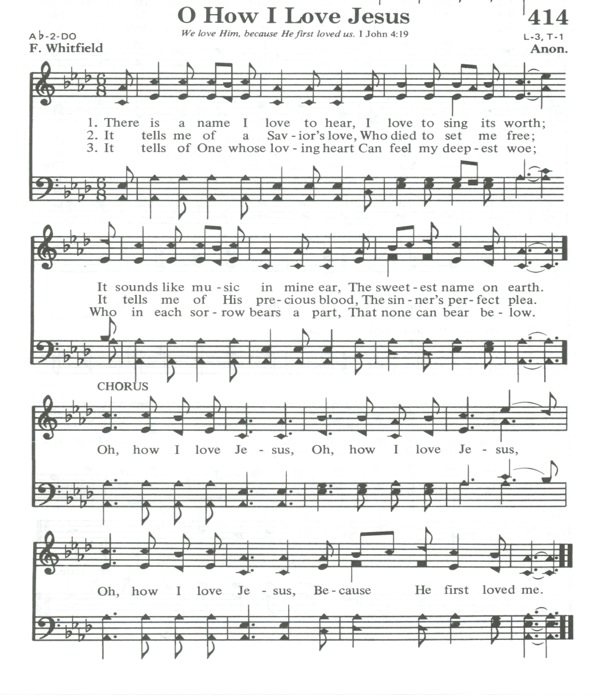
Unlike many of the more stately hymns that I have written about in this Sunday morning series, this popular hymn lacks the majesty of lyric as well as the almost classical melody of previous favorites. Nevertheless, I find myself coming back to this simple hymn often because of the power of simple words and the appropriateness of its common tune.

Frederick Whitfield (1829-1904), the author, was an English clergyman who left over thirty volumes of writings behind at his death. The tune is a simple American ditty; no one really knows when the lyrics and the tune came together, but by the turn of the century, it had appeared in several songbooks and was a favorite of Ira Sankey and Dwight Moody during their revivals.

When Sherrylee and I first came back from Germany and I needed to earn some extra money, a young man working on his Masters degree hired me to translate a very thick 19th century German theological book into English for him. It has been so long ago that I don’t remember the exact name of the book nor its author, but I do remember how much I learned about The Name of God and Jesus.

Not only do you see the great holiness of “The Name” in Old Testament verses like the following, but the power—almost a personification of The Name itself:

Exodus 3:15 – God also said to Moses, “Say to the Israelites, ‘The LORD, the God of your fathers—the God of Abraham, the God of Isaac and the God of Jacob—has sent me to you.’ “This is my name forever, the name you shall call me from generation to generation.

Exodus 9:16 – But I have raised you up for this very purpose, that I might show you my power and that my name might be proclaimed in all the earth.

Exodus 23:21 – Pay attention to him and listen to what he says. Do not rebel against him; he will not forgive your rebellion, since my Name is in him

Leviticus 22:32 – Do not profane my holy name, for I must be acknowledged as holy by the Israelites. I am the LORD, who made you holy

2 Samuel 7:13 – He is the one who will build a house for my Name, and I will establish the throne of his kingdom forever.

I Kings 8:17 –My father David had it in his heart to build a temple for the Name of the LORD, the God of Israel.

I Kings 11:36 – I will give one tribe to his son so that David my servant may always have a lamp before me in Jerusalem, the city where I chose to put my Name.

Psalm 91:14 – “Because he loves me,” says the LORD, “I will rescue him; I will protect him, for he acknowledges my name.”

Daniel 9:19 – Lord, listen! Lord, forgive! Lord, hear and act! For your sake, my God, do not delay, because your city and your people bear your Name.

Matthew 18:20 – For where two or three gather in my name, there am I with them.”

John 14:14 – You may ask me for anything in my name, and I will do it.          

Even our baptism needs the name of the Father, the Son, and the Holy Spirit (Acts 2:38).

There are those who have chosen to no longer close their prayers using Jesus’ name or to call the Name of Jesus at baptism. I am not one of them! They probably are trying innocently to avoid triteness or meaningless ritual, but having been sensitized to the power, the glory, the holiness, and the eternal magnitude of the Name of God-Jesus, I could never approach his throne without The Name.

And that is why I love this hymn and many more that exalt The Name.

There is a name I love to hear, I love to sing its worth;
It sounds like music in mine ear, the sweetest name on earth.

It tells me of a Savior’s love, who died to set me free;
It tells me of His precious blood, the sinner’s perfect plea.

It tells me what my Father hath in store for eve’ry day,
And tho’ I tread a darksome path, yields sunshine all the way.

It tells of One whose loving heart can feel my deepest woe,
Who in each sorrow bears a part, that none can bear below.

Oh, how I love Jesus, Oh how I love Jesus,
Oh, how I love Jesus, Because He first loved me

“Nevertheless, that time of darkness and despair will not go on forever.” 

WHEW!  Have you ever been miserably awake in the night—perhaps sick or afraid or distraught—and you long for sleep just to escape the pain, but the darkness, the night goes on forever!  I know that is why morning sunrise has assumed symbolic status as resurrection, rebirth, and emerging hope—any hint of light is promise of escaping the darkness.

Thank you, Isaiah, for this first light of the morning!

Isaiah is often called messianic because so many of his prophecies announce the one who brings hope and salvation to Israel.  Just in the first eight chapters, you have certainly recognized Isaiah 2:2-4 “He will judge between the nations . . . .They will beat their swords into plowshares . . . ,”   and Isaiah 7:14 “The virgin will be with child . . . .”and as we read through this book, we will find many more, including one of the greatest today in chapter 9.

In this chapter, Isaiah joyfully announces the Light coming into the world: “The people who walk in darkness will see a great light. For those who live in a land of deep darkness, a light will shine”(v.2). If he has choked with the message of wrath because of the sins of Israel, now his words must have been sweet to his lips.

Christmas!

For to us a child is born,
    to us a son is given,
    and the government will be on his shoulders.
And he will be called
    Wonderful Counselor, Mighty God,
    Everlasting Father, Prince of Peace.
Of the greatness of his government and peace
    there will be no end.
He will reign on David’s throne
    and over his kingdom,
establishing and upholding it
    with justice and righteousness
    from that time on and forever.
The zeal of the Lord Almighty
    will accomplish this.

Notice the us in the first two lines! Who is that but the people of God. Just last night we were looking at baby pictures of our friends in New Zealand who are celebrating their first grandchild. Didn’t you feel humbled, blessed, overwhelmed by the gift of your first child? You know the biology of conception, but the resulting little baby and the perfect joy that surrounds it just can’t be completely explained by the physical mechanics.

And this child announced in Isaiah 9 is even more . . . . He will establish a great, eternal community of peace, using justice and righteousness to establish it.

But where is this peace and justice and righteousness?  It doesn’t look like the world I see on CNN!

Isaiah is extending this hope to a people ravaged by their own corruption, their own fears and faithlessness, and who are even using the occult to find some relief from their pain.  To them—and to us–he is saying, when you see peace and justice and righteousness in the world around you—even momentarily, it is the light breaking into the darkness.  And just as morning follows the darkness, so the Dayspring has broken into this world’s despair in the real presence of this child.

The zeal of the Lord will accomplish this! (v.7)

If you can believe that, then you have hope. If you can’t believe that, you have no real choice but either to sink below what Francis Schaeffer called the “line of despair” or to delude yourself that there is no evil, no real unhappiness in this world.

If you can believe that to us a child is born, then you’ll break out into something like Handel’s Messiah and sing the many names of this child:  Wonderful, Counselor, Almighty God, Everlasting Father, and Prince of Peace.

The rest of chapter 9 deals with those people who “have not returned to him . . . nor have they sought the Lord Almighty”(v.13).  Go ahead and read the terrors that face those who have not returned to him.  I don’t think you will enjoy it.

And then make your choice! We all make our choice whether to revel in the joy and happiness of 9:1-7 or to stubbornly refuse God and live in 9:8-21.

PS> Would you like to listen to one of the most beautiful pieces of music ever written, taken from this chapter and celebrating the Prince of Peace:   Click here!