Feeds:
Posts
Comments

One of the sweet traditions that has all but disappeared in the last twenty years in many of our churches is the singing of morning and evening hymns.  If you don’t know what I’m talking about, then you probably worship in a little more contemporary church with no Sunday night service.

This is not a doctrinal issue or a matter of salvation, but it feels a little like it must have felt to give up eating food you grew in your own garden, or playing checkers with your friends at the courthouse, or watching Gunsmoke every Sunday night after church.  Some traditions were just sweet.

Here are some of my favorite morning hymns:

  1. Early My God Without Delay I Haste To See Thy Face
  2. In the Hush of Early Morning
  3. Again the Lord of Light and Life Awakes the Kindling Ray
  4. Awake and Sing the Song of Moses and the Lamb
  5. Holy, Holy, Holy, Lord God Almighty, Early in the Morning Our Songs Shall Rise to Thee

Of course, these specifically morning hymns blend with the great songs of praise that were opening calls to worship, mostly for morning worship:

  1. O Worship the King
  2. Come Thou Almighty King
  3. Joyful, Joyful, We Adore Thee
  4. All Creatures of Our God and King
  5. Come Ye That Love the Lord
  6. All Things Praise Thee  (also, For The Beauty of the Earth)
  7. Praise God From Whom All Blessings Flow

But nothing compares to evening hymns, the ones we not only sang at church but at retreats—and summer camp.  Every night at camp we would go to a different spot after dark, look up at the stars that none of us city kids could ever see, and sing one of these songs

  1. Abide With Me Fast Falls the Eventide
  2. Now the Day is Over (great tenor and bass parts)
  3. Softly Now the Light of Day
  4. Be With Me, Lord
  5. Savior, Breathe An Evening Blessing –  my very favorite!

James Edmeston wrote this last hymn sometime around 1820. There is a story told that during the Boxer Rebellion in China between 1898 and 1901, which was an uprising to root out imperialism and Christianity and when many thousands of Chinese Christians and foreign missionaries had been massacred, this hymn was sung as missionaries huddled together at night, worshipping God, but wondering if they would be alive in the morning.

Threatened with imminent death, the last verse must have taken great courage and faith to sing:

Should swift death this night o’er take us and our couch become our tomb . . . .

Here are all the lyrics:

Savior, breathe an evening blessing
Ere repose our spirits seal;
Sin and want we come confessing:
Thou canst save, and Thou canst heal.

Though destruction walk around us,
Though the arrow past us fly,
Angel guards from Thee surround us;
We are safe if Thou art nigh.

Though the night be dark and dreary,
Darkness cannot hide from Thee;
Thou art He who, never weary,
Watchest where Thy people be.

Should swift death this night o’ertake us,
And our couch become our tomb,
May the morn in heaven awake us,
Clad in light and deathless bloom

Of course, morning and evening hymns can still be sung suggesting symbolically the beginning and ending of life, so even without Sunday night services, I hope modern writers will draw on two of God’s most beautiful metaphors.

Smithfield Cemetery

Memorial Day used to be called Decoration Day in most places in the United States.  This annual event probably started as a memorializing of soldiers who fell during the Civil War, at first only the Union soldiers and then, a little later, even the slain Confederate soldiers.  Somewhere around the beginning of the 20th century, the general public adopted the event for their dead loved ones, regardless of military experience.

I had about twenty minutes to kill yesterday before my haircut appointment, so I decided to walk through the cemetery that abuts the parking lot to the hair salon.  The sign says “Historical Smithfield Cemetery,“  a notice that piqued my curiosity about why it was historical.  I found two graves of interest to me. The first was the grave of Eli Smith, recognized as the donor of the land for the church and cemetery and for whom the original town of Smithfield had been named.  The second I stumbled upon, but was glad I did, was for Clarence Cobb , “The barber of Smithfield for 65 years” as the marker read.

“Barber” Cobb cut my hair for all of my teenage years. I would ride my bicycle to Smithfield, walk in his little barbershop, get my burr haircut (we call it a buzz now, I think), get my neck shaved with the strap razor, and talk local baseball.  Good memories of small, insignificant moments—maybe that is what Memorial Day is about.

Memorial Day is not really a religious holiday, like Christmas or Easter–it’s more like Veterans Day—but maybe it should be!  How should Christians feel about those they have buried?  I’ve long felt like our tradition does not have a very highly developed theology of death.

At most we do some lip service to deceased Christians resting in Abraham’s bosom, drawing on Jesus’ teaching on the rich man and Lazarus (Luke 16:19ff).  We certainly believe in the resurrection of the dead, but are uncertain about how physical that resurrection is.  We believe and preach eternal reward and eternal damnation, but we can’t really imagine either and both bring with them divisive questions.

I experienced one of the more shocking expressions of Christian theology in Germany during the 70s when the son of our landlord was killed in a car accident.  Shortly, thereafter, his father died of lung cancer inside the ambulance outside of our office.  We attended both funerals at the local protestant church (Evangelische Kirche), and in neither funeral was there mention of resurrection or heaven; the deceased live only in the hearts of their loved ones.

Is Memorial Day only about our memories of the dead?  Are our loved ones and those we honor still dead in those coffins under the ground upon which we stand?

I’ve come to believe very strongly and very literally in the words Jesus spoke to Martha, “The one who believes in me will live, even though they die; and whoever lives by believing in me will never die“(John 11).

What a difference it makes if we believe the deceased are alive! 

If the dead are alive, then

  • Perhaps we should view death as a transition from life to life– not such a big transition–one completed with no significant loss.
  • Perhaps we should view dying as more of a “laying off” or a “putting down” rather than “being robbed.”
  • Perhaps we should not mourn as those who have no hope.  We do not mourn that a planted seed will be transformed into a beautiful flower. We do not mourn the loss of a precious seed because we know that it was intended for planting (1 Corinthians 15:35-44).
  • Perhaps we should be more aware that the Body of Christ lives, including those members who no longer live with us!  The saints and witnesses of Revelation are all quite active in the plan and will of God, working on behalf of the saints and witnesses who breathe.
  • Perhaps we would be less afraid, knowing that Death has lost its sting.

Because “the last enemy to be destroyed is death” (1 Corinthians 15:26), Memorial Day is safe and secure, as are the funeral homes and cemetery owners.  Our appointment with dying is unavoidable.

But  what would be different for you if on this Memorial Day, you remembered that those by whose graves you stand are alive—very much alive?


Her name was Joyce Blackman Johnson, but everyone except her one still-living brother called her Joy—and rightfully so.  Sherrylee and I named our third child Emily Joy after her!  Emily and Tim named their oldest daughter Anna Joy.  Our family benefits from a lot of Joy, and most of the story began with Joyce Blackman Johnson—Granny Joy.

Joy Johnson and her family (1996)

Blessed are the dead . . . . (Revelation 14:13).   We non-Catholics usually want to finish the preceding verse in order to encourage living well until the very end of our lives.  The catholic and orthodox churches have a much more highly developed awareness of the dead saints, soliciting from them whatever form of intercession is still available to them on our behalf. If we ask living saints to pray for us, and if we believe in life after death, then it really doesn’t seem so far-fetched as I may have believed to ask for the prayers of saints on the other side as well.

Fifteen years ago yesterday, we buried Joy Johnson.  After a long and lingering time of dying, she passed peacefully in her sleep on the night that our Emily Joy graduated from high school.  The family gathered quickly in Columbus, Mississippi, where she and Max had served the church for many years. We buried her under an old tree in a new part of the old cemetery in Columbus, the one known for its Civil War graves.  We buried her on her 70th birthday.  The dogwoods were in full bloom; the day was beautiful.

And Joy was perfected—by the grace and mercy of her Father.

Joy had known she would die soon for quite some time. Her cancer had made it impossible for her to eat and properly digest food. The doctors operated once hopefully, but when the cancer recurred, they said that further intervention would not be effective. So Joy said she wanted to go home.

She lived the last two months of her life with unforgettable faith and confidence that nothing bad was getting ready to happen, rather that for which she had lived her life.  None of us will ever forget the day we all went to the funeral home to make final arrangements.  Yes, of course, Joy was with us. She would never have let us go without her!

We first picked out the casket, not the most expensive, but the one with the right color lining that would not clash with the blouse that she had already chosen to wear!  Chuck, a lay Baptist pastor who also worked at the funeral home, unfortunately tried to change her mind on the blouse color—bless his heart—but immediately bumped into the determined strength that characterizes all the Joys that I know! He will be forever know in our family lore as Chuck, the Baptist, bless his heart!

After settling everything at the funeral home, Joy and her daughters went to a little boutique in Columbus to shop for a scarf for her to be buried in.  “Good morning, Miss Joy” the nice lady at the store said. “How can we help you today?”

“Well, I’m looking for a scarf that will go with an accrue blouse as well as the coffin lining that I’m going to be buried in. Can you help me?”  The poor lady did her best not to gasp, but she was obviously a lot less at ease than Joy was with her imminent death.

As she grew smaller and weaker, so many people came to visit her. The hospice nurses would sometimes stay much longer than required, just to visit with Joy.  The Pentecostal neighbors came to try to heal her—and Joy, completely confident that God had another kind of healing in mind, nevertheless allowed their expressions of love and faith—although she did kind of roll her eyes when they weren’t looking.

Max and her children surrounded her in her last days as delirium began to take over—but even then she gave us some terribly funny moments.  Once Max and Phil were trying to change her sheets and accidentally rolled her out of the bed! After they got her back in, she said, “Max, am I in hell?”

Her most common delirious thought was that she had already died and was at her own funeral. Sherrylee played some beautiful Taize music on the CD player, thinking this would soothe Joy’s spirit, but after a while, Joy, only half-conscious, calls out, “Max, Max, I didn’t really want Catholic music in my funeral!”

She also thought that every time the doorbell rang, that someone was bringing a casserole to the funeral!  She was quite concerned that we had way too many casseroles.

On her final day, she woke up at some point feeling great! She sat up in bed and said, “Max, let’s call the doctor and tell him that I’m well!”  Then she said she wanted to sing, so she launched into all the verses and chorus of “I’m Pressing On the Upward Way” – which some of you will remember. She sang it all, ending with “Lord, plant my feet on higher ground!” and then she lay down, closed her eyes, and did not wake up again until she was with God.

Fifteen years ago, her Father planted her feet on higher ground. We miss Joy, but she is still very much with us.  The dogwoods are blooming in Mississippi again, but she is not there! She’s laughing and singing, saved by His grace, but bringing Him glory.

Blessed are the dead who die in the Lord  . . . .


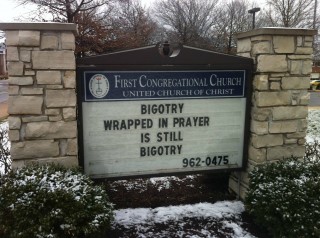
The word bigot is a terrible word.  For me, it is in the same category as maggot, or phlegm, or vomit!  Those may be a little more sensory than you are comfortable with, but what about the racist N… word or the F… word for homosexuals?  Some words evoke so much emotion that to use them carelessly can damage others and to use them intentionally can be immoral, sometimes illegal.

A common dictionary defines bigot as a person who is “obstinately or intolerantly devoted to his or her own opinions and prejudices, especially one who exhibits intolerance or animosity toward members of a group.”  The etymology is a little shadowy, but some suggest the root of the word may have been “by God,” or the mocking of that phrase by those who resented others using it.  In any case, the word has been around since the 12th century—and people who acted with intolerance or animosity toward others even longer!

Are Christians who oppose same-sex marriage guilty of bigotry?  Piers Morgan, who certainly can be seen as representative of a certain mindset in the American population, suggested the Rick Santorum, a practicing Catholic, was a bigot because he held to the teachings of his church that homosexuality is a sin.  Santorum made very clear that he did not feel it was government’s place to regulate morality for all citizens, but that did not keep Morgan from using the B..word!

I wonder if we could agree that it is not bigoted to just hold opinions?  I wonder if we could agree that within our working definition of bigotry that it is the words intolerance and animosity that give the odious smell to the word?

Was Jesus a bigot for saying that a man who lusts after a woman has committed adultery with her in his heart (Matthew 5:28)? In the same lesson, he says it is wrong to commit murder or to be angry and hate another person. Is that intolerant? (Matthew 5:21-22).

Was Jesus a bigot for saying that adultery is a sin? Or that divorce for frivolous reasons is not God’s Will? Or that not only breaking an oath, but anything other than a truthful Yes or No is not godly?

Was He intolerant because he said not every teacher is a good teacher, that some are wolves in sheep’s clothing (Matthew 7:15)? Or that those who simply call out to God without the prerequisite obedience will not enter the kingdom of heaven (Matthew 7:21).  Shouldn’t everyone get a trophy?

Was St. Paul intolerant and bigoted when he says that it was immoral and wrong for a man to sleep with his father’s wife (1 Corinthians 5:1-2)?

If today a minority group banded together to insist that all loving sexual activity between consenting adults was moral and should be allowed by law throughout the nation, including—as the opponents would certainly point out—prostitution, incest, sibling marriage, cousins marriage, and polygamous marriages, would we relegate St. Paul  to bigotry.

And if I haven’t yet touched anything that you hold a strong opinion on in any of the above paragraphs, anything that crosses your moral line and where someone else might be more liberal than you, how would you feel about wearing the bigot label?

Having said all of the above, I do believe there are bigots among us—on all sides. I’m appalled by bigotry among Christians like the Westboro Baptists who appear to me to cross over unequivocally into bitter intolerance and animosity.

I was reading a great story yesterday about a 9-year-old boy in Topeka, KS who with his mother happened to come upon a Westboro Baptist group picketing with hateful signs. He looked up at one picket sign that said, “God hates F….s”  According to his mother, he immediately ran back to the car and made his own crude, but profoundly true response to the sign.  His sign said, “God hates No One!”

God hates sin, but Paul says—yes, the same one who opposed incest:  Very rarely will anyone die for a righteous person, though for a good person someone might possibly dare to die.  But God demonstrates his own love for us in this: While we were still sinners, Christ died for us. (Romans 5:7-9)

Christians cannot but hate sin as God does, but we must be just as loving of sinners, and we must demonstrate our love by letting mercy triumph over judgment! (James 2:13)


Those who risked responding to my blog on same-sex marriage with differing viewpoints did us all a favor by kindly but clearly raising cogent arguments supporting same-sex marriage.  Neither Christians nor non-Christians should fear open and honest conversation; rather, I hope that we can all “speak the truth in love.”

In John 9 when Jesus heals the man born blind, Jesus’ disciples did not really see the blind man as Jesus did. They saw a theological problem: who sinned, this man or his parents?  They might have continued their conversation while walking right by the man himself.

Jesus, however, saw a person in need of healing, both physical and spiritual, for the glory of God.  I try to remind myself that in all of these difficult conversations, we are talking about our neighbors, our family, our church members, about classmates, co-workers, about people whom God loves!  That helps me with my tone of voice when responding.

But the love of Christ compels us (2 Corinthians 5:13-15) to speak and to say what God would say because “Since we believe that Christ died for all, we also believe that we have all died to our old life. 15 He died for everyone so that those who receive his new life will no longer live for themselves. Instead, they will live for Christ, who died and was raised for them.” I believe; therefore, I speak out.

So let me extend the conversation in response to those comments:

Argument:  Christians should not force Christian views on non-Christians.

Response:  I agree completely.  God doesn’t force people to believe, Jesus did not force people to follow him, and those who follow Him should not either.  However, my counter-question is how should it work in a democracy or representative government as we have when the political question involves what Christians believe to be a God-revealed truth?  Can only non-religious people have a seat at the table? Can only non-Christians campaign and vote on these issues?  Why are Christians who speak out and vote according to their faith “forcing” their views on non-Christians? And should any majority OR minority group, simply because they believe their cause to be moral and right, be silenced,  be segregated, be harassed, or be hated?

Argument: Marriage is a civil institution, not a religious one; therefore, the definition of marriage can and should be determined by the State.

Response:  I agree and disagree with this argument.  There is certainly a civil aspect to marriage. The State (and I am not using that term pejoratively) regulates the societal aspects of marriage in many ways, such as:

  • Who can get married?  Not 10-year-olds, not siblings, not people currently married, etc.
  • When can people get married? Some states have waiting periods; some require blood tests, etc.
  • Who can legally perform weddings? Some states allow anyone; others require ordained ministers and/or particular government officials.
  • Which marriages are recognized?  If you marry in a foreign country, the U.S. may not recognize your marriage. This is regulated by federal law.

In my opinion, everyone—including Christians—should “render to Caesar the things that are Caesar’s.” We all should submit to the legal authorities in every way with one exception, and that is, if required by law to violate the higher laws of God.

But I also disagree that marriage is only a civil institution. Marriage precedes the existence of civil states.  Marriage exists outside of political states.  For example, I was just watching “Finding Your Roots” with Henry Louis Gates, Jr., who discussed the fact that prior to the Civil War in the United States free African-Americans could marry legally, but slaves could not.  He continued to say, however, that, of course, slaves did marry, but that it was not recognized by the State.

Marriage, according to Jesus (Matthew 19:6) is God joining people together.  The earliest biblical revelation states that the reason for marriage was that “The Lord God said, ‘It is not good for the man to be alone. I will make a helper suitable for him.” Adam was meant for Eve and Eve for Adam.  No legal ceremony occurred, only God joined them.  And the writer goes on to explain that because of God’s actions in the beginning, future men who marry will “leave his father and mother and be united to his wife, and they will become one flesh. (Genesis 2:18,24)

I also believe all of the references describing Jesus as the bridegroom and the church as His bride made repeatedly from Matthew to Revelation are witnesses to the holy nature of marriage. And the metaphor is consistent with the Genesis passages and the words of Jesus in that only God joins people to Christ. We are born again, not by human will but by the will of God (John 1:13).

This is the “holy” side of marriage that Christians want to preserve.  Of course, they carry those convictions into the political discussion—and don’t they have the right to? They are just one voice, not the only voice, in the political debate.

Next we will talk about the argument that opposing same-sex marriage is bigotry—a very serious charge.

The President’s choice to come out for same-sex marriage disappoints me greatly, not really because of the politics, but rather because of what it says about the moral predicament in our country.  I am strongly in favor of equal civil rights for all Americans, regardless of their immorality, unless, of course they cross the line into criminal behavior—and even then, they should have equal access to the processes of law.

The poll numbers show an American public divided almost 50-50 on the issue. What really disturbs me even more than what the president did is that polls also show that 71% of 18-29 year-olds support gay marriage. I was pretty shocked one day in the LST office to hear a wonderful Christian young woman say, “I wish God hadn’t come down so hard on homosexuality!”   I suspect what these numbers show for young Christians (who certainly have to be in the 71% mix) is their sensitivity to social justice issues in conflict with what might appear to be the more restrictive biblical imperatives.

Before I write another paragraph, let me state that God so loved the world that He gave His Son!  God’s love is all-inclusive, me with my sin and you with yours.  And the Creator God who defines the essence of reality (Truth) by His Word has set homosexuality outside of that which is pronounced “Good!”  The question is not about choice, nor about love, nor about equal rights, but rather about submission.  The question for all of us is whether we live out “not my will, but Thine be done!”

I’m also disappointed in us for making the 50 Shades of Grey trilogy the best-seller on everyone’s list. Romance novels have always sold well, so that’s nothing new, but this particular trilogy seems to be a hit because of its kinky eroticism—especially aimed toward women’s fantasies apparently. I haven’t read it, but here just before Mother’s Day to have all the best-seller lists led by what the reviewers often refer to as “mommy porn” is a sad commentary on us!

Both of these phenomena are possible partly because we Christians have separated our physical bodies—including our sexuality—from our understanding of the image of God, the incarnation (God in us), and the indwelling of God’s Spirit¸ which makes our bodies a temple!

This skewed thinking probably starts as teenagers, when we are taught which sexual activity is right and wrong, but never hear anyone say that sex is for anything other than fun! And adults/church are always trying to keep kids from fun things, so how is sex any different.

I also firmly believe that we Christians have also completely removed the “holy” from holy matrimony.  Although held in church buildings, most of our marriages are secular services, sometimes with an occasional nod toward God who is sitting in the back of the auditorium.

Three things I would like to see:

  1. I’d like for our children to be taught that their bodies are the temple of God. I think once that is our predominant message, we will learn how to help them understand the implications for their life.
  2. Secondly, I would like to see us appear before the throne of God in our wedding ceremonies and not just come to the marriage altar and sign a legal document.
  3. And, lastly, I would like to see us re-mystify our sexuality, acknowledging it as a God-breathed gift, not only for our personal benefit, but because creating and loving is a reflection of God in us!  The oneness of sex is the same mystery as the oneness of God. The joy and pleasure of that oneness should be transcendent, not sado-masochistic.

I pray for the president; I pray for us.

After visiting Oxford, MS three weeks ago, I began reading William Faulkner again, specifically the Snopes trilogy (The Hamlet, The Town, and The Mansion). One of Faulkner’s recurrent themes is the legacy that one generation leaves to the next, so I shouldn’t have been surprised by a passage in The Town describing the Snopes, a pretty low-life clan that is gradually inserting itself into the well-bred society of post-Civil War Mississippi:

And then suppose, just suppose; suppose and tremble: one generation more removed from Eck Snopes and his innocence; one generation more until that innocent and outrageous belief that courage and honor are practical has had time to fade and cool so that merely the habit of courage and honor remain. . . .

“ . . . So that merely the habit of courage and honor remain!” Those are really frightening words.

The whole idea reminded me of something I came upon while studying about Puritans a number of years ago.  After fleeing from religious tyranny in Europe,  the early Puritans in America established theocracies in New England, that is, church membership and civil citizenship were the same. Both communion and voting privileges were denied the unbaptized and/or those not admitted to the church.

For the first generation of Puritans, the system worked well. Their children were baptized as infants and  full church membership was granted after their conversion experience, which all prospective church members were required to rehearse in front of the congregation.

Some slippage occurred between the first and second generations, but by the third generation of Puritans in New England, the lack of a personal conversation experience created an embarrassing and difficult situation both politically and religiously.  Because large numbers of these third generation Puritans had no personal conversion experience to relate, they could not be accepted into full church membership, so they could not vote as citizens of New England.

In 1662, only forty-two years after the Mayflower and the first pioneer Puritans landed in the New World, the colony leaders felt compelled to shore up both the church and the state.  Their solution was what was called The Half-Way Covenant, according to which the less-pious third generation could receive partial church membership if they simply agreed with the creed and accepted the covenant.  With this covenant established, the children of the Third Generation could be baptized in the church.

The hope of the Second and First Generation was that granting partial church membership would encourage participation by the Third Generation and keep them and their children from feeling excluded, resulting ultimately in their deciding to go for full church membership with a personal conversion.

Records from the time show the reduced requirements and the lesser call did not dramatically affect the personal piety of the Third Generation, a precedent from which we should learn.  In fact, the historical consensus seems to be that over sixty more years were needed for another generation of New Englanders to find personal faith.  Specifically, during The Great Awakening of 1730, these halfway measures were rejected out of hand and personal conversion became again a requirement for church membership.  The expectation of complete commitment was much more successful than meeting the hardly committed halfway.

Sherrylee and I are enjoying a few days in southern California with our daughter and her husband and three grandchildren—three generations of our family.  Can you see why I’m thinking about this third generation stuff?

The figures I hear are that half of our children who grow up in church with us will give up their faith within a few years of high school graduation.  If that doesn’t bother you, then you probably are a Third Generation and your children are a Fourth Generation group.  It really bothers me!

By the grace of God, our children not only have faith, but have married people of great faith as well.  I know they are teaching their children and taking them to church, but Sherrylee and I as First Generation of this family have committed to Second Generation to be an active part of Third Generation’s lives, so that they not only have every chance to choose Faith, but they have seen something in the lives of First and Second that they want as well.

They will not have seen us accumulate much; they will not see us with great fame or power; but they will see faithfulness—sincere faithfulness—that’s the best we Firsts can give to the Thirds that we love so much.

I do not want to appear in some long, future Faulknerian sentence that says,

And then suppose, just suppose; suppose and tremble: one generation more removed from Mark and his innocence; one generation more until that innocent and outrageous belief that faith and personal devotion to Christ are practical has had time to fade and cool so that merely the habit of faith and devotion remain. . . .

The 69th Pepperdine Bible Lectures were outstanding—again! In spite of my good intentions to post during the lectures, especially to keep you current on the class that I led, it was just impossible! Too many people, too many conversations, too many outstanding teachers to take in, and too much late night pie and coffee with friends!

I hope you believe in “better late than never,” because with this post, I’ll try to fulfill my intentions.

I had really wanted to post audio recordings, at least excerpts, from the two-day class which I led on “What’s New and What’s Needed in 21st Century Missions,” but I was stymied on two fronts: by technology from doing my own recording and by copyright issues as well, so the best I can do for you is to give you the link where you can purchase the CDs of the class http://www.purelogicvideo.com/page.cfm?pageid=13737.  They really should make it possible to download these files, but I didn’t see that option.

One of the reasons PBL has continued to thrive and grow while other lectureships have failed is because young preachers are given big platforms! 

Jonathan Storment, a friend and the terrific young preacher for Highland in Abilene, opened the PBL on May 1. Jonathan has always been a dynamic and entertaining speaker, but the depth and courage that he now brings with his preaching is a special blessing to those who hear him.  Aaron Metcalf and Josh Ross are two more younger preachers who keynoted before any of the older, established speakers were given the pulpit.

Almost 250 classes are held during the three full days of PBL.  And the range is from textual to philosophical, from field reports to marriage/family, from the best known teachers like Randy Harris, Mike Cope, Rick Atchley, and Jeff Walling to the fully unknown but people with something important to say!

“Lively” would be the word I would choose to describe our class.  I invited Dr. Dan Bouchelle, President of Missions Resource Network, and Dr. Dan Rodriguez, professor of Religion and Hispanic Studies at Pepperdine, to join me in discussing issues surrounding foreign missions in churches of Christ.  We had a great time talking about each other’s ideas.

I’ve given you in the last post the summary of what I was going to deliver. Dan and Dan responded to my ideas and contributed their own. Dan Bouchelle suggested that while I addressed the current situation in American churches creatively, that perhaps I had not addressed the deeper problem that our churches as a whole must become more deeply and completely missional before they will do foreign missions well.

In addition, he said that for the 21st century, we Americans must surrender our patriarchal attitudes toward foreign missions and become co-workers, partners, with existing foreign churches who will more likely know what their part of the world needs better than we Americans could conceive.

Dr. Dan Rodriguez also supported the general tenor of my suggestions, but his personal message was that American churches need to cooperate with each other enough to strategically reach into parts of the world that no single congregation will probably ever have the resources to penetrate—especially those countries in the 10-40 window, which contain the fewest Christians and the largest portion of the world’s population.

I really appreciate so much what both of them said, and they were both quite kind to my rather subversive suggestions regarding the way we do foreign missions.  Don’t forget that you can get the entire discussion through this website: http://www.purelogicvideo.com/page.cfm?pageid=13737.

Dr. Jerry Rushford

Without question, the most spectacular moment of the lectureship was the last night when Dr. Jerry Rushford, director of the PB L for thirty years, passed the baton to his successors Mike Cope and Rick Gibson.  As President Benton said, Rushford could have chosen any number of career paths; a historian, a writer, a preacher, or a professor. But very early in his life he chose to direct the lectureship because he saw a chance to effect a whole fellowship of Christians.

For thirty years, he has been encouraging new preachers by giving them a chance to be heard; he has given foreign preachers and missionaries a classroom or a stage to expose American churches to the needs of the world; he has provided a stage where issues could be discussed with love and respect.

Thank you, Jerry Rushford, for a lifetime of serving the Kingdom in a way that few could have taken to the mountain tops as you have.  And thank you for leaving the Bible Lectures with integrity, passing it on to men of great heart and stature in our tradition.

The theme for next year’s lectureship (April 30-May 3) is “Can I Get A Witness? Faithfully Following the Lamb in Revelation” and promises continued excellence.

I hope to be there. Won’t you come too?


Sherrylee and I are leaving Seattle tomorrow for Malibu and the Pepperdine Bible Lectures. PBL is the last great Christian college lectureship among Churches of Christ. The main force  behind the lectureship for almost three decades has been the director Dr. Jerry Rushford. This is his last lectureship; he has passed the baton to Mike Cope and Rick Gibson, who assume the responsibility for the future of PBL.

I think they will do a great job, but maintaining the quality while updating the format is a daunting challenge. As great leaders should, they have already begun asking and receiving input from a broad spectrum of people who have vested interest in the welfare of the lectures. 

I pray they do well. We need this forum for our conversations.

Dr. Dan Rodriguez

On Wednesday, we will be discussing the current state of missions among Churches of Christ, and on Thursday, we will go forward to what Churches of Christ need to do to have effective mission efforts in the next fifty years.  I think it will be an exhilarating conversation with these men who are passionate and informed about missions.

Dr. Dan Bouchelle

I hope to provide at least a summary of the two classes on Wednesday and Thursday for you to read—perhaps even an audio file for you to be able to listen, but today I thought I would give you a copy of the handout I will use on Wednesday.  You’ll recognize it as a summary of the blog series I did on “Re-Thinking Mission Work.”  If you want more explanation and detail to flesh out these thoughts, you can find that series in the side panel.

Even if you can’t come to the Pepperdine Bible Lectures, I hope you can enjoy a portion of it vicariously through these next posts. 

Overview of ”Re-thinking Mission Work in Churches of Christ”

By Mark Woodward

The current model for sending, supporting, and overseeing missionaries from Churches of Christ needs to be re-thought for the following reasons:

  1. The selection process is mostly self-selection with only minimal help from experienced missionaries or those who have skills or information that could guide the selection process.
  2. The choice of mission sites too often is an uncoordinated, non-strategic choice with little input from experienced or engaged persons.
  3. The preparation for mission work, if any, is not readily available for most people who would like to become missionaries.
  4. The support gathering system among Churches of Christ not only discourages the vast majority of potential missionaries from even beginning, but also most of those who do attempt to work their way through it.
  5. The “sponsoring church” system neglects spiritual oversight, is occasionally about strategic oversight, and mostly about financial oversight.
  6. The role of either elders or general mission committees to oversee missionaries/mission churches puts the decisions about mission work too often into the hands of well-intentioned people who have little or no personal experience in missions, and little or only secondhand primary information about how to do missions.
  7. The relationship between the missionary and his/her overseers is generally an employer/employee relationship with financial arrangements being the most important control mechanism.

Some of the changes that I would like to suggest that Churches of Christ implement in order to change our paradigm for missions.

  1. Mission committees should be restructured to have as their sole responsibility, implementation of strategies for raising up and surfacing  missionaries from their congregation.
  2. Hopeful missionaries should be expected to seek experienced and skilled help, either inside or outside of their home congregation, for making all of their First Decisions (Should I be a missionary? Where should I go? Who should I go with? How should I prepare?)
  3. Primary oversight of a missionary should be in the hands of Christians who know the person intimately and care about the proposed work, who likely are even personally involved.
  4. Every Missionary Hopeful should be expected to spend two years in an apprenticeship on the field with a Master Missionary before they are supported to work independently.
  5. Financial support and oversight control need to have more separation, so that both are in the hands of Christians who love the missionary and care about the work.

You can read the expanded blog articles on “Re-Thinking Mission Work” at www.markwoodward.org.

Four hours until we land in Chicago.  We were not scheduled originally to fly through Chicago, but when we got up this morning, we found the notice that our flight to New York from Rome was delayed two hours, meaning that we would certainly miss our connection to Seattle, which is our next stop.

With the cost of making international calls via internet now affordable, I turned on my own mobile phone, called the American Airlines  US office and rescheduled us through Chicago.  No problem—as they say all over the world!

Because Sherrylee and I spent our first Thanksgiving together in Germany in 1971, to call home, we went to the Post Office, informed the clerk that we wanted to make an international call, gave him the number, and then stepped into a special telephone booth in the office to wait for the call to be placed.

In a minute, our phone rang—no ringtones then—and her parents were on the other end. We talked for eight minutes, part of which was taken by Sherrylee asking her mother which end of the turkey to stuff. I remember vividly paying over $50 for that phone call, which, as a point of reference, was exactly what we had been paying monthly for rent at our first apartment.

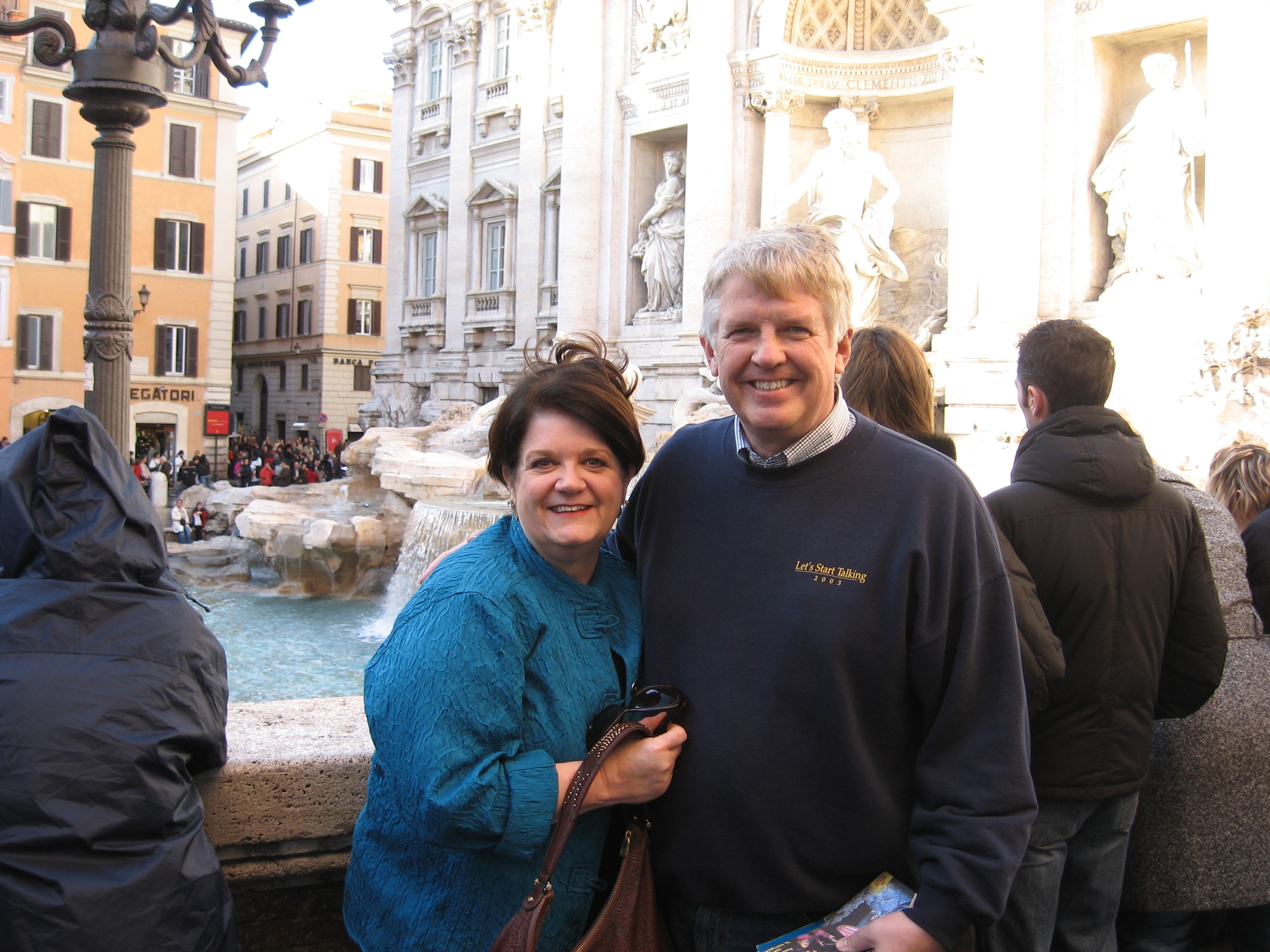
I’m glad we came to Italy.  Our Rome to Florence flight took a bit longer because our plane was diverted to Pisa because of high winds.  I thought I might catch a glimpse of the leaning tower as we landed, but no such luck.  By the way, if you ever go there, the baptistery in front of the church in front of the leaning tower may be the most interesting structure to visit.

The same is true in Florence where the Baptistry of St. John  is a must visit.  As it was explained to us, these early medieval churches built their buildings to reflect their theology. A large building would be built, large enough for a very large pool of water into which you went down and walked out of to be baptized. This building not only would be highly adorned and appropriately decorated, but often the artwork—or so it appears to us—was really the medieval version of Powerpoint slides thrown onto all the walls and ceilings for instructional purposes. The art of baptistries tends towards the stories of God’s redeeming work , which seems highly appropriate to me!

But the theological lesson continues. The baptistry would always be built outside of the church, but not too far from the front door!  So in Florence,  one would be baptized, exit the building through the famous doors called the “Gates of Paradise” and then walk into the church as a new-born member of the Body of Christ, straight to the altar to participate in communion.  The theological instruction for the new Christian is unavoidable!

Makes me wonder about our baptistries?  I’ve seen baptistries under trap doors under the pulpit! Then there are those high above the pulpit—or low and over on the side behind a curtain.  In fact, almost all of ours are behind a curtain. What does that say??

We had about an hour of wandering in Florence before we met two missionaries from Ancona, Italy, who rode a train several hours both ways to meet with us. Brian and Kyle have been part of a team, which has worked in Ancona for the last ten years. Wonderful guys who didn’t know that much about LST, so we spent some time together talking about possibilities.

Our second day in Florence, we had a delicious lunch with Mike and Anto Mahan and their two children. They have ministered to the Church of Christ in Prato, just outside of Florence for many years and have hosted many mission interns over the years, but will host their first LST team from York College this summer.  We like to meet personally with new hosts to make sure everyone has the same expectations.

After rushing to the airport this morning, then, to catch the flight to Chicago, which left an hour earlier than the New York flight, just enough time remained before we needed to go through passport control and security to meet with Andrea and Heather Gentile, a great couple who are part of a team planting a church outside of Rome. He is Italian and she American; in fact, their teammates are of the same configuration.

Sherrylee and I have the best job in the world. We get to travel to Scotland, Ukraine, Greece, and Italy, meeting with local Christians, U.S. missionaries, national evangelists; we get to listen to them tell excitedly about their work; sometimes we get to encourage them ; we always pray with them.  We talk about the Kingdom of God and what we might be able to do together to bring glory to God!

The churches we have visited this time battle for God in fields, where the spiritual warfare is vicious. But we must never forget that even in Europe, we are more than conquerors!