Feeds:
Posts
Comments

Day 1: Arrival

What is the first image you see when you get off the plane in Israel?

The whole transatlantic trip yesterday was quite uneventful—which is exactly the way you want it to be.  Sherrylee and I had arrived at the airport in DFW two hours early, and it paid off. When we got to the ticket counter, we checked on the possibility of upgrading to business class in exchange for mileage. The airline agent was very helpful, but it took over an hour to make it happen, but it did!

The ride across the Atlantic was a little bumpy, and the movie selection was not exciting (Captain America  and Green Lantern). I did finish the book I was reading Moneyball, which I found fascinating. The book is so detailed that unless you are a hardcore baseball fan like I am—and, yes, I’m still wearing black for the Texas Rangers—you probably want to stick to the recent movie release Moneyball with Brad Pitt. I haven’t seen it yet, but it has been highly recommended to me.

We arrived early in the morning in Frankfurt, rested for about four hours, stored our winter suitcase in the hotel luggage room as planned, and then headed back to the airport to check in on El Al, the Israeli national airlines.

I’ve been fascinated with El Al, since all the trouble of the 70s and 80s, with hijackings. During the 80s, there was actually a small bomb in the Frankfurt airport which was left near the El Al ticket counter, so for thirty years now I have had a mental note not to spend any time near their counters in foreign airports.

El Al has the reputation for the highest level of security, but I have always been thankful for security, so other than waiting in a couple of more lines, the extra security was just as it should be—effective!

The loading/unloading ramps in many airports now have lots of advertising. I love the Chinese bank that puts pictures comparing cultures: a squid in one culture is YUK and another YUM!  A cricket in one culture is GOOD LUCK and another culture A PEST! But that was not what was on the ramp when we walked off the plane in Tel Aviv!

I expected perhaps a picture of Old City Jerusalem, or a menorah, an ancient church, or the Dead Sea—something representing the deep, deep religious and cultural heritage of this country.

No, the first image on the wall across from you as you exit the plane is a big golden BUDDHA! In Thailand, yes, but not Israel!  Because it was all written in Hebrew, I don’t even know how the picture was being used, but the incongruity was unnerving!

Fortunately, I found equilibrium again after meeting our tour guide Nabil and our driver Omar. Before we were even outside of the airport, Nabil turned and said, “Are you a Christian?”  I said, “Yes.” I returned his question, and he said, “Yes, I am a Roman Catholic, born in Jerusalem.” Apparently his family has been Christian as far back as he knows. Today I want to find out what it is like to grow up Christian in Israel.  Nabil went on to describe himself as a Palestinian Arab Roman Catholic Christian with Israeli citizenship.

Do you know the word syncretism?  If I had internet connection now—which I don’t—I’d link you to the definition, but its basic idea involves the blending of diverse cultural or religious elements in a particular culture.  This may be the word that explains Buddha and Nabil—I don’t know yet, but that is one of the things we will watch for on this trip.

It’s 4am, and I’m sitting in the bathroom because I’m jetlagged and don’t want to wake Sherrylee up by turning on the light.  I think I’ll go back to bed and see if I can catch a couple of more hours of sleep before we start our tour of Galilee today!

Shalom!

Eight hours until departure—that is, six hours until we leave for the airport! Sherrylee and I are pretty well packed for our twenty-seven-day trip—just our toiletries to add after showers this morning!

We have two carry-on suitcases, one school-size backpack, and one purse to carry on the planes. In addition, we have packed one “winter” suitcase because we are going to be in relatively warm countries for the first two weeks, but the last thirteen days will be in northern Europe where it will definitely be winter. That winter suitcase has Sherrylee’s boots and our winter coats.

The winter suitcase is possible because we have a seven-hour layover in Frankfurt on our way to Tel Aviv. We like it that way because when you land in Frankfurt at 7am, it is really only midnight “body time”. So we have taken a dayroom at a nearby hotel where we can sleep for five hours before flying on. The added benefit is that I will put our winter suitcase into their luggage storage for free and then pick it up when we come back through two weeks later.  You can store luggage at the airport as well, but it costs something like 5 Euro per day per bag. I’d rather apply that 60 Euros to a few hours sleep and a hot shower!

Last Minute Decisions

Do I take my computer or just my smartphone?  I do have a phone that will work wherever we go, and we use T-Mobile because it is a very common carrier in and around Europe, so taking my phone is a given.  You do have to watch how you use it though because it is expensive to do two things with it: make phone calls and use the internet!  We use it primarily for unavoidables or emergencies. I don’t answer it if I don’t recognize the person calling. I’m not going to pay 2-3 dollars to hear some pre-recorded telemarketer!

But I do use it to scan my email each day and see which ones need to be addressed quickly! I used to carry my laptop computer for this, but if email were all I needed a computer for, I would leave the computer at home.  I don’t like the extra hassle at the airports, the problems with logging in at hotels, nor the weight in my backpack.

BUT, just for you I am taking it this year, so that I can blog more easily! I tried last year using hotel computers, but did you know that many countries have different keyboards—a real pain! And often, at least in the hotels where we stay, there are only one or two computers and they won’t let you tie them up for an hour at a time.

To help avoid lots of computer time though, I have been downloading several apps to my smartphone (Android) especially for this trip.  Kayak is a great search engine for travel, so that is now mine! I also downloaded Priceline’s app because I still have to make hotel reservations for the last part of our trip in Europe.  I love to get 4-star hotels for 50-75% off!! I’m using Pageonce to track our flight information. With these apps, I don’t have to pull out the computer and try to get online in airports or at poorly wired hotels. I can do most of our travel arrangements with my phone, if need be.

I also bought a Garmin for this trip because we will be driving all over western Europe for the last 15 days. If you rent one from the car rental place, they cost you about 10 Euro or $15/day, so I figured I could buy one and get the European maps for it and pretty much break even.  Navigation systems are time and nerve-savers when you are driving in foreign countries—and they all speak English!

Last-minute To Do’s!

Here’s my list for the next few hours:

  • Get about $500 cash from the local bank—all in newer $100 bills.
  • Pick up the cleaning!
  • Leave the car with at least ½ tank of gas.
  • Call my Mom again and make sure she has our itinerary
  • Update itinerary and distribute it to our families
  • Check-in online before we go to the airport
  • Email contacts at our first stops and just verify that they will meet us.
  • Update our personal finances so that there are no bad surprises about our checking account while we are on the road and they are hard to fix!

That’s it!  It’s 7:45 am, time to wake Sherrylee up! Ben will pick us up and take us to the airport in exactly five hours.  If there is any time, I may try to go to Kellan’s flag football game!

Let’s have fun on this trip! Pray that we have great conversations about spreading the Word everywhere we go! I’m really excited because we have three firm appointments in Israel and Jordan to talk about LST—and maybe another one!

This is the day the Lord has made! To Him be the glory!


I have a feeling that many, if not most Christians do not plan to go to church on Sundays when they are traveling. Sometimes we haven’t, but most of the time we try to and I’d like to tell you why.

First, why don’t Christians go to church when they travel? Here are my top ten reasons:

  1. Don’t want to take the time away from travel, sightseeing, or relaxing.
  2. Don’t want to take the time to find a church.
  3. May not like the church you find, so then you will have wasted two hours.
  4. Don’t want to take Sunday clothes.
  5. Don’t like going to church with people you don’t know.
  6. You might bump into teaching, worship, or something that makes you uncomfortable!
  7. You might get invited to lunch or something else that would just take up more time.
  8. They might expect you to come to Sunday night or Wednesday night services and that would just be more time out of your schedule.
  9. They might not have anything for the children and we’d just have the kids on our laps for the whole time!
  10. It is not a salvation issue, so why should we?

As I said, we have used some of these excuses ourselves over the years, but we have also been blessed many, many times by finding a church and breaking bread with Christians on Sundays. Maybe I can give you some hints that will encourage you to look for these blessings as well!

  1. If it is part of your travel plan, then you are more likely to follow through. If you don’t plan to find an assembly of saints on Sunday, then you will not. Write it in to your travel itinerary from the beginning—just like tithing from the first fruits.
  2. Do a little research about the available churches. On a recent trip, I spent no more than thirty minutes on the internet, looking for churches of Christ in an unfamiliar city. I looked for things like location and time of services.  If churches are too far away or they start too early or late, then I look for alternatives. These are not deciding factors, but not unimportant.
  3. Try to learn the intangibles from the website.  Is this an open church or pretty closed? Is this a church involved outside of itself? Does this church have only traditional worship?  Almost all of these questions can be answered by looking at a church’s website.  If the church doesn’t have a website—well, that says a lot right there.
  4. Arrive at least 5-10 minutes before services begin, so you can meet a few people. Not only will you meet some nice people, but you will likely find a connection with some church or some person that you both know.  We recently went to church in Savannah, GA that was completely new to us. We didn’t find any relatives, but we did find out that the preacher was a cousin of a missionary that we had worked with in Kiev, Ukraine!
  5. Expect to give, not just to receive.  I find more and more truth in Jesus’ saying that it is more blessed to give than to receive. When we give concern, friendship, our fellowship in communion, our common worship, prayer, then we are blessed! If we attend only to receive, we can still be blessed, but maybe not as much!
  6. Communion is too important to miss! If Jesus thought that breaking bread was important, then….it doesn’t really make any difference what I think.  I must need that fellowship and koinonia often!  We always look for an opportunity to break bread with Christians!
  7. Worshipping with other Christians teaches us the breadth of God’s kingdom. Not every church building, not every worship style, not every sermon has to be the all-time best or even as good as the ones at home.  Being gracious is being Godly!

And your children will only complain about it if you do!  Spending that time with Christians on Sunday is a great discipline for teaching children to put God first—before vacations, before sleeping late, really FIRST!  And that is worth a lot!

Sometimes it just doesn’t work out—we used to call this being “providentially hindered!”  Sometimes we have to miss meals, and  sometimes we have to miss sleep, but we are healthier and feel better if we don’t.

Don’t miss the spiritual feast awaiting you when you travel!

It is not the last minute before our trip, but because Sherrylee and I will be doing these things in that last twenty-four hours, I’m going to write about them now!

  1. Check in online before you go to the airport, if possible. It’s not always possible because of the information the airlines and the government must collect for overseas trips and sometimes for security reasons, but if it is, do it! It will save you standing in lines that are unpredictably long and watching your two-hours lead time at the airport dwindle to a panicky thirty minutes before you board your plane!
  2. If you haven’t started packing yet, get the suitcases out—the smaller ones—and start putting the clothes you are taking near, if not in, the suitcases. Allow yourself at least a couple of hours between packing and closing the suitcase to walk out the door. If you wait until the very last hour to pack, you will forget something!!
  3. Get your quart-sized plastic bag and put all of your liquids in it to make sure it all fits.  If you need to purchase travel size deo or shaving cream or toothpaste, then put it on the final shopping list.
  4. Go to the store only once today and do it at least 2-3 hours before you leave for the airport.
  5. Decide which lights to leave on, which timers to set, and where you are leaving a spare house key for emergency purposes. You may want to unplug most other electrical items, just in case of a power surge. I usually turn our home computer completely off.
  6. Think ahead about the weather at home and prepare your house for it. Do you need to maintain a certain temperature to keep things from melting? Freezing?  We’ve had wax decorations melt in the Texas summer as well as unexpected freezes that would certainly threaten your pipes if you don’t have a minimum amount of heat still on in your home.  Make sure you set everything appropriately as you walk out the door.
  7. Go over your checklist one more time, but realize that everything is no longer of equal importance! At this point the highest priorities are
    1. Tickets, Passports and documents
    2. Money—however you decided to carry it
    3. Medicines

The nice thing about international travel these days is that if you suddenly need a jacket and you didn’t bring one, or if your battery-operated toothbrush gets turned on accidentally in your suitcase and runs completely out, you can find what you need in the airports or wherever you are going.

I have a friend who always said that any problem that can be solved with money is not a real problem! I’m not quite sure that works for every situation in life, but it is very true about traveling overseas. Having said that, those items in #6 are much more difficult to remedy, so double-check those before you leave.

Then walk out the door! We always feel this great sense of relief when we leave for the airport because whatever is not done will not be done, and whatever is forgotten is either unnecessary or replaceable when we arrive at our destination.

If you have done a little planning, started a little early, not left anything too big until the end, then you should be able to board the plane ready for a great trip.

There’s a sermon in that last sentence somewhere!

A week from today we leave on our overseas trip. What should I be thinking about after having finished most of the items on the big checklist I gave you in the last post.  Just one big thing left to do before we get to the things that can only be done at the last minute:  Go back over your big check list to make sure you really did everything you checked off—or that you forgot something that should have been on that list.

Some of you Readers, especially Randy,  made some excellent suggestions of actions that should have been on the first check list that I gave you.  It’s hard to think of everything at once.  Here is what you have added to my list:

  1. Check for visa requirements. This should be done at the same time you are checking on your passport for the first time. If you need a visa where you are going,  it can take up to a month to get; for other countries perhaps only a week; and for many countries you can just buy it at the border. Most visas are pretty easy to get, but some are not. Be very exact in filling out their forms and following their instructions. If you have any doubts about how to fill out the forms, you may want to use a visa service. Their prices are not unreasonable.  And, lastly on visas, sometimes you have to send your passport in to have the visa inserted into the passport, so you can only start the visa process after you have a passport. You must plan ahead for this! Also, always use a mailing procedure that allows you to track where your passport and/or visa is in the mail.
  2. If you are taking anything electrical (phone chargers, computers, etc), you will need a plug adapter at least and you may need a voltage transformer.  Fortunately, most of our gadgets and computers are built to transform their own current, so you just need a plug adapter. I recommend that you take nothing that has to heat: curling irons, travel irons, hair dryers.  Our experience is that they are likely to burn up no matter how careful you are—and they may burn your clothes or your hair!!  Buy one in the country where you are going to be!
  3. Speaking of phones, if you are taking your phone, especially if you have a smartphone, check for both call rates and international roaming charges where you are going.  There are many ways to make cheap calls—which will have to be another whole posting—but the one that you might miss is that all that internet usage that you enjoy in the States for a package price could cost you per MB in other countries. I have heard stories of hundreds of dollars of charges just for checking your email on your phone. Check this out before you go!
  4. Double check your itinerary.  For me that means printing out the confirmation pages from every flight and hotel I booked and every car I rented. I can’t tell you how often some little discrepancy has popped up—maybe because I changed our plans in the middle of booking things or maybe just human error—but it is so much better to catch those mistakes and fix them before you have to stand in front of a counter in a foreign country and try to work it out with someone there!

Have I ever told you about the time we had a flight booked from Antalya, Turkey to Frankfurt, Germany, via Istanbul.  It was scheduled to leave about 10pm—in foreign countries many flights leave and arrive in the middle of the night! We got to the airport in plenty of time—which I always recommend because things go wrong—and this time, we got there and could not find the counter where we should check in. We searched in the international terminal and then went to the domestic terminal. All kinds of people told us where to look, but we never found the counter where we should check in. The clock was ticking too. Our scheduled departure was less than an hour away!!

After trying to communicate with a number of people whose English was sketchy, we finally were informed that the airline that we had booked with no longer even flew out of this city! We had a worthless ticket to Istanbul! Our only alternative was to buy another ticket to Istanbul and connect with our flight the next day to Frankfurt.

This whole fiasco probably took two hours to work through and on a scale of problems was a fairly minor one—which is the only kind I wish for you in your travels!  But if you travel much internationally, you will eventually have these kinds of experiences.

–which brings me to my last piece of advice as you get to the final countdown for your trip!

5.  Get yourself into the frame of mind that things will not go as you planned them! Count on it! So you can either be flexible and take it as part of the experience, or you can wind yourself up, yell at the people who do you wrong, complain about how you were jerked around and cheated for the rest of your trip, and make yourself and others quite miserable.  And if you are a Christian and doing this, you should have stayed at home! You are not representing well that Name you are wearing.

If you tend toward the wind-up side of things though, you might want to consider fairly comprehensive travel insurance.  It might provide you with a little peace of mind. A good website that allows you to compare many plans is www.insuremytrip.com .

Soon—before you leave—I’ll give you a list of things to do during the last twenty-four hours before you go!  No, you are not procrastinating, but there are some things that just can’t happen any earlier.

Don’t begrudge preparation!

I love the quote from Abraham Lincoln on preparation: “If I had eight hours to chop down a tree, I’d spend six sharpening my axe.”


We are leaving in ten days for a four-week overseas trip. Between now and the time we leave, we have three days of activity at the Global Missions Conference and a five-day visit with our kids and grandkids in California. That leaves today and one day next week to get ready to go.

Sounds impossible, but it can be done with a little planning, so here’s my checklist. I thought I’d share it with you just in case you needed to make an extended trip on short notice or with an unusually short amount of time to prepare.

Let’s start with the things that must be done at home before you can leave:

  1. Stop your mail. Go to www.usps.gov and give them the information and that’s all you have to do! Your mail will be waiting when you return . . . which leads to the next item!
  2. Make arrangements for all recurring bills and payments that will come while you are gone. You don’t want to come home to cut-off notices or threats to ruin your credit.  I have put everything on some form of autopay where possible, including all our utility bills, our water and sewage, gas, electricity, telephone.  If you have any credit cards payments to make, go to your account online and set it on auto pay for the minimum amount each month just to make sure you are never late.
  3. Call any credit card companies and let them know of your travel plans. There is nothing worse than using your credit card once overseas and having it blocked by the company thereafter as part of their fraud security.
  4. Check the weather where you are going, so that you will take the appropriate clothing. It is so very hard to wear a heavy winter coat to the airport in DFW, when it is still 80 degrees every day!
  5. Check your passports TODAY and make sure that they are valid for at least six months beyond the date of your return! This is a fairly new requirement that even seasoned international travelers may not know!  You are also certain then where your passports are.  And carry a second form of picture ID, like your driver’s license, even if you don’t intend to drive.
  6. Take care of pets and/or houseplants.  What about your yard? Make the necessary arrangements with friends or professional services so that you don’t come back to either a jungle or a desert!
  7. Make sure you have enough of all prescriptions for the entire trip. Carry this medicine in original bottles, so it is easily identifiable as prescription medicine.  Also make sure you have an adequate supply of contact lenses and solution.  You probably should carry a copy of your lens prescription with you.  Purchase any OTC medicines you intend to take. In some countries you can find any drug over the counter; in other countries, you can’t even get aspirin without a local doctor’s prescription.
  8. Reduce or replace everything liquid you think you need to take! Shaving cream , toothpaste, deodorant, perfume, men’s cologne, liquid makeup, nail polish remover, cough syrup, nothing liquid can go in a bottle more than three ounces, and ALL of your liquids have to fit into one quart-sized plastic baggie.  And no big cans of hairspray!
  9. Decide about luggage!  The size and number of pieces you need depends on how you pack. We are going to be gone for three weeks, so we will pack for one week—does that make sense? We will pack into carry-on-sized suitcases, knowing that we will likely be forced to check our luggage on every flight except the Atlantic crossing.
  10. Determine how you are going to pay for daily expenses while traveling?  Cash? Travelers Checks? Credit Cards?  I used to use travelers checks but haven’t in years. ATMs have made getting local currency much easier, though not always safer. You have to be a little careful when and where you get cash out of ATM machines; nevertheless, you should make copies of front and back of all your debit and/or credit cards that you are going to carry with you and leave one copy with someone at home and take the other copy with you.  That way, if one or all of them are stolen, you can easily report the theft—or have someone in the States do it for you!

By the way, don’t carry cash in your billfold in your back pocket, not in your backpack, nor in your purse, nor in those fanny packs (either front or rear versions).  The only safe place to carry cash is in one of those money belts that fits under your clothes—which is quite inconvenient, so you put just a little in your pocket, but no more than you could afford to lose.

That’s enough for today, but before Sherrylee and I leave, I’ll be back writing about preparations at work and things that must wait until the last minute to do.

Here are a few thoughts for you on leaving things until the last minute. I hope they make you laugh!

  • “Only Robinson Crusoe had everything done by Friday.”
  • “You know you are getting old when it takes too much effort to procrastinate.”
  • “Even if you’re on the right track-you’ll get run over if you just sit there.”  Will Rogers


Campus ministries are perhaps the most undervalued area of kingdom work in spite of having the greatest potential for kingdom growth.

In the last week, Sherrylee and I have visited three different campus ministries. In a normal year, Let’s Start Talking will work directly with 15-20 different campuses. In our history we have probably worked with as many as fifty different campus works.

Here’s what you find on almost every campus that offers such great potential for the kingdom:

  • Thousands of impressionable people searching for who they are and what they want to become.
  • Hundreds, if not thousands, of foreign people who are eager to learn everything they can about American culture, including Christianity.
  • A whole community with a lot of discretionary time. (I know they don’t think so, but going to class 15 hours a week  in addition to preparations rarely comes up to the 40 hour work week, and they usually do not have family obligations.)
  • A whole community in a learning and experiencing mode.
  • A whole community in the age of challenging the values they received from home.

To me, all of the above describe a great mission field! If all of the above is true, then why is campus ministry such a neglected area of ministry?

One reason for neglect is that campus ministry is poorly defined! We aren’t sure what we are supposed to be doing—or what the best approach would be! Is the purpose of campus ministry

  • the protection of Christian students who might find their faith attacked by higher learning?
  •  outreach to Christian students who don’t attend your church?
  •  outreach to foreign students?
  • in-depth Bible study for the nurturing of believing students?
  • provision of a Christian environment for students?

Another reason for neglect is that there is no specific educational path to become a campus minister. Virtually all of our Christian universities have majors or emphases in Youth Ministry, I know of none who have such a program for campus ministers.  This absence may be because of lack of demand, but I suspect it is something else. The result, however, is that potential ministers don’t know how to become one and churches don’t know who is qualified to be one—not a promising situation.

These questions are all inter-related, aren’t they! If a church doesn’t know what they really want the campus ministry to do, then they don’t know who to hire. The potential ministers don’t know how to prepare, and the colleges don’t know what to offer—if anything!

In the meantime, thousands of students are left on their own spiritually. We vaguely hope that those who are seeking will come to our church on their own, find a group of peers that they will like and who will like them, and listen to our sermons.  That seems a pretty poor way to reach out to what could be the most receptive community of people in our neighborhood!

And my worst fear is that we are negligent in this area because of the economics of campus ministry. Students have two big black strikes against them:

  • Students have little money, so they do not contribute; they just take.
  • Students don’t usually stick around to become long-term members of the local church, so they are a poor investment.

So why should a local congregation invest in reaching out to them?  Of course, you will recognize right away a business model for growing a congregation, not a Spirit-led model for growing the kingdom of God!

Students are also a little messier. They test values, they challenge tradition, they lack “proper” respect for authority, and worst of all, they don’t dress appropriately!!

Here are a few suggestions for your church to think about:

  • If there is a campus near you that does not have a campus ministry, at least determine the demographic of the students and see if you don’t currently have resources enough to do something with some part of that campus!  If there are international students, could you start a FriendSpeak program to help them with their English and share the story of Jesus with them?
  • If you see great potential on your campus, contact one of the churches with a vital campus ministry and ask them to mentor your leadership!  Do this before you go out and just try to hire a campus minister. Know what your purpose is first.
  • If you have a campus ministry and/or a good campus minister, make part of his/her job description to mentor emerging campus ministers.  Provide the necessary time and money for this task of multiplying and training new workers.

The common statistical wisdom is that most people experience conversion to whatever religion they will choose between the ages of fifteen and twenty-five!

 If this is true, we Christians have no choice but to focus on all those unchurched people in this age group—and lots of them are in college.

Going into all the world is pretty easy when the whole world is next door to your church building on a local campus! 

In Savannah, they call it “the Book!”  They are referring to the novel  Midnight In the Garden of Good and Evil by John Berendt, which was first published in 1994. It was a bestseller for 216 weeks on the NY Times list. Many probably remember the story from the Clint Eastwood-directed movie, released in 1997, starring Kevin Spacey as Jim Williams.

Unfortunately, the book version is true!  Williams, a local antique dealer, is tried four times and finally acquitted for the murder of a male prostitute. A voodoo priestess, a local drag queen, and a mad scientist threatening to poison the water system of Savannah are some of the quirkier characters who populated Savannah and are part of the backdrop for the non-fictional novel’s storyline. It’s a quirky, tawdry story, and I’m not trying to send you to see the film or buy the book.

Sherrylee and I are in Savannah for a few days, so we keep bumping into two dark elements that are a disturbing, and I am beginning to think that one may have led to the other.  The term southern gothic is the literary genre to which Midnight belongs .  Macabre , supernatural, and grotesque are words often used to describe the genre. Other well-known authors that have used this genre include William Faulkner, Eudora Welty, Ann Rice, and Flannery O’Connor, who was born and raised in Savannah.

Southern gothic keeps coming to mind as you tour old homes in Savannah because you keep hearing stories of murder, spirits, and voodoo! The cemetery/ghost tours are among the most popular.  We rode past one mansion that has been abandoned by its owner because he is convinced it is haunted.

This strong tradition of dark magic/religion came to America—especially to the southern slave states–with the early slaves from Africa, then blended with other religions and superstitions into a recognizable and now celebrated southern tradition. Have you been to New Orleans?? Much of Mardi Gras tradition comes from this dark and superstitious tradition.

It’s frightening! It’s the garden of evil side of Savannah!

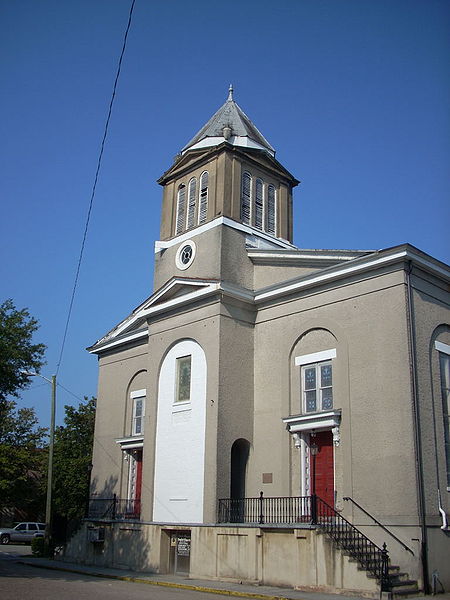
First African Baptist Church of Savannah, GA

On the opposite side of Savannah from the Bonaventure Cemetery is the First African Baptist Church, probably the first Black congregation in North America, dating back to 1773.  The congregation was entirely slaves, including the first pastors. The current building was built by freed African Americans and slaves, brick by brick made and layed after their day’s work for their masters in Savannah.

If you look closely at the floors of the sanctuary, you find small holes—ventilation holes to the built-out crawl space under the floor.  This church building was Stop Two on the Underground Railroad, used by thousands of slaves, attempting to escape to the north to gain their freedom.  They would spend two or three days sometimes under the floor of the church in a four-foot high space, fed and watered through the holes in the floor by other slaves.  At a safe moment in the middle of the night, someone would lead them through a tunnel from the church to the Savannah River, where they would be ferried in a small boat across to South Carolina for the next leg of their dangerous journey.

As I was thinking about the haunted houses, the voodoo, and the southern gothic on one side of this city, I started comparing it to the hallowed house, the Holy Spirit, and the Christian tradition on the other side.  No one lives in the haunted house! The First African Baptist Church is still a living, thriving congregation of Christians—still serving, still loving, still sacrificing for the welfare of others.

When the clouds roll back and the Light comes on and all the deeds of darkness are exposed for what they are, I know which garden of this city I would want to be in!


While a student at Harding in the late 60s, Owen Olbricht, director of Campaigns Northeast,  introduced me to the hymn Great Is Thy Faithfulness. We sang it often in devotionals, sometimes in parks, and even once on a local TV station.

Yesterday, after receiving some especially good news, Sherrylee started quietly singing this great hymn again—and I joined in. Her voice is much lower than mine, so when she starts a song, her natural pitch leaves me no choice but to sing the tenor to it. Regardless, however, of who sings which part, that particularly hymn has been a special blessing to us at significant moments in our journey for many, many years now.

Great is thy faithfulness, Oh God, my Father. . . . Thou changest not. . . .where thou hast been, thou forever wilt be!   If you know our story, you know that Sherrylee and I feel like our mission time in Germany were some of the best and most formative years of our lives, but that made it all the harder when overnight literally we found ourselves on a plane back to the U.S.. We felt like we had been ripped out of home, dreams, church, mission—all those things that give purpose to life. How could things change so quickly, so drastically! 

This song reminded us then that God had not changed. He was still in control. He knew where we lived. He knew our pain. He had not abandoned us—nor we Him, so in spite of a traumatic upheaval in our lives, God had not changed and was not far from us.

Summer and winter and springtime and harvest . . . join with all nature in manifold witness to thy great faithfulness, mercy, and love.  Life has seasons. Our time in Germany was a wonderful time, but so were our twenty-two years in Oklahoma. We had serious doubts about whether Oklahoma was really where we should be! After all, we were missionaries, not Sooners!  But God was faithful and took that season in Oklahoma and shaped that moment into a wonderful place to raise our family, a meaningful ministry with students at Oklahoma Christian, and a place and time for Let’s Start Talking to take root and grow.

And now in the fall and winter season of our life, the mercy and love of God is even more evident. We continue to love deeply the work we have been given; we are surrounded by not only a God-called team of co-workers, but grown, faithful children– and grandkids who are being taught God’s faithfulness every day.  What more could anyone ask for.  God is faithful, full of mercy and love.

Morning by morning new mercies I see! Strength for today . . . The more I learn as I walk along the journey with God, the less I worry about tomorrow—not because there is less uncertainty, not because there is less catastrophe around the corner, but just because I think I’ve learned that God only takes care of us one day at a time! 

It has something to do with the same reason he gave the Israelites only one day’s worth of manna every day (except on the Sabbath). It’s Jesus in the garden praying in spiritual pain for what was going to happen the next day.  It’s Noah not knowing if and when the dove would return!

As Executive Director of LST, I’m often asked about our five-year plan: where do you want LST to be in five years?  Or we sit and talk about how wonderful it would be if the ministry were supported with an endowment, so that we did not live each year hand to mouth like we have for the last thirty-one years!

My personal fear is that sometimes we are trying to build barns and create our own security rather than depending on the Lord day by day. 

Fortunately, the Lord has never given us that kind of security, not personally nor in the ministry—and I keep thinking that maybe day by day, morning by morning, maybe that is supposed to be enough!

If you don’t know this great hymn, find it on YouTube and listen to it and learn it, so that every day of your life, you have these words in your heart and on your lips:

Great Is Thy Faithfulness, O God, My Father!

Yesterday, Sherrylee and I were in Oxford, Mississippi. You may not know that Oxford was our first home as a married couple. Before we went to Germany, I spent two years in Oxford, working for the church as a campus minister while completing my Masters degree in English.  The first year I was there and before Sherrylee and I were even in love, I lived with Doug and Cora Beal Shields, one of the elders of the church in Oxford.

Doug was a professor of physics at the University of Mississippi, but his real work in life was the campus ministry, which he had begun, supported, and led because of his passion for the mission of God among the young people who came through Ole Miss.

At that time, campus ministry was mostly  offering fellowship for Christians and in-depth Bible courses. Not only did the Student Center offer regular devotionals, but an evening meal and a place to just hang out—I’m not sure that’s what we called it then, but that’s what we did.

Doug had bigger and better dreams though.  First, he raised the funds and built a dormitory for Christian students.  Ole Miss is a top-tier party school, so his experience was that students who came and stayed in the university dorms usually ended up in the parties instead of the devotionals.  Even he moved away from the idea of sheltering Christian students years later, but at the time, this was a very ambitious dream for a small campus ministry.

But his second dream was much bigger—almost shocking.  He asked the church to hire a campus evangelist—someone whose sole task was to go on campus, find students who wanted to find faith, and then study the Bible with them.  This person would also minister to the Christian students on campus and try to involve them in the local campus ministry and/or local church activities.

What was shocking for 1968 is that the first campus evangelist the church hired was a young woman!  Sandra Purkey took the first position—which had to be called women’s counselor to avoid having female ministers.  In 1969, I was hired then to be a campus minister for the male students.

Sherrylee and I married in April 1971 and moved into a small, back porch apartment in Oxford. She took her courses and I finished my thesis, then we left for Germany in September.  The Oxford Church of Christ supported us for all of our eight years in Germany.  That was forty years ago!

Now Doug and Cora Beal are in their mid-eighties, a little slower, a few health concerns, but the primary topic of conversation when you visit them is the same: the kingdom of God!  They want to talk about the new approach to campus ministry; they talk about trying to heal the wounds of a church rift several years ago.  They want to tell us about their FriendSpeak program, reaching out to international students at Ole Miss.

The word that kept coming to mind as I thought about them was perseverance, the willingness to continue to work and dream in spite of difficulty, in spite of setbacks—to do whatever it takes to bring glory to God in the place where you are.

But more than just persistence, I admire their willingness to do it for their entire lives! Doug had a full academic career, even serving as an assistant dean for several years at Ole Miss. He is a recognized scholar, but his life was only about God!  He retired from teaching and research, but he has never taken one step backwards from his passion for the mission of God. And Cora Beal is even more vocal, just as passionate, and right there leading the way in her own right.

Someone said, “Perseverance is the hard work you do after you get tired of doing the hard work you already did.”  That is Dr. and Mrs. Shields of Oxford, Mississippi.

I would like to live my whole life working as hard and focused in the mission of God as Doug and Cora Beal Shields.