Feeds:
Posts
Comments

Concluding this short series is a woman whose name was known around the world, but who lived long enough to be forgotten by many. I appreciated the chance to be re-introduced to her and to get to know her more as a person than as a figure in the news.

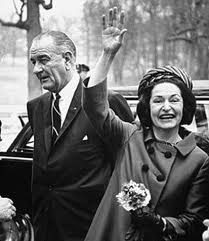
Lady Bird Johnson

There is a whole section in the LBJ Library dedicated to his wife Lady Bird. Of course, I knew her as having been an advocate for wildflowers in Texas and as the one responsible for removing the billboards from the interstate highway system, but that was all.

Again, I was struck by a strong person who found herself in a position to do good, so she searched for avenues to do as much as she could. She was very active in lobbying for both the civil rights legislation and for the education agenda of her husband. She consciously searched within his agenda to find areas where she could make her best contributions—and she made a lasting impact on the country.

Lady Bird 2004

Then she was widowed when she was just 59 years old in 1973.  She lost her husband, but she did not lose her platform nor her will to serve, so she continued her humanitarian activities right up until her death in 2007.

Conclusion

These people may not be spiritual giants, but everything good comes from God and when we see perseverance, optimism, a passion for the oppressed, even a passion for beauty—when we see these in people and when we recognize them as God-given gifts, then, I find, when I am inspired and encouraged—that’s spiritual.

I’ve got three more biographies that I want to read now.

On our second day in the hill country, we went to Stonewall, Texas, to see the place where the 36th President of the United States had been born, had worked, and had died.  I thought it would take thirty minutes and we spent several hours there.  I did not expect to meet real people there–just historical figures, but we met a man with big ambitions and a big heart.

Lyndon Baines Johnson

On the land where he was born in Stonewall, Texas, just outside of Johnson City, LBJ lies buried in a family cemetery. His ranch became known as the Texas White House during his presidency (1963-1969). He was the first president to have enough technology to really conduct affairs of his office away from Washington, spending over 500 days of his presidency on this typical Texas ranch.

Unlike H. Nelson Jackson, LBJ is a well-known historical figure in American history. I remember his tenure in office as extraordinarily turbulent years. Assassinations, demonstrations, burning cities, and above all, Viet Nam filled the news reports all those years.

Johnson was not a well-loved president when he left office–maybe unjustly disliked–, but here is what I came to admire as I learned more and more about him.

  • He was a passionate advocate for the poor and for the disenfranchised. He used all of his political power to get sweeping civil rights legislation passed, to build the social net for the poor and aged that we now take as just basic human rights, and to secure equal educational opportunities for all children.
  • He probably worked himself to an early death, and I don’t really admire him for that, but I do think that without his almost inhuman ability to work long, continuous hours, he would not have reached the high goals he set for his presidency. He worked himself to death doing what he thought was right!
  • Johnson is a perfect example of the 10,000 hour principle that Malcolm Gladwell made notable in his book Outliers—which I highly recommend.  Johnson started as a political volunteer when he was twenty-two years old and served at virtually every level, working his way up to the top, so that when he became president, he knew as well as anyone else in Washington how the system worked.  He was able to put thirty-three years of political experience/preparation to achieve in just five years amazing things.

    LBJ meeting with Civil Rights Leaders

After touring his ranch, we went to the LBJ Library and Museum on the campus of the University of Texas at Austin.  We love presidential libraries. I’ve toured four of the twelve now: Truman, JFK, Reagan, and LBJ. I hope to see them all someday. To see all the positive accomplishments of a person stacked up—and knowingly ignoring the dark side—well, almost anyone would inspire us, but these are all men who have faced hard decisions, made hard choices, and have all tried their very best to promote the common good!

May we all spend our lives doing good!

Sherrylee and I took last weekend and went to the Texas Hill Country, just west and south of Austin. It’s beautiful during the spring bluebonnet season, but just different in February. We spent a day in Fredericksburg, center of the German settlements in the previous century. It’s becoming quite a tourist stop, but is fun!

In our traveling over the years, we have learned that our best trips are those where we get to explore something that catches our historical fancy.  This trip was no different. We spent time with three historical figures, and coincidentally, all their last names began with the letter J.

I won’t try to recount their history which you would do better to get from Wikipedia or other sources, but I would like to share with you briefly over the next three days what impressed me about each of these people.

The first is a rather obscure person from Burlington, Vermont. We met him late one night as a serendipitous choice on Netflix!

Horatio Nelson Jackson

In 1903, this 31-year-old man bought a used car, hired a mechanic to go with him, and became the first person to drive a car across the United States. It took them sixty-three days, twelve hours, and twenty-three minutes to drive from San Francisco to New York City.

But it is not the feat itself, rather the perseverance of this man that is amazing. In 1903, there were no gas stations, there were no road maps, and there were often no roads—just wagon and horse trails. The car had no windshield, no service manual, and no spare parts to speak of.

Jackson had to use his only spare tire the second day of driving! In the course of the trip, they were lost, they were stranded, they were stuck in river beds, they were misled, they were days without food—this was a dangerous adventure in 1903.

Virtually every part in the car had to be replaced somewhere along the route! When the car broke down, first they had to find a telegraph to order parts from San Francisco, then wait days for the train to bring the part.

In all of his letters to his wife, letters which document the adventure, Jackson never loses heart! He believes that every day will be better, that nothing worse can happen, and he never ever doubts that they will complete their journey.  His optimism in the face of insurmountable odds is amazing!

Sherrylee and I watched the Ken Burns PBS documentary called Horatio’s Drive which told the story as only his documentaries can and loved it. It’s an inspiring story of what optimism and determination can accomplish. You’ll enjoy seeing the documentary too!


Bud rode with Jackson across the U.S.


Do you remember Gulliver’s Travels from your literature class? Or maybe you saw the pretty silly Jack Black movie recently. In either case you know that Gulliver is challenged with being extremely large in the land of the Lilliputians and extremely small in the land of Brobdingnag.  In both countries, he is a celebrity/curiosity of sorts, but he is not successful in either country, neither as the All-Powerful nor as the No-Powerful!

Not many of us think of ourselves as all-powerful, although there are people we see in the news who do! No, our problem is more often seeing ourselves as small—powerless, without influence!

God wrote a letter once to a group of Christians that He described as small, but he had a much different perspective on their smallness! Listen to what He says:

8“I see what you’ve done. Now see what I’ve done. I’ve opened a door before you that no one can slam shut. You don’t have much strength, I know that; you used what you had to keep my Word. You didn’t deny me when times were rough. . . .  10“Because you kept my Word in passionate patience, I’ll keep you safe in the time of testing that will be here soon . . . (Revelation 3:8-10, The Message).

When we think of ourselves as little, it makes us either envious or afraid of what is large!

But doesn’t it seem to you like God always had a special place for little people, people who used what strength they had to obey—and God blessed that!. Maybe David and Goliath is the first story that comes to your mind (1 Samuel 17) or perhaps you think about how God took the large army of Gideon and whittled it down until it was a small army (Judges 6ff).

When we are small, we understand better that we are not really able to do things that only BIG can do. You see another word for BIG is GREAT! And only God is GREAT!

OK, so we can understand that we are small and He is Great, but instead of charging through open doors, we use our “small strength” to excuse ourselves . . . .

After all, I don’t have very much

After all, I really don’t know much

After all, I’ve never done that before

After all, I am  . . . .alone!

After all, I am too young   ….too old  .. ..too poor ….too nervous . . . too afraid

To the church/Christian that is too small, He says, I have opened a door just for you that no one can close! Because you have obeyed, because you did nothing more than use all your pitiful little _______________( strength ,money, ideas, time, age, energy—fill in the blank!) I will bless you!  You can go through the door that He has prepared and do something that NO ONE CAN STOP because God is Great!

So, to all of us who find ourselves inadequate, that’s GREAT! If you think of yourself as a pygmy Christian—GREAT! If you think your church is pretty weak—GREAT!

If you can just be obedient and use that little cupful of whatever God has given you to be obedient, then He will do with you what He will–and He will be GREAT!


The story of the poor man we know as Legion has always captured me. I’ve written about him before (8/14/2010 “Who Are You In This Story?”), but for me, his story is so easily seen as an Everyman story!

When Jesus climbed out of the boat, a man possessed by an evil[b] spirit came out from a cemetery to meet him. 3 This man lived among the burial caves and could no longer be restrained, even with a chain. 4 Whenever he was put into chains and shackles—as he often was—he snapped the chains from his wrists and smashed the shackles. No one was strong enough to subdue him. 5 Day and night he wandered among the burial caves and in the hills, howling and cutting himself with sharp stones.

 6 When Jesus was still some distance away, the man saw him, ran to meet him, and bowed low before him. 7 With a shriek, he screamed, “Why are you interfering with me, Jesus, Son of the Most High God? In the name of God, I beg you, don’t torture me!” 8 For Jesus had already said to the spirit, “Come out of the man, you evil spirit.”

 9 Then Jesus demanded, “What is your name?”  And he replied, “My name is Legion, because there are many of us inside this man.”

If I were making a movie of this man’s life, I’d have to write a little backstory to turn this monster into a real person. I’d make him the youngest son of wealthy and devout parents, beloved and spoiled. Then I’d introduce tragedy into the story: his doting mother dies and his father, lost in grief, forgets about his son and his own grief, so the son seeks consolation first in friends, then in alcohol, then in drugs, and then he’s lost! Out of his mind! Out of control! Unable to function in society, so he is cast out and lives in the cemetery.  He pierces himself, abuses himself, and is hardly recognizable as the cute little guy in Sunday clothes in the family portrait that still hangs in his dad’s house.

15 A crowd soon gathered around Jesus, and they saw the man who had been possessed by the legion of demons. He was sitting there fully clothed and perfectly sane, and they were all afraid. 16 Then those who had seen what happened told the others about the demon-possessed man and the pigs. 17 And the crowd began pleading with Jesus to go away and leave them alone.

 18 As Jesus was getting into the boat, the man who had been demon possessed begged to go with him. 19 But Jesus said, “No, go home to your family, and tell them everything the Lord has done for you and how merciful he has been.” 20 So the man started off to visit the Ten Towns[c] of that region and began to proclaim the great things Jesus had done for him; and everyone was amazed at what he told them.

I love the way Mark tells the story from the viewpoint of the villagers who discover this horror of a man, now just sitting there by Jesus in a polo shirt and slacks, nice haircut, talking to Jesus about his experience, about God, about whether he ought to go home and try to work things out with his dad.  The villagers are afraid! They don’t want anything to do with someone like Jesus who can change people’s lives so radically. They like the way they are!

I can’t help thinking about how the Apostle Paul told this same story to the Christians in Ephesus, except he used their own personal histories in this version. Look at how he substitutes their story for our man in Mark 5:

1 Once you were dead because of your disobedience and your many sins. 2 You used to live in sin, just like the rest of the world, obeying the devil—the commander of the powers in the unseen world.[a] He is the spirit at work in the hearts of those who refuse to obey God. 3 All of us used to live that way, following the passionate desires and inclinations of our sinful nature. By our very nature we were subject to God’s anger, just like everyone else.

Doesn’t this sound just like the man in Mark’s story: living among the dead, obeying the devil, bound by our passions and our sinful inclinations!

 4 But God is so rich in mercy, and he loved us so much, 5 that even though we were dead because of our sins, he gave us life when he raised Christ from the dead. (It is only by God’s grace that you have been saved!) 6 For he raised us from the dead along with Christ and seated us with him in the heavenly realms because we are united with Christ Jesus.

And here God through Christ intervenes and rescues them from the tombs, he does what no one could do for them and what no one could do for himself!  And then God makes them sit down where Jesus is—because we are part of Him and His world now!

 8 God saved you by his grace when you believed. And you can’t take credit for this; it is a gift from God. 9 Salvation is not a reward for the good things we have done, so none of us can boast about it. 10 For we are God’s masterpiece. He has created us anew in Christ Jesus, so we can do the good things he planned for us long ago.

Irene Johnson Gatewood, the great missionary to Germany always coaxed us as she worked circles around us at Camp Gemunden, “We’ll rest in heaven!”  Paul reminded the Ephesians that it wasn’t really about sitting. There are lots of people out there who are still living among the tombs, hurting themselves and others, crying out in pain! God didn’t really intend for us to sit too long! 

 “Go back to your family and friends and tell them what the Lord has done for you—and how he has had mercy on you! ”  That’s when you know that you are whole again, when you are doing the good things He created you to do—long ago!

What a great story about the Gadarene!

What a great story about the Ephesian Christians! 

And what a great story about me!   

And you?

 *****Scriptures are taken from the New Living Translation, Mark 5 and Ephesians 2.

The Second Year!

One year ago today, I started this blog–and I must confess that I have enjoyed it immensely!  If it didn’t sound so melodramatic, I would probably say that blogging regularly has changed my life in meaningful ways.  Just a quick list will show you what I mean:

  • I spend most of at least three and sometimes more mornings each week writing. I started writing this post before six this morning because I woke up thinking about it. It usually takes me somewhere between one and two hours to write each post, edit, find pictures, apply tags, check category boxes, and post it.  That’s a significant amount of time each week.
  • I hardly go anywhere any more without someone mentioning the fact that they have enjoyed reading one or keeping up with my posts.  I don’t mean lots of people because in the blogworld, mine is microscopic; I just mean I do have a widely spread and wonderful set of readers.
  • It has been a great challenge to address even highly sensitive topics positively, which for me means not just to criticize–probably not even criticize at all–but to offer a positive idea that if adopted or practiced would achieve a positive change.  One gets the impression that the only way to be heard in our media world today is by being both cynical and offensive. I’m still of the persuasion that we can speak the truth in love.
  • I love the task of seeing what is going on around me and looking for that which might be of help to someone else.  I’ve enjoyed doing the movie reviews as I have for many years, but I’ve especially enjoyed writing the “How to Talk To Kids About Movies” reviews. I probably should have done more. I’ve loved talking about the British TV series that Sherrylee and I have been hooked on. In my imagination, these posts help a few people experience a TV world that they wouldn’t even have tried otherwise, one that opens up their world in a positive way.

Well, I said a short list, didn’t I. Brevity continues to be a challenge. I’ll work on that this next year.

In my first post, I made you some promises which I want to post again.

  • I will be honest and truthful, but not blunt.
  • I will try to limit myself to what I know about and not write about things I don’t know about.
  • I will try to be helpful to you the Reader rather than just cathartic for my own benefit.
  • I will stop when I’m finished.  

These still work for me. I hope they don’t surprise and that you find them consistent with the blogs that you have read.

In addition, I promised a focus to the posts, which were

  • Christian missions –especially foreign missions, and even more narrowly short-term missions.
  • Christian culture – especially juxtaposed to western culture, and even more narrowly in family cultures.
  • Bible study – I really want to share regularly things I learn about the living Word—it’s just who I am.

I only feel that I did not do nearly as much Bible study with you as I had planned. We did do the Luke 10 series as well as the Advent series, but I really want to do a lengthier study of Acts with you this year.

As we begin this next year together, let me say how much I appreciate your comments, both online and in person. It’s much easier for me to write for people with names and faces than to just write out into cyberspace, so just be aware that I’m really thinking about you when I write.


Did you hear the broadcast from Egypt on Sunday that told of Coptic Christians conducting mass in Tahrir Square?  What caught my attention was the report that Muslims surrounded the Christians in order to protect them while they worshipped. (Reuters, February 6 2011).

This action follows many reports of Egyptian Christians protecting Muslim men in the same square as they prayed last Friday. Coptic Christians make up approximately ten percent of the population of Egypt, perhaps the largest Christian community in the Arab world. (For background information, you might want to read this article from Foreign Policy.)

Have you heard about the big controversy among some Christians over whether Christian churches should rent church space to Muslims to conduct their prayer services. What do you think your church would do?

Recently, Christianity Today has featured several articles that raised questions about the relationship between Islam and Christianity as well as between Muslims and Christians.

Why We Opened Our Church to Muslims | A response to “Muslims in Evangelical Churches.” (January 27, 2011)

Muslims in Evangelical Churches | Does loving your neighbor mean opening your doors to false worship? (January 3, 2011)

From Informant to Informer | The “son of Hamas” senses God in his life before coming to Christ. (June 8, 2010)

Dispute in Dearborn | Small ministry creates big waves at Arab festival. (August 18, 2010)

Out of Context | Debate over ‘Camel method’ probes limits of Muslim-focused evangelism. (March 31, 2010)

How Muslims See Christianity | Many Muslims don’t understand Christianity—especially the idea of salvation by grace through faith. (March 1, 2000)

The above list appears in a lengthy article discussing the use of the phrase “Son of God” in Bible translations used in Muslim countries. It is an excellent discussion of the difficulties inherent in cross-cultural evangelism (Christianity Today, February 4, 2011).


If you are having trouble even reading the word Muslim without thinking terrorist, then I think you are a pretty normal American Christian.  Unfortunately, I think the dominate word in that last phrase is American, not Christian. But it is very difficult for many of us to separate the flag from the cross, isn’t it!

I am encouraged that in the middle of the political tumult, Christians in Egypt have acted like Christians to those who sometimes even persecute them.  I’m equally thrilled to see Muslims responding favorably to the Christians.

It begins to sound like the early chapters of Acts, you know those verses that describe the good that the first followers of Jesus did among the people who had killed Jesus (2:47) and the “good favor” that ensued from the entire community.

We and LST have been involved in faith-sharing work with Muslims for many years now. Our first experiences were in western Europe–which is struggling with a mushrooming Muslim population. Then later we began work in places that were secular politically though Muslim culturally, both in Asia and Africa.   I have no personal experience in the fundamentalist Arab Muslim countries, but I do know people who have worked there.

So I have many more questions than I have answers, but I am more and more convicted that not only is vilification of Muslim people wrong, but that either intentionally or indifferently ignoring them is equally ungodly.

I am convicted—as you are, I believe—that God so loved the Muslim world as well as the Christian world that He sent His only Son to die for the whole world!  Isn’t that what you believe too?

So how does that change anything for you today?


Clint Loveness, a friend and Let’s Start Talking participant has created a great story video that speaks about young people, video games, and missions. You probably want to share this with your teens and grandteens!  It’s just over four minutes, so click below and enjoy it.

http://www.youtube.com/watch?v=JJGuAInoOlk

Sherrylee and I got tired of CSI–regardless of the city! Don’t the Survivor-type reality shows start running together for you too? When you’ve reached your limit—like we did a few months ago—try something completely different! Try British TV  series! We get them through Netflix, but I know that they often show on PBS channels as weekly series.

Just last night we finished Bleak House (2005 TV series, Rated PG), and, I must say, although I am not a big fan of Charles Dickens, this plot and these characters captured me completely.  In this fifteen-episode series, a string of memorable characters appear with fanciful names like Lady Dedlock,  Mr. Krook, Mr. Guppy, Mr. Tulkinghorn. Say these quickly and with a pronounced British accent and the playful names reveal clues about each character.

Set in the first half of the nineteenth century, the plot revolves around a legal dispute (Jarndyce vs. Jarndyce—but sounds like “jaundice vs. jaundice) over a large inheritance that has been in the courts for many years with no likelihood of being resolved.  Three young people and their guardian of the upper crust mix and mingle with some of the most treacherous and/or despicable characters that Dickens ever created.  Murder, secret love, stolen identities, family shame, even small pox all make their way into a plot that moves quickly and is never boring.

Well acted—especially Gillian Anderson as Lady Dedlock–and interestingly edited, Bleak House should be on your watch list. If you have a drop of anglophile blue blood at all, you’ll love it.  I even plan to read the book!

Doc Martin (2004 TV series, Rated M) is a universe away from anything similar to Bleak House. Doctor Martin Ellingham (Martin Clunes) is a renown London surgeon who develops a phobia for blood. He leaves London and takes a post as a general practitioner in the seaside village of Port Wenn in Cornwall. Here he meets all kinds of eccentric small town personalities, each of which presents him with very comic complications because the doctor himself is extraordinarily socially dysfunctional.

Doc Martin is rude, abrasive, insensitive, and kicks dogs—but the town takes to him anyway—especially the local schoolteacher Louissa Glasson (Caroline Catz) whom the town adores. Their attempts at romance carry a good many of the episodes.

Doc Martin is not another Dr. House. He is not edgy or cynical; rather, he is a brilliant and dedicated doctor, but one equally oblivious to his own handicap and naïvete about people in general.  The supporting characters—and I do mean characters—are equally brilliant (as the British are prone to say!) and entertaining.

The Mature rating is likely because of some mild sexuality and perhaps some British swearing—I don’t always catch all of their words!

For a slightly different series, try Monarch of the Glen (2001 TV series, Rated G). Set in modern Scotland, the ancient MacDonald clan tries to hold on to its vast estate Glenbogle by making the only surviving son Archie the newest Laird of Glenbogle. He is reluctant to assume this responsibility, so his elderly father and devoted mother use their wiles to win his attention.

The estate includes a whole community full of tenants, servants, employees, and families, so not only does Archie try to apply modern business techniques to rescue the ancient estate fiscally, he is also compelled to settle disputes, to hire schoolteachers, and to marry!!

The series ran in the UK for seven seasons, the final episode seeing Glenbogle facing foreclosure. Of course, help arrives. The cavalry comes over the hills in Scotland as well.

It’s fun, interesting, comic, romantic, and not silly. Once you get the feel for the Scottish brogue—which isn’t all that easy at first—you’ll wish you could hop right over to Glenbogle and hang out with the MacDonalds.

Finally, and I’ve saved the best for last, Foyle’s War (2002 TV series) is an incredible series! Michael Kitchen plays Christopher Foyle, a detective for a small town on the south coast of England in 1939-40, which feels threatened daily by the clouds of the European war. Foyle’s unquestionable integrity drives him not only to solve the local crimes of theft and murder, but also to delve into the murkier crimes that arise out of greed, passion, and local attempts to profit unlawfully from the war.

Each episode in the seven-season series has the prerequisite crime that Dectective Foyle investigates and solves, but the series so much more about the people than about the crimes. And I mean about what it is like to know the German army is just across the waters from you, to watch your sons and daughters join the RAF, knowing that only a small percentage will survive, about good people who are corrupted by war, or crippled, or deprived . . . .

From the first episode as war with Germany looms until the conclusion of the series at the end of WWII, each episode is a story of a country at war and what ordinary people do during war!

Michael Kitchen is terrific, as are Anthony Howell and Honeysuckle Weeks, his supporting  characters for most of the episodes. You will be sorry to see it end—and you won’t be alone. The series actually concluded in 2007, but popular demand brought in back in 2008. The most recent episodes aired in 2010.

You can get all of these through Netflix, but if you don’t subscribe, watch for them on your PBS channel and then set your DVR to record them weekly so you don’t miss even one!

Urban Africa (Nairobi, Kenya)

The image of African mission work is that of walking dusty, impassable roads to get to villages with a dozen mud or thatch huts, no electricity, no running water, sometimes no well, working with illiterate people whose religion is animistic , pagan, and highly superstitious. And, in fact, much–maybe most–of the mission work done by American churches of Christ probably fits generally into this framework, even though specific works might not.

 
Read this paragraph from Wikipedia, which documents a major upheaval in African demographics since 1950.  It is this extraordinary shift that causes me to wonder if our paradigm for African missions has shifted along with it:

“It is estimated that in 1900 about 95% of Africa’s inhabitants south of Sahara lived from the primary occupations of farming, hunting & gathering, cattle nomadism, and fishing (Aase, 2003:1) meaning that less than 5% were urban. In 1950 (the start of the independence period) 14.7% of Africa’s inhabitants were urban, in 2000 it had risen to 37.2% and it is expected to rise to 45.3% in 2015, in effect 3.76% –3.35% per year (UN, 2002). The Nigerian city of Lagos that in 1963 had 665 000 inhabitants (Rakodi, 1997) and 8.7 million in 2000 is expected to become the worlds 11th biggest city by 2015 with 16 million inhabitants (UN, 2002). The urbanization of most of Africa is moving fast forward, especially south of the Sahara.”

My questions revolve around this growing urbanization of Africans and whether we Christians might be stuck in a strategy for missions in Africa based on the pre-1950 realities.
1. Are we training new workers for urban settings or is working in the “bush” still the primary assumption for preparations ? At a recent mission workshop, African missions was simulated so that students discovered experientially how missions were done and/or perhaps their own affinity for working in Africa.  Nowhere, though, was there an opportunity for talking about working with professional Africans in urban settings.  The entire experience was rural, fairly primitive Africa.

2. Do potential workers even want to go to cities, or is the African bush image that which draws them? We mission types don’t often admit that the exotic nature of our work is attractive to us—but it usually is. If a potential missionary is thinking about Africa, are they attracted more to a picture of themselves holding Bible studies for office workers in a downtown Nairobi high-rise , or would they rather see themselves preaching under African acacia trees to goat herders?
3. Are we defaulting to bush missions because it is perceived as easier or more receptive? Is the assumption that urbanized Africans might be more educated, more sophisticated, wealthier, and less superstitious a reason to head for the bush?  We mission-types often consider all of the above to be barriers to reception of the gospel message.

Even these assumptions about urbanized Africans are only true for a very limited part of the population, since so many of the Africans in cities are very poor refugees from the rural environs.

4. We know what to do for rural poverty. We drill wells and teach them to fish. We introduce drip irrigation and provide basic education. Do we, however, have a theology to share for urban missions in Africa that will address the wealth/poverty issues in urban settings where the two are in much closer proximity to each other? What is the word of the Lord for affluent and/or educated Africans?  And can a foreigner speak this word to them or should it preferably come from their own prophets?

I will be the first to admit that I know very little about African missions, so please forgive me if my questions are somehow offensive.  These are, however, my questions.

I would love to hear your response.