Feeds:
Posts
Comments

On Saturday, I presided over the wedding of two young people in their mid to late twenties. I’m going to hide their names for the sake of their privacy, but I wanted to share with you some of the thoughts that I shared with them.

wedding ringWe opened with this prayer:

Almighty God, our Father in Heaven, we come before you today, celebrating the wishes of Him and Her to be joined together in holy matrimony. We ask not only for your blessing on them, Father, but we pray for your Spirit to seal their vows both to you and to each other. Purify their hearts, Father, and pour into them the selflessness that will allow the miracle of two becoming one to happen, the same selflessness that Jesus showed by emptying himself and becoming flesh, so that we might have life.  Do this miracle today, Father, in the hearts of Him and Her, so that they will praise you as the Creator of their marriage and all good things—as we all praise your name and the name of Jesus.  Through Him we pray, Amen

Here we are, the day you have been looking towards, planning for, and dreaming about for a long time.  You both have been raised in Christian homes and have a living, personal faith, so it should be no surprise to you when I say that followers of Jesus have a view of marriage that is a bit different from that of the culture that surrounds us.

Many around us see marriage as just “a piece of paper,” “a legal document” that creates a new legal relationship. Christians recognize the right of governments to regulate legal relationships like this–but in the words that the Church once used on occasions like this, Christians don’t just get married, they enter into holy matrimony.

And the differences between that “piece of paper” and holy matrimony are vast—and ones that, if you will pay attention to them, will shape and bless your relationship and your life together as you go forward from this beautiful beginning.

The biggest difference between marriage and holy matrimony is that with a license, a few legal words, and a couple of signatures two people can be married; whereas, for holy matrimony to occur God Himself must act.  Just as God literally created the first marriage, introducing Eve to Adam, Scripture says it is God who joins you two together in holy matrimony.  So when you celebrate your first, your fifth, and your fiftieth anniversary, instead of saying, “Look what we did,” perhaps you will remember what we have said today, and you will say, “Look what God did! Thank you, God!”

Another difference between marriage and holy matrimony is that marriage is legal, but matrimony is holy. In other words, the relationship that you are entering into is one that is set apart for God.  The Apostle Paul said, Don’t you realize that your bodies are the temple of the Holy Spirit, who lives in you and was given to you by God? You do not belong to yourselves. (1Cor.6:19)

So when God joins you together, then together—with your bodies—you become a holy temple where God lives.  Fill your temple with love, with good deeds, with compassion. And put up big walls and barriers! Fight against anything that would defile or desecrate the temple of your marriage. Protect your marriage against evil and darkness in every form.

And never forget that this beautiful temple of your marriage is where God lives! He is there, not as an intruder to judge you nor as a guest to complicate your life; He lives in your marriage and brings with Him love and forgiveness and mercy and kindness and goodness and patience and endurance and compassion and everything Good into your marriage all the days of your lives together.

As you make your pledge and say your vows today, remember that you not only are asking God to do a miracle in making the two of you into one, but you are also inviting Him to live with you, to always be a part of your life together. Live every day of your marriage in His presence.  His promise is to work everything that comes to you in life—the good and the bad—for your Good and to be with you always.

Having recognized the holiness of what you are doing and having acknowledged what God will do, let’s proceed with our part in this mysterious miracle of God joining Him and Her together.

We then, of course, took their pledge and heard their vows to each other, after which they exchanged rings as symbols of their vows.  We then prayed that God would seal their love and join them together as one.  Finally, the Pronouncement:

He and She, because you have expressed your desire to enter into holy matrimony and because you have committed yourselves to be married before God, as a minister of the Gospel and in the Name of the Father, the Son, and the Holy Spirit, I pronounce you husband and wife.  “Since they are no longer two but one, let no one separate what God has joined together.”

And we ended with a kiss—a holy one, I’m quite sure!

fatherHappy Father’s Day to all of you fellow dads! One of the moments I enjoy the most is sharing the postings of new fathers to Facebook.  The scores of pictures of that unique little baby, almost always wrapped around gushy, sometimes tearful, praises for the amazing woman who made you a father!  I’m not making fun of you guys because I was exactly the same way on three wonderful days in 1974, 1976, and 1978.  And, honestly, I have re-lived all of those emotions  when our nine grandchildren were born, watching our sons (including Tim) become fathers!

The strangest thing happened to me after my father’s death twenty-five years ago this week.  For a period of time after his death, I found myself talking to him in my prayers.  It was not anything mystical or intentional. I would be talking to my Father in heaven and conversation would just merge into talking to my dad.  I don’t really have a theology that supports praying to saints, so at first I was a little shocked and felt slightly guilty to realize what I was doing, but the phenomenon didn’t last long.

As you can tell, however, I’ve remembered this vividly for twenty-five years and have actually come to believe even more strongly that God has always intended for earthly fatherhood to be a first experience for both fathers and children of His relationship to us. If He has bound His Fatherhood and ours so closely together, then perhaps it is not so unique or unnatural for our hearts and minds to merge the two.

God as Father was a gift from Jesus His Son. Yes, there are a handful of references to “Israel my son” (Ex. 4:22) and David “my son” (2 Sam. 7:14), for instance, but such references are extraordinarily rare in the Old Testament.  On the other hand, God is called Father over 160 times in just the Gospels. In his letters, Paul talks of the fatherhood of God over forty times. Peter and John also use the same word they had been taught to use by the Lord. That Jesus taught his followers to understand God as father is special and uniquely Christian.

I have a sweet story to tell you to illustrate this point.

Sherrylee and I were in north Africa in a predominantly Muslim country. One night we met for prayer with a group of Christians, and there was one young woman present who told us this story.  She had been raised in a Muslim family, having no contact with Christians. One night, however, as a young girl, she had a dream about God. She dreamed that God appeared to her and told her that He was going to do something special for her. He was going to allow her to call him “Father.”  She treasured this dream in her heart and in her own prayers and meditations, she secretly and silently called God “father,” thinking she was the only one with this privilege.

Years later, as a young woman she traveled to a western country where she made friends with another young woman who was a Christian.  At some point they were talking about God and the young Christian woman said something about God, calling him  “my Father ” The Muslim woman was shocked—not because her friend had blasphemed or disrespected Allah, but because she had used the Muslim girl’s most special, secret words as if they were her own.  The Muslim girl asked her friend why she had called God father and thereby discovered the special relationship that all Christians have with God. It was not long until she too was adopted as His child, and her dream became reality.

And for those who have had abusive, troubled, unfaithful, sick fathers, I can only imagine that it is extremely difficult to relate to God as Father. Someday all that is broken in this world, including fatherhood, will be made right again.  The first taste of this perfection is allowing God the Father to renew you, to re-birth you, to adopt you into His family. Your pain is real, but God’s willingness to be a loving Father to you is real too!

Today is Father’s Day!  Our gathered family is going to grill and talk and watch the World Cup today in celebration.  But first we are all going to spend time in praise and prayer to God, thanking Him for being our Father.

Our Father, who is in heaven, holy is your name!”  

Reposted from June 2014

Relay-race_02In the last post, I began to tell you about how the LST Board initially organized itself for transitioning from the Founding Executive Directors (Sherrylee and me) to a new Executive Director. You will remember that the board organized itself into two work groups: a Search Group to identify the new Director and a Transition Group to negotiate the Woodwards continued relationship to the ministry after our transition. (We avoided the word retirement from the beginning because we knew we did not want to walk away completely from LST, nor could we really afford to.)

The Search Committee began almost immediately to work through a list of potential candidates, contacting them, asking them if they would consider the position.  Most of the candidates were happy where they were or the timing was not right. They were honored to be considered, but practically, could not pursue the position any further. About six months into the search process, the committee was very close to making a final recommendation to the board with a potential transition as close as 6-8 weeks later.

The Transition Committee, on the other hand, for a variety of good reasons had not yet met!  Nor did they have yet all the information they needed from Sherrylee and me in order to fulfill their mandate.  One thing had become clear to the Transition committee, however, and that was that the Woodwards needed to continue drawing their salary for at least another year and maybe longer in order to make their long-term financial planning work.

When the Transition committee and the Search committee talked to each other, they discovered that their timetables did not come close to matching up.  The Search committee was ready to move to transition, but that was impossible with the needs that the Transition committee was presenting.  Some members of the Search committee felt like their work was at risk of being voided and discarded; some members of the Transition committee felt unfairly judged for doing what they were supposed to do.

For the first time in the long history of LST, there was potential tension between board members. To make matters worse, one of the four “objective” board members resigned at this critical moment for non-related issues.

In an attempt to clear the air, the whole board convened a special session. With prayer, great transparency, and a generous spirit of cooperation, all the issues were laid out. Ultimately the board decided at this meeting to make all the necessary decisions involving dates and compensation that affected the Woodwards, feeling like with those set in concrete, the search for their replacement could continue on firmer footing.  One board member strongly opposed this solution, abstaining from the final vote, which was otherwise unanimous.  Predictably, this board member resigned immediately following this meeting, feeling out of step with the other board members.

Now the LST Board consisted of five members, only two of which were not directly involved in the transition process—clearly an untenable situation for the Board.  In our next regular meeting—approximately one month after the special meeting—the Board decided to call a “time-out” and to search for new board members.  Six very strong candidates were identified, all people who had been involved with LST and loved the ministry.

Surprisingly, all six of these candidates accepted nomination to the Board of Directors and were installed at the next meeting.  Now we were eleven—with lots of fresh eyes to look at the transition process that one could describe best as frustratingly stalled.

Bringing in great new board members may be the best decision the LST board has ever made!  One item dominated the agenda at their first meeting and that was the transition.  The history of the current stalemate was rolled out, their questions answered, and nothing held back.

At the end of the day, the new board decided to stop the process—completely—so that the old board members could take a breather from the load they had been carrying, but also allowing the new board time to initiate a newer and better process.  Six months later, the search began again–new committees, new eyes, new timetable–and here we are, less than a year later, with an Executive Director-elect, stepping into his new role as the unanimous choice of the board of directors, on July 1.

Two people are better off than one, for they can help each other succeed. If one person falls, the other can reach out and help. But someone who falls alone is in real trouble.  Ecclesiastes 4:9 (NLT)

Relay-race_02If you had asked me five years ago, who I thought would succeed us as the LST Executive Director, I would have had a name and all the reasons why my choice was the only choice!  Privately, I would tell board members, lobbying in a preemptive way to ensure that my choice was their choice.

But I had made a big mistake.  My big mistake was that my One-and-Only-Possible-Choice absolutely did not want to do the job!

I’ve thought a lot about my flawed choice and have decided that asking the current Executive Director to find his/her own successor is not a very good idea. If the ED is a founding director, it may be even worse, and certainly more problematic.

First, why should not the Founding director name his/her own successor?  After all, who would know better about what skill sets or gifts are needed than the Founder?  Allow me to answer this rhetorical question with several more:

  • Can Founders choose someone different in skill sets from themselves?
  • Can they be objective enough to bring in someone who has the gifts that they themselves did not have?
  • Can they see beyond their own circle of relatives/acquaintances/associates to evaluate fairly someone who has not been intimately associated with the organization?
  • And what does it do to their legacy, if their chosen successor does not prove to be a good choice—so does that risk push Founders to safe choices rather than best choices?
  • What if the Founder consciously or unconsciously still wants to control the organization?  Isn’t this almost a predictable tension at a time of transition?  Would that tend to lead toward a choice of someone who can be controlled or overly influenced by the Founder?

These questions are hard for Founders to answer—which is why I would encourage you to opt for strong board involvement in choosing a successor!

What if the board does not want to be involved, but prefers that the Founder/Executive Director do the selection?   Then you have the wrong board!  Regardless of who started has led it for years, the board of directors has the responsibility for the sustainability of the organization.

Your board should lead in choosing the successor for a Founder/Executive Director for the following reasons:

  • The members of the board are legally responsible for the actions of Executive Director.
  • A multi-member board has the advantage of diverse input, out-of-the-box thinking, regional perspectives, and often even generational insights, all of which should engender better candidates.
  • Board members, by the fact of sheer number, have wider circles than a single Founder. If the board searches among their acquaintances, a larger number of good prospects is more likely.
  • A public announcement of an open position by the Board of Directors gives the organization more legitimacy than an appeal by a Founder/Executive Director.  It also makes the process seem more objective.
  • The Board of Directors is almost always the employer of the Executive Director, so giving the Board the responsibility for selection of the new ED builds an appropriate relationship between the employer and employee from the very beginning.  This is much different than if the new ED has been selected and “hired” by the outgoing Executive/Founder.

The LST board went through a bit of transition turmoil after Sherrylee and I gave notice of our retirement.  Let me start by saying that the main problem was not the board members themselves, but probably the constitution of the board at the time.  We were seven members; Sherrylee and I were two of those seven.  That left only five to work through the transition.  As it turned out, one of the board members was to becoming one of the declared candidates interested in the Executive Director’s position.  What we were left with after Sherrylee and I and this other board member recused ourselves was only four “objective” members.

We made the decision to divide into two working groups and to invite some of our non-board member supporters to join us in these work groups in order to expand the number of people in the process as well as to provide a wider perspective.  One work group was to search for the successor; the other work group was to manage the transition of the Founders (Sherrylee and me).  That seemed like a very productive arrangement, but actually things got off track pretty quickly.

I’ll explain what happened in the next post.


Scott LambertThe Board of Directors of the Let’s Start Talking Ministry is pleased to announce the appointment of Scott Lambert of El Segundo, California, to the position of Executive Director, beginning July 1.

Scott served for over twenty years as the campus minister at Pepperdine University, and for the last eleven years as the Network Director for the Kairos Church Planting organization.  Scott is well-known throughout Churches of Christ for his passion for evangelism and outreach, fundraising, public speaking, teaching, coaching, and mentoring of leaders.

Scott also has a long history with LST, recruiting and training many teams from Pepperdine University from 1990 to 2005; serving on the original LST Advisory Board from 1994-2000; and continuing to serve as a charter member of the Board of Directors since 2000. Scott and his family have participated personally in fourteen LST projects.  Scott’s wife, Kim, will be joining the LST staff as well.

Dr. Mark and Sherrylee Woodward, founders of the Let’s Start Talking Ministry and co-executive directors for over 35 years, are continuing with the ministry in supportive roles and as members of the Board of Directors.   Woodward says, “Scott and Kim Lambert bring a passion for Christ and for sharing the Gospel throughout the world that has long been the driving force in their lives.  They will bring all of this to the leadership of a ministry they have loved and been a part of for most of their lives already.”

The transition of both the Woodwards and the Lamberts will be celebrated at the LST September Celebration Dinner, September 24. All LST alums, supporters, and friends are invited.

The Let’s Start Talking Ministry began in 1981 as a short-term summer mission opportunity for college students who offered English practice using Bible texts to start conversations about Jesus.  The ministry expanded to offer the same opportunity to both adult church members as well as high school students (YoungFriends).  Today, LST trains and sends hundreds of workers each year and has sent mission volunteers into 65 countries.

LST also sponsors the FriendSpeak Ministry which has trained hundreds of churches in the United States with a strategy for reaching non-English speaking neighbors in their communities or international students at local universities.

For more information about Let’s Start Talking, visit www.moreaboutLST.org

Relay-race_02Almost three years ago, Sherrylee and I gave the LST board of directors our two-year notice as we had agreed to do many years ago.  The LST Board of Directors wisely had been discussing the eventual transition from the Founders (Sherrylee and me) to a Successor probably for at least five years before we gave notice. In fact, the “Succession Plan” as it was always called in those earlier board meetings is what eventually drove us to the first Strategic Plan in 2013.  Afterwards, Sherrylee and I knew what we were supposed to do to start the transition process.

Just a few months ago, I was sitting with two wonderful kingdom workers who were both in their late 70s, living in a difficult, foreign country, directors of a local non-profit organization—and after eight years there, just exhausted from the physical and spiritual demands of their mission!  As they told me over dinner one night, they had repeatedly told their American Board of Directors and their supporters that one of their top priorities was to find their replacements, and while everyone acknowledged the need, not much was really done to move the process forward.  A few comments in newsletters and a little correspondence with casual inquiries were all that the older couple themselves could do while keeping up with the strenuous daily demands of their foreign ministry.

I told them that they needed to give notice!  Not that they should create a hardship for their Board of Directors, but they needed to do what was right both for the mission and for themselves.  And by giving notice—in this case they decided (quite generously, I believe, for their age) to give their board two years notice—they were also placing the responsibility for the continuation of the mission squarely on the shoulders both of those who truly carry the responsibility as well as those in the best position to successfully find their successors.

If you have been reading carefully, you will have picked up on the fact that we gave our two-year notice almost three years ago!  Perhaps where there is tension between a board of directors and their executive, the official notice might be an irreversible legal step, for most of us in non-profits it is probably more a statement of intent.  In our case, the process of finding a successor took longer than anticipated. For others there could be financial considerations, a health issue, or even questions of momentum that might make the official hand-off date other than what was anticipated. In some cases, the succession might even need to occur earlier for the good of both the executive and/or the organization.

Here are my conclusions about giving notice as a step in the transition process:

  • The Board of Directors should create a Succession Plan long before it is needed, and this plan should include an appropriate and agreed upon timeframe for their executive to give notice.
  • If the Board does not have a succession plan or one that includes giving notice, then the executive should initiate the conversation with them and encourage them to develop one.
  • If the Board does not grasp their responsibilities for succession, the Executive may need to simply give notice on his/her own initiative, in order to raise the urgency level—for the sake of the organization or for him/herself.
  • Only in rare cases, does either the Board or the Executive need to feel that the Notice must be strictly enforced. Neither the organization nor the executive should view it as a bludgeon, rather as a green light signaling the start of a slightly unpredictable journey into a new future for both.


Relay-race_02Many Founders can be found in the Bible. Maybe not the 501(c)(3) variety, but Founders they were, so there must be something to learn from them about Founders.
Adam founded the human race—but he couldn’t admit his mistakes, blaming others instead of admitting his own error. In addition, he failed to some degree to raise successors who were in a position to lead this newly founded group of people into a positive future.  Adam is not the one we want to imitate.

Noah re-founded the original human organization that Adam’s progeny had driven into total collapse. It took a massive shakeup, where everyone was washed out of the human organization except Noah and his family. Unfortunately, in forcing through this necessary but painful shutdown and restart, Noah suffered from PTSD and turned to alcohol.  No doubt Noah was a righteous man who courageously did very hard things, but he did not finish strong.  Let’s keep looking!

Abraham founded the nation of Israel. Interestingly enough, although he had the amazing promise and assurance of all the help he needed to launch this nation, he actually had two failed start-ups, one with his servant Eliezer, whom he thought might grow into his successor, but the Chairman of his board had chosen someone else and thought Abraham showed a lack of trust by inserting this personal choice into board-approved plan.

Then a second time, Abraham, listening to his wife, got impatient and decided to create his own succession plan using foreign resources.  He managed to generate his own nation that lasted a few years, but then fell apart. Again, he had acted on his own initiative, thinking he could change the agreed upon plan.  He was showing no confidence that his Biggest Supporter would really fulfill his pledge.  The result of taking things into his own hands has led to almost 4000 years of terror from which we still suffer.

We will continue this business metaphor, talking about David as the Founder of a royal dynasty, but while David himself was a person of great faith and courage, he was also carried away by his passions, which led to hideous crimes for which he paid with his horribly troubled family. His love child dies, his daughter is raped by her brother, another son murders his incestuous brother, and his most beloved son attempts to steal his throne. Because of David’s goodness, his Backer honored his promise to do whatever it took to continue the dynasty, but because of David’s flaws, He had to intervene over and over again. David’s dynasty lost 83% of the original holdings (10 of 12 tribes) and ultimately was left with just a remnant of the original company!

Finally we get to the Son of David, the Founder of Founders, who established his Church.  Here is a Founder to follow and emulate—finally.

Jesus spent thirty years getting ready to launch His church.  When the time came, He opened with an act of personal humility (his baptism), not starting with great fanfare or extravagance.  He had one clear message that he delivered to his audience: the Kingdom of God is at hand. He pursued his single goal relentlessly, not only in the face of blatant opposition, but also when his own followers totally misconstrued the mission statement He had delivered to them.  With patient compassion, He continued to lead and coach them even when they started in-fighting, looking for the seats of power in this new organization.

For three years, He led them by example, He mentored them, He planted visionary seeds of what would be after He was gone. Before the end of His tenure with them on earth, he started preparing them for His departure. He gave them assignments, He sent a Consultant to continue working with them. One of the most important things He did was prioritize for them their prime directives as representatives of this new organization; He taught them that relationships—especially how they worked together—would be how their potential customers would evaluate the organization.  He promised to leave everything they needed in order to continue the mission, and that even though He was leaving them physically, that He would always be with them.

As a Founder whose time it is to leave, I have searched and searched Scripture for a model for the transition we are experiencing. I have thought about Elijah passing his mantel to Elisha. Or Moses handing off the wandering Israelites to Joshua. Or Samuel guiding the transition from judges to a king over Israel.  But while these metaphors may be a little artificial, I find no better model of transition than Jesus, one who gave his whole life, laying it down for His friends. He prepared those who worked for him, he taught them all He could—even more than they could understand. He arranged extended help for them after He was gone. He weeded out those who had another mission; He mended relationships among his staff, not focusing on the weaknesses even the strongest of his people had shown. Instead He lifted them up and gave them hope.

He did not tell them the future, but inspired them to believe that they would accomplish the great mission they had begun together. He prayed for them, he addressed their doubts, and finally, he gave them specific instructions for what to do immediately after He left. And so they went out, and here we are two thousand years later—not without problems, but still following His vision, still members of His Church.

I have not been such a Founder—far, far from it. But if all of us Founders will do our best to transition as He did, our ministries, our charities, our missions will be better blessed. Of that I am sure.


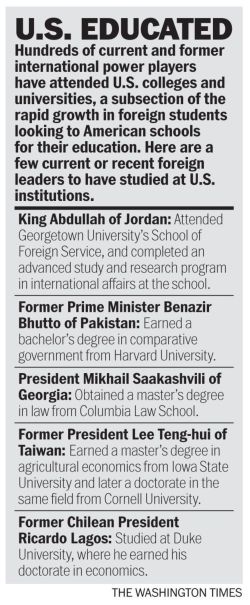
educationThree hundred current world leaders, including several heads of state, studied at American universities.  Over 300,000 Chinese students, many pursuing Masters and Doctors degrees are in the dorms and apartments in your neighborhood.  Sixty thousand Saudi students are living among us for up to five years.  The world is here!

We Christians can choose to be afraid and to suspect all of them of being potential terrorists—or we can choose to believe that God has brought the nations to our universities for His purposes.  Let me help you with that choice.

In his speech to the Athenians, the Apostle Paul said about God:

 God began by making one person, and from him came all the different people who live everywhere in the world. God decided exactly when and where they must live. God wanted them to look for him and perhaps search all around for him and find him, though he is not far from any of us. . . . (Acts 17:26-27 NCV)

Paul says they are here because God wants them here. He wants to give them a chance to look for him and perhaps find him!

And why are you here? Why are you living on this date in the place where you live, surrounded by people from all over the world?  Could it be that this same verse describes you as well?  Could God have put you here in order to be the one who helps one of these international students to find Him!

Let me tell you the story of Wendy:  She was born into a family of atheists in China. Her mother even joined the Communist Party, so she grew up with no exposure whatever to faith in God.  When it became possible for her to go to the US to study, she applied to the first university listed alphabetically—Abilene Christian University—and was accepted.

At ACU, many people talked to her about Jesus, even took her to church, so many people in fact, that she felt like it was taking away from her studies, so she decided to leave ACU and go to another school.  She enrolled at UT Dallas and that was that for her and God.

Except that one day one of her friends told her that there was a local church offering the FriendSpeak program, which was the opportunity to improve her English through one-to-one conversations.  She was eager to improve her English, so she signed up, even though it was being conducted at a church building.

For weeks and weeks, she consistently practiced her English with an American FriendSpeak worker, reading texts from the Book of Luke. One day, however, the story they read about a great banquet where so many people made weak excuses about why they could not attend the great feast. Suddenly—unexpectedly—Wendy thought, Is that me?  Is this story about me and am I making excuses for not believing in God or Jesus?

That day, she began a process of re-looking at all those stories in Luke that had been only conversation texts before, but now they started speaking to her personally.  Two months later, she became a Christian. Since then, she also led her mother to faith. In addition, she has helped with FriendSpeak ministries in two congregations where many other Chinese people have become followers of Jesus.

What if Wendy had been at the university near you?  Would she have found God?

Greg SwinneyA good friend of mine Greg Swinney works with an organization called Crossroards International Student Ministries. He travels the country, encouraging campus ministries to raise their eyes from just providing protection for Christians to being the first contact with international students who don’t know Jesus, of being the first to tell the Story, of being their first friends, showing them the love of God.

Today we were teaching a class together at the Pepperdine Bible Lectures and he told the story of an elderly man who spends his days working as a greeter at Wal-Mart.  To the world, he is simple and almost unnoticeable, but he and his wife have made it their ministry to make friends with international students at their local university.  They have a map in their home with pins in it. Those pins represent all the countries where all the students are from whom they have made friends for God by simply inviting them to their humble home.  Forty pins in forty countries touched by this remarkable Christian couple.

One million international students in our neighborhoods! Just start with one of them. Let’s all start with just one and see what God does.  I’m quite sure He will do more than we can imagine!

Relay-race_02Just to show how difficult it is to transition from Founders to Successors, let’s be very honest and answer the questions that I said every Founder was thinking when the question of succession is raised:

  • Who knows more about this ministry than I do?
  • Who is willing to do what I am willing to do?
  • Who will cast a vision that others will follow like they follow our vision?
  • Who is willing to risk what I have been willing to risk?
  • What kind of outcome could be expected without the great risk?
  • Who can lead this ministry better than I can in spite of my age, my health, my family, my . . . ?

The truth of the matter is that unless your Founder has serious mental or health issues or has done something that morally/ethically disqualifies him/her, then the obvious answer is nobody knows more, no one will do more or risk more personally, and no one has more followers already in step with their vision than Founders. 

And the longer they have led, and the more successful they have been, the harder it is to move them out!

So what reason are you going to give to convince this Leader that he/she needs to step down? 

First, you need to consider that you may not convince them to step down.  Your board may be able to force them out—but unless they are totally out of favor with staff, volunteers, and donors, you will suffer great damage by doing so. The whole ministry/organization may be threatened, and by forcing them out, you may find yourself in competition with their new, parallel organization!  Not good.  Allowing them to continue to lead until such time that they are persuaded by some of the observations listed below may be the only viable strategy.  Sorry, if you were looking for a miracle way out!

Two approaches that I don’t think will work, but that are often attempted anyway are

  • You may be able to appeal to them on the basis of age, health, or family situation. Aren’t you ready to spend more time with your family, with your grandchildren?  Aren’t you going to be spending a great deal of time caring for your spouse now?  You need to focus your energy now on recovering your health/taking care of yourself. It may take family members to convince them, close friends, even their respected church leaders.  And while their own health or age might seem like strong appeals to you, don’t forget that the Founder is used to being sacrificial and may have a “leave it all on the field” attitude about the ministry/organization that keeps them from being moved by what they see as self-serving rationalizations.
  • You may appeal to them on the basis of popular opinion. The staff thinks it’s time . . . . The board thinks you should step down, or Everyone sees it, but you . . . . Don’t forget though that Founders have always had the courage to go against the mainstream or they probably wouldn’t have done what they did.  They probably did not lead by taking polls, so I don’t think this is going to achieve a congenial, voluntary resignation.

My only good suggestion to you is to appeal to their desire for the success of the ministry/organization! More than their own personal welfare, they have given everything so that the ministry/organization can accomplish the greater good which they desired. If you can help them understand that this greater good—the advance of the Kingdom of God, the health of children, the care of the aged, any benevolent cause that was worth someone giving years and years plus all the tangible and intangible sacrifices that Founders make—that their cause will be advanced by their stepping down, then you will have pricked their soul.

As Sherrylee and I looked at our own ministry and what was best for it, several very specific situations propelled us toward our decision to step down voluntarily after thirty-six years. I’ll share these with you with the hope that it will help you with your Founder:

  • As I mentioned in the first of this series, our experiences in our youth watching Founders being locked out of their organizations was so painful that we determined to stop before someone wanted our keys.
  • Although reasonably healthy, our age has made extensive international travel much harder on us physically.
  • The financial responsibility for the ministry had always been heavy, but it began to feel like a burden. We thought that was our problem, not the ministry’s.
  • We have found ourselves getting further and further away from those who volunteer to go, not even recognizing the names of some who have done LST for several years.
  • Sherrylee and I are boomers. When we began working with students, we were dealing with Gen Xers. We’ve now gone through Y’s and are well into millennials.   We have also gone from moderns to post-moderns, and some even say post postmoderns.  We are less sure that we are in touch with the way students today are thinking.

We still believe in the mission; we still see the vision in front of us, and we are still sold out to the goal of sharing Jesus and sharing ourselves—and we will be until the day we die! But, honestly, we believed in that mission before LST began.

I’m very grateful to our board of directors, all of whom are dear friends and people who have been a part of the Let’s Start Talking Ministry, who have understood and walked with us through our own transition.  My prayer is that you will be as wise and gentle with those Founders who need your help with a pretty difficult moment in their lives.

Relay-race_02Founders, charter members, church planters, entrepreneurs—all of these terms probably describe the same kinds of people—and all of them create unique and real challenges when it comes time for the BIG TRANSITION.
For entrepreneurs, the start-up phase is over and it is time to build the business; for church planters the new church is stable and now needs to appoint its own leaders from within; for charter members who stepped out in faith to establish something new, they are now outnumbered and out-voted by those who joined after the struggle and sacrifice were just the story rolled out for special occasions.

Founders may be the biggest challenge of all. Entrepreneurs move on because they have to in order to scratch their itch; church planters begin with the expectation of growing new leadership; charter members never had that much control to start with, but FOUNDERS are all of the above—and they see that organization/ministry/business they have begun as their life’s work!  They expect to lead until they die!

Sherrylee and I have been all of the above!  We have been instrumental in planting one church, were charter members of another, started a for-profit business in the mid-80s that was a disaster, and, much to our surprise, founded Let’s Start Talking—a mission and ministry that God has blessed and grown far beyond our imagination.  For over 35 years, we have walked in front of hundreds of volunteers and dozens of extraordinary staff members.  We have always worked under the oversight of elders of our sponsoring churches, with advisory boards, and, for the last sixteen years, within a passionately committed board of directors.

So what’s the problem with Founders, especially at the time of the BIG TRANSITION?

Let’s list some characteristics of Founders, just to get some insight into what might make it difficult for them to transition:

  • Founders often launch their boat when and/or where no one else is really going!
  • Founders often launch without the means to achieve the goal, just with an idea or a dream.
  • Founders often launch in the face of opposition, either political, financial, or personal.
  • Founders have often failed at previous launches, so they don’t necessarily inspire overwhelming initial confidence from others.
  • Founders may be “lone rangers”. They don’t need lots of other people to follow them in order to proceed.
  • Founders believe they are prepared for the task. They can do it!
  • Founders, when their project is successful, generate great followings and loyalty.  The longer their organization survives and the more successful it is, the greater the following and loyalty of those who have not only joined them, but who also have committed to their vision.
  • Founders are often willing to sacrifice more for the sake of the mission than most people would be willing or would think reasonable.
  • Founders may “own” their life’s work—sometimes literally, but almost always emotionally.

What makes it hard for Founders to step down or to transition to a supportive role?  In light of the above characteristics, just listen to their questions—their feelings:

  • Who knows more about this ministry than I do?
  • Who is willing to do what I am willing to do?
  • Who will cast a vision that others will follow like they follow our vision?
  • Who is willing to risk what I have been willing to risk?
  • What kind of outcome could be expected without the great risk?
  • Who can lead this ministry better than I can in spite of my age, my health, my family, my . . . ?
  • This is mine.

Please don’t hear me being critical of Founders.  Don’t forget, I am one!  I am trying to describe a category of persons broader than myself, but I will certainly confess to entertaining all of the above questions as we personally go through this transition.

We Founders know what the problem is with Founders.  Next time, we’ll talk about successful ways to deal with Founders when it’s time for them to give up control.