Feeds:
Posts
Comments

Posts Tagged ‘evangelism’

World_face_north_america

Third in a series of guests posts from Tim Spivey, senior minister of New Vintage Church (San Diego, CA).

Today’s post offers some relatively blunt observations regarding the relative strength of a church and it’s ability to be a good “missions church.” I offer these with redemptive intent–wanting churches to become all God wants them to be.

  • My experience is that struggling churches struggle for good reasons. It usually has something to do with leadership issues, and those issues by nature permeate all aspects of the church. It’s important for the sake of missionaries these issues are dealt with. Typically (though not always), churches will do mission work with the same level of health and excellence they do local ministry. Bad local ministry, bad missions ministry. If they don’t show care for what is happening locally, they typically won’t care about what God’s doing half a world away. This is another reason to pay attention to local ministry…it buoys the eventual effectiveness of whatever happens overseas.
  • A lack of well-formed theology and ecclesiology manifests itself in silo thinking. In this mindset, church-planting, benevolence, global missions, local ministry, campus ministry, etc…are all completely different ministries needing their own advocates at the church leadership table. In this way of thinking, each ministry is separate and altogether disconnected. The silo mentality is one of the great enemies of global missions ministry and healthy ministry. The church is a Body, and each part is connected. Both practically and theologically, when all parts are working together for the common good of the Body according to their place, the church grows in unity, vibrancy, and effectiveness. We cannot just report on missions. Biblical teaching on the church, ministry and the nature of evangelism is an important part of becoming a good missions church.
  • Integrated ministry recognizes the symbiotic relationship between all ministries of the church. It leverages the strengths of all for the sake of all. This why effective global mission requires more ingenuity, a strong focus on integration with the ministries of the whole church and less initial funding than one might think.
  • Most churches still view “successful” mission works as those they have supported for many years…regardless of their effectiveness or the real impact of continual support for decades. This way of looking at missions bottlenecks resources at a national level and tends to build co-dependent relationships between congregations and mission points. Relationally, it’s wonderful to continue to support a particular work. However, the relationship can continue regardless of support…as a parent doesn’t cut off relationship with a child once they leave the house. It’s important that mission efforts become self-supporting after some reasonable period of time–for their good and that of the supporting congregation.
  • Here is a difficult one. Struggling churches usually have declining budgets as well. They often will only cut missions as a last resort and will thus kill the proverbial “goose” by first slashing local ministries, cutting salaries, etc. in draconian fashion–which often means more decline, which means less revenue, which means more cuts, etc. This is a noble impulse, but HUGE mistake. Sometimes this must happen–but not usually. More on that in another post. For now, I would recommend cutting what isn’t working wherever it’s located and moving the resources to where the most good for the Kingdom can be accomplished. That’s a delicate process of discernment…but a necessary one.
  • If the “goose” continues to be plucked or starved, at some point, the ministers of the church come to view missions as a competitor rather than an ally in what God’s doing in the church. This is never good…and isn’t necessarily all the minister’s fault. The minister may fear blame for the church’s decline when he or she didn’t have much to do with it–they simply had the ball taken out of their hands. The ministers need to be strong allies in building a vibrant global missions ministry. In fact, I would start building buy-in with them first.

Which brings me to the next posts in this series: Concrete steps to improve both your church and the church’s global mission efforts.

I would enjoy hearing to what extent to you believe world missions is separate or different from other ministries of the church? Why?
 

Read Full Post »

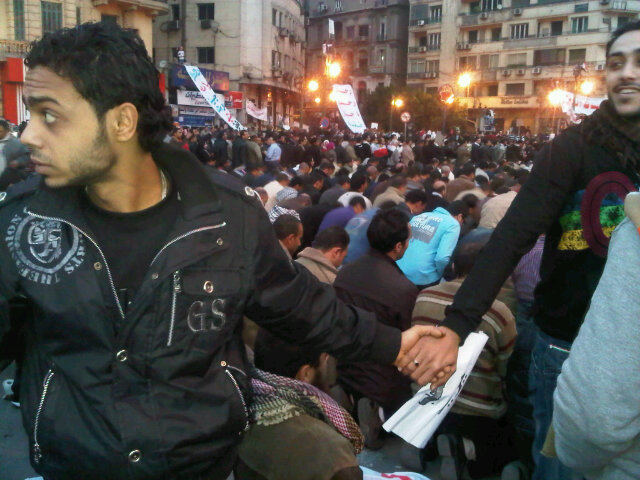
Did you hear the broadcast from Egypt on Sunday that told of Coptic Christians conducting mass in Tahrir Square?  What caught my attention was the report that Muslims surrounded the Christians in order to protect them while they worshipped. (Reuters, February 6 2011).

This action follows many reports of Egyptian Christians protecting Muslim men in the same square as they prayed last Friday. Coptic Christians make up approximately ten percent of the population of Egypt, perhaps the largest Christian community in the Arab world. (For background information, you might want to read this article from Foreign Policy.)

Have you heard about the big controversy among some Christians over whether Christian churches should rent church space to Muslims to conduct their prayer services. What do you think your church would do?

Recently, Christianity Today has featured several articles that raised questions about the relationship between Islam and Christianity as well as between Muslims and Christians.

Why We Opened Our Church to Muslims | A response to “Muslims in Evangelical Churches.” (January 27, 2011)

Muslims in Evangelical Churches | Does loving your neighbor mean opening your doors to false worship? (January 3, 2011)

From Informant to Informer | The “son of Hamas” senses God in his life before coming to Christ. (June 8, 2010)

Dispute in Dearborn | Small ministry creates big waves at Arab festival. (August 18, 2010)

Out of Context | Debate over ‘Camel method’ probes limits of Muslim-focused evangelism. (March 31, 2010)

How Muslims See Christianity | Many Muslims don’t understand Christianity—especially the idea of salvation by grace through faith. (March 1, 2000)

The above list appears in a lengthy article discussing the use of the phrase “Son of God” in Bible translations used in Muslim countries. It is an excellent discussion of the difficulties inherent in cross-cultural evangelism (Christianity Today, February 4, 2011).


If you are having trouble even reading the word Muslim without thinking terrorist, then I think you are a pretty normal American Christian.  Unfortunately, I think the dominate word in that last phrase is American, not Christian. But it is very difficult for many of us to separate the flag from the cross, isn’t it!

I am encouraged that in the middle of the political tumult, Christians in Egypt have acted like Christians to those who sometimes even persecute them.  I’m equally thrilled to see Muslims responding favorably to the Christians.

It begins to sound like the early chapters of Acts, you know those verses that describe the good that the first followers of Jesus did among the people who had killed Jesus (2:47) and the “good favor” that ensued from the entire community.

We and LST have been involved in faith-sharing work with Muslims for many years now. Our first experiences were in western Europe–which is struggling with a mushrooming Muslim population. Then later we began work in places that were secular politically though Muslim culturally, both in Asia and Africa.   I have no personal experience in the fundamentalist Arab Muslim countries, but I do know people who have worked there.

So I have many more questions than I have answers, but I am more and more convicted that not only is vilification of Muslim people wrong, but that either intentionally or indifferently ignoring them is equally ungodly.

I am convicted—as you are, I believe—that God so loved the Muslim world as well as the Christian world that He sent His only Son to die for the whole world!  Isn’t that what you believe too?

So how does that change anything for you today?


Read Full Post »

The city of Rothenburg ob der Taube was first settled in 960 A.D.  OK, stop and think about that for a moment. That is 532 years before Columbus discovered America.  I hardly know how to relate to dates like that.  But here is the date that really caused me to pause and think:  the first Christian church was built in Rothenburg in 968. 

Now I know that the 10th century is 900 years after Paul started churches in Turkey, Greece, and other places, but what that means is that people in this valley next to the Taube River have had some exposure to the name of Jesus and the story of Jesus for over one thousand years.

One thousand years is time enough for many things to happen, for instance:

  • the simple story of Jesus can morph into a complicated, unknowable story, one that only seminary-educated people are supposed to or expected to know.
  • the community of Christ can evolve into a state-organized community listed primarily on rolls for tax collection purposes.
  • the faith of those that would leave the civilized world to build a church in the middle of paganism can evolve into a kind of Christian paganism–a phrase that to me means simple disbelief of the real story but a disbelief described  in words that were formerly Christian words.
  • the buildings constructed on the backs of and at the expense of several generations of peasants, a sacrifice made because of very simple faith but devout faith, these buildings are now museums, some museums of culture and others museums of faith–not much difference really.
  • the values preached and practiced by those earliest Christians have had time to simply be absorbed into the culture–no longer recognized as Christian values, just good values.

All of these thoughts, rather than being reason for discouragement, can also be taken as a challenge for the Christian warrior–not an image we really use very much any more.  At the Euro-American Retreat in Rothenburg, there are about 135 people from twenty different countries, many of whom qualify as Christian warriors though.

There are American missionaries from Albania, from France, from Belgium, from Austria. There are national evangelists from Romania,  from Ukraine, from Italy, from Germany. Then there are the foot soldiers, not missionaries or preachers, but Christians who live in the middle of pagan, of secular, of formerly Christian and formerly Communistic societies, who are here to be encouraged and strengthened, so that they can go back and fight some more!

That’s one of the reasons we love being on mission fields with people who live in mission fields. They know they are in a battle, they know that they are fighting against immense odds. Nothing would suggest that they will win the battle–nothing except their absolute faith in the Victory of Jesus. 

Thanks to Phil Jackson from Missions Resource Network for keeping this retreat alive. It began as an American military retreat when Europe was full of American soldiers. Phil has developed a quality program for all Christians and a growing number now recognize the benefit of spending these 4-5 days together.  Let me recommend it to you!

Tomorrow, Sherrylee, Cassie, and I leave for home via an overnight in London. We are going to take Cassie to the Tower of London and to Phantom of the Opera.  She may remember London more in the future, but I believe she will be shaped more by the conversations with Bill Wilson, with the van Erps, with the Brazles–both couples–and with the workers in Hildesheim. I’m so glad she is with us in Rothenburg; I want her to be a true believer in the Victory for the rest of her life!!

Thanks for going with us on this journey.  We will talk again next week after we recover from Thanksgiving.

Read Full Post »

The first time I was in Bucharest, Romania, was Spring of 1990, just months after the revolution. The streets were empty, the stores were empty, the people were friendly–but empty, and there were bullet holes in the walls of many of the downtown buildings.  One of my strongest memories is of how the main road from the airport to  the city had to be navigated through huge potholes.

Well, the potholes are gone, the streets are full of cars, the stores are full of stuff, the bullet holes are gone except for the museum pieces, the people are still friendly–but as in much of Eastern Europe, the emptiness of 1990 has only been filled with materialism, not God.

One of the earliest LST workers in Romania was Bubba Cook–he goes by Albert in Romania, but I noticed that most of his friends still call him Bubba, so I will too.  He did short-term work for four years in several cities in Romania, and after completing his Masters at Harding Graduate School in Memphis, he was invited back to Bucharest to work full-time.  He married one of the young women in the church Lavinia and now ten years later, they have two beautiful children Bogdan and Lara. (See their picture on my Facebook page–I can’t figure out how to get to these pictures from public computers!)

But their road has not been easy. The main church in Bucharest is typical of many “post-war” churches in Europe.  Feeding on the brokenness and emptiness of the Communist era, the immediate impact of the love of Christians and the gospel story touched many post-revolution lives, so at one point in the first ten years, the congregation numbered over 300 members here in Bucharest. As people recovered economically, however, they began filling their lives with things other than God, so the numbers are down to under 50 in this same church. 

It is an old story in Europe. Frankfurt had at least three congregations that built buildings to hold 1000 people after WWII; all the buildings emptied and now have been sold, and the body of members continues to shrink with each year–and it is one of the better churches!  The same story unfolded in Japan after WWII, so this is not a country-specific spiritual disease, but one that threatens every congregation in its own story.  You can probably think of some great American churches of the past that are struggling to keep their doors open now.

As this kind of slow death begins to occur in a church, the macro-struggles of the church to survive only reflect the micro-struggles of individual Christians in the church–and often on the mission field, the missionaries or the national evangelists receive the brunt of the frustrations the church feels as it declines.

Without getting into the details of their story–because it is their story–Bubba and Lavinia shared with us many of their frustrations and their struggles. We talked and we prayed for them and know that God will continue to lead them, but they are still dodging the potholes in the roads in Romania.  Bubba is actually enrolled in doctoral studies at a seminary here in Bucharest and doing very well. I think God has great plans for him and Lavinia.  Our advice to him was simple:  “Don’t quit!”

We visited with two of the Romanian leaders of the church of Christ in Bucharest–wonderful young men, full of the love of God, and as we talked about LST in Bucharest and how we might help, they began raising the same kinds of survival questions that Bubba and Lavinia had raised. We talked about how churches plateau in Europe at about 50, then they reach a point where it takes all their manpower to sustain the church, so they quit reaching out to new people. First, they just level out, then they start to shrink. When they start to shrink, they get scared of shrinking, so they throw all their energy into trying to rescue each other, which brings them closer to each other–but makes an even more closed group for any new people to try to enter–so eventually they settle into a comfortable number–and they stay comfortable until they die.  To survive, not just to grow,  a church must continue to reach out to new people!  That is true everywhere!

We left Bucharest yesterday hopeful! All of the people we talked with were eager to reach new people, to once again offer the Great News of Jesus to the Romanian people in a way that they can really see Jesus, not just as a flat-faced icon, but as the One who loves them and died for them, the One who can really fill the emptiness in their lives.  Pray for the work in Romania.

Today, we are in Kiev, Ukraine.  I can’t wait to see what God has in mind for us today!  I’ll try to tell you tomorrow.

Read Full Post »

We arrived in Antalya, Turkey, at 3am, took a taxi to our small pension in the old part of town called Kaleici, then went to sleep.  About 5am–I’m not quite sure–I was slightly awakened by the call to prayer that is heard five times each day in Muslim countries. 

I’m not sure myself how they determine when to pray, but I do know there is a slight contest between the different minarets to be the first to call each morning.  I suppose in some parts of town you might only hear one call, but where we are staying, there are at least five different people competing over their very loud speakers to be the first, or the best, or something. Anyway, it is always an interesting cavalcade of sounds–especially at 5am after an all-night flight–as each chanter begins his liturgy.

About noon, A… and K… and their nine-month old son I… met us for lunch. We first met A and K before they were married in 2002. They were part of the first Let’s Start Talking team in Turkey. A couple of years later, they participated in the first LST internship in Turkey, and now they are full-time M….. in Antalya and great young heroes of faith.

A and K met each other first in Moscow, Russia, where both of their parents were missionaries–not working together, but putting their children in the same school. This background, of course, gives them great experience and perspective for tackling this very challenging work in Turkey.  A’s dad Tim was actually one of the last full-time workers in Turkey from churches of Christ before all were expelled in the 1970s.  Sherrylee and I are grateful to Tim for opening the door to LST in Turkey, but even more for instilling in A a desire to reach out to the wonderful Turkish people.

A and K have been in Antalya for two years now. They are already involved in leading a small Russian-speaking church–you never know how God will use you–as well as working in a college outreach effort near Akdenz University (which uses English classes, but is not LST). In addition, they have several young Christians they are mentoring.

Sherrylee and I took them to their favorite restaurant for lunch where we had a kind of mincemeat-stuffed hushpuppy with some yoghurt dip/soup and a delicious quesadilla-style entrée made with their wonderful pita bread that is native to Turkey. A and K did all the ordering, so I’m afraid I didn’t learn the names of their favorite foods to share with you. I’ll try to do better in the future.

The pita bread though and a small bottle of red wine that we ordered gave us the opportunity to break bread and remember the Lord until he comes again–something Sherrylee has started reminding me to do often at our many “fellowship meals” with people. We Christians have ritualized the Lord’s Supper so much that at first it was a bit awkward to just casually pray, eat and drink–but I suspect it is much more first-century than what we typically do on Sundays.

We talked a lot with A and K about their work, especially brainstorming how to more effectively use the LST workers that come every year. Turkey, though legally a secular country, is enough in reality a country of muslim culture and just enough of the religion to force Christians to be careful.  Turkey has the same problem with Muslim fundamentalists that the U.S. has with Christian fundamentalists. If you can imagine the challenges for Muslim missionaries in the U.S., then you will understand the challenges of Christian M…..in Turkey.

(The M……s in Turkey never even say that word because in the vernacular it conjures up the Crusades and extreme Christian oppression among the Muslims.  We will have to explore together soon the use of words like that in foreign countries.)

Saturday evening we had dinner with the A & K and their Russian co-workers M and T with whom we had such an interesting conversation that I want to write separately about that tomorrow–if that’s OK with you!

Read Full Post »

Several of you have commented on this series or have written with specific questions, and I just want you to know how much I enjoy hearing from you!  One of your comments that I have heard several times is how much you appreciate the concrete suggestions that I offer you for raising children with a heart for missions.

I have observed a certain reticence in many younger parents that we are around, a hesitance to be both concrete and confident in their own child-rearing ideas.  I’d like to just talk with you briefly about knowing what you are doing because I think it is pretty important if you want to raise children with hearts for the mission of God.

Post-modernism says that you can’t be certain. Most young couples are highly influenced, if not completely post-modern in their thinking, and so this worship of relativity has framed their thinking about child-rearing as well.  It’s suggested in all kinds of common remarks:

  • You don’t just want to indoctrinate your kids!
  • Each child just has to find his/her own path.
  • I don’t want to over-control my kids.
  • Who knows what they will become!

The best lies have a certain truth to them, and so it is with these comments! But for Christians, there are other Words that are more important than what we hear from our surrounding culture.  Try these Words and see if you can get comfortable with them.

Listen, O Israel! The Lord is our God, the Lord alone.[a] 5 And you must love the Lord your God with all your heart, all your soul, and all your strength. 6 And you must commit yourselves wholeheartedly to these commands that I am giving you today. 7 Repeat them again and again to your children. Talk about them when you are at home and when you are on the road, when you are going to bed and when you are getting up. 8 Tie them to your hands and wear them on your forehead as reminders. 9 Write them on the doorposts of your house and on your gates. Deuteronomy 6:4-9

This does not sound hands-off to me!

Come, my children, and listen to me, and I will teach you to fear the Lord. Psalm 34:11.

This sounds like parents who know not only what they believe, but WHO they believe, and they want more than anything else that their children will be believers also.

Have you ever thought what a statement and commitment the act of circumcision was for both the parent and child? At eight days, the parents committed their child to faith in the God of Abraham, Isaac, and Jacob. They physically marked the child to distinguish him from all the children who were not of Jewish families.  And circumcision was the command of God, so it wasn’t thought up by over-zealous, religiously, fanatical parents.

Here are now my words of encouragement to you about parenting your children so that they will have a heart for the mission of God.

  • Be confident in your own faith, so confident that you MUST share it with your children first! Youthful questioning and searching needs to give way as we become parents, not to dogmatism, but to confident faith—faith that doesn’t have all the answers, but knows that God is God!
  • God picked YOU to be the parents of your children; it wasn’t an accident. YOU were chosen to be the caretakers for one of His precious children, so He must believe YOU can accomplish with those children what He wants.
  • Of course, you have to depend on HIM for wisdom and help in child-rearing because you feel inadequate! But God has put ALL of His earthly treasures in earthen vessels. He is OK with our weaknesses and inadequacies. If we are fearful because of our weakness, we are confessing our own doubts about the power of God in our lives.
  • Enjoy the work of God! We are happiest when we are doing His work within His will. Teaching your children to love God and walk in His way is undoubtedly His work and His desire, so . . . delight in doing it!  Then your children will delight in Him also!

Letting children just happen is not the way of God! Your children are meant for Him. Your children were created for Him!  And God blessed your children with YOU! Be confident in your parenting and repeat the Word of God to them “again and again!”

Read Full Post »

I love baseball! I started in Little League when I was 10 years-old and by the time I was eleven, I had found my position. I was a pitcher. I threw hard and could get the ball over the plate—all you need to dominate when you are eleven!

One Wednesday night when I was eleven, I was having a great night. After four innings of our five-innings game, the other team had no hits. I had pretty much struck out every batter.  But it was 7:15 and church started at 7:30.

My mom and dad gave me the choice of staying or leaving, but there was no doubt what they thought the right decision was, so we left the game and went to church.  No regrets, not really any big deal. In my family, it was just the right thing to do.

Now, I know that we have discovered that Wednesday nights don’t count—so it may be difficult to even relate to family values that were so different, but it is not about Wednesday nights. It’s about an 11-year kid learning that what he is doing is not the most important thing in the world.

That was 1958. Let me show you how that translated into the Woodward family of 1987. Ben, our middle son, loves everything sports, but especially baseball.  By the time he was eleven, he had played several seasons of Little League—or parts of several seasons.  You see, when Ben was four years old, Sherrylee and I started taking our family to Europe each summer for Let’s Start Talking mission projects.

I would usually go with the students about mid-May and Sherrylee would stay home with the kids until school was out about June 1.  Little league baseball season usually started about the first of May and went until the end of June.  This meant that Ben was only around for a couple of weeks of practice and a 3-4 games at the most–every summer.

We always registered Ben for Little League. We always paid the fee for the whole season and we paid for the uniform. We got the bat and the glove that he needed, and we made sure that he got to every practice and every game—BUT, Ben knew that baseball and his activities were not at the center of our familiy’s summer activities.

We did not ignore Ben’s needs. No matter where we were in Europe, we bought a daily newspaper for him so he could study the box scores and follow his baseball teams.  Every year, we asked friends who had Armed Forces Network television to tape the All-Star Game for us, and then whenever we passed through their city, we would all sit down and watch the All-Star game with Ben.

I don’t remember Ben ever complaining. I don’t know if he knew what he was learning.  He knew we loved him, but he knew that he was not at the center of our family’s universe.

I could have told you about purchasing dumbbells in Germany and taking them around wherever we went so that Philip could lift weights after he started playing prep football. We didn’t stay home.

We did all kinds of things for our kids while we were traveling every summer, knowing that we wanted them to love what we were doing. We went to theme parks, we put all three of them in German church camp, and one summer we even arranged for Philip to go to soccer camp in the Netherlands—where he was the only “foreigner.”  But we did not stay home!

For most kids, I would not advise preaching the “seek ye first the kingdom of God” sermon to make this point. That’s a sermon for parents.  For kids, it suffices to learn from the decisions their parents make that the world—especially the world of their family—does not center on them! They are important—but not the center.

Then, of course, the big question becomes what is the center of your family’s universe? If you want to make sure that your children grow a heart for the mission of God, then make sure they see you making decisions that clearly make the mission of God the center of your family’s world!

Read Full Post »

Being afraid of foreign things is part of the Fall, I suspect. I know that we have encountered this same fear in children all over the world.  In Africa, the little children who have never seen a white person run away crying. In Japan, the little children cautiously want to touch our “round” eyes.  The Chinese can’t keep their hands off the blonde hair of some American children.  If we want our children to have a heart for the mission of God, then we have to begin helping them not be afraid or put off by foreign things.

In fact, what would happen if they loved foreign things? God so loved the world . . . which was very foreign, so perhaps learning to love foreign things is learning to be more godly!

Here are a few ideas for you to help your kids (and yourself) love the world—the whole world, not just your small corner of it!

  • Never talk disparagingly about foreigners and foreign things! We all know that prejudice and bigotry are passed on from generation to generation, but sometimes only very subtly.  You don’t have to wear a white cap and robe to teach your children to be racists.  Just your typical racial jokes or stereotyping will suffice. The same with their attitude toward foreigners. What do you say about the men who cut your grass or the teaching assistant that is difficult to understand? What do you say about foreign cars, foreign athletes—even about immigration issues?
  • Expose your young children to foreign foods. Instead of just Happy Meals and hamburgers, take your kids for a gyro sandwich on pita. Some of our grandkids like Sushi (I don’t), but all of them think that the Hibachi steakhouse is the best treat ever for special occasions. Our son’s family found a German deli where they could buy Brötchen and other German things, so we had a very fun German breakfast together one morning!  Take your pick from all the countries of the world and explore their foods. Remember, they are all going to be at the banquet of the Lamb!
  • Encourage your children to start learning other languages as early as possible. I love that Dora the Explorer and other kid shows expose the pre-schoolers to Spanish. Did you know that only about 1/3 of American children take any foreign language in school!  No wonder we are internationally illiterate. I just read that 200 million Chinese children are learning English and only 24,000 American children are learning Chinese.  Who do you think will influence whom in the future?  For us Christians, the question is not political; it is who will share their heart for/against God with whom?
  • Watch foreign movies! (Now I’ve really crossed a line, haven’t I !!) With all the rental possibilities now, you have access to children’s movies from around the world. Yes, they may be subtitled, but unless you make a big deal out of that, your children won’t.  Maybe start with films from England or India in English. There are also cartoons. Sure they are different—that’s what foreignness is!!  You might even try some yourself!
  • Look for schools that offer the International Baccalaureate Diploma Program! The IB program, which is an internationally recognized curriculum, is gaining some popularity in the U.S,  You do find it in public schools as well as private schools.
  • Give your child an early experience abroad—anywhere! Lots of soccer teams, choirs, bands, etc. are doing international trips. Encourage this. Of course, a mission trip would be even better.
  • The absolutely best thing you can do is to take your children with you overseas—especially on a mission trip. The combination of watching the people they love and admire the most, interacting with foreign people and foreign situations, together with their own unique opportunities to experience foreignness are the best heart-forming experiences hands down!

I do need to warn you that loving foreign things is not very American—to our own shame! I do believe, however, that it is very Christian.  Perhaps we should take Paul’s words more seriously when searching our own hearts to discern our attitudes toward foreigners:

“Remember that at that time you were separate . . . excluded from citizenship  . . . and foreigners . . . But now you who once were far away  have been brought near through the blood of Christ . . . .Consequently, you are no longer foreigners and aliens, but fellow citizens with God’s people!” (Ephesians 2:12-19).

As God loved us foreigners, so we should love other foreigners—and teach our kids to do so also. By doing so, we will certainly see a heart for the mission of God grow in them.

Read Full Post »

For over thirty years, Sherrylee and I  have been dealing with parents who thought that their student’s desire to do an LST summer mission trip was at best just a one-time fling, and at worst, a frivolous, extravagant indication of their child’s immaturity.

A large number of our summer workers have come home wanting to change their majors from Accounting to International Business, or from Computer Science to Ministry—just exactly what their parents were afraid of!

Do you really want your child to grow up to be a missionary? Here are the obvious reasons why parents do not encourage this desire in their children.

  • No money in it.  In fact, you become dependent on the charity of others.
  • Not a success-oriented career.
  • No upward mobility.
  • Takes you away from the family. And what about the grandkids knowing the grandparents?
  • Makes you misfits! Everyone knows that missionaries don’t really fit into mainstream America after returning home.
  • Bad for your children. They grow up not speaking English, not playing baseball, and maybe even vegetarians.
  • It’s not safe. Stay home and live in Oklahoma City or Dallas or Los Angeles or New York City, where you’ll be safe.

I love the Old Testament story of Hannah, who can’t have children, so she prays—so hard that the observing priest thinks she is drunk.  Then she does something pretty preposterous: she vows to God that if given a son, she will “give him to the Lord all the days of his life”(1 Samuel 1:11).

If she hadn’t been quite so rash with her vows, she would have realized that she was giving away what she so desperately wanted—but I don’t think she saw it all that way!  When Samuel was very young, his mother took him to the priest and gave him into the ministry.  I’m sure there was pain in the moment, but the first words out of her mouth are:

My heart exults in the Lord; my strength is exalted in the Lord. . . . There is none holy like the Lord…there is no rock like our God (1 Samuel 2:1ff)

Hannah visits her young son each year, bringing him new clothes to wear. Samuel served the priest Eli humbly for many years until one day the Lord called his name! Yes, that is what happens when we raise children to be servants of God.  They are called–and not to that which we may have planned for them.  Samuel does not become high priest. Samuel does not become king over Israel. Samuel does not become commanding general of the armies of Israel.  Scripture says,

And Samuel grew, and the Lord was with him and let none of his words fall to the ground. And all Israel from Dan to Beersheba knew that Samuel was established as a prophet of the Lord” (1 Samuel 3:19-20).

Here’s what I glean from this story that will help you have a child with a heart for God’s mission:

  • Recognize that your child is a gift from God, that he/she belongs to God, and that if God had not answered your prayers, you would have nothing!
  • Having recognized that your children belong to God, don’t hold on to them as if they are yours. Give them back to His service at a very young age. I don’t know exactly what this means search for any answer about our children.
  • Teach your children to serve the Lord by placing them in the hands of those who do serve the Lord. (1 Samuel 1:11) Learning to serve is almost always the first step, not learning to lead.
  • Support your children in their service! (1 Samuel 2:19)
  • Teach your children to hear the voice of the Lord calling their name! And if you can’t do that, then bring people into their lives who can! (1 Samuel 3:1-14)

So the first step in helping your children have hearts for the mission of God is to search your own heart as a parent!  What precious item belonging to God are you trying to keep for yourself? Are your desires for your children covered in prayer by the words, “not my will, but Yours be done?”

Read Full Post »

Sherrylee and I are going to California today to be with our daughter Emily and her wonderful family. We had to get up at 5am to catch an early flight, so I woke up even earlier, thinking about—and giving thanks to God—for the family that He has blessed us with.  Our family members—starting with the Mom and Dad—each have their own battles, but there is much, much more that keeps us thanking God for His undeserved graciousness in our lives.

One of the characteristics of our children—and their families now– that I personally take great delight in is that our grown children, now in their 30s, all love missions!  Of course, that they are all involved in various ways in Let’s Start Talking is one of the great joys of our life, but even more importantly, they each have what today is called missional hearts.  I think what that means is that they are both sensitive to and burdened by the needs of others to know Jesus and they actively do something about it.

I’d like for you to have this measure of joy when your children are grown, but I don’t have any formulas. Sherrylee and I certainly had a desire to see our children like this, but we did not have a plan to ensure it. I feel a bit like Peter: “Silver and gold I don’t have, but what I have, I will give to you!”

Over the next few days, I’d like to share with you some ideas that we have discovered in retrospect. These are lessons that God has taught us, and so we share them with you.  Don’t hold me to this outline–I often discover that some of the topics are really two or three and others are just bits and pieces–but here are some of the big ideas I want to explore with you.

  1. Do you really even want your kids to be missionaries?
  2. Teaching kids to be flexible.
  3. Teaching kids to love foreign things, not be afraid of them.
  4. Teaching kids by example and by participation.
  5. Teaching kids instead of just letting them happen.
  6. Making missions fun and meaningful for kids
  7. Teaching kids that they are not the center of God’s creation
  8. Teaching kids to love people, not just to be loved.
  9. When to let your kids do what they want to do, not what you want them to do.
  10. Giving your kids to God!

OK, that’s way too much, but maybe you get a hint of where I want to explore in the next few days.  I hope you will go with me.

P.S.      Did you know that you can subscribe to this blog and that by doing so, a link to it will come to your email whenever there is a new post. I usually create a new file for blogs that I subscribe to and have those go right into the file rather than cluttering my inbox, so that I can stop and read it when I have time to.  Click on the Subscribe button on the home page of this blog and you can do the same—if you think it will simplify your life a little

Read Full Post »

« Newer Posts - Older Posts »