Feeds:
Posts
Comments

Archive for the ‘Uncategorized’ Category

Yesterday, my wife’s sister Linda died at home at the end of a very long journey with early onset Alzheimer’s Disease.  She was just short of her 63rd birthday. Married for over forty years, grandmother of four, Aunt Linda to many nephews and nieces, best friend to many, and servant to everyone whose need she saw, we will miss her.

I only met Linda after Sherrylee and I started dating, so  I can’t speak to her early life firsthand. I do know that as the oldest child in a preacher family, she not only was the typical challenge to her parents, but the sparkle and glitter of their family’s life together. 

Linda and I were both in the freshman class of 1965 at Harding University. I didn’t know her because she had already met Don and was hanging out with the football player crowd. She was always a little embarrassed when Don told how they were both put on probation at Harding for leaving campus to go swimming with a bunch of friends–did I say “mixed swimming!!!”  She left Harding to marry Don the next year, so we never met until I met Sherry.

She and Don had two beautiful daughters, and she and Don were the backbone of the churches where they attended. Linda always had a heart for the underdog, a trait that perhaps frightened the parents of a teenage girl, but one which grew into a real servant’s heart.  She was extraordinarily sensitive to those in need. Twice in our life, Sherrylee and I have fled to their home for rescue–once living with them for six weeks. I know of many others who also received their love and generosity.

God’s ways are not our ways and His thoughts are not our thoughts. Linda’s illness and death were not our plan for her. While she did grieve, she did not blame, she did not whine, she continued to submit and to trust God. 

On Tuesday, I will lead the prayer at Linda’s funeral::

Holy Father, our Beginning and End, our Comforter, our Savior, only in You do we find Rest and Peace. Your Glory fills our lives from Beginning to End, everything Good we enjoy comes from your Hand. We offer to you our worship and praise.

Beyond our tears of human grief, Father, see our joy and happiness that Linda has been relieved of her ill body and is restored to wholeness. We are grateful that she rests from her struggles.  You are above all Good, Father, and this we will proclaim.

Our prayer, Father, is for comfort and peace for Linda’s family, for the blessing, not just of memories, but of the recognition of the very real parts of our lives that are the result of living with and learning from Linda throughout her life.  May her children and grandchildren, may all of us  live such lives that we may join her around the banquet table of the Lamb, to laugh and recall, but more so, to praise your Name forever.

Through the Name of Jesus who crossed the threshold before us to prepare the Way, Amen.


Read Full Post »

I was in Abilene, Texas, yesterday for a conference with those who minister to retirees in our churches. The group was not large, but it was quite interesting. Much of the program was really sharing what churches are doing as they begin to realize not only the challenges of a graying population, but the potential for the kingdom.

Here are a few of the facts that drove ministers to this conference and should drive every church into re-thinking and re-visioning its ministry with members aged 55 and above.

  • In 2000, Baby Boomers (born between 1946-60) made up 28% of the U.S. population. In 2020 it will be 36%.
  • Boomers own 77% of all financial assets in the United States. They also account for 80% of luxury travel.
  • Boomers believe old age to start between 72-78. (They will not join any group with the word senior in it nor any other of our cute euphemisms.)
  • Boomers intend to stay active. Here is what Newsweek (2/16/2010) reported, “These days, baby boomers don’t see retirement as a withdrawal from activity but as a new adventure. Many seniors will travel, volunteer, consult, and remain active, in addition to leaving some afternoons free for golfing and spending time with grandchildren. “It is a generation that is far more comfortable and even addicted in some ways to change and newness and adventures,” says Dychtwald. “They are going to pioneer a lifestyle where people reinvent themselves again and again and again.”

If you want to think about how this applies to your congregation, then think about how your membership would look if 35-40% of your members were 65 or older.  This is where all of our congregations are headed—if we are not there already.

Most of us tend to think churches are dying if all we see is gray hair in the pews. As Boomers re-invent the retirement years, however, church leaders must re-vision the potential for good that retired Boomers have for the kingdom.  For instance:

If Boomers are going to travel and remain active, they need to be challenged to revision their retirement as the time for a new mission, a new faith adventure! Re-read the above paragraph from Newsweek and apply it to Christian retirees. What can your church do to focus this energy and wanderlust for God?   LST has seen a huge boom already in retired Christians going on short-term mission projects.

If Boomers own so much of the purchasing power in the U.S., they need to be challenged to be generous. You may be suppressing a cynical laugh at this, but let me suggest that instead of targeting the cash in their bank accounts, appeal to them to use their legacy, i.e., their estate, as an extraordinary resource for the kingdom.

And here is perhaps one of the most significant unknown factors that I can share with you:  the Millenials (1980-2000) have much more respect for Age than we Boomers did for those before us. The next 25 years are a great opportunity for multi-generational synergy.  We have an opportunity to escape things like worship wars that are driven primarily by generational differences, and, instead, see whole families—extended families, led by the grandparents sometimes—serving God in active and generous ways.  The Millennials like the old and the Boomers want to relate to the young because they don’t think of themselves as old!  What can you do with that phenomenon??

God knows we Boomers as a group have brought a lot of sin into the world. Perhaps these next twenty-five years are our opportunity for redemption.  Wise church leaders will take advantage of this.

Read Full Post »

In the “Seven U.S. Standards of Excellence In Short-Term Missions” published by the SOE, the first one after God-centeredness is empowering partnerships—and for a very good reason.  Out of unpardonable ignorance, we American Christians have viewed ourselves as the only source of mission strategy, the only spring of mission compassion, and, regrettably, the only well of resources that God can use for taking the gospel to the world.  Lord, forgive us of our arrogance!

The way this flavor of hubris shows itself concretely in short-term missions is in the following ways:

  • A church is looking for a good STM for its youth group, so they call their missionary and announce that they will bring 40 kids for 10 days in July. . . . and we know you will be grateful!
  • A church sees a small, but vibrant mission church in a developing country and decides to send down a band of construction workers to build them a building.
  • A church sends a note to their missionary contact that they are prepared to come with puppets and all to do a two-week Vacation Bible School, if the locals will put them up in their homes.
  • The local evangelist agrees to provide food and housing for the STM workers if they will provide the funds. The workers will provide the funds but need receipts. The national minister is highly offended, but the American workers find his/her actions very suspicious.

Some of you may not even recognize a problem in the above scenarios, but the idea of an “empowering partnership” is absent from each one. In its place, a one-sided power-based, culturally insensitive, and borderline paternalistic attitude exudes from the American Christian side of the equation—mostly because we don’t really believe that we are in a partnership. We may be betraying the fact that we prefer a charitable relationship over an empowering partnership.

We made some of these mistakes early in our ministry, but we have tried to learn from them, so let me share with you some very concrete actions that Let’s Start Talking does to avoid these mistakes:

  • LST only sends teams when we have received a formal invitation. I know you think this is what everyone does, but, in fact, it isn’t. I know that many mission sites feel compelled, virtually coerced to receive mission teams for any number of reasons. If your site can’t say No to you because you support them or because you are white or because of any reason whatsoever, then it is not a real invitation to come.
  • Each missionary and/or national evangelist is respected as a true host. We are thankful for his/her invitation; we are grateful that they want to work with us; we are eager to serve them. They are the initiators, just as if they were inviting us into their home.
  • The important details of every stm mission project are mutually agreed upon before any final commitments are made—on both sides. From the dates of arrival to the times of every event to the cost of using the telephone, we try to clarify details prior to arrival so that we do not even accidentally trample the desires or feelings of the local church.  This is tricky cross-culturally and takes great effort, but it is essential.
  • The real needs of the hosting congregation are foremost. If it is not good to host American groups during U.S. school holidays—which is rainy season and/or winter in other countries—then don’t expect a mission site to want you to come then. If the burden of hosting 20 people is too great, then either cut the group to five or don’t send anyone. If the hosting church needs funds rather than two weeks of preaching, which would be the better gift????  And if you don’t know what the needs are, you just haven’t asked.
  • We meet with potential hosts, get to know them, and don’t accept invitations until there is mutual trust. Of course, we trust us . . . . but what about the indigenous leaders of the local church? Do you trust them to tell you the truth? Do you trust them enough to give them your food money? Do you trust them enough to let them buy the supplies for the project? Do you trust them to tell you when the best time to receive a group is? And are you only flexible about your plans, but hate it when they are irresponsible and change things? Do they even have the power to change anything?  All very tell-tale questions for any stm mission trip!

I think the word “partnership” is just a modern bit of jargon for what the New Testament called “one another.” Re-read those many passages and apply them to the relationship you have with potential stm sites and then you will know if you are a loving neighbor . . . oops, I meant empowering partner.

Read Full Post »

In celebration of our first anniversary (April 1972), Sherrylee and I drove our little Chrysler Simca down the autobahn from our home in Munich, Germany, to the city of Verona in northern Italy. It was just far enough away that we could do this on a long weekend and a short budget. And since both of us were English majors, well what more needs to be said.
Perhaps this is the reason that we saw Letters To Juliet last night when we could have seen Robin Hood. We don’t go to much fluff, having avoided all the latest round of Nicholas Spark tear-jerkers and their lookalikes. Perhaps it was that we had my in-laws with us, and they hardly go to the movies at all. When both of you are in your 80s, I suppose you have seen everything!

Nevertheless, we entered with low expectations and left having thoroughly enjoyed one of the best fluffy movies that I have seen in a long time.

The plot is absolutely predictable: a young woman (Amanda Seyfried) goes to Verona with her fiancé on a pre-honeymoon, where she becomes involved with the local women who respond to lovers’ notes left under Juliet’s balcony. She discovers a note that has been hidden for over fifty years, answers it, which leads to an older British woman (Vanessa Redgrave) and her grandson (Chris Egan) coming to Verona to find Lorenzo!

You can imagine much of the rest, so I won’t spoil it for you, but let me tell you what made the film delightful. First, Vanessa Redgrave does an amazing job of not letting her character—the woman chasing love lost 50 years ago—become schmaltzig. Instead she plays her role with extraordinary sensitivity, perhaps more than the film deserves—but it makes her character believable and sympathetic.

Amanda Seyfried may have started as a Mean Girl (2004), but most recently she has taken on roles that exploit her very blonde innocence—and I don’t mean that disparagingly. I enjoyed her in Mama Mia and again in this film, where she manages to pull off a very tricky role. Her character Sophie has to show disappointment in love, ambition, intelligence, abandonment, but most of all vulnerability. With only a few exceptions, I thought she was fun to watch.

Her counterpart is Chris Egan, playing a stuffy, British prig who is captured by Sophie’s winsomeness. Franco Nero, the famous Italian actor, enters on a white horse….yes, it is true—without any damage to the film whatsoever.

It is a very clean, little romantic comedy—nothing that embarrassed my in-laws at all—and some scenes that are quite funny.  (I do wish they had just said the word “marry” once.)The beautiful Italian countryside and the scenes of Verona and Siena are just about worth the price of the tickets alone.

For a light, fun, clean night out, you won’t be disappointed with Letters To Juliet.

Read Full Post »

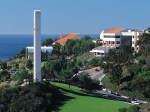
If you are one of the people who have never thought well of Pepperdine, well, shame on you!  Let me tell you about Pepperdine University from my experiences with it.

Yes, Pepperdine has one of the most beautiful campus settings of any university in the nation. That’s what people see on the surface. And, yes, Pepperdine has a national reputation, being mentioned in the same breath with much larger, private universities, a reputation which it no doubt deserves. But this is not what I want to tell you about.  I want to tell you about the well-being of the Christian faith at Pepperdine, specifically with regard to its relationship to churches of Christ.

Pepperdine is a place where you can send your child to school and they will be taught by people of faith. Our three children and two of their spouses graduated from Pepperdine in the late 90s. While they were students, their faith was tested, their faith grew, and their faith was affirmed.  One was an English major, one a history major, one a biology major, one in sports medicine, and one was a religion major. Some were members of fraternities, one played collegiate sports, some were active in the campus ministry, and others were not particularly.  All of them graduated with a stronger commitment to serving God in better ways because of Pepperdine people who inspired them.  Even that occasional faculty member who does not share our faith tradition and who challenged my children were an opportunity for them to prove their faith. They learned not to be afraid.

Pepperdine actively seeks to serve churches of Christ with whom it has always had a strong relationship. We have just finished the Bible Lectures at Pepperdine—and it was a spiritual feast. The gathering of thousands on the campus each year is a highlight for Christians from across the country.  At these lectures, the best speakers/teachers in our fellowship gather. Classes are offered from 8am to 10pm, almost non-stop and the only bad thing is, so many are addressing issues, questions, methods, challenges, and ideas among our churches that it is impossible to be everywhere at once.

The evening venues are filled with a capella singing groups from throughout the country—and they are always packed. Next week, Pepperdine hosts one of the most unique conferences in the country, called “Ascending Voice” which is a celebration of a capella music from many traditions.

Conferences and opportunities are offered to California ministers, to families who want to grow in faith. Pepperdine just opened a Center for Restoration Studies, which is a repository for rare and valuable Restoration Movement pictures and documents. You really do not have to mine the Pepperdine website very much to find lots of events specifically for building up and serving Christians.

The very openness of the conversation at Pepperdine and the fact that a small percentage of its undergraduate students are from our fellowship make it suspect to some. My children thrived here as Christians for these very reasons. They found a real world environment that did not artificially protect them, but rather helped them learn to live as ambassadors for Christ in a way that did not alienate those they were living among. Sounds like the first century, doesn’t it, when the earliest Christians lived in favor in their community.

Has Pepperdine presented itself on every occasion appropriately; have any of our Christian universities? Are there faculty members who cross lines? Do some of the students do things that offend our sense of right and wrong?  Aren’t we just asking if it is full of people, some Christian, who don’t always do the right thing?

I love Christian education. I graduated from Ft. Worth Christian High School and from Harding University; I taught twenty-four years for Oklahoma Christian University. Over the years, LST has had much to do with Lipscomb, ACU, York, OVU, and many of the Christian colleges. I am proud that Pepperdine University is tended and supported by our fellowship.

Read Full Post »

Here are some topics that I have in mind to spend time writing about in the near future.  I’d love to hear what you think about them. You can vote for as many as you like.

Thanks for reading the blog. I’m enjoying your comments and the feedback I’m getting. Feel free to suggest other topics or ways I could improve the blog.

Read Full Post »

Fifteen years ago today, I was standing in my office at Oklahoma Christian when one of my colleagues rushed in and said, “A bomb just exploded downtown!”  I thought, “That’s interesting,“  imagining something like a small letter bomb or something that blows up an office, set by some disgruntled employee.

Of course, within minutes the reports started coming of what was until 2001 the deadliest terrorist attack on U.S. soil in modern times.  Now fifteen years later, the country has experienced worse, so it is easy to forget what we learned from Oklahoma City.  Here are a few of my thoughts:

  • Home-grown, flag-waving extremists are just as dangerous as foreign jihadists. Immediately following the bombing, reports of Arab-looking suspects were all over the news; the real bomber, however, was born in New York of Irish Catholic parents, voted “most promising computer programmer” at his high school, a decorated veteran of the first Gulf War, and an outspoken anti-tax, pro-gun, anti-government proponent.  The current extreme political rhetoric and hyper-polarization frightens me!
  • The use of war metaphors does not justify killing innocent people. McVeigh declared war on the federal government, so killing kindergarten children in the Murrah Building was for him an unhappy, but acceptable consequence of his military objective. Neither as individuals nor as countries should we be confused about the morality of killing innocent people for our own benefit.
  • Average people are amazingly good and amazingly brave in a crisis. Immediately following the bombing, police and medical personnel rushed towards the bomb site. One of our church members was among the first police officers to arrive; he crawled into the rubble to pull out a baby covered in ash—but alive.  Vendors brought bottled water, sandwiches, blankets, medical supplies; people of all sorts came to help however they could.  Students at OC with just minimal training in first aid rushed to the scene, wanting to do something to help.  I’m not sure I have ever experienced a greater sense of community.
  • Everyone is damaged; the world is diminished by such acts of violence. Our friend the police officer was so traumatized by what he saw and experienced in the first hour after the bombing that he spent months –maybe longer—seeking help and attempting to recover.  Not only the families of the victims, but the friends of the families of the victims, and the relief workers, and those who narrowly missed being victims just by “chance,” and the man who rented the delivery truck, and people who sell fertilizer, and everyone who works in a government building who goes to work every day, the whole community has been damaged. There are no armies, no federal agencies, no screening devices, nothing that can restore this world to wholeness. We can only forget–which we will with time.

But Christians must live in certain hope, participating with God to transform this world from being a bombed-out shell to a place where swords have been beaten into plowshares and lions lie down with lambs. What we can’t forget is that we belong to the Prince of Peace!

Read Full Post »

My wife and I watched the whole first season of Flashforward over the last few days, and I admit being captured by it. The characters are well-developed, the actors are good, and the drama is centered on the human dilemma.  For those not familiar with it, all of the story threads revolve around how people’s lives were/are changed by a global blackout, lasting 2 minutes 17 seconds, during which time everyone saw  themselves six months later doing whatever they would be doing in those 2 minutes 17 seconds. For some it brought hope, for others despair, but for everyone the question became what to do about now.

Today as I was walking, I was thinking about the young character that has learned that he will be murdered on March 15. That led me to the question: what would I do if I knew that in thirteen days I would die? There’s no time for a Bucket List kind of response; there is no illness to usurp mind and body over these last few days as in The Notebook. What would I do if I knew that March 15 I would die suddenly?  Here are my thoughts:

Things I would not do

  • I would not panic spiritually. I would be fearful of the process of dying, but I am confident in a gracious God.
  • I would not feel “robbed” of future days; I’m a strong believer in “All the days ordained for me were written in your book before one of them came to be” (Ps. 139:16)
  • I would not publish this on FB, Twitter, or a blog—that’s just me.
  • I would not join the March Madness office pool or prepare for the fantasy baseball draft.

Things I would do

  • Get my will and financial affairs in order for my wife’s sake.
  • Make appropriate arrangements for the LST ministry to minimize the effect of my sudden absence.
  •  I would once again do something proactively to mend relationships with a few people.
  • Yes, I’d probably do some kind of video for the grandkids—they are so young that they would scarcely remember me. I would not want to be maudlin, but maybe tell them stories from my life. (I have a cassette tape of my Granddad telling stories of homesteading in Arizona in first years of the 1900s, and it is much of what I remember about him.)

What would you do/not do?  Having made my lists, I have now decided that I need to take care of all of this as if my last day were right around the corner.

And by the way, if this kind of conversation makes you uncomfortable, you might try to figure out why because as Shakespeare’s Hamlet says, “If not today, then tomorrow….”

Read Full Post »

Just this week, I received word that Outreach Magazine, a leading evangelical magazine with a readership of 80,000 people, had selected the Let’s Start Talking Sycamore Series as the #1 small-group curricula for 2009 (See www.outreachmagazine.com .) Since most people do not know about Sycamore yet, I thought I’d use this opportunity to share with you enough to tempt you to investigate more. I believe it has the potential of being a game-changer –but then I am totally biased—so I’ll let you decide.

For 30 years, LST workers have been trained to “let the Word be the Teacher, and you be the illustration,” also, that faith begins with the story of Jesus (“These things are written so that you may believe that Jesus is the Christ, the Son of God—John 20:30,31). Working this strategy creates a very non-threatening, natural relationship between two people in which a Christian can easily find natural words for sharing  faith with another.   About five years ago, returning LST workers began asking for materials to use here in the States with their family and friends. All LST materials prior to Sycamore used a person’s desire to improve their English as the starting point for the relationship; what our workers wanted was something they could use with anyone.

As we sat down to work on this project, we set the following goals for this new material:

  • It would continue to be Word-centered, starting with the story of Jesus in the Gospels.
  • It would assume no faith on the part of Readers (LST jargon for a Christian’s conversation partner).
  • It would be for a post-modern culture, which meant that it would not be linear sequential, i.e, logically building upon biblical truths in order to reach a rational conclusion.
  • It would nurture authentic relationships.

We currently have three workbooks published, titled The Life, Encounters, and Stories, but have six more in progress. In addition, we produced a valuable training DVD with a training guide that is essential in order to use Sycamore most effectively.

Finally, let me say as a father how proud I am of our daughter Emily, the author of the series, who bears with my ideas and intrusions and whose love for Jesus and sensitivity to those who seek is found on every page. And she is great on the DVD too!

If you would like to know more about the Sycamore Series, go to www.sycamoreseries.org .

Read Full Post »

« Newer Posts