Feeds:
Posts
Comments

Each time I choose to use Luke 10 as a sermon text, I learn something new.  Just last Sunday, I used it once again as my text for the Sunday sermon in Columbus, Georgia, and a couple of very important lessons and applications jumped out at me for the first time as I prepared.

Of course, Luke 10 is the chapter that describes the sending out of the seventy-two disciples:

 “1 After this the Lord appointed seventy-twoothers and sent them two by two ahead of him to every town and place where he was about to go.”

Who are these seventy-two people? In Chapter 9, Jesus sends out the Twelve and we know all their names! We even sing songs about them in Sunday school to help us remember their names. We call our sons Peter, John, James, Andrew, Philip, Bart, Tom, Matthew—not so much Thaddeus, but there was a time when even that was a popular name. But who are the seventy-two?

In Chapter 9, the Twelve go out with the same basic instructions and have a successful mission trip. Later in the same chapter, however, they start arguing about who will be the greatest in the kingdom. They had returned in triumph, but Jesus had almost immediately started talking about His death—which to them must have meant defeat, not triumph.

They meet the man with the demon-possessed son and apparently have lost either the power or the faith to cast out the demon because they fail in their attempts, according to the father’s report to Jesus (9:40) Maybe Jesus had talked too much about His death.

Perhaps it was this failure on their part that caused their jealousy first of each other, then of other people who were casting out demons in the name of Jesus but were not one of the Appointed Twelve! Jesus has to first remind them that not high position but humility is of value and then that their appointment did not make them greater than the unappointed who worked in His name.

Then those same Twelve walked with Jesus into an unbelieving Samaritan village and just wanted to nuke all the unbelievers! Jesus rebukes them again for not having learned that mercy triumphs over judgment!

Who are these seventy-two people in Luke 10 then? Perhaps they were some of the followers left over from the 5000 that Jesus fed near Bethsaida (9:10). I wonder what the Twelve thought when Jesus started choosing some of these “loaves and fishes” disciples!  I wonder if they thought they were being replaced?

 I wonder if they secretly were hoping that the seventy-two failed in their mission. Schadenfreude lies hidden in many of our hearts.

The Twelve had so much to learn! Yes, Peter had just made the Great Confession, and, yes, witnessing the Transfiguration was a life-changing event, but they still had much to learn about following Jesus.

I know who the seventy-two were! They were just no-name people like you and me! Their names never surface; never is anyone later identified as one of the Seventy-Two! We don’t know what happened to them after the great experience recorded in Luke 10. I’d like to think that they continued to follow Jesus and were part of the 120 in Jerusalem after the resurrection, or part of the 500 to whom Jesus appeared after His death!

But there is a lesson to be learned: Jesus was not looking for first-round draft picks that would become celebrities! He was looking for people who could deny themselves, take up their cross, and follow him.

He was looking for people who did not let anything come between them and following him. Perhaps he had been calling those in Luke 9 for this second mission team, when they turned him down to bury their fathers and say good-by to their families, or because Jesus didn’t really have the proper arrangements for housing made yet (9:57-62).

Jesus was not looking for superstars, but for regular people who would go out in His name—lacking support, warned of rejection, no promise of success! He found seventy-two No-Name Disciples who were not looking for power positions or name recognition, but who were willing to go where they were sent, to talk about the kingdom, and to use their gifts for the good of those they met.

I believe Jesus still uses no-name people for great service in His kingdom in greater numbers than the group of those whose names we recognize.

Not being appointed to The Twelve is no disadvantage. Those who are have perhaps greater struggles, greater challenges, and harder roads. Most of us should be delighted to be chosen to the No-Name group.

In fact, all of us should be thankful to be chosen at all!

 

Missional is one of those fuzzy buzz words that one hears at large church gatherings. You think you know what it means, but maybe you don’t—and you can’t ask anyone because everyone else knows what it means except you!

Simple definitions leave a lot of us asking questions, so here is my attempt to give you concrete pegs on which to hang your understanding of missional .

A missional church is

  1. Where YOU show up, not God. A missional church is joining God in His work, not inviting God to be a part of your work!
  2. Where the members know that the Great Commission says GO, not COME!
  3. Where all of the members are missionaries, not just those out of the country.
  4. Where mission contributions are not special contributions.
  5. Where what happens out of the building is equally important—if not more important—than what happens in the building.
  6. Where “going to worship” happens every day, not just on Sundays.
  7. Where church leaders meet to pray for new work, not just to manage and control old work.
  8. Where members know their neighbors.
  9. Where the community would be diminished if the church closed its doors.
  10. Where no borders are recognized except those of the Kingdom of God.
  11. Where members expect to meet new people at church!
  12. Where members expect to have unbelievers at church!
  13. Where the church is God’s church, not “our” church.
  14. Where its children grow up wanting and encouraged to be missionaries.
  15. Where benevolence and evangelism are the same thing.
  16. Where there is no difference between my life and church life, my time and God’s time, or my money and God’s money.
  17. Where members are not afraid of being in the world because they see it as their mission field.
  18. Where members are motivated by love and gratitude.
  19. Where members extend grace and mercy, speaking the truth in love.

I feel like there ought to be a #20! What if I leave that open for you to fill in. Leave a comment and share with us what you understand a missional church to be!

“A Deity Retires! ” This was the tagline to an article in Der Spiegel about the retirement of the Dalai Lama. The “god-king” of Buddhism is tired of being divine and wants to become just a simple monk again.

He does not want to be a “wish fulfilling jewel” nor does he want to have any further “political responsibilities.”

While Jesus became frustrated with his followers, and God the Father is described as “longsuffering,” I’m thankful that we do not have a God who will abandon us, who will “leave his followers to their own devices.”

So what do you think of this paragraph about the religion that is losing its deity?

Buddhism has become the fashionable religion, from Los Angeles to London, just as the monk Padmasambhava predicted more than 1,200 years ago: “When the iron bird flies, when horses run on wheels, the king will come to the land of the red man.” The Germans are particularly enamored of Tibetan Buddhism, with their dozens of Tibetan centers and tens of thousands of Dalai Lama disciples, who see the Asian faith as the most appealing world religion, and one that generally does not look down on people of other faiths. It preaches peacefulness instead of inquisition, persuasion through meditation instead of missionary evangelism and the hope of attaining Nirvana instead of the threat of jihad, and it treats guilt and sin as concepts from a different, more punishing religious tradition and man as the sole creator of his own fate. What could possibly be wrong with that?   http://www.spiegel.de/international/world/0,1518,782329,00.html  8/25/2011

What could possibly be wrong with that?

Look at the assumptions about Christians:

  • Christians look down on people of other faiths.
  • Christians preach inquisition and judgment instead of peacefulness
  • Christian persuasion through missionary evangelism is somehow inferior to persuasion through meditation.
  • Guilt and sin are the result of a punishing religion, not the normal response of created-in-the-image-of-God people.
  • Being the sole creator of your own fate is both true and possible—and is superior than being created by a loving Creator and living under His wing!

To the degree that any of the above are true about Christians, they are true because Christians have not acted like Jesus.  Sadly, our human weakness gives rise to false assumptions about our God—all of which should motivate us even more to strive for perfection.  But the flaws of Christians do not in any way diminish the divinity of our Creator! We don’t create God; He creates us!

But does it bother anyone else that this “god-king”, chosen when he was two-years-old because he was believed to be the reincarnation of the original Dalai Lama born in 1391, can simply resign his divinity.

As a Christian, I know that my faith does not rest in a god who will resign, but in I AM WHO I AM,  who was, who is, and who is to come!  I take great comfort in the absolute certainty that “the steadfast love of the Lord never ceases! His mercies never come to an end.”

Heaven is real. Shangri-la is not!  The Lord our God is One God!

He and his wife had been close family friends.  He was a well-respected preacher for one of the better congregations in town.  Then he became one of my heroes when he and his family moved to a foreign country and became missionaries.  His reports were what helped kindle the fire for missions in my own heart.

It’s an all too familiar story.  I don’t know the details, but he was caught up in adultery, his wife and children left him, he lost his support, returned to the States pretty broken–a minister who had lost his way, his family, his work, his life.  You’ve seen this too.

Years later, I was visiting with him and his second wife.  He had found a humanitarian organization that would support him to work in a small village in a third world country, so he, now late in years, was leaving the States, having sold insurance to make a living for a couple of decades, finally able to use his marvelous gifts in a special way for God again. He will work anonymously there and probably die there—he and his second wife.  I’m thankful for his redemption—and mine.

The one time that we visited just before he left, he made a special point to say, “Mark, I want you to know that although we love each other, both of us realize that our sins against God and our mates were terrible. The cost of what we lost and the damage to others which we inflicted can only be forgiven, never repaid. “

It’s not law that we need to stop the tidal wave of divorce; it’s not judgment!  It’s Truth!  Speaking the truth in love is what will set us free!

If you are divorced, please do not hear my plea as judgment; rather, join me in saying that Sin causes divorce.  And God hates Sin! And the consequences of Sin are pain, destruction, even death without the Grace of God.

If you were sinned against, then you know better than anyone why God hates Divorce.

If you sinned against your spouse, then you know better than anyone how destructive guilt and shame are and why God hates Divorce.

Tell the truth in love, if you want to teach your children and mine to hate Divorce.

Tell your friends who are thinking about divorce the honest truth. Talk to them about Sin, not happiness. Unmask the lies they are telling themselves. Describe the loss and destruction—the collateral damage to their children, their friends, their church.

No matter what we do, there will be spouses who must escape from abusive relationships, dangerous relationships, who are abandoned or betrayed.  Divorce is part of our broken world that we all are enduring until the Lord comes again and makes everything right.

But I do believe we Christians can be a part of that redemptive process now by teaching our children and teens and young singles and young couples and marrieds and parents and classics that God hates divorce!

Every Sunday morning for the four years I was in college at Harding, I got up about 7am, got dressed, and drove an hour and a half to Formosa, Arkansas, where I preached for the Church of Christ there.

Every Sunday morning for four years, at 7am, my radio alarm would go off to wake me up. No buzzer, no rock station. In Searcy, every Sunday morning at 7am the local religious program would begin with a hymn as its program opening.

So every Sunday morning for four years at 7am, I awoke to the following words:

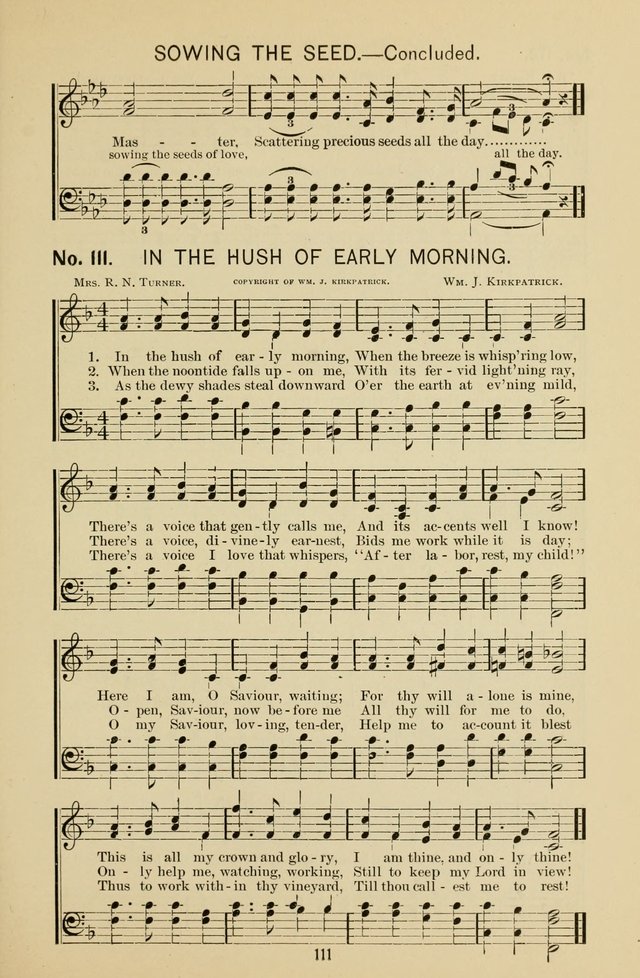
In the hush of early morning, /When the breeze is whisp’ring low,

There’s a voice that gently calls me,/And its accent well I know!

Here I am, O Savior, waiting; For Thy Will alone is mine,

This is all my crown and glory,/I am Thine and only Thine.

Every Sunday morning for forty years now, if it is a quiet Sunday morning, that is, no phone call wakes me, no children crying, no illness requires immediate attention, if it is a quiet Sunday morning, I wake with these words and that soft melody in my head.

Actually, it’s embedded even deeper, because often, when it is not Sunday, and  I get up early to walk, if it is still quiet in our neighborhood, those words come first to mind—sometimes I even sing as I walk.

In a time when even our worship together on Sunday seems to need to be loud and the goal seems to be to pump us up into a holy frenzy, in a time when most of those who aren’t going to church I meet walking are plugged into something that drowns out the quiet, let’s be careful that with all of our self-created noise, we don’t drown out the voice that gently calls us.

Starting Sunday, the Lord’s Day, with quiet surrender: “Here I am, O Savior, waiting; For Thy Will alone is mine”

. . . well, I think I’ll quit talking now and just be quiet for a while longer.

I suspect that most of our young people who are still in church think that the only reason to get married is to have sex without sinning. Otherwise, why do you need to bother getting married? It’s just a piece of paper.

Certainly this is the message of the culture we live in. Listen to what the Huffington Post said on July 5, 2011:

Shocking new statistics released recently by the U.S. Census Bureau suggest that Americans may no longer need marriage. For the first time ever, fewer than half of the households in the United States are married couples. In the past decade, the number of unmarried couples increased 25 percent as more people chose to cohabitate. A Pew Research Center study last year put it more succinctly, finding an increasing number of Americans now believes marriage is “becoming obsolete”.

Christians will not win this battle for Christian marriage—even with our own children and grandchildren—unless we teach our children a much more biblical view of why people should marry.I’m not talking about just advantages, but rather God-ordained purposes for marriage, His design for marriage.

Here’s my brief list. You may want to add to it—but if you do, be sure and ground your reason in the Word.

  1. Genesis 2 & 3.   People were created to live in pairs. It was not good for people to be alone, so God made spouses.  Marriage is a state of completeness that God intends for most people! Yes, there are exceptions—including Jesus himself—but most people were intended to be completed by another, not to be alone.
  2. I Corinthians 7:2-6           People should marry to enjoy sex, which will help them avoid sexual immorality, which includes promiscuity, adultery, pornography—any sexual sin.
  3. I Corinthians 7:2               People who marry should be confident and secure with faithfulness from their spouse.
  4. I Corinthians 7:5               People should marry to support each other’s relationship to God. It’s not good physically to be alone; it is perhaps worse spiritually to be alone.
  5. I Corinthians 7:33,34       People who marry learn to better please each other. They learn to put someone else’s needs above their own.
  6. Ephesians 5:21ff               Both husbands and wives learn submission in marriage, a virtue that is essential for pleasing God.
  7. I Timothy 5:14                Marriage is for the purpose of having and raising children.
  8. I Corinthians 7:15             Marriage should provide a haven of peace!
  9. Ephesians 5:22ff               Marriage is for enjoying every benefit of love and respect
  10. Deuteronomy 24:5          Marriage should be a place of real happiness.

I’m trembling even as I write this because I can hear so many of you screaming, “That’s not how my marriage is!”

“That’s not a description of anybody’s marriage!”

“Faithfulness, hah! Submission—sure or get hit! Peace? With that mean drunk!

“My marriage is hell!”

The abandonment of God’s purposes for marriage is so widespread that the corruption seems both inherent in the institution and unavoidable!  So why get married?

So why follow Jesus at all? Most people don’t, and most of those who do follow Him do so quite imperfectly—many even blatantly hypocritically!  Lots of Christians do terrible things. In spite of this, Jesus says, “Follow me” and we believe there is no other way!

I have to argue that the same is true for marriage. In spite of the corrupted marriages all around, marriage as God intended, as He purposed, is still designed to fulfill all of the wonderful purposes listed above.

Yes, marriages can be hell if the will and purposes of God are not foremost!  Where God is not present is the very definition of hell.  But do you not believe also that where God is, there is heaven! Can marriage be anything but heaven when God is there?

To those in bad marriages: search your heart honestly and repent of your own sinfulness, then pray that God will be present in your marriage, and raise it from the dead. He can do what you can’t even imagine! Ask other Christians to fight for your marriage in prayer!

To those already divorced because of bad marriages and still angry because God did not save your marriage: the consequences of sin in marriage are terrible. If you were sinned against, God still loves you! God allowed even His only Son to be sinned against and to suffer horribly.  No one can tell you why you had to endure such pain, but God has not abandoned you.  You can be sure of that!

To those in good marriages:  remind yourselves of why you are happy! Don’t take credit for it yourselves. Give glory to God! And teach your children and grandchildren why they should marry in the Lord. Teach them not to be afraid of marriage because of the corruption they see around them, but to trust God’s steadfast love.

To those yet unmarried: The only way to happiness is a marriage made in heaven! Be serious about testing both your own heart and the heart of a person you might marry to see if the reasons you want to marry include all of God’s purposes for marriage.  Before you step to the altar, make sure you are ready to take vows before God and that you really want God to join you together.

There are no perfect people, so there are no perfect marriages, but both we and our marriages can be perfected. In Ephesians 5, Jesus washes away all blemishes from His Bride, so their marriage will be perfect. The more we lose our marriages in Him, the more perfect our marriages become as well.

Because God didn’t dictate a particular ritual or ceremony, even Christian weddings today are trending towards being completely secular. Yes, we still do them in church buildings—but it is not an official church service! Ministers still perform the ceremony—but so do fathers, professors, camp counselors, and county judges.  Most couples write their own vows rather than use stuffy church words.

One of the reasons the act of marriage is under fire in society is because of our uncertainty about what it is. Is marriage just a piece of paper, a legal status, a social status? Is there anything spiritual about marriage or is it just a cultural convention?

We really don’t even know what it takes to be married, or when marriage occurs! If a couple live together for twenty years are they married? Does it depend completely on the laws of the county or state or country where they reside? Can people just decide to be married? Or are two people married if they have a sexual relationhip—whether they intend to be married or not?

Does God not have anything to say about any of this???

We are so confused about what marriage is, no wonder Christians have so little trouble either ignoring it or abandoning it!

Moses, Jesus, and the Apostle Paul all return to the Beginning to talk about marriage—yes, the very beginning, so I think we should too.  In simple words, let’s remind ourselves of God’s description and design from the beginning

From Genesis 1:26-28—The First Creation Account

  • We are created in the image of God, male and female. As God is “us”, so are we!
  • The first command is to be fruitful and increase in number. “Fill the earth”! Procreation seems to be high on God’s agenda for men and women.

From Genesis 2:18-25—The Second Creation Account

  • Creation is incomplete until both Man and Woman are created.
  • Because both are incomplete without the other, Moses inserts  “for this reason”  people get married!
  • His basic description of the marriage ceremony  includes three distinct actions:
    • First a man decides to leave his birth family to create a new family.
    • He bonds himself intentionally to a wife, with the intent of being married
    • The two become one flesh through the sexual union.

THEN GOD JOINS THEM TOGETHER! This is the part we forget! We think that the law joins people together, or our vows, or that sex joins people together, but Jesus says, GOD JOINS THEM TOGETHER.

We make the same mistake with marriage that we do with baptism. Sure, we decide to be baptized! Sure, we submit to baptism. Sure, we are immersed in the Name of Jesus–but nothing would happen if God did not do something, if God did not wash away your sins! If God did not give you new life. If God did not add you to those who are being saved!  You cannot save yourself—and you cannot join yourself to another without God!

Don’t you think that this understanding elevates marriage from where it currently is in our world?  If we were to truly believe that God was joining a man and woman, would this moment not become much more holy!

I do believe that if we want to avoid divorce, we must recognize the divine participation in marriage and the holiness of the union.  We need to teach our children what God does at marriage. We need to instruct our engaged that God must do their ceremony. We need to instill in all of us who are married an awareness of being acted upon by God, divine intervention that created this union.

Only when we understand the sacred holiness of marriage can we understand the laws and attitudes of the world have very little to do with our marriages.


I grew up in Texas and am old enough to remember the bathrooms and water fountains labeled “Colored Only” and “White”. I remember the racial jokes that were told by children as naïvely as “blonde” jokes or “aggie” jokes are today.

From 1969 to 1971, I lived and worked in Oxford, Mississippi, just seven years after James Meredith was enrolled in the University of Mississippi only with the help of the National Guard and after people were wounded, even killed, in the attempt to keep him out!

The Christian Student Center in Oxford was where Gladys cooked meals for Christian students who wanted to eat supper together. She was a wonderful Christian woman, but she had lived in a racist world her whole life and knew the rules in Mississippi. Rightly or wrongly, she did not feel comfortable even coming out front, but preferred to stay in her kitchen. She couldn’t go to church with us—she could only cook for us.

The Help captures that time in a painfully accurate way, but in a way that shows the courage of those women who didn’t march, who didn’t face fire hoses and dogs, but who refused to suffer silently any longer.  You have to see this movie!

Aibileen (Viola Davis) and Minny (Octavia Spencer) are house maids for young Junior League women of Jackson. They raise their children, cook their meals, and clean their houses, but are not just ignored like the British do their house staff, they are treated like farm animals kept in the barn, brought out whenever you need to work them, and put out when no longer useful. I found it extremely painful to be reminded of how common blatant bigotry was.

Skeeter (Emma Stone) is a white girl who grew up in an ante-bellum home, but perhaps because she herself was an outsider, she found a way past the racism that surrounded her. She wants to be a writer, so she starts trying to capture the stories of the women who raised her and her friends. The women are afraid at first—too dangerous to step out of the crowd—but later events give them courage and Skeeter is their voice.

The characters are rich. I was often reminded of the performance of Oprah Winfrey in The Color Purple (1985) that set her on the path to where she is today. The emotions are true. The intensity is real, but broken just enough by truly funny moments.  Even as the film came to a close, I could not completely free myself of the fear of retaliation towards the women—that was all too common.

Although there is some bad language, I think teenagers ought to be able to handle this film if seen with their parents so they can ask questions.

I highly recommend The Help to you.

“Those who cannot remember the past are condemned to repeat it!”

By the way, Gladys’ son became campus minister in the same student center where his mother cooked. The white church was the first to integrate in Oxford. The pain is real, but there are some happy endings.

The terrific pain and trauma surrounding any divorce should be enough to convince everyone that it is not what God wants for anyone!  The only proper response when we meet those who are scarred and damaged by divorce is to weep with those who weep! I’m truly sorry for the suffering, also for the anger, for the guilt, and for the deep sense of loss that you may have suffered with as well.

Divorce is not a fruit of the Spirit: love, joy, peace, patience, kindness, goodness, faithfulness, gentleness, self-control—these are the fruit of the Spirit of God in us!

Sexual immorality, impurity and debauchery, idolatry, hatred, discord, jealousy, fits of rage, selfish ambition, envy, drunkenness…and the like, this sounds more like Divorce, doesn’t it! Paul says that these are acts of our sinful nature. Divorce definitely belongs on that side of the ledger.

No wonder God hates Divorce! Can we agree that if God hates Divorce that we should also hate Divorce?  Can we teach our children to hate Divorce? Can we teach our churches to hate Divorce?

Can we show enough love to divorced people that they know they are loved by us and by God even if God and we hate Divorce?

So what should the spouse do who is battered, or abused, or betrayed, or humiliated, who is disrespected?  Is divorce an option? 

Much I don’t know, but here is what I do know from God’s Word. Let’s look first at Jesus’ words in the Gospels (Matthew 5:31-32; 19:1-12, Mark 10:1-12,  Luke 16:18)

  1. When asked about Divorce, Jesus said that the plan from the beginning of time was that what God has joined together, no man should separate!
  2. Jesus acknowledges that God allowed divorce because of the sinfulness of God’s people, even though it was not what He wanted for His people.
  3. Jesus says that to divorce your spouse to marry another is adultery.
  4. Jesus allows divorce in the case of adultery.  (Other translations of porneia include unchastity, sexual unfaithfulness, fornication, sexual immorality, even incest.)

So Jesus hates Divorce, but allows for it. 

The Apostle Paul mentions another exception: if a person becomes a Christian, but the spouse does not , if the unbelieving spouse leaves, the other is not bound. (1 Corinthians 7:15). I know that we have argued about this verse, but usually it is over the question of remarriage, not over divorce.  Paul says clearly that the believing spouse is not bound!  The divorce here, it should be noted, is instigated by the unbeliever, not the believer. That is important!  God hates Divorce!

I need to mention also that God Himself divorced Israel. Read Jeremiah 3 and Isaiah 50. He divorced Israel for adultery (Jeremiah 3:8) and for her sins and transgressions (Isaiah 50:1). In both cases, He longs for reconciliation, but there is no doubt that He has divorced her!

God hates Divorce—but He Himself has been through divorce. No wonder He hates it!

I really didn’t want to start with Divorce. I wanted to start with Marriage, but so many of us Christians are already divorced that I needed to let you know where I was coming from—and that I’m not advocating a return to law. The Sabbath was made for man, not man for the Sabbath!

I would have much preferred to start with Marriage because Marriage is made for us! The place to stop Divorce is in marriages full of life in the Spirit, in marriages where the Spirit bears fruit. 

We will talk about Marriage next.

I was walking this morning in our neighborhood and noticed an unfamiliar car just stopped in the middle of the street. Suddenly it started backing up—quite a distance—until it reached the next intersection.  As it turned down the street it backed up to, I wondered what was going on with that driver to make such a risky maneuver—until I turned the corner and saw that one of the main exit streets from our neighborhood was closed due to construction.  STREET CLOSED!

What would happen if the road to divorce was just CLOSED? I mean NO OPTION! IMPOSSIBLE!  CLOSED! What would happen in our churches if we preached that God hates divorce?  What if our view of marriage were so sacred that we believed and practiced “what God has joined together, let no one separate” (Matthew 19:3-12)? I feel the need to stop in the middle of the street and just back up. What if Divorce St. was absolutely closed?

Just this summer two couples from church in our circle of acquaintances have broken up, one after thirty years and the other after about fifteen.  Both have been faithful in attendance, active in church programs, teachers, in small groups, generous contributors—I mean, what more could you expect?

In one case the spouse just announces the end of the marriage—to the total shock and surprise of the other!  In the other case the two are still talking at least.  These are Christians, these are people who have been spiritual leaders. And, sadly, these people are not different from a large number of people in all of our churches.  Something is seriously wrong!

In 2008, Barna Group published results of their latest surveys on Marriage and Divorce and came to the following conclusions:

  • “There no longer seems to be much of a stigma attached to divorce; it is now seen as an unavoidable rite of passage,” the researcher indicated. “Interviews with young adults suggest that they want their initial marriage to last, but are not particularly optimistic about that possibility. There is also evidence that many young people are moving toward embracing the idea of serial marriage, in which a person gets married two or three times, seeking a different partner for each phase of their adult life.”
  •  “Government statistics and a wealth of other research data have shown that co-habitation increases the likelihood of divorce, yet cohabiting is growing in popularity. Studies showing the importance and value of preparing for marriage seem to fall on deaf ears. America has become an experimental, experience-driven culture. Rather than learn from objective information and teaching based on that information, people prefer to follow their instincts and let the chips fall where they may. Given that tendency, we can expect America to retain the highest divorce rate among all developed nations of the world.”  http://www.barna.org/barna-update/article/15-familykids/42-new-marriage-and-divorce-statistics-released

One out of three marriages ends in divorce.  This Barna survey found that there was no statistical difference between “born again/Evangelical” Christians and the general population. One-third of the people at church have been through a divorce—or will! One out of three of your teenagers at church, one out of three of your children or grandchildren!  I hate to even write those words!

Here are some of the questions I think we have to address.  I’ll ask them today and then try to respond to them in future posts.

  1. Is marriage something we do or is it something God does?
  2. Have we obscured or skewed the purpose of marriage? Does anyone really know what the purpose of marriage is?
  3. What are the values necessary for marriage?
  4. How can these values be transmitted to our children?
  5. What would it take to get to a 0% divorce rate among Christians?

I hope you will jump in the deep end  and think with me about these very serious questions.  And may our praying and thinking lead to something that renews our commitment to marriage.